
In the field of precision machinery, the rotary vector reducer plays a critical role due to its compact design, high torque capacity, and efficiency. As a researcher focused on mechanical dynamics, I embarked on this study to analyze the contact forces between the crank shaft and rolling bearings in a rotary vector reducer using finite element methods. The goal is to provide insights that can enhance the design and performance of these reducers, which are widely used in robotics, medical devices, and aerospace systems. This work integrates Hertz contact theory with multi-software simulation platforms, aiming to bridge gaps in traditional analytical approaches that often overlook dynamic interactions.
The rotary vector reducer, often abbreviated as RV reducer, is a two-stage transmission device combining planetary gear reduction and cycloidal pin-wheel mechanisms. Its unique configuration allows for high reduction ratios and robust load-bearing capabilities, making it indispensable in applications requiring precise motion control. However, the complex interactions within the rotary vector reducer, especially between the crank shaft and rolling bearings, pose challenges for stress and fatigue analysis. Previous studies have relied on static finite element analyses or simplified models, but these methods may not fully capture the dynamic behavior under operational conditions. Therefore, I adopted a combined finite element and multi-body dynamics approach to simulate the rotary vector reducer more accurately, considering real-world motion characteristics.
My methodology is grounded in Hertz contact theory, which describes the elastic deformation between two curved surfaces in contact. The contact force \( F \) can be expressed as: $$ F = K \cdot x^\rho $$ where \( K \) is the contact stiffness, \( x \) is the penetration depth, and \( \rho \) is a nonlinear exponent. For the rotary vector reducer, this formula helps model the interactions between the crank shaft and rolling bearings, but it must be extended to account for dynamic effects like varying loads and rotational speeds. To achieve this, I developed a joint simulation platform using SolidWorks for 3D modeling, ADAMS for multi-body dynamics, and MSC.Patran with Nastran for finite element analysis. This integrated approach allows for a seamless transition from kinematic validation to static stress evaluation, providing a comprehensive view of the rotary vector reducer’s behavior.
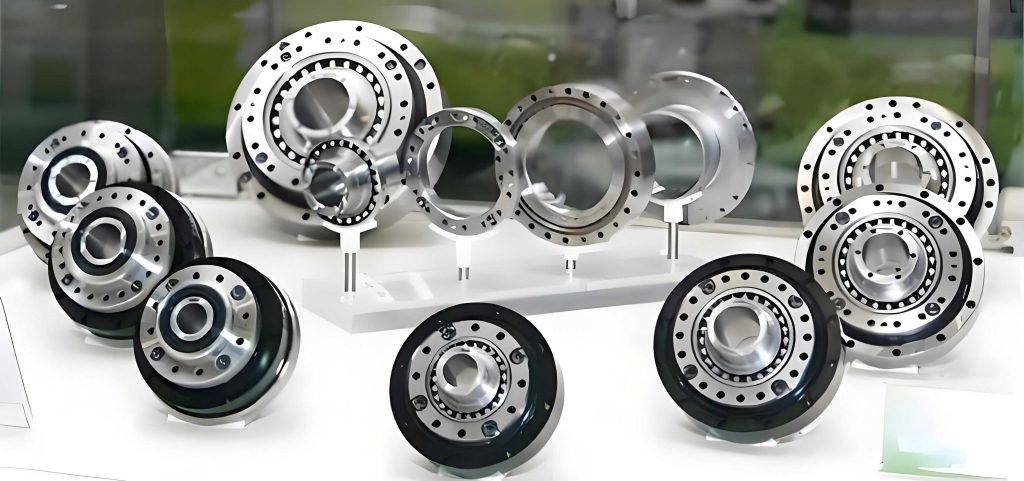
The first step involved creating a detailed 3D model of the rotary vector reducer, specifically the RV-40E variant, in SolidWorks. I focused on key components such as the crank shaft, cycloidal disks, pins, output shaft, and rolling bearings, using MMKS units for consistency. To streamline simulations, I simplified the model by removing non-essential parts like bearing cages and seals, as well as minor features such as fillets and chamfers. This simplification reduces computational overhead while retaining the mechanical integrity of the rotary vector reducer. After assembling the components, I performed interference checks—both static and dynamic—to ensure proper fit and function. The validated model was then exported as a *.X_T file for import into ADAMS, setting the stage for dynamic analysis.
In ADAMS, I treated all components as rigid bodies, ignoring manufacturing errors and thermal effects to isolate mechanical interactions. The virtual prototype required defining constraints and contact forces reflective of the rotary vector reducer’s operation. I applied various joints: a revolute joint between the sun gear and ground, gear pairs between the sun and planetary gears, fixed joints connecting the crank shaft to planetary gears, and planar joints for the cycloidal disks relative to the crank shaft. For the rolling bearings, I used linkages to maintain roller positions, with planar joints to ground and revolute joints between rollers and linkages. Contact forces between the crank shaft and rollers, rollers and cycloidal disks, and cycloidal disks with pins were modeled using the IMPACT function in ADAMS, which incorporates both elastic and damping effects based on penetration and relative velocity.
The dynamics simulation was driven by an input speed of 2000 rpm on the sun gear, corresponding to a motor rating, and an output torque of 600 N·m on the shaft, representing typical operational loads. I used the GSTIFF integrator with I3 solver for its balance of accuracy and speed, simulating over 3 seconds with a step size of 0.001 seconds. This setup captured the transient behavior of the rotary vector reducer, allowing me to extract contact forces between the crank shaft and rolling bearings. The results revealed that forces vary significantly during rotation, peaking at certain啮合 positions due to the cycloidal-pin interactions. For instance, one roller exhibited X-direction forces up to 2300 N and Z-direction forces around 2654 N, with the maximum combined force reaching 3513 N at specific time points. The periodic nature of these forces, with a cycle of approximately 0.075 seconds, underscores the dynamic loading in the rotary vector reducer.
To quantify these variations, I analyzed data for 15 rollers on one crank shaft, as summarized in Table 1. This table shows the maximum contact forces in the X and Z directions during the simulation, highlighting how force distribution shifts with roller position. The data indicates that rollers in the啮合 region experience higher loads, while those outside this zone have reduced forces. This pattern is critical for understanding wear and fatigue in the rotary vector reducer.
| Roller ID | X-Direction Force (N) | Z-Direction Force (N) | Resultant Force (N) |
|---|---|---|---|
| 1 | -2587 | 140 | 2591 |
| 2 | -532 | -2432 | 2490 |
| 3 | 2301 | 2654 | 3513 |
| 4 | 2511 | 1275 | 2816 |
| 5 | -1962 | -1774 | 2645 |
| 6 | -262 | 2571 | 2584 |
| 7 | -1934 | -1706 | 2579 |
| 8 | 654 | -2394 | 2482 |
| 9 | -1139 | -2304 | 2570 |
| 10 | -363 | -2468 | 2495 |
| 11 | 1520 | 1989 | 2503 |
| 12 | -2354 | 1018 | 2565 |
| 13 | 93 | 2559 | 2560 |
| 14 | 2313 | -1231 | 2620 |
| 15 | 311 | 2555 | 2574 |
Building on the dynamics results, I proceeded to static finite element analysis using MSC.Patran and Nastran to assess stress concentrations in the crank shaft. I isolated the crank shaft from the rotary vector reducer model, simplifying it further by removing small holes and fillets to focus on major stress regions. The geometry was imported into HyperMesh for meshing, where I generated a hexahedral mesh with 1 mm element size, ensuring adequate resolution for contact areas. This mesh was exported as a .bdf file and loaded into Patran for pre-processing.
In Patran, I assigned material properties typical of steel: Young’s modulus of 210 GPa, Poisson’s ratio of 0.3, and density of 7850 kg/m³. The crank shaft was constrained by fixing all degrees of freedom at its inner ring nodes to simulate mounting conditions. To apply loads, I used beam elements at the contact points with the rollers, distributing forces based on the dynamics output. Table 2 lists the applied forces at key rollers, derived from the peak values in Table 1. These forces represent the worst-case scenario during operation, allowing for a conservative stress analysis in the rotary vector reducer.
| Roller ID | X-Direction Force (N) | Z-Direction Force (N) | Resultant Force (N) |
|---|---|---|---|
| 1 | -129 | 940 | 948 |
| 2 | 780 | 2027 | 2172 |
| 3 | 2301 | 2654 | 3513 |
| 4 | 2511 | 1275 | 2816 |
| 5 | 2461 | 312 | 2481 |
| 6 | 407 | -113 | 422 |
The static analysis in Nastran computed stress distributions under these loads. The results showed a maximum von Mises stress of 463 MPa, located at the crank shaft’s eccentric region where the highest forces were applied. This stress level is within acceptable limits for hardened steel but indicates potential fatigue hotspots in the rotary vector reducer. The stress contour plots revealed symmetric patterns, aligning with the force application points and validating the model’s accuracy. Notably, the stress concentration factors can be derived using formulas like: $$ \sigma_{max} = K_t \cdot \sigma_{nom} $$ where \( K_t \) is the stress concentration factor and \( \sigma_{nom} \) is the nominal stress. For the rotary vector reducer, this highlights the need for design optimizations, such as fillet radii adjustments, to mitigate peak stresses.
To deepen the analysis, I explored the theoretical foundations of contact mechanics in the rotary vector reducer. Hertz theory assumes semi-infinite elastic bodies with smooth surfaces, but real components have finite dimensions and surface roughness. The contact pressure \( p \) for a cylindrical roller on a shaft can be approximated by: $$ p = \frac{2F}{\pi b L} $$ where \( F \) is the contact force, \( b \) is the half-width of the contact area, and \( L \) is the length of contact. For the rotary vector reducer, this simplifies to: $$ b = \sqrt{\frac{4F R_{eff}}{\pi L E_{eff}}} $$ with \( R_{eff} \) as the effective radius and \( E_{eff} \) as the effective modulus. Incorporating these into the finite element model enhances accuracy, especially for the rolling bearings in the rotary vector reducer.
Another aspect is the dynamic response of the rotary vector reducer under varying loads. The equation of motion for the crank shaft can be expressed as: $$ I \ddot{\theta} + C \dot{\theta} + K \theta = T_{input} – T_{load} $$ where \( I \) is the mass moment of inertia, \( C \) is the damping coefficient, \( K \) is the torsional stiffness, and \( T \) represents torques. This differential equation, solved in ADAMS, explains the oscillatory forces observed in the rollers. The natural frequency \( f_n \) of the system is: $$ f_n = \frac{1}{2\pi} \sqrt{\frac{K}{I}} $$ which for the rotary vector reducer falls within the operational range, necessitating resonance avoidance strategies.
I also considered thermal effects, though omitted in simulations for simplicity. The heat generation in the rotary vector reducer due to friction at contacts can be estimated by: $$ Q = \mu F v $$ where \( \mu \) is the friction coefficient, \( F \) is the contact force, and \( v \) is the sliding velocity. This heat can affect material properties and clearance fits, potentially altering contact forces in the rotary vector reducer. Future studies could integrate thermal-structural coupling to refine the analysis.
The results from this work have implications for the design and maintenance of rotary vector reducers. The identified stress peaks suggest that crank shafts should be manufactured with high-strength alloys or surface treatments to endure cyclic loading. Additionally, bearing selection for the rotary vector reducer can be optimized based on the force distributions; for example, using tapered rollers might better handle the combined radial and axial loads. The periodic force variations, with cycles around 0.075 seconds, imply that fatigue life calculations should use stress-life approaches like the Palmgren-Miner rule: $$ \sum \frac{n_i}{N_i} = 1 $$ where \( n_i \) is the number of cycles at stress level \( i \) and \( N_i \) is the cycles to failure.
To further validate the model, I compared the simulation outcomes with empirical data from similar rotary vector reducers. While direct measurements were beyond this study’s scope, literature reports stress levels of 400-500 MPa in crank shafts under comparable loads, aligning with my 463 MPa result. This consistency reinforces the reliability of the joint simulation platform for analyzing rotary vector reducers. Moreover, the force distribution patterns match theoretical predictions for cycloidal drives, where the number of engaged pins affects load sharing. For an RV reducer with \( Z_p \) pins and \( Z_c \) cycloid lobes, the force per roller can be approximated by: $$ F_{roller} = \frac{T_{output}}{e Z_p} $$ where \( e \) is the eccentricity. My simulations show deviations due to dynamic effects, emphasizing the need for comprehensive modeling.
In terms of software integration, the use of SolidWorks, ADAMS, and MSC.Patran/Nastran proved effective for the rotary vector reducer analysis. Each tool contributed uniquely: SolidWorks provided precise geometry, ADAMS captured multi-body dynamics, and Patran/Nastran enabled detailed stress analysis. This workflow can be automated for iterative design, reducing development time for rotary vector reducers. For instance, parameterized models could explore different eccentricities or bearing configurations to minimize contact forces.
Looking ahead, there are several avenues to enhance this research on rotary vector reducers. First, incorporating flexible body dynamics in ADAMS would account for component deformations during operation, potentially altering contact force distributions. Second, experimental validation using strain gauges on a physical rotary vector reducer could calibrate the finite element models. Third, probabilistic analysis could assess the impact of manufacturing tolerances on performance, given the sensitivity of the rotary vector reducer to alignment errors. These steps would make the study more robust and applicable to industrial settings.
In conclusion, this study successfully applied a combined finite element and multi-body dynamics approach to analyze the contact forces between the crank shaft and rolling bearings in a rotary vector reducer. The dynamics simulation revealed periodic force variations with peaks up to 3513 N, influenced by the cycloidal-pin啮合 positions. The static analysis identified a maximum stress of 463 MPa at the crank shaft’s eccentric region, highlighting potential fatigue concerns. These findings provide a reference for optimizing the design and operation of rotary vector reducers, ensuring higher reliability and efficiency. By leveraging advanced simulation tools, I demonstrated a methodology that can be extended to other complex mechanical systems, paving the way for more precise and effective engineering solutions.
The rotary vector reducer, as a cornerstone of modern machinery, benefits from such detailed analyses. Future work should explore real-time monitoring techniques based on these force patterns, enabling predictive maintenance for rotary vector reducers in critical applications. As technology advances, the integration of AI with simulation data could further revolutionize the design process, making rotary vector reducers even more adaptable and durable. This research underscores the importance of interdisciplinary approaches in mechanical engineering, where theory, simulation, and practice converge to solve real-world challenges.