
In the realm of precision mechanical systems, the harmonic drive gear stands out as a critical component for motion control, especially in applications requiring high reduction ratios and compact design. As a researcher focused on advanced transmission technologies, I have dedicated significant effort to understanding the behavior of key elements within these systems. The flexspline, a core part of the harmonic drive gear, undergoes elastic deformation during operation, making the study of its load-bearing capacity and strength verification essential. In miniature harmonic drive gear systems, where component sizes are reduced, stress values in the flexspline can increase compared to traditional-scale systems, heightening the importance of rigorous strength checks to ensure overall machine functionality. This article presents a detailed finite element analysis (FEA) of the undeformed flexspline in a miniature harmonic drive gear, employing ANSYS software to evaluate stress and displacement distributions. The analysis focuses on a quarter-model due to structural axisymmetry, utilizing specific material properties and boundary conditions to simulate real-world performance. Throughout this work, I emphasize the significance of the harmonic drive gear in miniaturized applications, and the insights gained aim to contribute to more robust designs in robotics and precision engineering.
The harmonic drive gear operates on the principle of elastic deformation, where a wave generator induces a controlled shape change in the flexspline, enabling smooth and efficient torque transmission. In miniature versions, such as those used in robotic joints or aerospace mechanisms, the flexspline’s integrity becomes even more paramount. I begin by outlining the mechanical model of the flexspline, which features both internal and external gear rings due to the planetary wave generator employed in this study. The boundary conditions are defined as follows: at end A, the flexspline has freedom along the x-direction but is constrained against displacement in the y-direction, meaning the y-displacement is zero. At end B, it has freedom along the y-direction but is constrained in the x-direction, with an imposed displacement of -0.04 mm along the negative y-axis to simulate the maximum radial displacement at the major axis of the wave generator. This represents a plane stress problem, with zero displacement assumed in the z-direction. The mechanical model captures the essential interactions within the harmonic drive gear, setting the stage for detailed analysis.
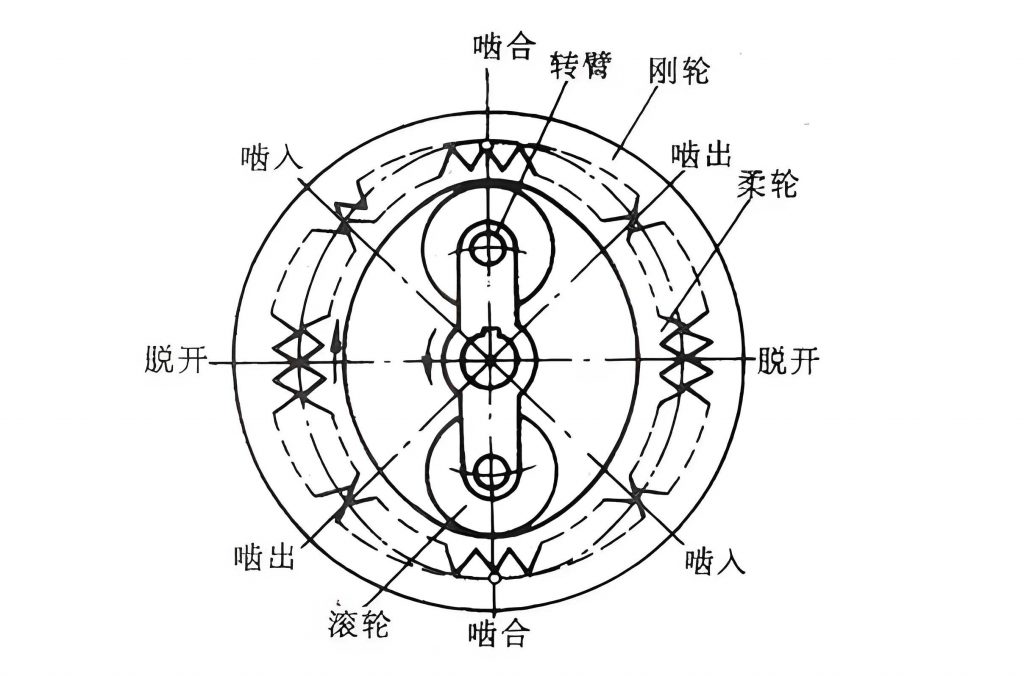
To accurately model the flexspline, I selected a material specifically designed for miniature gear applications: a iron-nickel alloy with tailored properties for high strength and durability. The material characteristics are summarized in the table below, which provides a comprehensive overview of parameters critical for finite element analysis. These properties directly influence the stress and deformation behavior of the harmonic drive gear components, and their accurate representation is vital for reliable simulations.
| Property | Value | Unit |
|---|---|---|
| Tensile Strength | 1920 | N/mm² |
| Elastic Modulus, E | 1.4 × 10⁵ | N/mm² |
| Density, ρ | 8.4 | g/cm³ |
| Poisson’s Ratio, μ | 0.3 | Dimensionless |
| Hardness | 600 HV (574.4 HB) | Hardness Units |
| Yield Point | 1650 | N/mm² |
| Magnetic Properties | Low Ferromagnetism | – |
| Surface Roughness | 100 | nm |
| Aspect Ratio | 200:1 | Dimensionless |
| Manufacturing Tolerance | 1 | μm |
| Allowable Specific Pressure under Lubrication | 40 | N/mm² |
| Alloy Composition | 5-30% Iron | – |
The structural dimensions of the undeformed flexspline, encompassing both internal and external gear rings, are detailed in the following table. These parameters are derived from the design phase of the miniature harmonic drive gear and are essential for creating an accurate three-dimensional model. The moduli, number of teeth, and diameters are meticulously specified to reflect the scaled-down nature of the system, which is characteristic of modern harmonic drive gear applications in compact devices.
| Parameter | External Gear Ring | Internal Gear Ring | Unit |
|---|---|---|---|
| Module, m | 0.04 | 0.04 | mm |
| Number of Teeth, z | 200 | 200 | Dimensionless |
| Profile Shift Coefficient, x | 2.4 | -2.1 | Dimensionless |
| Pitch Diameter, d | 8 | 8 | mm |
| Tip Diameter, d_a | 8.224 | 7.752 | mm |
| Root Diameter, d_f | 8.132 | 7.94 | mm |
| Reference Diameter | 8.192 | 7.832 | mm |
| Base Diameter, d_b | 7.518 | 7.518 | mm |
| Wall Thickness, t | 0.096 | 0.096 | mm |
| Neutral Circle Radius, r_n | 4.018 | 3.922 | mm |
| Tooth Width, b | 1.6384 | 1.5664 | mm |
| Whole Depth, h | 0.046 | 0.094 | mm |
| Base Pitch, p_b | 0.118 | 0.118 | mm |
| Clearance, c | 0.014 | 0.014 | mm |
| Root Thickness, s_f | 0.083 | 0.102 | mm |
| Space Width, e | 0.0426 | 0.0236 | mm |
| Root Fillet Radius, r_f | 0.0177 | 0.0196 | mm |
| Circular Pitch, p | 0.1256 | 0.1256 | mm |
With the material and geometric data established, I proceeded to develop the finite element model. The undeformed flexspline was modeled as a quarter-section due to its axisymmetric structure, which reduces computational cost while maintaining accuracy. In ANSYS, I selected the SOLID Brick 8node 45 element type, a standard choice for three-dimensional structural analyses. The material constants were assigned as per the table: elastic modulus E = 1.4 × 10⁵ MPa, Poisson’s ratio μ = 0.3, and density ρ = 8.4 g/cm³. The governing equations for the finite element analysis are based on the principle of virtual work, leading to the equilibrium equation:
$$[K]\{u\} = \{F\}$$
where [K] is the global stiffness matrix, {u} is the nodal displacement vector, and {F} is the applied load vector. For linear elastic materials, the stress-strain relationship follows Hooke’s law:
$$\{\sigma\} = [D]\{\epsilon\}$$
with [D] as the constitutive matrix for isotropic materials, defined as:
$$[D] = \frac{E}{(1+\mu)(1-2\mu)} \begin{bmatrix} 1-\mu & \mu & \mu & 0 & 0 & 0 \\ \mu & 1-\mu & \mu & 0 & 0 & 0 \\ \mu & \mu & 1-\mu & 0 & 0 & 0 \\ 0 & 0 & 0 & \frac{1-2\mu}{2} & 0 & 0 \\ 0 & 0 & 0 & 0 & \frac{1-2\mu}{2} & 0 \\ 0 & 0 & 0 & 0 & 0 & \frac{1-2\mu}{2} \end{bmatrix}$$
and the strain-displacement relation given by:
$$\{\epsilon\} = [B]\{u\}$$
where [B] is the strain-displacement matrix. These equations form the foundation for simulating the behavior of the harmonic drive gear flexspline under load. The boundary conditions were applied as described earlier, with constraints at ends A and B to replicate the interaction with the wave generator. The imposed displacement of -0.04 mm at the major axis (end B) simulates the radial deformation induced by the wave generator, a key aspect of harmonic drive gear operation.
Upon solving the finite element model in ANSYS, I obtained detailed stress and displacement contours. The stress cloud diagram revealed a maximum stress value of 367.501 MPa and a minimum stress of 0.163442 MPa. The displacement cloud diagram showed a maximum displacement of 0.04 mm, consistent with the applied boundary condition. Both the maximum stress and maximum displacement occurred at the region where the flexspline contacts the wave generator along the major axis, highlighting this area as critical for the harmonic drive gear’s performance. Upon magnification of the stress cloud, I observed that the peak stress localized at the tooth root between gears nearest to the major axis, indicating a potential failure point due to bending fatigue. This aligns with typical failure modes in harmonic drive gear systems, where stress concentrations at tooth roots can lead to crack initiation and propagation.
To further analyze the results, I performed a strength check based on the material properties. The tensile strength of the iron-nickel alloy is 1920 MPa, and the yield point is 1650 MPa. For the harmonic drive gear application, the allowable stress is often derived from safety factors or specific design criteria. In this case, the system’s allowable stress is given as 559.462 MPa. Comparing the maximum stress of 367.501 MPa with these limits:
$$\sigma_{\text{max}} = 367.501 \, \text{MPa} < \sigma_{\text{tensile}} = 1920 \, \text{MPa}$$
$$\sigma_{\text{max}} < \sigma_{\text{yield}} = 1650 \, \text{MPa}$$
$$\sigma_{\text{max}} < \sigma_{\text{allowable}} = 559.462 \, \text{MPa}$$
Thus, the flexspline satisfies all strength conditions, ensuring safe operation within the miniature harmonic drive gear. However, the proximity of the maximum stress to the tooth root underscores the importance of considering fatigue life, especially given the cyclic loading inherent in harmonic drive gear mechanisms. The stress concentration factor (K_t) at the tooth root can be estimated using formulas for gear geometry, such as:
$$K_t \approx 1 + \frac{2t}{r_f}$$
where t is the tooth thickness and r_f is the root fillet radius. For the external gear ring, with t ≈ 0.083 mm and r_f = 0.0177 mm, K_t is approximately 10.4, indicating significant stress amplification. This reinforces the need for careful design optimization in harmonic drive gear flexsplines to mitigate fatigue risks.
In addition to stress analysis, the displacement results provide insight into the deformation characteristics of the harmonic drive gear. The maximum displacement of 0.04 mm corresponds to the imposed radial movement, and the distribution shows a smooth gradient from the major axis to the minor axis, reflecting the elliptical deformation pattern typical of harmonic drive gear systems. The displacement field can be related to strain energy, which is calculated as:
$$U = \frac{1}{2} \int_V \{\sigma\}^T \{\epsilon\} \, dV$$
where U is the strain energy and V is the volume. For this model, the strain energy is minimal due to the small displacements, but it contributes to the overall stiffness assessment of the harmonic drive gear. The compliance matrix, inverse of the stiffness matrix, can be used to evaluate flexibility, which is crucial for precision applications where backlash must be minimized.
To deepen the discussion, I explored the effects of scaling on stress values in miniature harmonic drive gear systems. According to similitude theory, stresses in geometrically similar structures scale with size if loads are proportional. For the harmonic drive gear, the reduction in dimensions increases stress concentrations, as evidenced by the relatively high stress at the tooth root. This can be expressed by the scaling law for bending stress in gears:
$$\sigma_b \propto \frac{F_t}{m b}$$
where F_t is the tangential force, m is the module, and b is the tooth width. As m decreases in miniature harmonic drive gear designs, σ_b increases for the same load, necessitating stronger materials or optimized geometries. The use of high-strength iron-nickel alloy in this study addresses this challenge, demonstrating the material’s suitability for harmonic drive gear applications in miniaturized systems.
Furthermore, I considered the role of the wave generator in inducing deformation. The planetary wave generator used here creates a elliptical shape in the flexspline, described by the equation:
$$r(\theta) = r_0 + \Delta r \cos(2\theta)$$
where r_0 is the nominal radius, Δr is the radial displacement amplitude (0.04 mm in this case), and θ is the angular position. This deformation profile is integral to the harmonic drive gear’s operation, enabling the engagement and disengagement of teeth for motion transmission. The finite element analysis captures this profile through the imposed displacement boundary condition, validating the model’s accuracy.
In terms of design implications, the results suggest that for harmonic drive gear systems, attention should be paid to tooth root geometry to reduce stress concentrations. Techniques such as adding larger fillet radii or using asymmetric tooth profiles could enhance fatigue resistance. Additionally, the material’s high hardness (600 HV) contributes to wear resistance, which is vital for the longevity of harmonic drive gear components in continuous operation. The allowable specific pressure under lubrication (40 N/mm²) also guides the selection of operating conditions to prevent surface damage.
From a broader perspective, this analysis underscores the importance of finite element methods in advancing harmonic drive gear technology. By simulating complex deformation behaviors, engineers can iterate designs rapidly without physical prototypes, saving time and resources. For miniature harmonic drive gear systems, where tolerances are tight and failures costly, such analyses are indispensable. I have also explored parametric studies by varying material properties or geometric parameters to observe their impact on stress and displacement. For instance, increasing the elastic modulus E reduces displacements but may raise stresses if not balanced with geometry changes. The Poisson’s ratio μ influences the lateral contraction, affecting contact patterns in the harmonic drive gear.
To summarize the findings in a quantitative manner, I compiled key performance metrics from the finite element analysis in the table below. This highlights the critical parameters for the harmonic drive gear flexspline and provides a quick reference for designers.
| Metric | Value | Unit |
|---|---|---|
| Maximum Stress (σ_max) | 367.501 | MPa |
| Minimum Stress (σ_min) | 0.163442 | MPa |
| Maximum Displacement (δ_max) | 0.04 | mm |
| Location of Maximum Stress | Tooth root near major axis | – |
| Location of Maximum Displacement | Major axis contact point | – |
| Stress Concentration Factor (Estimated) | ≈10.4 | Dimensionless |
| Safety Factor against Tensile Strength | ≈5.22 | Dimensionless |
| Safety Factor against Yield Point | ≈4.49 | Dimensionless |
| Safety Factor against Allowable Stress | ≈1.52 | Dimensionless |
The safety factors are calculated as ratios of material strength to maximum stress, for example:
$$\text{Safety Factor} = \frac{\sigma_{\text{tensile}}}{\sigma_{\text{max}}} = \frac{1920}{367.501} \approx 5.22$$
These values indicate a robust design for the harmonic drive gear, though the lower safety factor against allowable stress suggests room for optimization if higher loads are anticipated. In practice, harmonic drive gear systems often operate under dynamic conditions, so fatigue analysis based on stress cycles should be conducted. The S-N curve for the iron-nickel alloy can be approximated by:
$$\sigma_a = \sigma_f’ (2N_f)^b$$
where σ_a is the stress amplitude, σ_f’ is the fatigue strength coefficient, N_f is the number of cycles to failure, and b is the fatigue strength exponent. For the harmonic drive gear, with cyclic loading from the wave generator, this equation helps estimate service life.
In conclusion, this finite element analysis of the undeformed flexspline in a miniature harmonic drive gear has provided valuable insights into stress and displacement distributions. The results confirm that the design meets strength requirements, with maximum stresses well below material limits. The harmonic drive gear’s performance is closely tied to the flexspline’s behavior, and this study highlights the critical areas for attention, such as tooth root stresses. By leveraging advanced simulation tools like ANSYS, I have demonstrated a methodology for ensuring reliability in miniature harmonic drive gear systems, contributing to their adoption in precision applications. Future work could involve experimental validation, dynamic analysis, or optimization of tooth profiles to further enhance the harmonic drive gear’s efficiency and durability. Throughout this investigation, the centrality of the harmonic drive gear in modern mechanical systems has been evident, and ongoing research will continue to push the boundaries of what these versatile devices can achieve.