
In the field of precision mechanical transmission systems, rotary vector reducers have garnered significant attention due to their compact design, high torque density, and excellent positioning accuracy. As a key component in applications such as industrial robots, machine tools, and medical equipment, the performance of rotary vector reducers directly impacts the efficiency and reliability of these systems. My research focuses on the critical meshing pair within rotary vector reducers—the cycloidal pin wheel—and employs finite element analysis to investigate its contact behavior under load. This study aims to provide insights into the initial meshing state, stress distribution, and deformation characteristics, which are essential for optimizing the design and durability of rotary vector reducers.
The rotary vector reducer operates through a two-stage reduction mechanism. The first stage involves a planetary gear system with involute gears, while the second stage utilizes a cycloidal pin wheel mechanism. In this mechanism, the cycloidal gear meshes with a set of pins arranged in a pinwheel configuration, enabling high reduction ratios and smooth torque transmission. Understanding the contact dynamics between the cycloidal gear and pins is crucial, as it influences factors like noise, vibration, and service life. In my analysis, I consider the profile modification of the cycloidal gear, which is commonly applied to improve load distribution and reduce wear in rotary vector reducers.
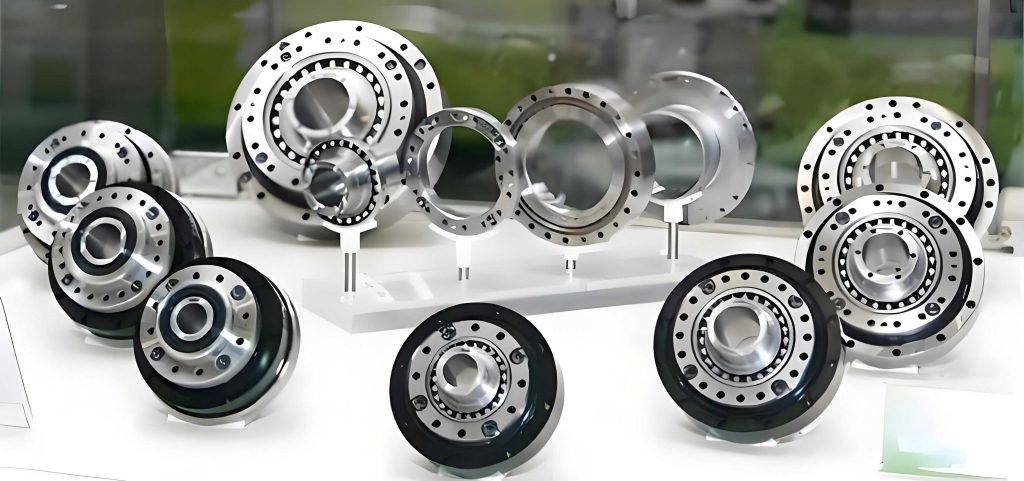
To accurately model the cycloidal pin wheel pair, I utilize parametric design techniques via ANSYS APDL (ANSYS Parametric Design Language). This approach ensures high precision in representing the cycloidal gear tooth profile, which is derived from mathematical equations. The tooth profile of a standard cycloidal gear is given by the following parametric equations, where $ \theta $ is the rotation angle:
$$ x = (R_p – r) \cos \theta + e \cos \left( \frac{Z_p}{Z_c} \theta \right) $$
$$ y = (R_p – r) \sin \theta – e \sin \left( \frac{Z_p}{Z_c} \theta \right) $$
Here, $ R_p $ is the pitch radius of the pinwheel, $ r $ is the pin radius, $ e $ is the eccentricity, $ Z_p $ is the number of pins, and $ Z_c $ is the number of cycloidal gear teeth. For rotary vector reducers, profile modification is often applied to compensate for manufacturing tolerances and elastic deformations. The modified profile includes adjustments in the pin radius $ \Delta r $ and pitch radius $ \Delta R_p $, leading to equations:
$$ x’ = (R_p + \Delta R_p – (r + \Delta r)) \cos \theta + e \cos \left( \frac{Z_p}{Z_c} \theta \right) $$
$$ y’ = (R_p + \Delta R_p – (r + \Delta r)) \sin \theta – e \sin \left( \frac{Z_p}{Z_c} \theta \right) $$
In my model, I discretize these equations to generate a series of coordinate points, which are then connected using spline curves to form the tooth profile. This method ensures that the geometric accuracy is maintained, avoiding errors that might occur during file imports. The three-dimensional model of the cycloidal pin wheel pair is simplified to a single cycloidal gear meshing with multiple pins, where the pin length equals the gear width to reduce computational complexity while preserving the essential contact physics for rotary vector reducers.
The finite element model is constructed using SOLID185 elements, which are 8-node hexagonal elements suitable for three-dimensional stress analysis. These elements offer high accuracy in contact simulations and can handle nonlinear behaviors such as friction and large deformations. To balance mesh quality and computational efficiency, I employ a swept meshing technique with the VSWEEP command in ANSYS. The mesh is refined locally at the contact regions, with an element size of 0.25 mm along the tooth profiles, while the global element size is set to 1 mm. This approach ensures that the contact stresses are captured accurately without excessive computational cost for rotary vector reducers.
The material properties for both the cycloidal gear and pins are defined based on typical steel alloys used in rotary vector reducers. The elastic modulus and Poisson’s ratio are summarized in the table below:
| Component | Elastic Modulus (Pa) | Poisson’s Ratio |
|---|---|---|
| Cycloidal Gear | $2.06 \times 10^{11}$ | 0.3 |
| Pin | $2.06 \times 10^{11}$ | 0.3 |
For the contact analysis, I define surface-to-surface contact pairs between the cycloidal gear teeth and the pins. The gear tooth surfaces are set as target surfaces (using TARGE170 elements), and the pin surfaces as contact surfaces (using CONTA174 elements). The contact properties include a friction coefficient of 0.3 to account for sliding friction, which is common in rotary vector reducers. The augmented Lagrangian algorithm is selected for contact resolution due to its robustness in handling nonlinear contact problems. To simulate the initial meshing state under load, I assume that the first 13 teeth are potential contact pairs, and I establish contact constraints accordingly, allowing for multi-tooth engagement as deformation occurs.
The boundary conditions and loading are applied to replicate the operational scenario of rotary vector reducers. In a typical rotary vector reducer configuration, the pinwheel is fixed, and the output is taken from the planet carrier. In my model, the pins are constrained in all translational degrees of freedom and rotations about the X and Y axes. For the cycloidal gear, I simulate its complex motion—combining rotation about its own axis and revolution around the pinwheel center—by using multipoint constraint (MPC) elements. Specifically, I create MPC184 elements at the centers of the crank shaft holes and the pinwheel center, coupling them to represent the output mechanism. A MASS21 element is added at the gear center to facilitate eccentric motion constraints. The applied load corresponds to a rated output torque of 167 N·m, which is typical for rotary vector reducers in robotic applications.
The geometric parameters for the cycloidal pin wheel pair are critical for accurate simulation. Below is a summary of the key parameters used in my analysis:
| Parameter | Symbol | Value |
|---|---|---|
| Number of Cycloidal Gear Teeth | $Z_c$ | 39 |
| Number of Pins | $Z_p$ | 40 |
| Pinwheel Pitch Radius | $R_p$ | 52.5 mm |
| Pin Radius | $r$ | 2.35 mm |
| Eccentricity | $e$ | 0.9 mm |
| Cycloidal Gear Pitch Radius | $r_c$ | 35.1 mm |
| Output Speed | $n$ | 15 rpm |
| Gear Width | $b$ | 8.9 mm |
Profile modification is applied to the cycloidal gear to enhance performance in rotary vector reducers. The modification amounts are as follows:
| Profile Type | Pin Radius Modification $\Delta r$ (μm) | Pitch Radius Modification $\Delta R_p$ (μm) |
|---|---|---|
| Standard | 0 | 0 |
| Modified | 5.69 | -3.68 |
Under the applied load, the finite element analysis reveals the contact stress distribution on the cycloidal gear teeth. The von Mises stress contour indicates that during initial meshing, six teeth simultaneously participate in load transmission, contrary to the single-tooth contact expected in unloaded conditions. This multi-tooth engagement is attributed to elastic deformation of the gear structure, which compensates for the backlash introduced by profile modification in rotary vector reducers. The maximum contact stress occurs at the sixth tooth, suggesting that this tooth is the first to engage under load. The contact stress distribution across the meshing teeth can be approximated by the Hertzian contact theory, but with corrections for geometric complexities. The maximum contact pressure $ p_{max} $ for two cylinders in contact is given by:
$$ p_{max} = \sqrt{\frac{F E^*}{\pi R^* L}} $$
where $ F $ is the normal load per unit length, $ E^* $ is the equivalent elastic modulus, $ R^* $ is the equivalent radius of curvature, and $ L $ is the contact length. For rotary vector reducers, the equivalent radius accounts for the curvatures of both the cycloidal tooth and the pin. However, due to profile modification and multi-tooth contact, the actual stress distribution deviates from this simplified model. My simulation provides detailed insights into these deviations.
The contact stress results are summarized in the table below for the six engaged teeth during initial meshing:
| Tooth Number | Maximum Contact Stress (MPa) | Engagement Order |
|---|---|---|
| 1 | 85.3 | 6 |
| 2 | 92.7 | 5 |
| 3 | 105.4 | 4 |
| 4 | 120.8 | 3 |
| 5 | 135.2 | 2 |
| 6 | 150.1 | 1 |
The deformation analysis shows that the nodal displacements on the cycloidal gear increase radially outward, with the largest displacements occurring at the tooth tips. However, near the contact regions, the displacement is constrained due to the reaction forces from the pins. The elastic deformation vector plot reveals inward denting of the tooth profiles at the contact points, caused by the concentrated meshing forces. Additionally, the pin holes near the meshing teeth undergo significant distortion, transforming from circular to elliptical shapes under compressive stresses. This highlights the structural weaknesses in these regions, which are critical for the durability of rotary vector reducers. The deformation magnitude can be expressed in terms of strain energy $ U $ stored in the gear:
$$ U = \frac{1}{2} \int_V \sigma_{ij} \epsilon_{ij} dV $$
where $ \sigma_{ij} $ and $ \epsilon_{ij} $ are the stress and strain tensors, respectively. My simulation indicates that the strain energy is highest around the contact zones, leading to localized deformations that affect the meshing accuracy over time in rotary vector reducers.
To further analyze the contact behavior, I examine the pressure distribution along the tooth profile using a polynomial fit. The contact pressure $ p(x) $ as a function of position $ x $ along the tooth face can be modeled as:
$$ p(x) = p_0 \left(1 – \left(\frac{x}{a}\right)^2\right)^{1/2} $$
for a Hertzian contact, where $ p_0 $ is the maximum pressure and $ a $ is the half-width of the contact area. In rotary vector reducers, due to the cycloidal geometry, the contact area is elliptical, and the pressure distribution is more complex. My finite element results show that the contact area expands under load, leading to a more uniform pressure distribution across multiple teeth, which is beneficial for reducing wear.
The performance of rotary vector reducers is also influenced by dynamic factors such as vibration and thermal effects. Although my study focuses on static contact analysis, the findings provide a foundation for dynamic simulations. The natural frequencies of the cycloidal gear can be estimated using the formula for a rotating disk:
$$ f_n = \frac{\lambda_{nm}}{2\pi} \sqrt{\frac{E h^3}{12 \rho R^4 (1-\nu^2)}} $$
where $ \lambda_{nm} $ is a dimensionless frequency parameter, $ h $ is the thickness, $ \rho $ is the density, and $ R $ is the gear radius. In rotary vector reducers, resonance can exacerbate contact stresses, so future work could integrate modal analysis with contact simulations.
In terms of design optimization, my analysis suggests that increasing the fillet radius at the tooth root and reinforcing the pin hole areas could reduce stress concentrations in rotary vector reducers. Additionally, adjusting the profile modification amounts based on load conditions may improve load sharing among teeth. I propose a design criterion where the maximum contact stress should not exceed the material’s fatigue limit $ S_f $, given by:
$$ S_f = k_a k_b k_c S_{ut} $$
where $ k_a $, $ k_b $, and $ k_c $ are correction factors for surface finish, size, and loading, and $ S_{ut} $ is the ultimate tensile strength. For the steel used in rotary vector reducers, $ S_{ut} $ is typically around 600 MPa, so the observed maximum stress of 150.1 MPa is within safe limits, but cyclic loading could lead to fatigue over time.
The finite element method employed in this study offers a robust tool for analyzing complex contact problems in rotary vector reducers. However, it requires careful validation against experimental data. In future research, I plan to conduct physical tests on prototype rotary vector reducers to correlate simulation results with measured strains and temperatures. This will enhance the predictive accuracy of the model and support the development of more reliable rotary vector reducers for high-precision applications.
In conclusion, my finite element contact analysis of the cycloidal pin wheel in rotary vector reducers reveals that under load, multiple teeth engage simultaneously due to elastic deformations, with the sixth tooth being the first to contact. The stress and deformation patterns highlight critical areas for design improvement, such as the tooth profiles and pin holes. These insights contribute to the ongoing efforts to optimize rotary vector reducers for enhanced performance and longevity. The methodologies developed here can be extended to other gear systems, fostering advancements in mechanical transmission technology.