
As a researcher in the field of robotic manipulation, I have observed a growing interest in actuators that can provide compliance and safety similar to biological systems. Traditional dexterous robotic hands, often driven by electric motors and tendon transmissions, offer high precision and strength but frequently lack the inherent softness and adaptability required for safe interaction with fragile objects or unstructured environments. This has led our community to explore alternative actuation technologies. Among them, Flexible Pneumatic Actuators (FPAs) have emerged as a highly promising solution. These actuators, powered by compressed air and primarily constructed from elastomers like rubber or silicone, exhibit muscle-like contraction, bending, or twisting motions. Their high power-to-weight ratio, inherent compliance, and simplicity make them exceptionally suitable for building a new generation of adaptable and safe dexterous robotic hands.
The fundamental principle behind most FPAs is elegantly simple: an elastic tube or bladder is constrained in specific ways so that when pressurized, it deforms in a predictable, useful manner. This constraint can be provided by external braiding, internal fibers or springs, or mechanical guides. The result is an actuator that is both the motion generator and the compliant structural element, blurring the line between actuator and joint. This report aims to provide a comprehensive, first-person perspective on the landscape of FPAs, their application in dexterous robotic hand prototypes, and the critical technical challenges that must be overcome to realize their full potential.
Taxonomy and Analysis of Key Flexible Pneumatic Actuators
Over the past decades, several distinct designs of FPAs have been proposed and studied. Understanding their individual characteristics is crucial for selecting the right technology for a specific dexterous robotic hand application.
1. The McKibben-Type Pneumatic Muscle Actuator (PMA)
This is the most historically significant and commercially available design. It consists of an inner rubber tube surrounded by a braided mesh shell, sealed at both ends. Upon pressurization, the tube expands radially, forcing the braid to reconfigure and resulting in a significant axial contraction force. Its behavior is highly non-linear, featuring a force-length-pressure relationship that has been modeled using energy principles. A common static model derived from the principle of virtual work relates the axial contraction force $F$ to the gauge pressure $P$, the initial braid angle $\theta_0$, the initial length $L_0$, and the contraction ratio $\epsilon$:
$$F = \frac{P \pi D_0^2}{4} (3\cos^2\theta – 1)$$
where $D_0$ is the initial diameter and $\theta$ is the current braid angle, related to the contraction $\epsilon = (L_0 – L)/L_0$. However, this ideal model neglects friction between the mesh and the tube, rubber elasticity, and the non-cylindrical shape at the ends, leading to hysteresis and modeling inaccuracies. Despite this, its simplicity, high force output, and commercial availability (e.g., Festo’s Fluidic Muscle) have made it a popular choice.
2. The Three-Degree-of-Freedom Flexible Microactuator (3-DOF FMA)
Developed to achieve multi-axis motion from a single element, this actuator features a silicone rubber tube with three separate longitudinal chambers embedded within its wall, reinforced by a helical nylon fiber windings. By pressurizing the chambers differentially, the actuator can bend in any direction, elongate, or twist (depending on the fiber winding angle). The kinematic and static modeling is complex due to the interaction between the pressurized chambers and the elastic matrix. The bending curvature $\kappa$ for a simplified case with two chambers pressurized can be approximated by considering the differential elongation:
$$\kappa \approx \frac{\Delta L}{L \cdot d}$$
where $\Delta L$ is the length difference between two opposing chambers, $L$ is the actuator length, and $d$ is the distance between chamber centers. Its main advantage is the integration of multiple degrees of freedom, but manufacturing complexity and cross-talk between chambers present significant challenges for precise control in a dexterous robotic hand.
3. The Flexible Pneumatic Actuator (FPA) with Internal Spring
Our work has focused on a variant designed for more predictable, constrained motion. The core is an elastic rubber tube with a helical spring embedded within its wall. The spring effectively constrains radial expansion while allowing axial elongation. When pressurized, the actuator extends linearly along its axis. This design minimizes unwanted radial bulging and provides a more direct relationship between pressure and displacement. A simplified static model balancing pneumatic force and spring/elastomer resistance can be expressed as:
$$P \cdot A_e = k_s \cdot x + F_{rubber}(x)$$
where $P$ is pressure, $A_e$ is the effective area (a function of displacement $x$), $k_s$ is the spring constant, and $F_{rubber}$ is the non-linear restoring force of the stretched rubber. By combining this basic extending FPA with specific mechanical joints (e.g., a hinge), bending or twisting motions for a dexterous robotic hand finger can be created with improved structural stability.
4. The Rotary Soft Actuator and Flexible Fluidic Actuator
Other notable designs include the Rotary Soft Actuator, which uses a constrained, fiber-reinforced silicone bellows to produce pure rotational motion, and the Flexible Fluidic Actuator, which is essentially a plain pneumatic bladder placed between two rigid plates to form a bending joint. The latter’s simplicity is attractive, but its low stiffness and large, shape-changing contact area with the plates complicate force control.
The table below provides a comparative summary of these key actuator types, highlighting their core characteristics relevant to integration into a dexterous robotic hand.
| Actuator Type | Primary Motion | Key Structural Feature | Advantages | Disadvantages for Dexterous Hand Use |
|---|---|---|---|---|
| McKibben PMA | Axial Contraction | Braided mesh over tube | High force, simple, commercial | Hysteresis, bulky ends, requires tendon transmission for fingers |
| 3-DOF FMA | Bend, Extend, Twist | Multiple internal chambers, external fiber winding | Compact multi-DOF motion | Complex manufacturing, chamber interference, difficult precise modeling |
| Spring-Embedded FPA | Axial Extension | Helical spring inside tube wall | Constrained deformation, simpler model, direct drive possible | Primarily provides linear motion, requires conversion mechanisms for joints |
| Rotary Soft Actuator | Rotation | Fiber-reinforced bellows | Direct rotary output | Limited angular range, potential for lateral deformation |
| Flexible Fluidic Actuator | Bending (at a joint) | Simple bladder between plates | Extremely simple, very compliant | Very low stiffness, variable contact dynamics, poor force transmission |
Dexterous Robotic Hand Prototypes Driven by Flexible Pneumatic Actuators
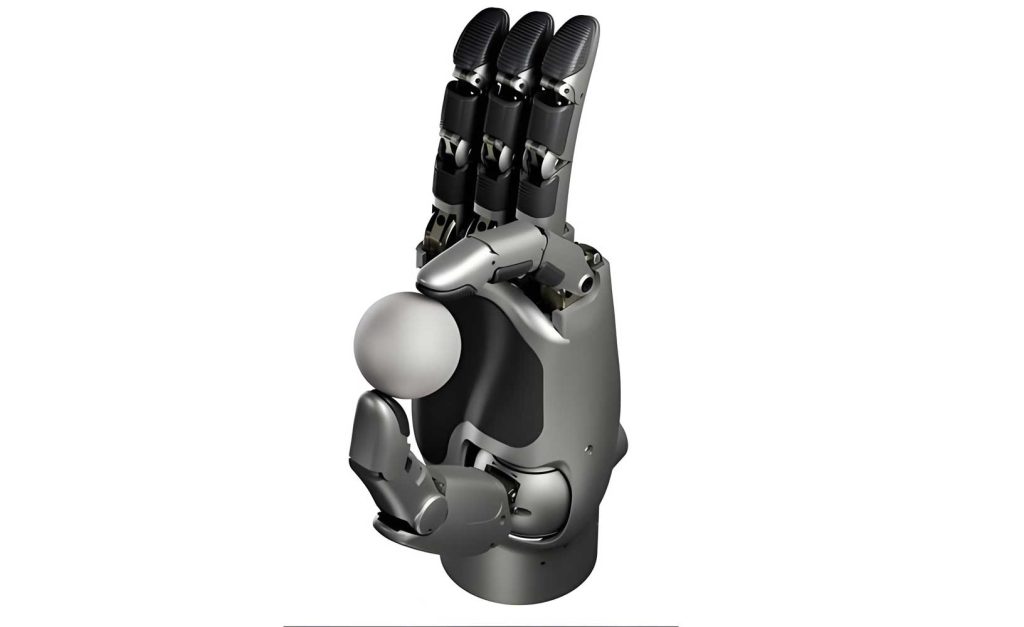
The unique properties of FPAs have inspired several research groups to develop innovative dexterous robotic hand prototypes. These hands often trade absolute positional precision for adaptability and safe interaction.
A prominent example is the Shadow Dexterous Hand, which uses an array of McKibben-type PMAs located in the forearm. These muscles pull on tendons that run to the joints of a rigid, anthropomorphic hand skeleton. This design decouples the actuators from the hand structure, allowing for a traditional kinematic hand form but adding complexity, friction, and energy loss in the tendon network. The weight and volume of the pneumatic muscle array in the forearm is also a significant drawback.
In contrast, other approaches integrate the actuator directly as the structural member of the finger. The “Ultralight Anthropomorphic Hand” uses Flexible Fluidic Actuators as bending joints directly within silicone fingers, resulting in an extremely light and compliant dexterous robotic hand. Similarly, research using the 3-DOF FMA has produced multi-fingered grippers capable of enveloping grasps and even simple in-hand manipulation like turning a screw. Our own work has led to a three-fingered adaptive gripper using FPAs configured as bending and twisting joints, demonstrating robust grasping of irregular, delicate objects like fruits, highlighting the potential for agricultural robotics.
The following table summarizes the characteristics of different dexterous robotic hand implementations based on FPAs.
| Hand Prototype (Concept) | Core Actuator Technology | Actuator Integration | Key Features | Inherent Challenges |
|---|---|---|---|---|
| Tendon-Driven Anthropomorphic Hand (e.g., Shadow) | McKibben PMA | Remote (in forearm) | Human-like kinematics, high grip force potential | Tendon friction/loss, bulky forearm, rigid fingers limit compliance |
| Direct-Drive Soft Hand (e.g., Ultralight Hand) | Flexible Fluidic Actuator / Bladder Joint | Direct (as joint) | Extremely lightweight, high inherent compliance and safety | Very low stiffness, difficult to model and control precisely, limited force output |
| Multi-DOF Soft Gripper | 3-DOF FMA | Direct (as finger segment) | Integrated multi-axis motion in compact form | Complex fabrication, control coupling between degrees of freedom |
| Adaptive Gripper with Custom Joints | Spring-Embedded FPA (configured for bend/twist) | Direct (as joint) | Good balance of compliance and constrained motion, adaptable grip | Motion is predefined by joint mechanics, less kinematic flexibility than 3-DOF FMA |
Critical Technical Challenges and Research Directions
While the potential of FPAs for dexterous robotic hands is clear, significant hurdles remain before they can match the performance and reliability of traditional systems in many applications. From our perspective, the following areas are the most critical.
1. The Compliance-Stiffness Dilemma
The very compliance that makes a pneumatically driven dexterous robotic hand safe and adaptable also limits its ability to apply large, precise forces or maintain posture under load. A hand made entirely from soft actuators may struggle to manipulate heavy tools. Conversely, a hand using PMAs to drive rigid links (like the Shadow hand) gains stiffness but loses the whole-limb compliance. Future dexterous robotic hands may need hybrid systems employing variable stiffness mechanisms, such as jamming structures or antagonistic actuator pairs, to dynamically modulate their impedance based on the task.
2. Modeling, Sensing, and Control
This is perhaps the most formidable challenge. FPAs exhibit strong non-linearities, hysteresis, and time-dependent viscoelastic effects. A general, accurate dynamic model usable for real-time control is elusive. Simplified models often take the form:
$$M(q)\ddot{q} + C(q, \dot{q}) + G(q) + F_{fric}(\dot{q}) + F_{hys}(q, history) = \tau(P)$$
where the inertial $M$, Coriolis $C$, and gravitational $G$ terms may be small, but the friction $F_{fric}$ and especially hysteresis $F_{hys}$ forces dominate and are difficult to characterize. This makes model-based control difficult. Consequently, researchers extensively use model-free strategies. Advanced PID with gain scheduling, fuzzy logic controllers, and neural network-based adaptive controllers have shown promise. Sliding mode control is attractive for its robustness to model uncertainties. A simple sliding surface $s$ for position control of a pneumatic actuator could be:
$$s = \dot{e} + \lambda e$$
$$\text{where } e = x_{desired} – x_{actual}$$
The control law then drives $s$ to zero. However, the discontinuous control signal often needs smoothing (e.g., boundary layer approach) to avoid chattering in pneumatic systems. Furthermore, integrating soft, stretchable sensors for position, force, and touch into the elastomeric structure of a dexterous robotic hand finger without compromising its mechanics is an ongoing materials and integration challenge. Without reliable internal sensing, closed-loop control remains dependent on external vision systems, which may be occluded during grasping.
3. Power and Mass Optimization
A dexterous robotic hand must be portable. The supporting infrastructure for pneumatic actuation—compressors, valves, regulators—is often bulky and heavy compared to a battery pack for electric motors. Miniaturizing high-flow, low-power valves and developing efficient portable air sources (e.g., chemical gas generators, miniature compressors) is essential. The mass of the hand itself is also critical; using soft materials can reduce weight, but the necessary reinforcement fibers or embedded sensors can add it back.
4. Kinematics, Dynamics, and Motion Planning
The kinematics of a dexterous robotic hand built with continuously bending soft fingers is fundamentally different from that of a rigid-link hand. Denavit-Hartenberg parameters are not applicable. Instead, models often treat the finger as a continuous curve (e.g., a constant curvature arc) parameterized by actuator pressures or chamber lengths. The forward kinematics for a bending section might be:
$$
\begin{bmatrix}
x \\
y
\end{bmatrix}
=
\begin{bmatrix}
(1/\kappa)(1 – \cos(\kappa L)) \\
(1/\kappa)\sin(\kappa L)
\end{bmatrix}
$$
where $\kappa$ is the curvature, a function of the pressure differential, and $L$ is the length of the bending section. Inverse kinematics and dynamics for such systems are complex, making traditional motion planning algorithms difficult to apply. New planning paradigms that embrace compliance and environmental contact as part of the motion strategy are needed for soft dexterous robotic hands.
The table below encapsulates these key challenges and points towards necessary research thrusts.
| Challenge Area | Core Problem | Impact on Dexterous Robotic Hand Performance | Potential Research Directions |
|---|---|---|---|
| Modeling & Control | Strong non-linearity, hysteresis, and viscoelasticity | Limits precision, repeatability, and bandwidth of manipulation tasks | Hybrid physics-informed/data-driven models, robust adaptive control (e.g., neural-network SMC), embedded soft sensor development |
| Compliance-Stiffness Trade-off | Inherent softness conflicts with need for precise force application and load bearing | Hand may be limited to delicate tasks or fail at tasks requiring firm grip or tool use | Variable stiffness actuators (VSAs), layer jamming, hybrid soft-rigid hand designs |
| System Integration | Bulk and mass of pneumatic support systems; integration of sensing/electronics | Reduces portability and practical applicability of the dexterous robotic hand | Development of miniature pneumatic components, printed soft electronics, multifunctional materials |
| Motion Planning & Kinematics | Continuous, non-linear deformation vs. discrete joint kinematics | Standard robotic planning algorithms are not directly applicable | Piecewise constant curvature models, learning-based planning, intrinsic compliance-based planning (exploiting contact) |
Conclusion and Perspective
The journey of developing a truly capable, pneumatically actuated dexterous robotic hand is a compelling intersection of materials science, fluid mechanics, non-linear control theory, and robotic design. Flexible Pneumatic Actuators offer a unique set of advantages—compliance, high power density, and simplicity—that are perfectly aligned with the needs for safe, adaptive, and robust manipulation in human-centric environments. We have moved from basic contracting muscles to actuators capable of complex multi-axis motion, and from rigid grippers to fully soft, adaptive hands.
However, the path forward is paved with significant technical challenges. The core issues of accurate modeling, robust control, the fundamental compliance-stiffness dilemma, and system integration are non-trivial. Overcoming them will not come from incremental improvements in actuator design alone but from a holistic, systems-level approach. This includes co-designing new materials with embedded sensing and conductive properties, creating innovative variable stiffness mechanisms, developing miniature and efficient pneumatic hardware, and forging new control paradigms that do not fight the system’s non-linearity but harness it through advanced learning and adaptive techniques.
The vision for the future dexterous robotic hand is one that seamlessly blends the strength and precision of machines with the gentle adaptability of biological systems. Flexible Pneumatic Actuators, despite their current limitations, remain one of the most promising technologies to make this vision a reality. As these challenges are gradually addressed, we can anticipate the emergence of dexterous robotic hands that are not only tools for automation but also cooperative partners capable of working safely and effectively alongside humans in homes, hospitals, farms, and disaster sites.