
The food industry, a cornerstone of the global economy, faces mounting pressure to enhance efficiency, ensure consistent product quality, and guarantee absolute food safety. In this context, robotic automation presents a transformative solution. However, the inherent diversity and delicate nature of food products—ranging from soft baked goods and fragile fruits to irregularly shaped meat cuts—pose a unique set of challenges not commonly encountered in manufacturing rigid industrial parts. The critical interface between the robot and the food product is the end effector. Its performance dictates the success of the entire handling operation, making the design and selection of appropriate food-grade end effectors a pivotal area of research and development. This article synthesizes current knowledge, classifies prevailing technologies, analyzes persistent challenges, and forecasts future trends for end effectors in food robotics.
An end effector, also known as a robotic gripper or tool, is the device attached to the wrist of a robot manipulator that interacts directly with the environment or workpiece. In the food context, it is the component responsible for the physical manipulation—grasping, lifting, placing, cutting, or otherwise processing—of food materials. The primary functional requirements for a food robotic end effector can be summarized as follows:
- Reliable Grasping: The end effector must achieve and maintain a secure hold on the food item throughout the required manipulation sequence.
- Non-Damaging Interaction: It must avoid causing mechanical damage such as bruising, crushing, tearing, or deformation, which compromises product quality and shelf life.
- Hygiene and Safety: The end effector must be designed to prevent biological, chemical, or physical contamination. Materials must be food-safe, and designs must facilitate easy and effective cleaning and sanitization.
- Operational Efficiency: Speed, precision, and cycle-time consistency are vital for integration into high-throughput production lines.
- Adaptability/Generality: Ideally, an end effector should handle a variety of shapes, sizes, and textures to reduce changeover time and cost, though this often conflicts with specialization for optimal performance.
The vast spectrum of food properties necessitates a corresponding variety of end effector working principles. A fundamental classification is presented in Table 1.
| Category | Sub-category | Working Principle | Typical Food Applications | Key Advantages | Primary Limitations |
|---|---|---|---|---|---|
| Adsorption | Vacuum (Contact) | Negative pressure differential via suction cup. | Flat packages, sliced bread, rigid trays. | Simple, fast, gentle on flat surfaces. | Requires smooth, non-porous surface; hygiene risk from debris ingress. |
| Bernoulli (Non-Contact) | Fluid dynamics creating a low-pressure zone via high-speed air flow. | Flat, fragile items (wafers, sliced vegetables). | No physical contact, excellent hygiene. | Low lifting force, potential for product dehydration or displacement. | |
| Gripping | Rigid Jaw | Mechanical closure of hard fingers/claws. | Heavy/robust items (cheese blocks, packaged goods). | High force, precise control, durable. | High localized pressure, risk of surface damage. |
| Compliant/Jaw | Rigid structure with soft padding or underactuated, adaptive fingers. | Fruits, vegetables, baked goods. | Better force distribution, adapts to simple shapes. | Limited conformity for complex shapes. | |
| Soft Robotic Gripper | Entirely soft, pneumatically or hydraulically actuated structure. | Delicate, irregular, and highly variable items (berries, pastries, raw meat). | Exceptional conformity, inherently gentle, hygienic design. | Lower force capacity, slower actuation, complex modeling/control. | |
| Other Specialized | Piercing/Needle | Physical penetration of the product surface by an array of needles. | Textured meat products (ham, fish fillets). | Extremely secure grip on fibrous materials. | Causes permanent damage (holes), significant hygiene challenge. |
| Freezing/Cryogenic | Localized phase change (liquid to solid) to adhere to the product surface. | Frozen products, items with high water content. | Very gentle initial contact, no moving parts. | Energy intensive, risk of freeze-damage, slow cycle time. |
Fundamental Analysis of Grasping
The core mechanical requirement for any gripping end effector is to generate sufficient frictional or adhesive force to overcome gravitational and inertial forces during manipulation. For a simple two-fingered pinch grasp, the condition for preventing slip is given by:
$$ F_{friction} \geq F_{gravity} $$
Where $F_{friction} = \mu \cdot N$, with $\mu$ being the coefficient of friction between the end effector surface and the food, and $N$ being the normal gripping force applied by the end effector. Therefore, the minimum required gripping force is:
$$ N_{min} = \frac{m \cdot g}{\mu} $$
Here, $m$ is the mass of the food item and $g$ is gravitational acceleration. This simplified model highlights the critical interplay between grip force, friction, and payload. Exceeding $N_{min}$ excessively, however, leads to damage. Thus, an ideal end effector either accurately controls $N$ to a safe threshold or increases $\mu$ through conformable, high-friction surfaces to reduce the required $N$.
Adsorption-Based End Effectors
This category utilizes pressure differentials to generate holding force.
Vacuum End Effectors: These are the most widespread. The holding force $F_v$ of a single suction cup can be approximated by:
$$ F_v = \Delta P \cdot A \cdot \eta $$
where $\Delta P$ is the pressure difference between atmospheric pressure and the vacuum level, $A$ is the effective area of the cup seal, and $\eta$ is an efficiency factor accounting for leaks and seal quality. For porous, irregular, or soft foods, maintaining an effective seal is challenging. Hybrid end effectors combine vacuum cups with mechanical fingers; the cup provides initial pull-in and stabilization, while lightweight fingers guide or enclose the item without applying high crushing forces.
Bernoulli (Non-Contact) End Effectors: These exploit the principle where a region of fast-moving fluid exhibits reduced pressure. Compressed air is directed through a nozzle across the top surface of the target. The high-velocity airflow reduces the local static pressure above the item, creating a lifting force $F_L$. A simplified model relates lift force to airflow parameters:
$$ F_L \propto \frac{1}{2} \rho v^2 A_c $$
where $\rho$ is air density, $v$ is the average air velocity, and $A_c$ is a characteristic area. The primary advantage is the complete lack of physical contact, which is ideal for sterile environments or exceedingly fragile, dry products like crackers. The main drawback is the low magnitude of $F_L$, restricting use to lightweight, primarily 2D items. Furthermore, the continuous airflow can dehydrate or cool the product surface.
Gripping-Based End Effectors
This category relies on direct mechanical contact and controlled application of force.
Rigid and Compliant Jaw End Effectors: These range from simple two-jaw parallel grippers to multi-fingered adaptive hands. Driven by electric, pneumatic, or hydraulic actuators, they offer high precision and force. For food applications, jaws are often coated with compliant materials (silicone, rubber) to increase $\mu$ and distribute pressure $P$, where $P = N / A_{contact}$. The challenge is that for hard jaws, $A_{contact}$ is small, leading to high local $P$ and potential damage. Underactuated mechanisms, where fewer actuators than degrees of freedom are used, allow fingers to passively conform to object shapes, increasing $A_{contact}$ and reducing $P$.
Soft Robotic End Effectors: Representing a paradigm shift, these end effectors are constructed entirely from soft, elastomeric materials (e.g., silicone rubber with a Young’s modulus in the MPa range). Actuation is typically pneumatic or hydraulic, where pressurization of internal channels causes large, programmable deformations. The bending curvature $\kappa$ of a simple pneumatic soft actuator can be modeled as a function of the internal pressure $p$ and the geometry of the constrained and expanding layers:
$$ \kappa \approx \frac{p \cdot w \cdot t}{EI} $$
where $w$ and $t$ are geometric parameters related to the channel, and $EI$ represents the bending stiffness of the composite structure. This inherent compliance allows the end effector to envelop delicate items, conforming to complex geometries and distributing grip forces over a large, continuous area. This massively reduces localized pressure and mechanical stress on the food product. From a hygiene perspective, their monolithic, seam-free design is easy to clean and resistant to bacterial harborage.
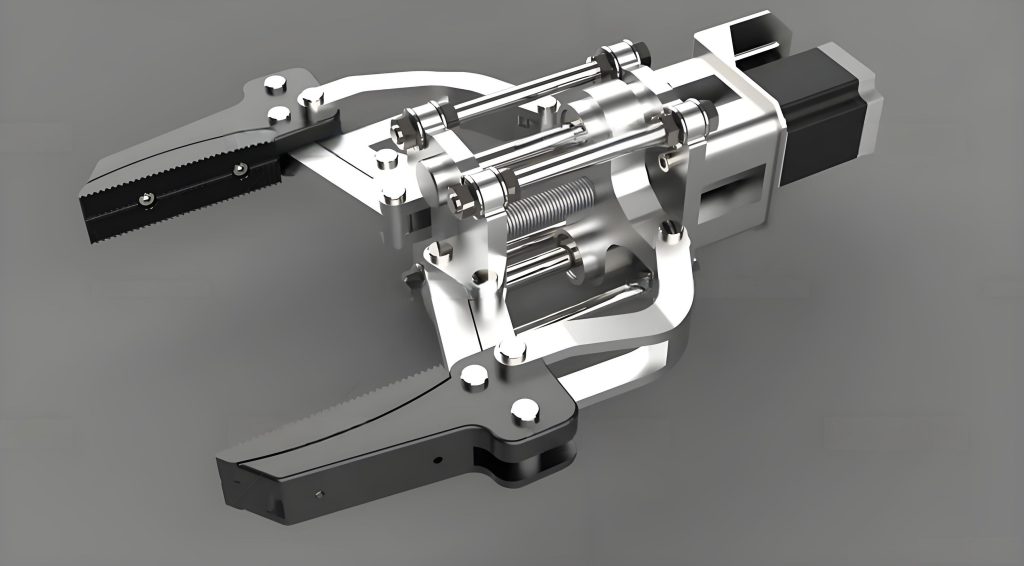
The image above visually encapsulates the principle of soft robotic gripping, showing a compliant end effector gently but securely holding a fragile egg, demonstrating perfect shape adaptation without damage—a task challenging for traditional rigid end effectors.
Other actuation methods for soft end effectors are emerging. Tendon-driven systems use cables embedded in soft fingers for precise bending control. Smart material-based end effectors employ technologies like Dielectric Elastomer Actuators (DEAs), which deform under an electric field, offering silent, lightweight, and potentially faster response. The force output $F_{DEA}$ of a simple planar DEA can be related to the applied voltage $V$ and material properties:
$$ F_{DEA} \propto \epsilon_0 \epsilon_r \left(\frac{V}{t}\right)^2 A $$
where $\epsilon_0$ and $\epsilon_r$ are the permittivity of free space and the relative permittivity of the elastomer, $t$ is its thickness, and $A$ is the area.
Comparative Analysis of Gripping Technologies
The choice of end effector technology involves critical trade-offs. Table 2 provides a comparative analysis based on key performance indicators relevant to food handling.
| Performance Metric | Vacuum Gripper | Rigid Jaw Gripper | Soft Robotic Gripper | Bernoulli Gripper |
|---|---|---|---|---|
| Damage Risk | Low (on flat surfaces) | High | Very Low | None (non-contact) |
| Hygiene / Cleanability | Poor (internal contamination) | Medium (joints, seams) | Excellent (monolithic) | Excellent (no contact) |
| Grasping Force Capacity | Medium-High | Very High | Low-Medium | Very Low |
| Adaptability to Shape | Very Low | Low-Medium (if adaptive) | Very High | Very Low (2D primarily) |
| Speed of Operation | Very Fast | Fast | Slow-Medium | Fast |
| System Complexity & Cost | Low | Medium | Medium-High | Medium (requires air supply) |
Persistent Challenges and Research Frontiers
Despite significant advances, the development of the ideal universal food robotic end effector faces several intertwined challenges:
- The Compliance-Damage-Speed Trilemma: Achieving high-speed manipulation while maintaining gentle, damage-free contact is extremely difficult. Highly compliant systems like soft grippers are gentle but often slower due to the viscoelastic response of materials and fluidic actuation dynamics. Research focuses on high-speed soft actuation materials and hybrid variable-stiffness structures.
- Hygiene by Design: Meeting stringent food safety regulations requires end effectors with smooth, crevice-free surfaces, compatible with aggressive cleaning chemicals and steam. This influences material selection (e.g., FDA-approved silicones, stainless steels) and drives the trend towards sealed, monolithic designs seen in soft robotics and specially coated rigid end effectors.
- Sensory Integration and Intelligent Control: A truly robust end effector requires perception. Integrating tactile, force/torque, and proximity sensors allows for closed-loop control of grip force ($N$), detection of slip, and recognition of object properties. The key is embedding these sensors in a hygienic, robust manner within the end effector structure. Machine learning algorithms are being developed to interpret sensor data and adapt grasping strategies in real-time.
- Generality vs. Specialization: The economic imperative favors flexible end effectors that can handle a broad product mix. However, physical laws often dictate that optimal, high-speed, reliable handling is achieved with specialized tooling. Current research explores rapidly reconfigurable or tunable end effectors, tool changers for robots, and grippers with multi-modal capabilities (e.g., combining suction and fingered grasp).
Future Outlook and Concluding Remarks
The trajectory of food robotic end effector development is clear: moving towards more adaptive, intelligent, and hygienically superior systems. Soft robotic end effectors will continue to mature, with improvements in modeling (using techniques like Finite Element Analysis to predict deformation), faster and more efficient actuation methods (e.g., electrohydrodynamic pumps, improved DEAs), and enhanced embedded sensing. The fusion of different principles—such as a soft gripper with micro-suction arrays on its fingertips, or a vision-guided system that selects between a Bernoulli pickup for slices and a soft grip for whole fruits—will lead to highly versatile, multi-strategy end effectors.
Furthermore, the standardization of hygiene protocols and the development of certified “food-safe” modular end effector components will lower the barrier to adoption. In conclusion, the end effector is the defining element that bridges the deterministic world of industrial robotics with the highly variable and sensitive domain of food products. Its ongoing evolution from simple mechanical claws to intelligent, biomimetic, and sensor-rich systems is fundamental to realizing the full potential of automation in ensuring a safe, efficient, and sustainable global food supply chain. The future food robotic end effector will not merely be a tool, but a perceptive and adaptive partner in food handling.