
In recent years, the global industrial landscape has witnessed a significant surge in the adoption of automation, with industrial robots playing a pivotal role. As the world’s largest manufacturing and consumer market, my country’s demand for industrial robots has been growing annually. According to the International Federation of Robotics (IFR) “World Robotics 2020” report, despite the severe economic consequences of the COVID-19 pandemic, the operational stock of industrial robots in factories worldwide reached 2.7 million units, marking a 12% increase. Specifically, the operational stock in my country grew by 21% in 2019, reaching approximately 783,000 units. Against this backdrop, intelligent manufacturing technology, with industrial robot technology at its core, has become a primary direction for the development of high-end and smart manufacturing industries. The RV reducer, as a novel transmission mechanism, is widely utilized in industrial manufacturing equipment, particularly in the field of industrial robots. Therefore, conducting in-depth research on the manufacturing technology of key components for precision reducers in industrial robots holds significant importance and value.
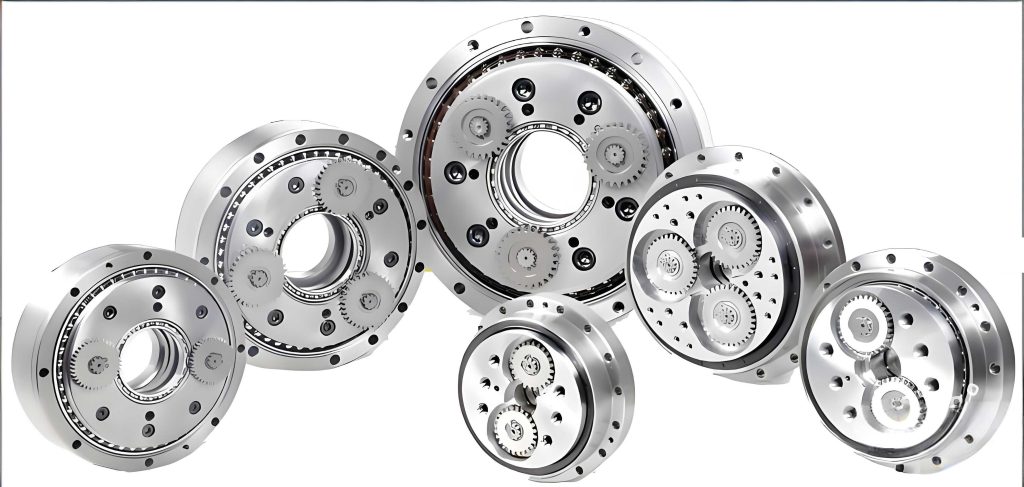
The RV reducer, renowned for its compact size, lightweight design, high stiffness, long lifespan, high transmission accuracy, and smooth operation, is extensively applied in industrial robotics. In the transmission process, the RV reducer achieves a large reduction ratio through a two-stage speed reduction mechanism. The first stage involves a planetary gear set, while the second stage comprises a cycloid-pin gear mechanism consisting of cycloid disks, pin teeth, and a planet carrier. A schematic diagram illustrates this transmission principle. The primary components of an RV reducer include the input shaft, planetary gears, crank shafts, cycloid disks, pin teeth, and the output disk. This structural configuration enables the RV reducer to deliver exceptional performance in demanding robotic applications.
To elucidate the mechanical behavior, we focus on a specific model, the RV-80E reducer, which has a rated speed of 15 rpm, a rated torque of 800 N·m, and a transmission ratio of 121. The fundamental technical parameters are summarized in the following table.
| Parameter Name | Value |
|---|---|
| Pin Tooth Diameter (mm) | 6 |
| Eccentricity (mm) | 1.5 |
| Pin Tooth Center Circle Radius (mm) | 76.5 |
| Number of Pin Teeth | 39 |
| Number of Cycloid Wheel Teeth | 40 |
| Number of Sun Gear Teeth | 12 |
| Number of Planetary Gear Teeth | 36 |
| Module | 1.75 |
In practical operation, the cycloid wheel in an RV reducer often undergoes profile modification to enhance transmission smoothness and reduce transmission error. This modification, however, introduces initial clearance between the cycloid wheel teeth and the pin teeth, affecting the meshing forces. The initial clearance Δ(ψ_i) for the i-th pin tooth, relative to the turn-arm angle ψ_i, can be expressed based on modification parameters. For the RV-80E, the modification includes a shift amount a = 0.008 mm and an equidistant modification amount b = 0.004 mm. The formula is given by:
$$\Delta(\psi_i) = a + b \cdot \cos(\psi_i)$$
Here, k is the short-range coefficient, defined as k = e z_p / r_z, where e is the eccentricity of the crank shaft, z_p is the number of pin teeth, and r_z is the radius of the pin tooth center circle. The analysis of forces between the cycloid wheel and pin teeth requires considering this clearance and the resulting contact deformation.
According to Hertzian contact theory, the deformation δ between two contacting cylinders (the cycloid wheel tooth and the pin tooth) can be calculated. The formula for the approach of two elastic cylinders in contact is:
$$\delta = \frac{2F}{\pi l_e} \left( \frac{1-\mu_1^2}{E_1} + \frac{1-\mu_2^2}{E_2} \right) \ln \left( \frac{4R_1 R_2}{b_c^2} \right)$$
Where F is the contact force, E1 and E2 are the elastic moduli of the two materials, μ1 and μ2 are their Poisson’s ratios, R1 and R2 are the radii of curvature, and l_e is the effective contact length. The half-width of the contact area b_c is determined by:
$$b_c = \sqrt{ \frac{4F}{\pi l_e} \cdot \frac{R_1 R_2}{R_1 + R_2} \cdot \frac{1-\mu_1^2}{E_1} + \frac{1-\mu_2^2}{E_2} }$$
The curvature radius of the actual cycloid wheel tooth profile, ρ, varies along the tooth flank. When the curvature is greater than the radius, the tooth profile is concave; when it is smaller, the profile is convex. The expressions are:
$$\rho = \frac{(r_z – r_p)^2 + e^2 (1 + k^2 – 2k \cos(\psi_i))^{3/2}}{(r_z – r_p) + e^2 k (k – \cos(\psi_i))}$$
For convex profile: $$\rho < r_p$$, and for concave profile: $$\rho > r_p$$, where r_p is the pin tooth radius.
The comprehensive deformation in the direction of contact is the sum of the deformation between the cycloid wheel and pin tooth and the deformation between the pin tooth and the pin housing. By calculating all deformation quantities, the maximum deformation δ_max can be obtained. Under elastic deformation conditions, the displacement in the normal direction of the meshing force for the i-th pin tooth is given by:
$$\delta_i = \delta_{i,cyc-pin} + \delta_{i,pin-housing}$$
When the condition δ_i – Δ(ψ_i) ≥ 0 is satisfied, the corresponding pin tooth is in meshing contact with the cycloid wheel. For the RV-80E, calculations indicate that 19 pin teeth are simultaneously in mesh. The meshing force between the cycloid wheel and the i-th pin tooth, F_i, can be derived from the deformation compatibility and equilibrium equations. The total meshing force on the cycloid wheel from all engaged pin teeth must balance the external torque. The equations are:
$$F_i = K_i (\delta_i – \Delta(\psi_i))^{3/2} \quad \text{for} \quad \delta_i – \Delta(\psi_i) \geq 0$$
$$\sum_{i=p}^{t} F_i \cdot r’_c \cdot \sin(\phi_i) = T_{load}$$
Here, K_i is the contact stiffness factor for the i-th pair, r’_c = e z_c is a reference radius, z_c is the number of cycloid wheel teeth, φ_i is the pressure angle, T_load is the output torque, and the summation runs from the p-th to the t-th engaged pin tooth. From these equations, it is evident that determining the maximum elastic deformation δ_max requires knowing the maximum meshing force F_max, and vice versa, necessitating an iterative solution approach.
We employ an iterative method starting with an initial guess for the maximum force F_max0. The iteration converges when the absolute difference between successive estimates is less than 1% of F_max0. The initial value is set as:
$$F_{max0} = \frac{T_{load}}{n \cdot r’_c}$$
Where n is the estimated number of engaged teeth. The iterative procedure flowchart is conceptualized as follows: begin with geometric and load parameters, compute initial clearances and deformations, check engagement condition, find maximum deformation, update maximum force, and iterate until convergence. After iteration, for the RV-80E under rated torque, the converged maximum meshing force is F_max = 709.95 N.
Based on Hertzian contact stress theory, the contact stress σ_i between the cycloid wheel and the i-th pin tooth is calculated using:
$$\sigma_i = \sqrt{ \frac{F_i E_d}{\pi \rho_i l_e} }$$
Where E_d is the equivalent elastic modulus, given by $$E_d = \frac{2E_1 E_2}{E_1 + E_2}$$ for similar materials, and ρ_i is the equivalent curvature radius at the meshing point, defined as $$\frac{1}{\rho_i} = \frac{1}{R_1} \pm \frac{1}{R_2}$$ (sign depends on convex or concave contact). For the cycloid wheel and pin tooth pair, R1 = ρ (cycloid curvature radius) and R2 = r_p (pin tooth radius).
The calculated meshing forces and contact stresses for the 19 engaged pin teeth are tabulated below. The data reveals that the maximum meshing force occurs at pin tooth number 3, while the maximum contact stress is found at pin tooth number 2. This phenomenon is attributed to the varying curvature of the cycloid tooth profile along the engagement arc, leading to differences in load distribution and stress concentration.
| Pin Tooth Serial Number | Meshing Force F (N) | Contact Stress σ (MPa) |
|---|---|---|
| 2 | 702.07 | 720.56 |
| 3 | 785.98 | 481.85 |
| 4 | 785.02 | 382.74 |
| 5 | 780.65 | 324.04 |
| 6 | 747.56 | 289.62 |
| 7 | 710.30 | 266.15 |
| 8 | 670.07 | 249.41 |
| 9 | 627.28 | 237.13 |
| 10 | 582.17 | 228.00 |
| 11 | 534.88 | 221.16 |
| 12 | 485.55 | 216.07 |
| 13 | 434.32 | 212.38 |
| 14 | 381.34 | 209.68 |
| 15 | 326.80 | 207.86 |
| 16 | 270.90 | 206.71 |
| 17 | 213.93 | 206.06 |
| 18 | 156.17 | 205.77 |
| 19 | 97.97 | 205.69 |
| 20 | 39.68 | 205.68 |
The resultant force on the cycloid wheel from all pin teeth, denoted F_res, is obtained by vector summation of individual meshing forces, considering their directions relative to the cycloid wheel’s coordinate system. This resultant force is crucial for subsequent bearing analysis.
Next, we analyze the forces on the crank shaft support bearings, which are critical components in the RV reducer. These bearings support the cycloid wheel and transmit loads from the meshing action to the housing. The bearing force on each crank shaft can be decomposed into three components: F_n1, F_n2, and F_n3. Here, F_n1 is a constant load component that balances the moment generated by the tangential components of the pin tooth forces about the center O. F_n2 and F_n3 are rotating load components that vary with the crank shaft’s rotation angle θ, balancing the radial components of the pin tooth forces. A schematic diagram illustrates this force decomposition on a crank shaft.
Assuming a constant output load, F_n1 remains constant in magnitude and direction relative to the crank shaft. In contrast, F_n2 and F_n3 have constant magnitudes but rotate with the crank shaft. The expressions for these force components are derived from static equilibrium conditions. For an RV reducer with m crank shafts (typically m=2 or 3), the forces are:
$$F_{n1} = \frac{T_{load}}{m \cdot e}$$
$$F_{n2} = \frac{F_{ix}}{m}$$
$$F_{n3} = \frac{F_{iy}}{m}$$
Where F_ix and F_iy are the resultant tangential and radial components of all pin tooth forces on the cycloid wheel, respectively. From our earlier calculations for the RV-80E, we have F_ix = 8976.3 N and F_iy = 3699.3 N. With m=2 for this model, substituting values yields F_n1 = 4538.88 N, F_n2 = 2491.93 N, and F_n3 = 624.06 N.
The total bearing force F_n on each crank shaft support bearing is the vector sum of these three components. In a coordinate system attached to the crank shaft, with the x-axis tangent to the bearing path and the y-axis perpendicular along the eccentric direction, the force varies with the crank shaft rotation angle θ. The expression is:
$$F_n(\theta) = \sqrt{ (F_{n1})^2 + (F_{n2} \cos(\theta) + F_{n3} \sin(\theta))^2 + (-F_{n2} \sin(\theta) + F_{n3} \cos(\theta))^2 }$$
Simplifying, we get:
$$F_n(\theta) = \sqrt{ F_{n1}^2 + F_{n2}^2 + F_{n3}^2 + 2 F_{n2} F_{n3} \sin(2\theta) }$$
Plotting this function over one full revolution of the crank shaft (θ from 0 to 2π radians) shows a periodic variation in the bearing force. For the RV-80E parameters, the maximum bearing force is 5911.2 N, and the minimum is 454.53 N. This cyclic loading is essential for fatigue life estimation and bearing selection in the RV reducer design.
To validate our analytical force calculations, we performed a dynamic simulation using UG NX software. A three-dimensional model of the RV-80E reducer was constructed and imported into the motion simulation module. Appropriate joints and constraints were applied to replicate the actual mechanism. The joint types are summarized in the following table.
| Joint Type | Component 1 | Component 2 |
|---|---|---|
| Fixed Joint | Pin Housing | Ground |
| Fixed Joint | Crank Shaft | Planetary Gear |
| Revolute Joint | Sun Gear | Planet Carrier |
| Revolute Joint | Planetary Gear | Planet Carrier |
| Revolute Joint | Planet Carrier | Ground |
| Revolute Joint | Crank Shaft | Cycloid Disk |
| Revolute Joint | Pin Tooth | Pin Housing |
| Gear Joint | Sun Gear | Planetary Gear |
| Contact Joint | Cycloid Disk | Pin Tooth |
An input rotational drive was applied to the sun gear with a step function to simulate smooth startup: 10890 rad/s * step(time, 0, 0, 0.1, 1). Similarly, a load torque of 800,000 N·mm (800 N·m) was applied to the output disk using a step function: 800000 * step(time, 0, 0, 0.1, 1). The simulation was solved for 0.5 seconds with 5000 steps to capture dynamic behavior. The output angular velocity stabilized at approximately 90 rad/s, confirming the transmission ratio of 121 and validating the model’s correctness.
The simulation output for the meshing force between the cycloid wheel and the most heavily loaded pin tooth was extracted. The force profile shows that the meshing force increases gradually as the pin tooth engages due to elastic deformation and contact area expansion, exhibits some fluctuation during full engagement due to line contact dynamics and manufacturing imperfections, and then decreases steadily during disengagement. The peak force from simulation aligns closely with our analytical result of around 785 N, providing confidence in our force analysis methodology for the RV reducer.
Furthermore, the simulation allowed visualization of force distribution across all pin teeth over time, corroborating the multi-tooth engagement characteristic of the cycloid drive in the RV reducer. The periodic variation in bearing forces on the crank shafts was also observed, matching the analytical predictions of cyclic loading with maxima and minima corresponding to specific crank angles.
In conclusion, this study conducted a detailed force analysis of key components in a precision RV reducer, specifically focusing on the cycloid wheel-pin teeth meshing interface and the crank shaft support bearings. Analytical models incorporating profile modification and Hertzian contact theory were developed to compute meshing forces and contact stresses. An iterative algorithm was implemented to solve the nonlinear engagement conditions. The bearing forces were derived from equilibrium considerations and expressed as functions of crank shaft angle, revealing significant cyclic variations. Dynamic simulation using UG software served as a validation tool, confirming the accuracy of the analytical force predictions. The results, including force and stress distributions and bearing load curves, provide valuable data for optimizing the design, material selection, and fatigue life assessment of RV reducer components. This work underscores the importance of rigorous mechanical analysis in advancing the reliability and performance of RV reducers, which are indispensable in modern industrial robotics and automation systems.
The methodologies and findings presented here can be extended to other RV reducer models and operating conditions. Future work may involve experimental validation using strain gauges or load cells, thermal analysis to account for temperature effects on material properties and clearances, and investigation of dynamic effects at higher speeds. Additionally, integrating these force models into finite element analysis for stress concentration studies or into system-level simulations for robotic arm dynamics could further enhance the design and application of RV reducers. As the demand for high-precision, durable, and efficient reducers grows, continued research in this area will contribute significantly to the advancement of smart manufacturing technologies.