
The pursuit of high precision, compact size, and exceptional load capacity in modern industrial robots has established the rotary vector reducer as the dominant solution for joint actuation. At the heart of this reducer lies the cycloidal-pin gear transmission mechanism, where the performance and longevity are critically dependent on the manufacturing accuracy and meshing quality of the cycloidal gears. Traditional gear generation grinding methods, while historically significant, present limitations in efficiency, flexibility, and particularly in implementing sophisticated tooth profile modifications essential for optimal performance. This has led to the increasing adoption of form grinding as the premier finishing process for cycloidal gears in rotary vector reducers. This article delves into the mathematical foundations, wheel profiling strategies, and dressing methodologies for the form grinding of cycloidal gears, with a focus on achieving high-precision modifications necessary for advanced rotary vector reducer applications.
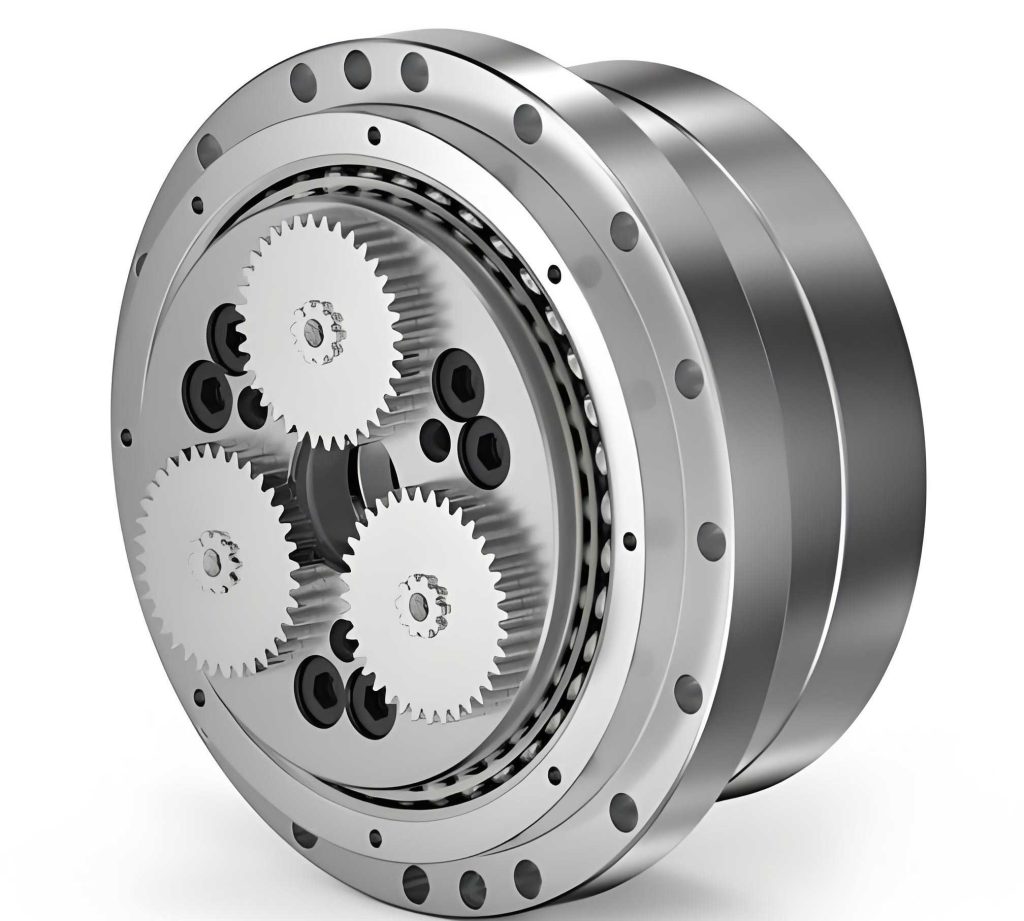
The precision transmission within a rotary vector reducer relies on the conjugate motion between the cycloidal gear and the stationary pin gear. The theoretical tooth profile of the cycloidal gear is generated by a rolling circle (associated with the gear) on a base circle (associated with the pin gear). The standard tooth profile, while theoretically providing perfect conjugation, is impractical for real-world applications in a rotary vector reducer due to the need for lubrication clearance, compensation for manufacturing and assembly errors, and prevention of jamming.
Tooth Profile Modification for Rotary Vector Reducers
Therefore, deliberate and controlled modification of the theoretical cycloidal profile is imperative. The primary objectives are to introduce a prescribed backlash and to optimize the load distribution across the tooth flank. Common modification methods include “Profile Shift” (or “Move Distance”), “Isometric” modification, and their combinations. Recent research for high-performance rotary vector reducers favors a combined “Negative Isometric plus Positive Profile Shift” modification or advanced “Parabolic” modification.
1. Combined Negative Isometric and Positive Shift Modification: This method involves simultaneously reducing the radius of the grinding/pin wheel (negative isometric, -Δrr) and increasing the center distance between the grinding wheel and the workpiece (positive shift, +ΔRp). This combination effectively creates a clearance between the tooth flanks while keeping the deviation from the theoretical profile minimal in the primary working area. The modified profile equation can be derived from the standard one by incorporating these parameters.
2. Parabolic Modification: This is a more advanced technique where the modification amount ΔL is not constant but varies as a function of the roll angle φ, typically following a parabolic law relative to a reference point on the profile (often the point of highest contact stress). The modification is applied along the normal direction of the theoretical tooth profile. The general form of the modified profile coordinates (in the gear coordinate system O2-X2Y2) is given by:
$$x_2 = R_z \sin\varphi – A \sin(z_b\varphi) + \frac{(r_z + \Delta r) [K_1 \sin(z_b\varphi) – \sin\varphi]}{\sqrt{1 + K_1^2 – 2K_1 \cos(z_a\varphi)}}$$
$$y_2 = R_z \cos\varphi – A \cos(z_b\varphi) – \frac{(r_z + \Delta r) [-K_1 \cos(z_b\varphi) + \cos\varphi]}{\sqrt{1 + K_1^2 – 2K_1 \cos(z_a\varphi)}}$$
Where, for parabolic modification, the total modification term (rz + Δr) is replaced by (rz + a * ΔL(φ)), with ‘a’ being the modification coefficient and ΔL(φ) being the parabolic function of φ. For the negative isometric plus positive shift method, Δr and Rz are directly adjusted. The parameters are defined as follows:
| Symbol | Description |
|---|---|
| Rz | Radius of pin gear center circle. |
| rz | Radius of pin (or grinding wheel for form grinding). |
| A | Eccentricity (generating circle radius). |
| za | Number of teeth on cycloidal gear. |
| zb | Number of pins (zb = za + 1). |
| K1 | Short-width coefficient (K1 = A*zb / Rz). |
| φ | Roll angle parameter. |
| Δr | Isometric modification amount (negative for -Δrr). |
| ΔRp | Profile shift amount (implicit in center distance adjustment). |
The selection of modification strategy has a direct impact on the torsional stiffness, positioning accuracy (backlash), noise, and lifespan of the rotary vector reducer. The parabolic method aims to keep the working region extremely close to the perfect conjugate profile, while the combined method offers a robust and manufacturable solution widely used in industry.
Mathematical Model for Form Grinding
Form grinding for the cycloidal gear in a rotary vector reducer involves using a grinding wheel whose axial profile is the exact negative (or conjugate) of the gear tooth space profile. The wheel axis is perpendicular to the gear axis. A typical five-axis CNC form grinding machine features three linear axes (X, Y, Z) and two rotational axes (workpiece rotation C and grinding wheel rotation B). The kinematic relationship is crucial for setting up the grinding process and for calculating the required wheel profile.
Let’s define two main coordinate systems:
1. Workpiece System (O2-X2Y2Z2): Fixed to the cycloidal gear. Z2 is the gear axis.
2. Grinding Wheel System (OG-XGYGZG): Fixed to the grinding wheel. XG is the wheel axis.
The center distance E between the wheel axis (XG) and the gear axis (Z2) is a critical parameter: E = R_ia + R_G, where R_ia is the root circle radius of the cycloidal gear and R_G is the radius of the grinding wheel.
The surface equation of the modified cycloidal gear in its own coordinate system is:
$$\mathbf{r_2} = [x_2(\varphi), y_2(\varphi), z_2, 1]^T$$
The coordinate transformation matrix M_G2 from the workpiece system O2 to the grinding wheel system OG involves a translation and rotations to account for the perpendicular axes arrangement. A point on the gear surface transforms to the wheel system as:
$$\mathbf{r_G} = M_{G2} \cdot \mathbf{r_2}$$
For the purpose of defining the wheel’s axial profile, we are interested in the coordinates in the wheel’s axial plane (OG-XGYG). In this plane, the radial distance from the wheel axis (YG) equals the wheel radius RG at that axial location XG. From the transformation, we can derive:
$$X_G = x_G = f(x_2, y_2, \text{transformations})$$
$$R_G = Y_G = y_G = g(x_2, y_2, E, \text{transformations})$$
Effectively, the axial profile of the grinding wheel (XG vs. RG) is determined by the coordinates of the gear tooth space profile (x2, y2) and the fixed center distance E. The specific functions f and g depend on the chosen machine tool configuration and alignment. In a common setup where the wheel’s axial section symmetry line aligns with the gear tooth space symmetry line, the relationship simplifies, and the wheel profile coordinates (X_G, R_G) can be directly related to the gear space coordinates (x_2, (y_2 – E)).
Grinding Wheel Profile Calculation and Widening Theory
The theoretical width B of the form grinding wheel corresponds to the face width of the cycloidal gear. However, a significant challenge in discontinuous form grinding (grinding one tooth space at a time) is the occurrence of “join marks” or discontinuities at the boundaries between successively ground teeth due to minute errors in the rotary table indexing.
To ensure a continuous and smooth transition and to eliminate these join marks, the grinding wheel is intentionally widened beyond the theoretical gear face width. The widened sections at the ends of the wheel act as transition zones that gently blend the profiles of adjacent teeth. The profile of this widened section must be carefully designed to avoid gouging the main working part of the tooth flank.
The principle is to use a circular arc as the transition curve for the widened section. The radius of this arc ρ_w is chosen based on the curvature analysis of the cycloidal profile. The curvature radius ρ at any point on the profile is given by:
$$\rho(\varphi) = \frac{ \left( \left(\frac{dx_2}{d\varphi}\right)^2 + \left(\frac{dy_2}{d\varphi}\right)^2 \right)^{3/2} }{ \frac{dx_2}{d\varphi} \cdot \frac{d^2y_2}{d\varphi^2} – \frac{dy_2}{d\varphi} \cdot \frac{d^2x_2}{d\varphi^2} }$$
A plot of ρ(φ) reveals a point M (the inflection point) where the curvature changes sign (ρ → ∞). More importantly, there is a point N on the profile, typically near the tooth tip in the working region, which has a local minimum positive curvature radius. All points on the profile “outside” N (towards the tooth tip or root) have a smaller curvature radius than ρ_N. Therefore, if the widened section of the wheel is designed with a circular arc of radius ρ_w = ρ_N, it will not interfere with (over-cut) the main tooth profile when it engages during the grinding of the adjacent tooth space.
Let the additional widening amount on one side be b/2. The transition arc, with radius ρ_w = ρ_N, is defined in a local coordinate system (O_N-X_NY_N) centered at the center of this arc. This center is located at a distance ρ_N from point N along the inward normal of the profile at N. The arc is defined for an angular parameter θ. The coordinates of the widened wheel profile section are then obtained by transforming this arc back into the grinding wheel coordinate system:
$$\mathbf{r_{G\_wide}} = M_{G2} \cdot M_{2N} \cdot [\rho_w \cos\theta, \rho_w \sin\theta, 0, 1]^T$$
where M_{2N} is the transformation matrix from the local arc system (O_N) to the workpiece system (O2). The final grinding wheel axial profile is thus a composite curve: the main section from the gear space transformation (Eq. for r_G) for the central width B, and the transition arc sections (r_G_wide) at both ends for the additional width b.
| Profile Section | Mathematical Description | Purpose |
|---|---|---|
| Main Working Profile | Derived from modified cycloid equation via coordinate transform (r_G). | Generates the precise, modified tooth flank of the rotary vector reducer gear. |
| Widened Transition Profile | Circular arc of radius ρ_N, transformed (r_G_wide). | Eliminates join marks between teeth; ensures continuity. |
Dressing Trajectory Calculation for the Diamond Roller
Once the required axial profile of the grinding wheel (X_G, R_G) is known, it must be imparted onto the abrasive wheel using a dressing tool, typically a rotary diamond roller. The dressing process involves the CNC-controlled simultaneous movement of the diamond roller (e.g., along the machine’s X-axis) and the grinding wheel (e.g., along the Z-axis).
The fundamental principle is that the center trajectory of the diamond roller must follow the outer offset curve (or equidistant curve) of the desired grinding wheel profile. If the diamond roller has a radius R_d, its center must be kept at a constant distance R_d along the outward-pointing normal vector of the wheel profile.
Let the desired wheel profile be defined as a curve: $$\mathbf{r_G}(s) = [X_G(s), R_G(s)]$$, where ‘s’ is a parameter (e.g., arc length). The unit normal vector $\mathbf{n}(s)$ pointing away from the wheel axis (outward) is:
$$\mathbf{n}(s) = \frac{ [-\frac{dR_G}{ds}, \frac{dX_G}{ds}] }{ \sqrt{ (\frac{dX_G}{ds})^2 + (\frac{dR_G}{ds})^2 } }$$
The dressing trajectory for the center of the diamond roller, $\mathbf{r_D}(s)$, is then given by:
$$\mathbf{r_D}(s) = \mathbf{r_G}(s) + R_d \cdot \mathbf{n}(s)$$
$$ \mathbf{r_D}(s) = [X_G(s), R_G(s)] + R_d \cdot \frac{ [-\frac{dR_G}{ds}, \frac{dX_G}{ds}] }{ \sqrt{ (\frac{dX_G}{ds})^2 + (\frac{dR_G}{ds})^2 } }$$
In practical CNC terms, this trajectory is discretized into a series of points (X_D, Z_D), where X_D corresponds to the diamond roller’s horizontal position and Z_D corresponds to the grinding wheel’s axial position during dressing. The CNC program for dressing is essentially the linear interpolation of these points.
Software Development and Simulation for Wheel Dressing
Implementing the above calculations efficiently requires dedicated software. A dressing trajectory simulation and generation software can be developed, for instance, using MATLAB or a similar platform. The software architecture typically follows a modular approach:
1. Input Module: For entering the basic parameters of the rotary vector reducer’s cycloidal gear (za, zb, Rz, rz, A, etc.), the modification type and amounts (Δr, ΔRp, or parabolic coefficient ‘a’), and dressing parameters (diamond roller radius R_d, wheel widening amount b).
2. Profile Calculation Module: This core module computes the modified cycloidal profile based on the chosen method. It performs the curvature analysis to find point N and ρ_N for the widened section. It then calculates the complete grinding wheel axial profile coordinates (X_G, R_G).
3. Dressing Trajectory Module: This module takes the wheel profile data, computes the unit normal vectors, and applies the offset equation to generate the diamond roller center coordinates (X_D, Z_D).
4. Output & Simulation Module: The software outputs the discrete point data for the CNC dressing program. It also provides graphical simulations, overlaying the standard profile, modified profile, the calculated wheel profile, and the dressing trajectory. This visual feedback is crucial for verifying the correctness of the modifications and the dressing path before actual machining.
| Software Module | Primary Function |
|---|---|
| Input & Parameter Management | Accepts gear geometry, modification data, and process parameters. |
| Curve Generation Engine | Computes modified cycloid, wheel profile, and transition arcs. |
| Numerical Differentiation & Offset Calculation | Calculates normals and generates the precise diamond roller path. |
| Graphical User Interface (GUI) & Visualization | Displays profiles, trajectories, and enables interactive simulation. |
| CNC Code Generator | Exports the dressing path as machine-executable G-code. |
The development of such software is integral to harnessing the full potential of form grinding for rotary vector reducer cycloidal gears. It bridges the gap between theoretical profile design and practical, high-precision manufacturing, enabling the implementation of complex modifications like parabolic or optimized combined profiles that are essential for the next generation of high-performance rotary vector reducers.
Conclusion
The transition from generation grinding to form grinding represents a significant advancement in the manufacturing of cycloidal gears for precision rotary vector reducers. The key to success lies in the accurate determination of the grinding wheel’s axial profile, which must account for the intended tooth flank modification, and in the precise CNC dressing of that profile. The mathematical modeling presented, encompassing the modified cycloidal equation, coordinate transformations for the grinding setup, curvature-based wheel widening theory, and the equidistant-curve principle for diamond roller path generation, provides a comprehensive foundation. The implementation of this methodology through specialized software allows for the simulation, verification, and efficient generation of dressing programs. This integrated approach ensures that the critical components of the rotary vector reducer are produced with the high accuracy, optimal meshing characteristics, and superior surface integrity required for demanding robotic applications, ultimately enhancing the performance, reliability, and longevity of the entire rotary vector reducer system.