
As a high-precision transmission component that converts rotary motion into linear motion, the planetary roller screw mechanism has found applications in areas demanding high speed, large lead, and high accuracy. The recirculating planetary roller screw represents a distinct evolution from the standard type, offering unique advantages and design challenges, particularly suited for applications with limited space and smaller lead requirements. This article, from my research perspective, delves into the foundational principles, spatial mobility, and kinematic behavior of this mechanism.
The fundamental difference lies in the design of the rollers and the method for ensuring continuous motion. Unlike the standard planetary roller screw, the recirculating version employs grooved rollers with zero helix angle and incorporates a cam-based reset mechanism, eliminating the need for a gear mesh between the rollers and the nut. This modification increases the complexity of the motion and introduces potential challenges related to motion continuity. The core components of a recirculating planetary roller screw include the screw, the nut, the grooved rollers, a cage (or planet carrier), and the reset cams fixed to the nut ends. The cage maintains an even circumferential distribution of the rollers around the screw.
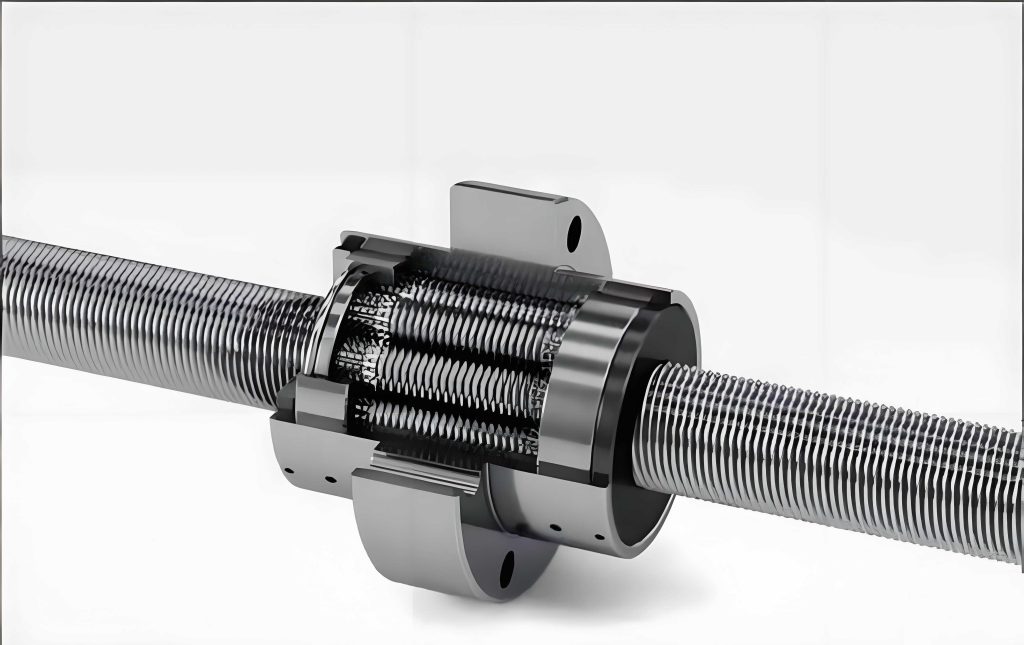
The operational principle is akin to a planetary gear system but within a spatial helical context. The screw acts as the sun gear, the rollers as the planets, and the nut as the annulus or ring gear, with the cage serving as the planet carrier. The key to its function is the recirculation path. After completing one orbital cycle along the screw threads, a roller reaches a limit position within the cage, aligning with a relief groove machined into the nut’s interior. At this precise moment, the fixed reset cam at the nut’s end engages the roller, forcing it to reset axially back to its starting position relative to the screw threads. This action allows the roller to disengage from one thread valley and re-engage in the preceding one, enabling a continuous, recirculating motion. During this reset phase, the roller only contacts the relief groove of the nut, not the working thread flank. Understanding the spatial kinematics and mobility of this planetary roller screw system is therefore crucial.
Spatial Mobility Analysis Using Constraint Screw Theory
To rigorously analyze the motion characteristics of the recirculating planetary roller screw, a formal mobility calculation is essential. Traditional Grübler-Kutzbach (G-K) formulas can be inadequate for complex spatial mechanisms. Here, we employ constraint screw theory, which provides a more accurate method by identifying and accounting for over-constraints and passive degrees of freedom.
The modified G-K formula is given by:
$$ M = d(n – g – 1) + \sum_{i=1}^{g} f_i + \nu – \zeta $$
where:
- $M$ is the mobility (degrees of freedom).
- $d$ is the order of the mechanism ($d = 6 – \lambda$, where $\lambda$ is the number of common constraints).
- $n$ is the number of links (including the frame).
- $g$ is the number of joints.
- $f_i$ is the degree of freedom of the $i$-th joint.
- $\nu$ is the number of redundant constraints.
- $\zeta$ is the number of local (passive) degrees of freedom.
To simplify the analysis, we consider a model with a single roller and its associated reset cam. The spatial kinematic diagram is established with the screw axis aligned along the Z-direction. The joints and their corresponding motion screws ($\$) are defined in Plücker coordinates. For instance, the revolute joint between the roller and the cage is represented by a screw along its axis. Assembling the motion screw system $\{ \$_1, \$_2, …, \$_7 \}$ for all connections (screw-frame, screw-roller, roller-cage, roller-nut, roller-cam, nut-frame), we find its rank.
Calculating the reciprocal screws (constraint wrenches) to this motion screw system reveals the constraints acting on the mechanism. For the recirculating planetary roller screw, the analysis yields two common constraint couples:
$$ \$^{r}_1 = (0, 0, 0; 1, 0, 0) $$
$$ \$^{r}_2 = (0, 0, 0; 0, 1, 0) $$
These represent constraints against rotations about the X and Y axes for the entire assembly relative to the frame, implying $\lambda = 2$. Consequently, the order is $d = 6 – 2 = 4$. Further inspection shows no redundant constraints ($\nu = 0$) and no local degrees of freedom ($\zeta = 0$). Substituting into the modified G-K formula with appropriate counts for $n$ and $g$:
$$ M = 4( n – g – 1) + \sum f_i + 0 – 0 = 1 $$
This confirms the recirculating planetary roller screw mechanism possesses one degree of freedom. This result validates that the mechanism has a determinate motion: the rotation of the screw uniquely determines the linear translation of the nut, which is circumferentially constrained.
Kinematic Modeling and Lead Calculation
Building upon the mobility confirmation, we develop a kinematic model to derive the relationship between input rotation and output translation, ultimately defining the actual lead of the mechanism. Consider the motion schematic in the plane perpendicular to the screw axis. Let $O_s$ be the screw center, $O$ the roller center, $A$ the contact point between screw and roller, and $B$ the contact point between roller and nut. The pitch radii are $r_s$ for the screw, $r_R$ for the roller, and $r_N$ for the nut. The screw rotates with angular velocity $\omega_s$.
Assuming pure rolling at the roller-nut interface (point B), B is the instantaneous center of rotation for the roller. Therefore, the velocity of the roller center $v_O$ is related to the roller’s angular velocity $\omega_r$ (spin about its own axis) by:
$$ v_O = \omega_r \cdot r_R \quad \text{(from rotation about B)} $$
Simultaneously, at the screw-roller contact point A, the velocities must be equal (assuming no slip for the kinematic idealization):
$$ v_A = \omega_s \cdot r_s $$
From the geometry of similar triangles ($\triangle O_s O A$ and the velocity triangle), we find:
$$ \frac{v_O}{v_A} = \frac{r_R}{2r_R} = \frac{1}{2} \quad \Rightarrow \quad v_O = \frac{1}{2} \omega_s r_s $$
Combining the two expressions for $v_O$ gives the roller’s spin angular velocity:
$$ \omega_r = \frac{\omega_s r_s}{2 r_R} $$
The velocity $v_O$ can also be expressed in terms of the roller’s orbital (revolution) angular velocity $\omega_R$ about the screw axis:
$$ v_O = \omega_R (r_s + r_R) $$
Equating this with $v_O = \frac{1}{2} \omega_s r_s$ yields the orbital angular velocity:
$$ \omega_R = \frac{\omega_s r_s}{2 (r_s + r_R)} $$
The translational speed $v$ of the nut is determined by the relative motion between the screw threads and the roller orbit. For a screw with a nominal lead $P_s$, the nut speed is:
$$ v = \frac{P_s}{2\pi} (\omega_s – \omega_R) $$
Substituting the expression for $\omega_R$:
$$ v = \frac{P_s}{2\pi} \left( \omega_s – \frac{\omega_s r_s}{2 (r_s + r_R)} \right) = \frac{P_s \omega_s}{2\pi} \left( 1 – \frac{r_s}{2(r_s + r_R)} \right) $$
The actual lead $P$ of the recirculating planetary roller screw assembly is defined by $v = \frac{P \omega_s}{2\pi}$. Therefore,
$$ P = P_s \left( 1 – \frac{r_s}{2(r_s + r_R)} \right) $$
$$ \boxed{P = P_s \left( \frac{2r_s + 2r_R – r_s}{2(r_s + r_R)} \right) = P_s \left( \frac{r_s + 2r_R}{2(r_s + r_R)} \right) } $$
This is a critical result. The actual lead $P$ is always less than the screw’s nominal lead $P_s$ for a standard thread form. The ratio depends solely on the pitch radii. For a zero-helix roller, a pure kinematic analysis assumes rolling at both contacts. However, in a real planetary roller screw with grooved rollers, sliding at the screw-roller interface is inevitable due to the lack of a matching helix to guide the roller axially along the screw thread. This sliding causes the actual operational lead to fall between the theoretical $P$ derived above and the screw’s nominal lead $P_s$. To minimize slip and ensure predictable motion, sufficient preload must be applied to generate the necessary frictional forces at the screw-roller contact. The key structural parameters influencing the kinematics are summarized below:
| Component | Pitch Diameter | Lead / Pitch | Groove Spacing (Roller) |
|---|---|---|---|
| Screw | $d_s$ (e.g., 25 mm) | $P_s$ (e.g., 1 mm) | N/A |
| Roller | $d_R$ (e.g., 5.5 mm) | 0 (Zero Helix) | $p_g$ (e.g., 1 mm) |
| Nut | $d_N$ (e.g., 36 mm) | $P_s$ (Matched to Screw) | N/A |
For comparative clarity, the fundamental differences between major planetary roller screw types are outlined:
| Feature | Standard Type | Differential Type | Recirculating Type |
|---|---|---|---|
| Roller Helix | Same as screw | Different from screw | Zero helix (grooved) |
| Roller-Nut Mesh | Thread + Gear | Thread | Thread only |
| Motion Continuity | Continuous | Continuous | Recirculation via cam reset |
| Typical Application | General high-load | Micro-lead / High reduction | Compact space, small lead |
Motion Simulation and Validation
To validate the theoretical kinematic analysis and the working principle of the recirculating planetary roller screw, a dynamic simulation was conducted using ADAMS software. A detailed three-dimensional model was imported, materials were assigned, and appropriate kinematic joints (revolute, cylindrical, translational, contacts) were applied between components. The screw was assigned a rotary motion input. The simulation parameters were set for a duration of 5 seconds with 2500 steps.
The simulation results clearly depict the complex spatial motion. The analysis of a single representative roller is particularly instructive. Its displacement curves in the X and Y directions (perpendicular to the screw axis) show perfect periodic harmonic motion, confirming its revolution around the screw. The amplitude of this oscillation corresponds precisely to the theoretical orbital radius of $(r_s + r_R)$. The roller’s displacement in the Z-direction (along the screw axis) shows a steady, linear increase, confirming its translation along with the nut assembly. Its axial travel per revolution of the screw matches the theoretical predictions derived from the kinematic model.
The velocity curves provide further insight. The X and Y velocity components of the roller are also periodic, 90 degrees out of phase with the displacement, as expected for circular motion. Its Z-direction velocity is constant, indicating uniform axial speed. The screw’s motion, as expected, shows only rotational velocity components in X and Y (due to its spin), with zero net displacement in these axes. The nut’s motion is characterized by zero velocity in X and Y, confirming its circumferential constraint, and a constant, non-zero velocity in the Z-direction, proving its pure translational output.
These simulation results are fully consistent with the proposed working principle and the derived kinematic equations. They visually demonstrate the coordinated planetary motion—where rollers simultaneously revolve around the screw and spin on their own axes—and its conversion into a linear nut translation through the threaded interfaces. The simulation thus serves as a robust validation of the entire kinematic model for the recirculating planetary roller screw.
Conclusion
This comprehensive analysis of the recirculating planetary roller screw mechanism has successfully addressed its unique spatial kinematics. By applying constraint screw theory, the mechanism’s mobility was rigorously calculated and confirmed to be one, ensuring a determinate motion transformation from screw rotation to nut translation.
The derived kinematic model established the fundamental motion relationships between the screw, rollers, and nut. A key outcome was the formulation for the actual lead $P$:
$$ P = P_s \left( \frac{r_s + 2r_R}{2(r_s + r_R)} \right) $$
This equation highlights that the lead is fundamentally dependent on the pitch radii and is less than the screw’s nominal lead. The analysis also critically identified the inherent tendency for sliding at the screw-roller interface due to the grooved roller design. This underscores the operational necessity of applying adequate preload to generate sufficient traction and ensure reliable performance, minimizing the deviation between the kinematic lead and the practical operational lead.
Finally, the dynamic motion simulation provided a powerful visual and quantitative validation of the working principle. The simulated motions of all components—the screw’s rotation, the roller’s planetary motion (combined revolution and spin), and the nut’s pure translation—exactly matched the theoretical predictions. This end-to-end analysis, from spatial mobility calculation to kinematic derivation and simulation validation, solidifies the understanding of the recirculating planetary roller screw and provides a firm foundation for its design and application in precision mechanical systems where compactness and a small lead are paramount.