
The pursuit of creating machines that can interact with the world as deftly as humans has long been a central theme in robotics. Among the most challenging and fascinating endeavors in this field is the development of the dexterous robotic hand. My research focuses on the design and virtual validation of such a hand, targeting applications where nuanced manipulation is critical, such as in robotic-assisted physical therapy or delicate object handling. This article details my comprehensive workflow, from initial three-dimensional parametric modeling in CATIA to a full multi-body dynamics simulation in ADAMS, demonstrating a robust virtual prototyping methodology.
The significance of the dexterous robotic hand lies in its potential to replicate the complex kinematics and compliance of its biological counterpart. While numerous impressive designs exist globally, the development cycle remains lengthy and costly. Physical prototyping iterations are expensive and time-consuming. Therefore, leveraging virtual prototyping technology is not just advantageous but essential. It allows for the exhaustive testing of design rationality, kinematic performance, and dynamic behavior before any metal is cut, thereby significantly improving development efficiency, reliability, and final performance. For my project, I chose to integrate the superior solid modeling capabilities of Dassault Systèmes’ CATIA with the powerful multi-body dynamics simulation environment of MSC Software’s ADAMS. This synergy enables a seamless transition from a high-fidelity geometric model to a fully functional dynamic simulation model.
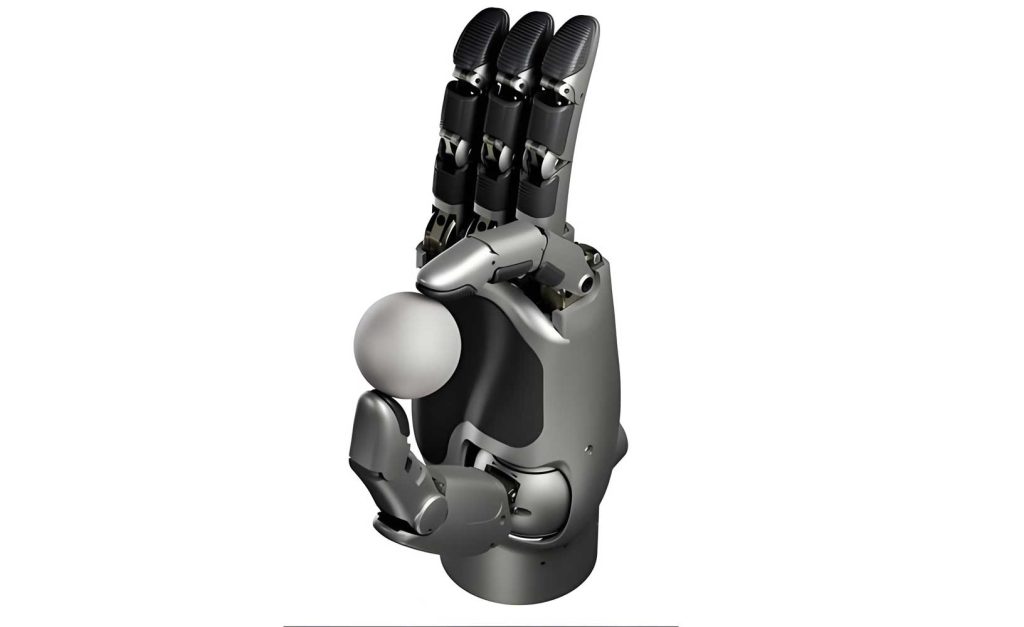
The foundation of any accurate simulation is a precise geometric model. I utilized the Part Design module within CATIA V5 to construct a fully parametric three-dimensional model of the dexterous robotic hand. The design philosophy prioritized functionality for targeted grasping and manipulation tasks while maintaining anatomical inspiration. The hand consists of five fingers: a thumb and four identical fingers representing the index, middle, ring, and little fingers. Each of the four identical fingers is designed with three phalanges (proximal, medial, and distal) connected by revolute joints, mimicking the interphalangeal joints. The thumb, requiring different degrees of freedom for opposition, was designed with a distinct base joint structure. All components, including phalanges, palm structure, gear trains, and motor housing, were modeled parametrically. This approach allows for easy modification of critical dimensions—such as link lengths, gear teeth numbers, and joint positions—by simply changing parameter values, facilitating rapid design iteration.
Following the part modeling, I employed the CATIA Assembly Design module to create a digital mock-up of the complete dexterous robotic hand. Constraints such as coincidences, contacts, and offsets were applied to position all components accurately relative to one another. A critical step in this phase was performing an Interference Check and Clash Analysis. This static analysis identifies any geometric conflicts between parts in their assembled state, ensuring the design is physically realizable without part collisions. Identifying and resolving these issues at the virtual stage prevents costly mistakes during physical manufacturing.
The core operational principle of my dexterous robotic hand is based on geared tendon-driven actuation. A small DC motor embedded in the palm provides the primary torque. This motor drives a primary gear, which engages with a series of idler and final drive gears. The rotation of the final drive gears is converted into linear motion via a capstan or pulley system that pulls on synthetic tendon cables. These cables run along channels in the fingers and are attached to the distal phalanges. A coordinated pull on these tendons flexes the finger joints, while passive elastic elements (modeled as torsional springs at joints) provide the restoring force for extension. This mechanism aims to achieve a coupled motion across the finger joints, enabling enveloping grasps and pinch grips.
The kinematic structure can be summarized for one finger. The motion of the dexterous robotic hand‘s finger is driven by the motor rotation $\theta_m$. The relationship between the motor angle and the tendon displacement $d_t$ is given by the capstan radius $r_c$:
$$ d_t = r_c \cdot \theta_m $$
This tendon displacement is then related to the joint angles. For a simplified model with coupled joints, the flexion angle $\phi_i$ for joint $i$ can be related to the tendon displacement by a moment arm $r_i$:
$$ d_t = \sum_{i=1}^{3} r_i \cdot \phi_i $$
Where $i=1,2,3$ represents the metacarpophalangeal (MCP), proximal interphalangeal (PIP), and distal interphalangeal (DIP) joints respectively, for the four identical fingers. The design parameters for the main components are summarized below:
| Component | Parameter | Designed Value | Unit |
|---|---|---|---|
| Identical Finger | Proximal Link Length | 45.0 | mm |
| Medial Link Length | 30.0 | mm | |
| Distal Link Length | 25.0 | mm | |
| Gear Train | Motor-to-Final Reduction Ratio | 50:1 | – |
| Capstan | Effective Radius | 4.0 | mm |
| Joint Stiffness (Spring) | Torsional Spring Constant | 0.05 | Nm/rad |
The transition from a geometric assembly to a dynamic simulation model is a crucial step. CATIA and ADAMS do not share a native file format. The standard bridge is to export the CATIA assembly in a neutral format that preserves geometric data. I used the *.igs (IGES) or *.stp (STEP) format for this purpose. The process involves:
- Export from CATIA: The fully constrained assembly is saved as a *.igs file. Care is taken to ensure the correct export units (mm) and to include all relevant part geometries.
- Import into ADAMS: In ADAMS/View, a new model is created with consistent units (MMKS – mm, kg, N, s). The File > Import dialog is used to select the *.igs file. ADAMS reads the file and creates a set of geometry objects.
- Model Cleanup and Part Creation: Initially, all imported geometries are lumped into a single part or many small parts. I used ADAMS geometry Boolean operations (e.g., Merge, Union) to group geometries belonging to the same physical component (e.g., a single phalanx) into a single ADAMS Part. Each part was then given a meaningful name (e.g., INDEX_PROXIMAL, PALM_BASE).
- Attribute Assignment: Critical physical properties were assigned to each part. This includes defining the material (e.g., Aluminum, ABS Plastic) which automatically assigns density, or directly inputting mass and inertia properties calculated from the 3D geometry. The material properties used are standard for prototyping:
| Material | Density ($\rho$) | Young’s Modulus (E) | Poisson’s Ratio ($\nu$) |
|---|---|---|---|
| Aluminum (Links, Gears) | 2.77e-6 kg/mm³ | 71,000 N/mm² | 0.33 |
| ABS Plastic (Cover, Housing) | 1.05e-6 kg/mm³ | 2,300 N/mm² | 0.35 |
With all parts correctly defined and positioned, the next step is to “animate” the assembly by defining how parts move relative to each other. This is done by applying kinematic constraints (joints) and drives. For the dexterous robotic hand, the primary constraints are revolute joints. A revolute joint removes five degrees of freedom between two parts, allowing only one rotational DOF about the joint’s common z-axis.
The joint configuration for one finger is as follows:
$$ \text{Finger Joints: } J_{\text{MCP}} (\text{Part}_\text{Palm}, \text{Part}_\text{Proximal}), \quad J_{\text{PIP}} (\text{Part}_\text{Proximal}, \text{Part}_\text{Medial}), \quad J_{\text{DIP}} (\text{Part}_\text{Medial}, \text{Part}_\text{Distal}) $$
The gear interactions are modeled using coupled rotational motion constraints or contact forces for higher fidelity. To simulate the tendon coupling, I used motion constraints (algebraic equations) that relate the rotation of the different finger joints. For instance, a simple coupling can be expressed as:
$$ \phi_{\text{PIP}} = k_1 \cdot \phi_{\text{MCP}}, \quad \phi_{\text{DIP}} = k_2 \cdot \phi_{\text{MCP}} $$
where $k_1$ and $k_2$ are coupling ratios derived from the tendon routing geometry. Finally, the actuation is applied. A rotational motion drive is applied to the motor shaft part:
$$ \text{MOTION}_\text{Motor} = A \cdot \sin(2 \pi f t) \quad \text{or} \quad \text{STEP(time, 0, 0, 1, 90d)} $$
The first represents a oscillatory motion for testing, while the second is a STEP function commanding a 90-degree rotation over 1 second for a grasping simulation.
The complete dynamic model of the dexterous robotic hand can be described by the equations of motion generated by ADAMS, which take the Lagrangian form:
$$ \frac{d}{dt}\left( \frac{\partial L}{\partial \dot{q}_i} \right) – \frac{\partial L}{\partial q_i} = Q_i, \quad i=1,…,n $$
where $L = T – V$ is the Lagrangian (kinetic energy minus potential energy), $q_i$ are the generalized coordinates (joint angles, motor position), $\dot{q}_i$ are the generalized velocities, and $Q_i$ are the generalized forces (including motor torque, joint friction, and external contact forces). For a system with constraints, ADAMS solves the augmented formulation:
$$ \begin{bmatrix} M & \Phi_q^T \\ \Phi_q & 0 \end{bmatrix} \begin{bmatrix} \ddot{q} \\ \lambda \end{bmatrix} = \begin{bmatrix} Q \\ \gamma \end{bmatrix} $$
where $M$ is the mass matrix, $\Phi_q$ is the Jacobian of the constraint equations, $\lambda$ are the Lagrange multipliers (representing constraint forces), and $\gamma$ is the right-hand side of the acceleration constraint equations.
With the virtual prototype fully defined—comprising parts, materials, constraints, and drives—I proceeded to the simulation phase. I set up a dynamic simulation with a time duration of 2 seconds and 500 output steps, providing a balance between simulation speed and output resolution. The simulation computes the motion of all parts under the influence of the applied motor drive, joint constraints, and gravity. Upon completion, the post-processing module ADAMS/PostProcessor is used to analyze the results. Key performance metrics were plotted and analyzed:
- Motor Torque: The torque required at the motor shaft to achieve the prescribed motion. This is critical for motor selection.
- Joint Angular Displacement/Velocity/Acceleration: The kinematic output of the finger joints.
- Reaction Forces at Joints: The forces and moments transmitted through the revolute joints, important for structural analysis and bearing selection.
The graphs from the simulation provided clear validation. The motor torque curve showed a smooth profile without extreme spikes, indicating stable loading and no internal binding or severe dynamic impacts within the mechanism. The angular acceleration curves for both the motor and the finger joints demonstrated that the system responded smoothly to the input drive, with transient peaks settling quickly into steady motion. There were no signs of sustained vibration or instability, confirming that the inertia properties and constraint definitions were physically plausible. The coordinated motion of the fingers successfully resulted in an enveloping grasp around a virtual object, visually verifying the kinematic design.
The table below summarizes key numerical results extracted from the simulation at the moment of peak grasp force:
| Performance Metric | Simulated Value | Unit | Design Implication |
|---|---|---|---|
| Peak Motor Torque | 0.85 | N·m | Specifies minimum required motor torque (with safety factor). |
| Max MCP Joint Reaction Force (Magnitude) | 12.3 | N | Guides pin and bearing sizing for durability. |
| Fingertip Closing Speed (Average) | 150 | mm/s | Validates speed for intended interactive tasks. |
| Grasp Force (Normal, at Fingertip) | 5.1 | N | Indicates capability for light object manipulation. |
This virtual prototyping project, centered on a dexterous robotic hand, has successfully demonstrated a complete digital design and validation workflow. By constructing a parametric 3D model in CATIA and seamlessly transferring it to ADAMS for dynamic simulation, I was able to thoroughly analyze the kinematic performance and dynamic behavior of the hand before physical prototyping. The simulation results confirmed the fundamental soundness of the mechanical design: the motion was smooth, the actuator requirements were quantified, and the grasp functionality was visually verified. The integration of high-fidelity modeling with multi-body dynamics simulation provides profound insights, allowing for the optimization of parameters like link lengths, gear ratios, and spring constants in a virtual environment. This approach dramatically reduces the number of physical prototypes needed, shortens the development cycle, and lowers costs. The validated model of this dexterous robotic hand serves as a solid foundation for subsequent steps, including detailed stress analysis, control system design, and ultimately, the fabrication and testing of a physical prototype, pushing closer to the goal of creating truly capable robotic manipulators.