
For most people, robots are no longer unfamiliar. Over the past several years, whenever humanoid robots appeared at large exhibitions, galas, sports events, or similar occasions, they often generated traffic of their own. They could sing, dance, box, greet guests, make coffee, and perform other attention-grabbing tasks. If those abilities still seemed like ornamental skills, the arrival of humanoid robots in homes to do household chores has made more people genuinely feel the endless charm of science fiction entering reality.
The shift from “I can dance” to “I can help you work” appears to be only one sentence apart. Behind that sentence, however, lies a collective leap across artificial intelligence, machine vision, motion control, force perception, and a series of related technologies. In 2026, the opening year of the 15th Five-Year Plan, embodied intelligence has been clearly listed by the state as a future industry for priority cultivation. It has become an important carrier for cultivating new quality productive forces and connecting digital intelligence with physical manufacturing scenarios. At the same time, the Ministry of Industry and Information Technology continues to promote the implementation of standardization in the humanoid robot industry, while localities accelerate the layout of industrial real-scene application pilots. The robot industry is moving from “showing muscles on the exhibition stage” toward “entering the field to work.” How exactly are humanoid robots completing this “super-evolution”?
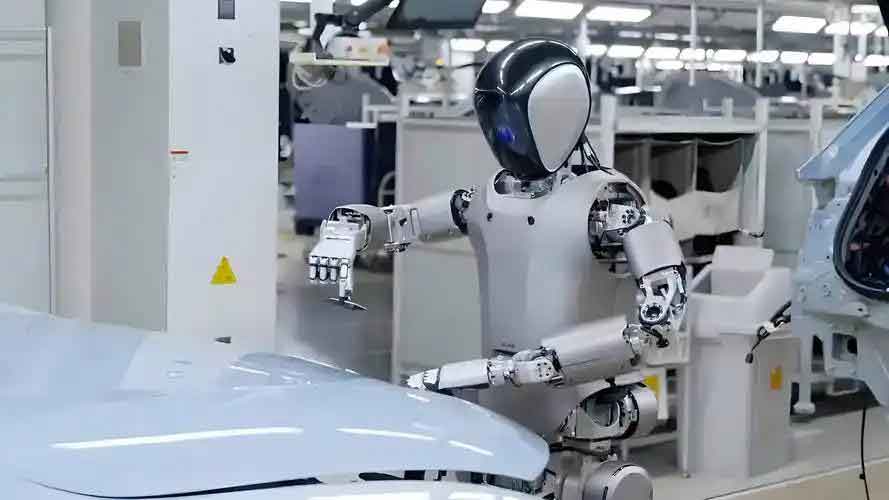
1. Humanoid robots no longer only dance; they are beginning to help people do things
During a visit to Unitree last year, the company’s humanoid robots had just appeared at the Spring Festival Gala and later attracted considerable attention because of a boxing competition. The development of technology is always accompanied by controversy. Some online observers said, “This is only a remote-controlled toy.” Unitree did not respond. It simply kept its head down and focused on research and development. Wang Xingxing, founder and CEO of Unitree, said directly that performance and movement are relatively easy scenarios to land. Unitree’s goal is to let humanoid robots do more work with actual value.
Helping people do things has always been the ultimate destination of robots and the goal pursued by manufacturers. At the 2026 World Robot Conference held in August, humanoid robots brought by various companies became more pragmatic. In order to be able to do things, they displayed a wide range of capabilities. Unitree’s nearly three-meter-tall giant manned mecha looked like a Gundam descending from anime. Zhichong AI’s robot cleaned up household tasks on site. Independent Variable Robot folded clothes and then leisurely watered flowers. Hikrobot put on an apron to simulate a fast-food employee, taking meals and placing lunch boxes. These scenes showed that humanoid robots are no longer satisfied with being performers; they are being pushed toward practical service, industrial work, and household assistance.
At the World Robot Conference, the most direct feeling was that the direction of the exhibition had changed significantly. Companies focused on humanoid robots doing things and completing tasks, emphasizing real improvement in productivity. For example, Zhichong AI’s newly self-developed robot TR6 is more flexible than the previous generation. Relying on a multi-eye visual fusion and force-sensing system, it can be applied in various complex working environments and can accurately identify irregular materials and complex objects. In the industry, attention may have previously focused on the body and the cerebellum. Now the main bottleneck and main direction of landing have shifted to the “brain,” namely the understanding ability of large artificial intelligence models. The family is regarded as one of the ultimate target scenarios for humanoid robots. It can greatly improve human quality of life and lifestyle. Humanoid robots will play diverse roles in the family, similar to a nanny, solving many life problems beyond travel. They are expected to become one of the largest industries in human history.
2. From machine to human: the generalisation ability of embodied intelligence still needs improvement
However, for humanoid robots to truly become all-capable butlers, the task is clearly not so easy. On August 20, Wang Xingxing said during a speech at the 2026 World Robot Conference that the biggest bottleneck in the robot industry is that the generalisation ability of embodied intelligence is still not enough. What is generalisation ability? Simply put, humanoid robots cannot only do “standard answers.” If a humanoid robot is trained to “see plate A and put plate A into the dishwasher,” it may complete the task beautifully. But if today the plate is replaced by plate B, or the position of the dishwasher is moved, the kitchen lighting changes, or an extra cup is placed nearby, the humanoid robot may suddenly be somewhat unable to do it.
Why does this happen? Because the real world has never been a standardized examination room. Humanoid robots must learn to “respond to moves with moves” in different environments. Hu Luhui, founder of Zhichong AI, said that the current insufficient generalisation ability of humanoid robots is mainly reflected in three points: generalisation of the body, generalisation of tasks, and generalisation of the environment. Humanoid robots still lack a true understanding of the physical world. The bottleneck is that the input and output of current artificial intelligence models are not sufficiently aligned with humanoid robots. It looks like only “a little” difference, but in reality it is a huge gap from “can do” to “do well.”
One answer to this problem may be the “world model.” In fact, in recent years, the main schools of artificial intelligence models have been VLA models and world models. VLA is “seen, therefore knows.” A world model is “reasons, therefore knows.” Its generalisation ability and causal reasoning ability are stronger, and it does not purely rely on “having seen” in order to “know.” Next, what truly needs to accelerate its development is the “brain” of humanoid robots. Only when humanoid robots truly understand the world can they accomplish something that seems simple but is actually extremely difficult.
3. Zhejiang and Hangzhou are building a regional engine for humanoid robots and embodied intelligence
Some people say that for a long time, humans building robots have been repeating the story of Pygmalion: first shaping the body to become more and more human-like, and then hoping that one day it will truly “come alive.” When will it come alive? To achieve this goal, governments at all levels are working hard. The proposals for the 15th Five-Year Plan mention forward-looking layout of future industries and promoting quantum technology, biomanufacturing, hydrogen and nuclear fusion energy, brain-computer interfaces, embodied intelligence, sixth-generation mobile communications, and others as new growth points.
As early as 2017, Zhejiang issued the Zhejiang “Robot+” Action Plan, becoming the first province in the country to propose a “Robot+” policy. Since 2024, Zhejiang has successively issued a number of special policies to provide targeted guidance for the development of the humanoid robot and embodied intelligence industries, promoting the gradual improvement of the policy system for the embodied intelligence robot industry. In Hangzhou, more than 700 robot-related enterprises have now gathered. In 2025, the output value of the embodied intelligence industrial cluster reached 106.8 billion yuan. Among them, the domestic market shares in the fields of quadruped robots and humanoid robots account for 80 percent and 50 percent respectively. Hangzhou is building a complete industrial chain covering complete machine manufacturing, core components, software algorithms, and scenario applications.
From January to June this year, the revenue of Zhejiang’s artificial intelligence core industry reached 429.6 billion yuan, a year-on-year increase of 25.6 percent. At present, the number of artificial intelligence core enterprises in the province has increased to 2,080, initially forming a full industrial chain pattern covering chips, large models, intelligent agents, and application services. Yan Xi’an, deputy director of the Zhejiang Development and Reform Commission, said that in the future, Zhejiang will persist in taking artificial intelligence as the core variable for winning the future, accelerate the creation of an intelligent economy industrial cluster with international competitiveness, and strive to make the province’s artificial intelligence core industry revenue reach 1.2 trillion yuan by 2030.
Hu Luhui said that the recent listing of Unitree has also given entrepreneurs in the humanoid robot field great confidence. Whether it is the forward-looking layout at the national level or Zhejiang’s strong investment in artificial intelligence, both have laid a solid foundation for the development of the humanoid robot industry. Talent and capital are flowing in, very much like the surging development momentum of the internet ten years ago. From “what can I do” to “what can I truly help you do,” this may be the true “super-evolution” of humanoid robots.
4. Why practical usefulness has become the new benchmark for humanoid robots
For years, humanoid robots have often been judged by how closely they resemble people in appearance and movement. A humanoid robot that can walk, wave, dance, or perform a martial arts routine can easily attract a crowd. But the value of humanoid robots cannot be measured only by stage presence. The real test is whether humanoid robots can enter daily life and production, understand instructions, adapt to changing surroundings, and complete tasks that save time, reduce risk, or improve efficiency. That is why the shift from “I can dance” to “I can help you work” matters so much.
The 2026 World Robot Conference provided a clear snapshot of this shift. Humanoid robots were presented not merely as entertainers but as workers in progress. They tidied rooms, folded clothes, watered plants, simulated fast-food service, and demonstrated large-scale manned platforms. These demonstrations did not mean that humanoid robots have already solved every problem. They did show that the center of gravity in the industry is moving. Companies are asking how humanoid robots can complete tasks in messy, unpredictable environments. They are asking how humanoid robots can handle different objects without being retrained for every single variation. They are asking how humanoid robots can move from controlled demonstrations to reliable assistance.
For households, the appeal is easy to understand. A humanoid robot that can help with chores could change the daily division of labor. It could assist with cleaning, organizing, carrying, and other repetitive tasks. For older adults or people with limited mobility, humanoid robots could offer a new layer of support. For service industries, humanoid robots could take on repetitive or physically demanding roles. For factories and logistics sites, humanoid robots could work alongside people in environments that require flexibility rather than fixed automation. These possibilities explain why humanoid robots are drawing attention from governments, investors, researchers, and the public at the same time.
Yet practical usefulness also raises the bar. A humanoid robot that fails once in a laboratory is a technical problem. A humanoid robot that fails in a home, a kitchen, a factory, or a public space can create inconvenience, damage, or danger. Practical humanoid robots must be reliable, safe, and understandable to the people around them. They must know when to act and when to ask for help. They must handle objects of different shapes, weights, and fragility. They must operate in spaces designed for humans, not for machines. These requirements turn humanoid robots from a showcase technology into a systems engineering challenge.
5. The technology stack behind the super-evolution of humanoid robots
The movement of humanoid robots from performance to practical work depends on more than a single breakthrough. It requires artificial intelligence, machine vision, motion control, force perception, and other technologies to advance together. A humanoid robot must perceive its surroundings, identify objects, plan actions, control its joints, apply appropriate force, and recover from errors. If any part of this chain is weak, the humanoid robot may fail in real-world conditions. A robot that can dance on a stage may still struggle to pick up a cup from a cluttered table or place a lunch box without crushing it.
Machine vision helps humanoid robots recognize objects, people, and environments. Force perception helps humanoid robots adjust their grip and avoid damaging fragile items. Motion control helps humanoid robots move smoothly and maintain balance. Artificial intelligence helps humanoid robots understand language, interpret goals, and make decisions. When these capabilities are combined, humanoid robots can begin to perform tasks that were once considered too complex for machines. Yet the combination is difficult. The physical world is full of variation. Lighting changes, object positions change, surfaces differ, and people behave unpredictably. Humanoid robots must handle this variation without constant human intervention.
This is why the generalisation ability of humanoid robots has become such a central topic. Body generalisation means that a humanoid robot should be able to use different bodies or hardware configurations without relearning everything. Task generalisation means that a humanoid robot should transfer skills from one task to another. Environment generalisation means that a humanoid robot should operate in new spaces, under different conditions, with unfamiliar objects. If humanoid robots only work in one laboratory or one staged setting, they remain demonstrations. If humanoid robots can generalize across bodies, tasks, and environments, they become practical tools.
VLA models and world models represent two important directions in artificial intelligence for improving humanoid robots. VLA models rely on what has been seen and learned, connecting vision, language, and action. World models attempt to build an internal representation of how the world works, allowing reasoning about causes and effects. For humanoid robots, world models could help them predict what will happen if they push an object, open a door, or move a cup. That kind of reasoning could improve generalisation and reduce dependence on exhaustive prior experience. The goal is not only for humanoid robots to repeat known actions but to understand enough to adapt.
| Technology area | Role for humanoid robots | Evidence from the described industry discussion |
|---|---|---|
| Artificial intelligence | Understanding, decision-making, and the robot “brain” | The main bottleneck and main direction have shifted to the “brain,” namely large artificial intelligence model understanding |
| Machine vision | Perception, recognition, and object identification | TR6 uses a multi-eye visual fusion system and can identify irregular materials and complex objects |
| Motion control | Movement, balance, and flexibility | TR6 is more flexible than the previous generation; performance and movement are easier landing scenarios |
| Force perception | Precise physical interaction and safe manipulation | TR6 relies on a force-sensing system for complex working environments |
| Embodied intelligence generalisation | Adaptation across bodies, tasks, and environments | Wang Xingxing identified insufficient embodied intelligence generalisation as the biggest bottleneck |
| VLA models | Linking vision, language, and action based on prior exposure | Described as “seen, therefore knows” |
| World models | Causal reasoning and stronger generalisation | Described as “reasons, therefore knows,” with less dependence on having seen every situation |
6. Policy, capital, and market momentum around humanoid robots
Policy support has become a major force behind the development of humanoid robots. The 15th Five-Year Plan proposals include embodied intelligence among future industries, signaling long-term national attention. The Ministry of Industry and Information Technology has continued to promote standardization for the humanoid robot industry. Standardization can help lower barriers, improve safety, and make it easier for components and systems to work together. Local governments have also accelerated industrial real-scene application pilots. These pilots allow humanoid robots to be tested in factories, service settings, and other environments where practical performance matters more than stage appearance.
Zhejiang has been an early mover. In 2017, it issued the Zhejiang “Robot+” Action Plan and became the first province in the country to propose a “Robot+” policy. Since 2024, Zhejiang has introduced special policies for humanoid robots and embodied intelligence. These policies provide targeted guidance and help build a more complete policy system. Hangzhou has gathered more than 700 robot-related enterprises. Its embodied intelligence industrial cluster reached an output value of 106.8 billion yuan in 2025. Hangzhou’s domestic market shares in quadruped robots and humanoid robots are 80 percent and 50 percent respectively. The city is building a complete industrial chain that covers complete machine manufacturing, core components, software algorithms, and scenario applications.
The broader artificial intelligence sector in Zhejiang also shows strong momentum. From January to June this year, Zhejiang’s artificial intelligence core industry revenue reached 429.6 billion yuan, up 25.6 percent year on year. The province now has 2,080 artificial intelligence core enterprises, forming an initial full-chain pattern that includes chips, large models, intelligent agents, and application services. Yan Xi’an, deputy director of the Zhejiang Development and Reform Commission, said Zhejiang will continue to treat artificial intelligence as a core variable for future competitiveness. The province aims to build an internationally competitive intelligent economy industrial cluster and to reach 1.2 trillion yuan in artificial intelligence core industry revenue by 2030.
Capital markets are also responding. Hu Luhui noted that Unitree’s recent listing has given entrepreneurs in the humanoid robot field greater confidence. National-level forward-looking planning and Zhejiang’s strong investment in artificial intelligence have laid a foundation for the humanoid robot industry. Talent and capital are flowing in. The atmosphere, he said, resembles the surging development momentum of the internet ten years ago. For humanoid robots, this combination of policy, capital, talent, and industrial demand could accelerate the journey from laboratory prototypes to real-world deployment.
7. Data snapshot: humanoid robots and embodied intelligence in Zhejiang and Hangzhou
| Indicator | Figure | Scope and timing |
|---|---|---|
| Robot-related enterprises in Hangzhou | More than 700 | Hangzhou, current period described |
| Embodied intelligence industrial cluster output value in Hangzhou | 106.8 billion yuan | 2025 |
| Domestic market share in quadruped robots | 80 percent | Hangzhou-based segment described |
| Domestic market share in humanoid robots | 50 percent | Hangzhou-based segment described |
| Artificial intelligence core industry revenue in Zhejiang | 429.6 billion yuan | January to June this year |
| Year-on-year growth of Zhejiang artificial intelligence core industry revenue | 25.6 percent | January to June this year |
| Artificial intelligence core enterprises in Zhejiang | 2,080 | Current period described |
| Target artificial intelligence core industry revenue in Zhejiang | 1.2 trillion yuan | 2030 target |
The table above reflects the scale and ambition behind the humanoid robot and embodied intelligence ecosystem in Zhejiang and Hangzhou. It also shows why humanoid robots are not developing in isolation. They depend on a wider artificial intelligence supply chain, including chips, large models, intelligent agents, and application services. The growth of this ecosystem can support humanoid robots with better perception, reasoning, and control. In turn, humanoid robots can become a demanding application that pushes artificial intelligence and robotics to improve.
8. A closer look at the World Robot Conference demonstrations of humanoid robots
The demonstrations at the 2026 World Robot Conference were significant because they showed humanoid robots in roles that required interaction with objects and environments. Unitree’s giant manned mecha represented scale and mechanical ambition. Zhichong AI’s household cleaning showed humanoid robots engaging with domestic tasks. Independent Variable Robot’s clothes folding and flower watering showed sequential household activity. Hikrobot’s apron-wearing fast-food simulation showed humanoid robots or robotic systems entering service workflows. Each demonstration pointed toward a different part of the practical economy: the home, the service counter, the logistics path, and the industrial floor.
These demonstrations also highlighted how humanoid robots are being evaluated differently. In the past, a humanoid robot might be judged by whether it could imitate human movement convincingly. Now, the question is increasingly whether the humanoid robot can complete a task under real constraints. Can it recognize an object it has not seen before? Can it adjust its grip when an object is slippery? Can it move through a room without knocking things over? Can it understand a spoken instruction that is slightly different from the training command? These are not cosmetic questions. They determine whether humanoid robots can leave the exhibition hall and enter everyday use.
The World Robot Conference also showed that humanoid robots are part of a broader robotics ecosystem. Quadruped robots, robotic arms, mobile platforms, and specialized service robots are all advancing alongside humanoid robots. In some cases, the technologies overlap. Perception systems, artificial intelligence models, motion planning, and force control can benefit multiple robot forms. In other cases, humanoid robots face unique challenges because they must operate in human-designed spaces and use human-like manipulation. This makes humanoid robots both a flagship category and a difficult test case for embodied intelligence.
9. Household scenarios: the ultimate target for humanoid robots
The household is often described as one of the ultimate target scenarios for humanoid robots. The reason is simple: homes are complex, unstructured, and personal. A home contains thousands of objects, many of them fragile, irregular, or placed differently from one day to another. A humanoid robot in a home must navigate around furniture, understand where things belong, avoid hazards, and interact with people who may give incomplete or changing instructions. Doing household chores may look mundane, but it requires a deep combination of perception, reasoning, and physical control.
At the World Robot Conference, household demonstrations included cleaning, folding clothes, and watering flowers. These tasks illustrate the direction of travel. A humanoid robot that can tidy a room must identify objects, decide where they should go, and move them without damage. A humanoid robot that can fold clothes must handle soft, deformable items that change shape when touched. A humanoid robot that can water flowers must understand the task, locate the plant, and apply the right amount of water. Each task is different, yet all require generalisation. The humanoid robot cannot rely on a single scripted motion.
For families, the promise of humanoid robots is not that they will replace human relationships or human care. The promise is that they may reduce the burden of repetitive labor and free people for other activities. A humanoid robot could help with daily chores, support older adults, or assist people with limited mobility. It could also serve as a platform for communication, monitoring, and emergency assistance if designed with appropriate safeguards. However, these possibilities depend on reliability. A household humanoid robot must be safe around children, pets, and fragile belongings. It must be trusted enough to be left alone with tasks. That trust cannot be created by a single impressive demonstration; it must be earned through consistent performance.
10. Industrial and service scenarios: where humanoid robots may work first
Although the household is a long-term target, industrial and service scenarios may become earlier landing grounds for humanoid robots. Factories, warehouses, restaurants, and retail environments often have defined tasks, repeatable workflows, and measurable outcomes. A humanoid robot that can take meals, place lunch boxes, move materials, or assist with complex assembly can provide value even if it does not yet understand every aspect of a home. These settings also allow humanoid robots to be tested under controlled but realistic conditions.
The World Robot Conference demonstrations reflected this potential. Hikrobot’s fast-food simulation showed how a robotic system might fit into a service workflow. Zhichong AI’s TR6 was described as suitable for complex working environments and capable of identifying irregular materials and complex objects. Those capabilities matter in industrial settings where objects are not always uniform and environments are not always tidy. A humanoid robot that can handle irregular materials may support logistics, inspection, assembly, or maintenance. A humanoid robot that can adapt to complex objects may reduce the need for specialized fixtures and rigid automation.
Industrial adoption will still require careful evaluation. Humanoid robots must meet safety standards, cycle-time requirements, and cost targets. They must integrate with existing systems and workflows. They must be maintainable and understandable to the people who work alongside them. Yet the direction is clear: humanoid robots are being developed not only as human-like machines but as flexible workers that can operate in spaces and tasks designed for humans. That flexibility is the core value proposition of humanoid robots in industry and services.
11. Standardization, pilots, and the infrastructure for humanoid robots
The push for standardization is an important part of the humanoid robot story. The Ministry of Industry and Information Technology continues to promote standardization in the humanoid robot industry. Standards can cover terminology, safety, performance, interfaces, testing methods, and more. For an emerging industry, standards help create a common language. They allow component makers, software developers, integrators, and end users to work together more efficiently. They also provide a basis for certification and regulation, which becomes increasingly important as humanoid robots move into public and private spaces.
Local industrial real-scene application pilots are another part of the infrastructure. Pilots allow humanoid robots to be tested in actual factories, service environments, and other settings. They generate feedback that cannot be obtained in a laboratory. They reveal where humanoid robots fail, what tasks are too difficult, what safety measures are needed, and what economic value is realistic. Pilots also help companies understand how humanoid robots should be deployed, maintained, and improved. In this sense, pilots are not merely demonstrations; they are learning systems for the entire industry.
Zhejiang’s policy history illustrates how regional support can build momentum. The 2017 “Robot+” Action Plan was an early signal. Since 2024, special policies for humanoid robots and embodied intelligence have added targeted guidance. Hangzhou’s more than 700 robot-related enterprises, its embodied intelligence industrial cluster output value of 106.8 billion yuan in 2025, and its domestic market shares of 80 percent in quadruped robots and 50 percent in humanoid robots show the scale of the regional ecosystem. The province’s artificial intelligence core industry revenue of 429.6 billion yuan from January to June this year, its 25.6 percent year-on-year growth, its 2,080 artificial intelligence core enterprises, and its 2030 target of 1.2 trillion yuan all point to a broader base of support.
12. Safety, trust, and the gap from “can do” to “do well”
The gap between “can do” and “do well” is one of the most important themes in the development of humanoid robots. A humanoid robot can be programmed to perform a task in a demonstration. Doing that task reliably in a real environment is much harder. The humanoid robot must handle variability, recover from mistakes, and interact safely with people and objects. It must know its own limits. It must avoid actions that could cause harm. It must communicate clearly when it is uncertain. These requirements are technical, but they are also about trust.
Trust is especially important for humanoid robots that work near people. In a home, a humanoid robot may operate around children, older adults, and pets. In a factory, a humanoid robot may work alongside human workers. In a service setting, a humanoid robot may interact with customers. In each case, people need to understand what the humanoid robot is doing and why. They need confidence that the humanoid robot will stop when necessary and will not take dangerous shortcuts. Safety standards, transparent design, and predictable behavior all contribute to this confidence.
The technical path to trust runs through better generalisation, stronger world understanding, and more robust artificial intelligence models. The input and output of artificial intelligence models must align with the physical capabilities and safety constraints of humanoid robots. A model may understand a command in language, but the humanoid robot must translate that understanding into safe motion. A model may recognize an object in an image, but the humanoid robot must grasp it without breaking it. A model may plan a sequence of actions, but the humanoid robot must adapt when the environment changes. This alignment is where much of the remaining work lies.
13. The road ahead: from demonstration to dependable work for humanoid robots
The road ahead for humanoid robots will not be determined by a single dramatic demonstration. It will be determined by whether humanoid robots can perform useful work reliably, repeatedly, and safely. A humanoid robot that dances once on a stage may impress an audience. A humanoid robot that can tidy a room every day, adapt to different objects, and work alongside people without constant supervision is a different kind of achievement. That is the shift now underway. The 2026 World Robot Conference showed that companies are aiming at tasks, not only tricks. Unitree’s leadership has emphasized valuable work. Wang Xingxing has pointed to embodied intelligence generalisation as the main bottleneck. Hu Luhui has identified the brain, driven by artificial intelligence models, as the key area for progress.
Humanoid robots still face hard problems. They must align artificial intelligence model inputs and outputs with physical actions. They must improve body, task, and environment generalisation. They must move beyond reliance on having seen every possible situation. They must develop stronger causal reasoning and world understanding. They must become robust in kitchens, factories, hospitals, offices, and other unstructured spaces. These challenges explain why humanoid robots are both promising and difficult. They also explain why governments are investing, companies are competing, and capital is flowing.
Zhejiang and Hangzhou illustrate how a regional ecosystem can support humanoid robots. Policy guidance, industrial clusters, supply chains, talent, and capital are all part of the picture. The numbers are significant: more than 700 robot-related enterprises in Hangzhou, an embodied intelligence industrial cluster output value of 106.8 billion yuan in 2025, domestic market shares of 80 percent in quadruped robots and 50 percent in humanoid robots, 429.6 billion yuan in artificial intelligence core industry revenue in Zhejiang from January to June this year, 25.6 percent year-on-year growth, 2,080 artificial intelligence core enterprises, and a 2030 target of 1.2 trillion yuan. These figures do not guarantee success, but they show the scale of the effort behind humanoid robots.
The final measure of humanoid robots will be practical. Can humanoid robots help people do things? Can humanoid robots understand a household, a workplace, or a service environment? Can humanoid robots adapt when the plate changes, the dishwasher moves, the light shifts, or a cup appears unexpectedly? Can humanoid robots move from “I can do this under controlled conditions” to “I can do this in your world”? Those questions define the next stage. From “what can I do” to “what can I truly help you do,” that may be the real super-evolution of humanoid robots. The age of humanoid robots as pure spectacle is giving way to an age in which humanoid robots are judged by their ability to work, assist, and improve productivity. The journey is far from complete, but the direction is increasingly clear.