
In a series of high-profile events this month, Beijing became the epicenter of robotic innovation, hosting the World Robot Conference and the Humanoid Robot Games. These gatherings captivated audiences with demonstrations of humanoid robots engaging in activities such as soccer, high jumps, long jumps, and street dancing. Yet, beyond the spectacle, the industry is navigating a critical transition for the humanoid robot, shifting from a focus on athletic and entertainment feats to practical applications that involve understanding, reasoning, and performing tasks in real-world environments. This evolution marks a pivotal moment for the humanoid robot sector, as companies strive to move from prototype showcases to scalable, functional deployments.
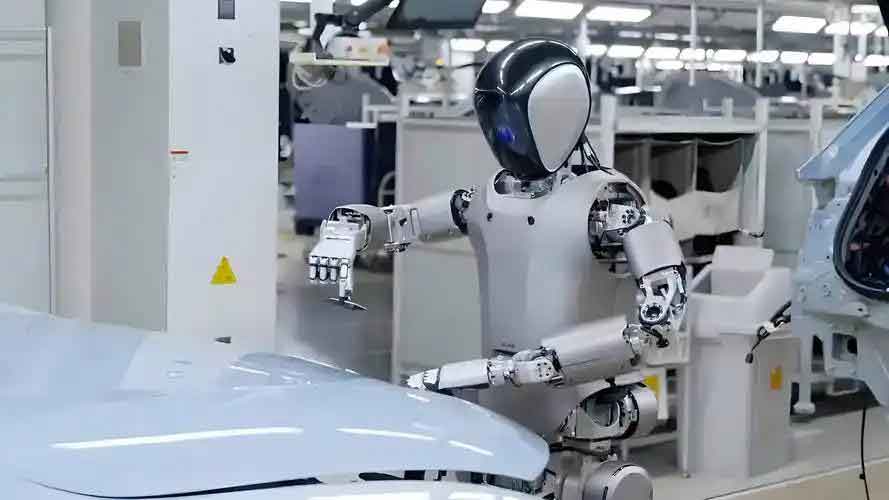
The recent exhibitions highlighted the advanced capabilities of humanoid robots in dynamic movements, but the real challenge lies in transforming these abilities into everyday utility. For instance, at a bustling retail space in Beijing’s Zhongguancun Darongcheng outdoor plaza, a humanoid robot operated a fully autonomous “convenience store,” fetching drinks and coffee for customers upon request. This implementation, dubbed the “Galaxy Space Capsule,” represents a global first in humanoid robot full autonomous service, with plans to expand to popular commercial areas like Qianmen Pedestrian Street, Wangfujing Pedestrian Street, and West Lake. Similarly, other firms are accelerating their delivery timelines; for example, Songyan Power aims to achieve a capacity of 200 units by August, while Zhiyuan Robotics secured a multi-million-yuan deal to deploy nearly 100 of its Expedition A2-W flexible manufacturing humanoid robots in an automotive parts factory, marking the first hundred-unit commercial deployment in China’s industrial sector for humanoid robots. According to Xu Xiaolan, Chairman of the China Electronics Society, the industrialization of humanoid robots has significantly accelerated, with last year’s technology prototypes giving way to small-batch deliveries and a shift from conceptual validation to actual procurement this year.
- From Stage to Workplace: The Shift in Humanoid Robot Applications
- The Morphology Debate: Is Humanoid the Ultimate Form?
- Core Bottlenecks: Overcoming Barriers to Scalability
- Future Outlook: The Timeline for Humanoid Robot Integration
The transition of the humanoid robot from a performer to a practical worker is gaining momentum across various sectors. In retail, the humanoid robot demonstrates its utility by handling tasks like serving beverages, while in manufacturing, humanoid robots are being integrated into assembly lines for repetitive or precision work. This shift is not merely about adding functionality but about ensuring that the humanoid robot can operate reliably in diverse settings. For instance, the humanoid robot in the Galaxy Space Capsule uses a combination of mobility and dexterity to navigate and interact with customers, showcasing how the humanoid robot can enhance consumer experiences. In industrial contexts, the humanoid robot is being deployed for tasks that require flexibility and adaptability, such as in the automotive industry where the humanoid robot assists in parts handling and assembly. The demand for the humanoid robot is evolving, with educational and research institutions currently dominating procurement, accounting for over 70% of publicly disclosed orders in China as of the first half of 2025. However, the scale remains modest, with 60% of contracts valued below one million yuan and only 6% exceeding ten million yuan, indicating that while the humanoid robot is making strides, widespread adoption is still in its early stages.
Despite the prominence of humanoid robots in recent events, experts question whether the humanoid form is the definitive shape for future robots. Wang Xingxing, founder of Yushu Technology, suggests that in the era of general artificial intelligence, robots may come in hundreds of different forms. For example, Yushu’s approach does not strictly adhere to a humanoid design; instead, they prioritize data collection and AI training, which can be optimized with human-like upper bodies for activities like dancing or combat. Similarly, Wang He, CTO of Galaxy Universal, explains that their humanoid robot employs a wheeled base with dual arms and hands, emphasizing endurance, industrial-grade safety, and the ability to achieve large-scale, reliable deliveries. This design choice reflects a pragmatic approach to the humanoid robot, where functionality outweighs form. Zhang Yanbo, co-founder of Lingxin Qiaoshou, adds that as embodied intelligence develops, the definition of a “robot” is expanding. In domestic settings, a wheeled humanoid robot might offer greater stability and speed than a bipedal one, while in industrial applications, a simple combination of a robotic arm, dexterous hand, and camera could suffice, reducing the need for a full humanoid robot. Thus, while the humanoid robot remains a focal point, its morphology is being adapted to specific use cases, challenging the notion that a humanoid robot must always mimic human appearance to be effective.
Despite progress, the widespread integration of the humanoid robot into daily life faces significant hurdles. Zheng Suibing, CEO of Ruier Man, identifies three core bottlenecks: operational capability, generalization ability, and cost control. The humanoid robot must not only perform tasks accurately but also adapt to unforeseen scenarios, which requires advanced AI and sensor integration. Additionally, early deployments of the humanoid robot often involve lengthy setup times—sometimes months—and poor scene adaptability, coupled with high costs, which hinder规模化应用. Zhang Xianghong, a professor at Beijing Jiaotong University’s International Research Center for Information Management Theory and Technology, points out that data limitations pose a global challenge for the humanoid robot; limited real-world data and simulations struggle to meet the infinite scenarios a humanoid robot might encounter, impeding the development of a universal humanoid robot. Wang Xingxing further emphasizes that embodied intelligence is not yet fully mature, and the industry needs to optimize model architectures to enhance the humanoid robot’s learning and decision-making processes. These bottlenecks underscore that for the humanoid robot to achieve mass adoption, technological advancements must address reliability, affordability, and flexibility, ensuring that the humanoid robot can seamlessly integrate into complex environments like homes and factories.
Predictions for the humanoid robot’s entry into ordinary life vary, but industry leaders offer cautious timelines. Zhao Weichen, Vice President of Accelerated Evolution, forecasts that within three years, domestic humanoid robots will be capable of simple interactions such as conversation, walking dogs, and fetching packages. However, it may take five to ten years for a general-purpose humanoid robot to emerge that can handle complex tasks like household chores, cooking, or assisting the elderly. This gradual progression reflects the ongoing challenges in perfecting the humanoid robot’s capabilities, from basic motor skills to advanced cognitive functions. As the humanoid robot evolves, its role is expected to expand beyond niche applications to become a commonplace assistant, but this will require continued innovation in AI, mechanics, and cost reduction. The humanoid robot’s journey from a novelty to a necessity hinges on overcoming current limitations, and with concerted efforts, the humanoid robot could transform industries and daily living in the coming decade.
In summary, the humanoid robot is at a crossroads, moving from impressive demonstrations to tangible applications. While events like the World Robot Conference and Humanoid Robot Games showcase the potential of the humanoid robot, the path to scalability involves addressing morphological diversity, core technological bottlenecks, and long-term integration forecasts. As companies push the boundaries of what the humanoid robot can achieve, the focus remains on making the humanoid robot a reliable, affordable, and versatile partner in various spheres of life. The continued emphasis on innovation and collaboration will determine how quickly the humanoid robot becomes an integral part of our world, reshaping how we work, live, and interact with technology.