
In this paper, we explore the cultivation model of future industries from the perspective of innovation ecosystems, focusing on the AI human robot industry as a case study. Future industries are emerging as critical drivers of global technological and industrial revolutions, playing a pivotal role in fostering new quality productive forces and building new engines for economic growth. These industries, characterized by their forward-looking nature, high uncertainty, complexity, disruptiveness, and long development cycles, require strategic cultivation models to navigate challenges such as technological bottlenecks, underdeveloped application scenarios, and immature innovation ecosystems. By analyzing the interactions among government entities, core enterprises, and other stakeholders within the innovation ecosystem, we aim to summarize experiences and propose a theoretical model for future industry cultivation. Our research highlights the government’s role as an “architect” in shaping the ecosystem, while core enterprises drive progress through technological breakthroughs and scenario development. We emphasize the importance of top-level design, robust policy systems, and local vitality in constructing effective cultivation models, with the AI human robot industry serving as a illustrative example due to its representative status as a future industry and its dynamic evolution.
The concept of future industries has gained significant attention in recent years, with various definitions emphasizing their roots in cutting-edge technologies, early development stages, and potential for substantial socio-economic impact. As shown in Table 1, future industries are typically defined by their reliance on前沿科技突破 (frontier technological breakthroughs), strategic importance, and transformative potential. For instance, they are often described as industries derived from emerging technologies that are in the incubation or initial growth phases, with the capacity to lead economic development and address future human and societal needs. Key features include their ability to integrate advanced technologies, foster cross-sector collaboration, and exhibit high levels of uncertainty and disruptiveness. In the context of AI human robots, these characteristics are evident, as the industry combines artificial intelligence, robotics, and sensory technologies to create systems with human-like structures and functionalities, yet it remains in a nascent stage with challenges in scalability and commercialization.
| Source | Definition Summary |
|---|---|
| U.S. Office of Science and Technology Policy | Supports innovative, inclusive, equitable, and sustainable growth; closely linked to R&D and STEM workforce; requires investment for transformative growth; benefits future economic prosperity and national security. |
| Chinese Ministry of Industry and Information Technology | Driven by frontier technologies; in embryonic or initial industrialization stages; possesses strategic, leading, disruptive, and uncertain characteristics. |
| Academic Literature | Aims to meet future human and societal needs; powered by emerging technological innovations; expands human cognitive spaces, enhances capabilities, and promotes sustainable development. |
| Additional Studies | Formed through major scientific innovations and high-tech industrialization; determines future industrial competitiveness and economic strength; plays a key role in technological revolutions. |
From an innovation ecosystem perspective, future industries thrive through the synergistic interactions of various actors, including governments, core enterprises, supply-side entities, demand-side players, complementary firms, research institutions, and financial bodies. The ecosystem can be modeled as a dynamic system where each component contributes to overall growth. For example, the innovation ecosystem efficiency (IEE) can be expressed as: $$ IEE = \sum_{i=1}^{n} (C_i \cdot R_i \cdot S_i) $$ where \( C_i \) represents the collaboration intensity among actors, \( R_i \) denotes resource allocation, and \( S_i \) symbolizes scenario development effectiveness. In the AI human robot industry, this translates to government-led initiatives fostering collaboration, core enterprises advancing technologies, and demand-side partners driving application scenarios. The government acts as an architect by setting strategic goals, defining roles, establishing standards, and facilitating communication pathways, while core enterprises, such as AI human robot manufacturers, leverage their capabilities to achieve technological breakthroughs and market penetration.
To investigate the cultivation model, we employed a single-case study approach, selecting the AI human robot industry due to its典型性 (typicality) as a future industry. This industry is in a phase of rapid evolution, with over 35 global enterprises developing humanoid robots, and it faces common challenges like high costs, technical limitations, and unclear application scenarios. We collected data from multiple sources, including interviews with government departments and core enterprises, public documents, policy texts, and internal materials, as summarized in Table 2. The data analysis followed a structured process, involving initial data processing, logical concatenation, and framework construction, leading to the identification of key themes such as ecosystem cultivation, technology promotion, and scenario-driven development. This methodological rigor ensures the reliability and validity of our findings, providing a solid foundation for the proposed theoretical model.
| Data Type | Source | Specific Content |
|---|---|---|
| Interview Surveys | Government Departments | Discussions on future industry layouts and action plans; insights into strategic planning and cluster development. |
| Interview Surveys | Core Enterprises | In-depth interviews with AI human robot manufacturers on R&D processes, market strategies, and collaboration ecosystems. |
| Public Documents | Policy Texts | Central and local government policies supporting future industries and AI human robots; guidelines and implementation opinions. |
| Public Documents | Enterprise Materials | Information from official websites of AI human robot companies; product releases and technological advancements. |
| Literature | Research Reports | Academic papers and智库 (think tank) reports on humanoid robotics from 2022 onwards; analysis of trends and challenges. |
| Internal Materials | Corporate Documents | Internal plans and development strategies from AI human robot enterprises; unpublished data on innovation processes. |
Our analysis of the AI human robot industry reveals three primary dimensions of cultivation: ecosystem building, technology promotion, and scenario-driven development. In ecosystem building, the government plays a crucial role through strategic planning and cluster development. For instance, central governments identify key technologies and set development goals, while local governments establish industrial parks and innovation platforms to aggregate stakeholders. Core enterprises contribute by open-sourcing platforms and engaging in talent cultivation, enhancing the overall ecosystem robustness. The innovation ecosystem’s health can be quantified using a sustainability index: $$ H_{ecosystem} = \alpha \cdot G_{support} + \beta \cdot E_{innovation} + \gamma \cdot C_{collaboration} $$ where \( G_{support} \) represents government support levels, \( E_{innovation} \) denotes enterprise innovation capacity, and \( C_{collaboration} \) indicates cross-actor collaboration efficiency. This formula underscores the multiplicative effects of coordinated actions in fostering a thriving environment for AI human robots.
Technology promotion in the AI human robot industry involves core enterprises driving progress through independent R&D, industry-academia collaboration, and integrated innovation. Independent R&D focuses on overcoming technical barriers, such as developing proprietary actuators and sensors, which are critical for cost reduction and performance enhancement. The technological advancement rate can be modeled as: $$ \frac{dT}{dt} = k \cdot I_{R&D} \cdot A_{collab} $$ where \( \frac{dT}{dt} \) is the rate of technological change, \( I_{R&D} \) is the R&D investment intensity, and \( A_{collab} \) is the collaboration amplitude among ecosystem actors. For example, AI human robot firms often partner with research institutions to translate academic成果 (achievements) into commercial products, accelerating innovation cycles. Integrated innovation, particularly with AI companies, enables the fusion of robotics and artificial intelligence, leading to breakthroughs in embodied intelligence and task execution capabilities. This synergy is essential for addressing the high technical thresholds and rapid iteration demands in the AI human robot sector.
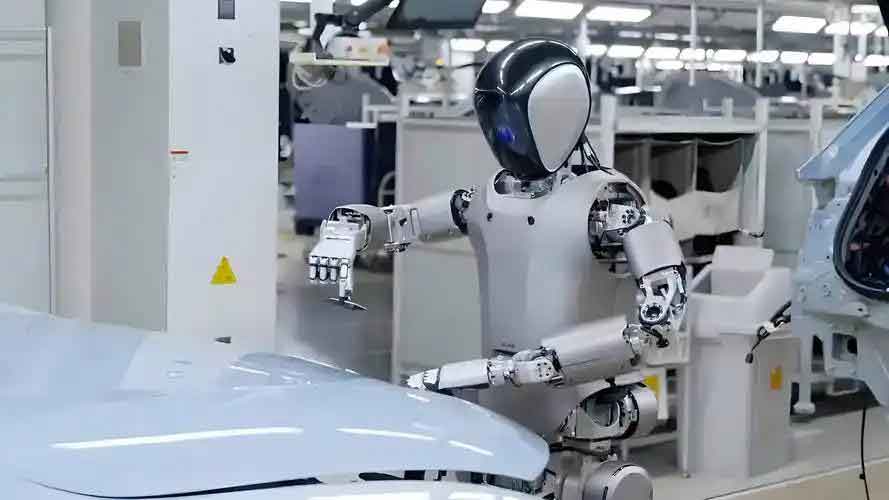
Scenario-driven development emphasizes the importance of application demonstrations in commercializing AI human robots. This dimension includes matching supply and demand through partnerships between core enterprises and end-users, as well as conducting典型场景示范 (typical scenario demonstrations) to generate high-quality datasets and validate technologies. The effectiveness of scenario development can be expressed as: $$ S_{effectiveness} = \sum_{j=1}^{m} (D_j \cdot U_j \cdot L_j) $$ where \( D_j \) represents dataset quality, \( U_j \) denotes user engagement, and \( L_j \) symbolizes learning feedback loops. In practice, governments facilitate this by organizing exchanges between AI human robot manufacturers and potential adopters, such as automotive or healthcare companies, to co-develop solutions. For instance, collaborations between AI human robot firms and electric vehicle manufacturers have led to prototypes capable of performing assembly line tasks, demonstrating the potential for large-scale industrial applications. These efforts not only enhance technical capabilities but also build market confidence in AI human robots.
Based on our case study, we propose a theoretical model for future industry cultivation centered on the innovation ecosystem. This model, as illustrated in the analysis, positions the government as the primary architect, responsible for strategic planning, resource integration, and institutional building. Core enterprises act as the main drivers, leveraging the ecosystem to achieve technological milestones and scenario expansions. The model can be summarized with the following key equation representing the overall cultivation impact: $$ I_{cultivation} = G_{architect} \cdot \left( \sum E_{core} \cdot T_{push} \cdot D_{scenario} \right) $$ where \( I_{cultivation} \) is the cultivation impact, \( G_{architect} \) is government architectural efforts, \( E_{core} \) represents core enterprise activities, \( T_{push} \) denotes technology push factors, and \( D_{scenario} \) indicates scenario-driven demand. This model highlights the multiplicative effect of government leadership in enabling other actors to contribute effectively, particularly in the context of AI human robots, where early-stage weaknesses necessitate external support.
In conclusion, our research underscores the critical roles of government and core enterprises in cultivating future industries like the AI human robot sector. The central government must strengthen top-level design by identifying key technologies and formulating long-term strategic plans, while local governments should stimulate regional vitality by building clusters and supporting platforms. Policy systems need to be comprehensive, covering fiscal incentives, talent development, financial support, and regulatory frameworks to foster a conducive innovation ecosystem. For core enterprises, focusing on independent R&D, collaborative partnerships, and scenario-based innovations is essential for driving the AI human robot industry forward. We recommend that policymakers prioritize these aspects to enhance China’s competitiveness in global future industries, with the AI human robot case offering valuable insights for other emerging sectors. Future research could extend this model to other industries or incorporate quantitative assessments of cultivation effectiveness.