
The continuous maturation of bionics technology has significantly propelled its application in the field of robotics. The development of bionic robots, designed to emulate the structure and function of biological organisms, has become a prominent research avenue. Among these, legged bionic robots, such as bipedal humanoids and quadrupedal or even hexapodal and octopodal machines, are of particular interest. Compared to their bipedal counterparts, quadrupedal bionic robots possess superior static stability, enabling them to better adapt to uneven terrain. Furthermore, when compared to robots with a higher number of legs, quadrupedal systems offer a lower degree of redundancy, relatively simpler modeling, and more straightforward stable control implementation. These advantages have cemented their status as a widely researched platform within the broader category of bionic robots.
The footholds of a quadrupedal bionic robot are distributed discretely. To achieve stable walking on complex ground, it is imperative to select optimal footholds that maintain the body’s equilibrium. Based on this principle, this article focuses on the gait planning for a panda-inspired bionic robot, utilizing the Zero Moment Point (ZMP) theory as its foundation. The primary objective is to ensure exceptional stability for the panda bionic robot during its walking cycle.
Gait Analysis of the Panda Bionic Robot
The locomotion patterns of quadrupedal animals can generally be described by two parameters: the phase difference φ and the duty factor β. Based on these, quadrupedal gaits are broadly categorized into three types:
| Gait Type | Phase Difference (φ) | Duty Factor (β) | Description |
|---|---|---|---|
| Crawl | 0.25 | 0.75 < β < 1 | Legs are lifted and set down sequentially. Only one leg is in the swing phase at any time, while the other three provide static support. Also known as a static walk. |
| Trot | 0.5 | β = 0.5 | Adopted for faster speeds. Diagonal leg pairs move in unison (e.g., left-front and right-hind together). |
| Gallop | < 0.25 | β < 0.5 | Used for high-speed running. Legs may move in pairs (front and hind together), and all four legs may be simultaneously airborne during a cycle. |
Observation of the giant panda reveals a characteristically slow and deliberate movement pattern. Its walking gait can be closely approximated as a crawl or walk gait. The sequence for a complete walking cycle is as follows:
- The left forelimb (scapula/humerus/radius-ulna) lifts and moves forward. As the body shifts forward, the right forelimb naturally moves to a rearward position, but remains grounded. Only the left forelimb is in the swing phase.
- Once the left forelimb makes contact with the ground, the right hindlimb (femur/tibia) lifts and swings forward. Concurrently, the left hindlimb shifts to a rearward position due to the body’s forward motion.
- The sequence continues with the right forelimb and then the left hindlimb executing their swing phases.
This cycle repeats to enable continuous, stable forward progression for the panda bionic robot. This careful, static gait is central to the stability strategy for this particular bionic robot.
Mathematical Modeling of the Panda Bionic Robot
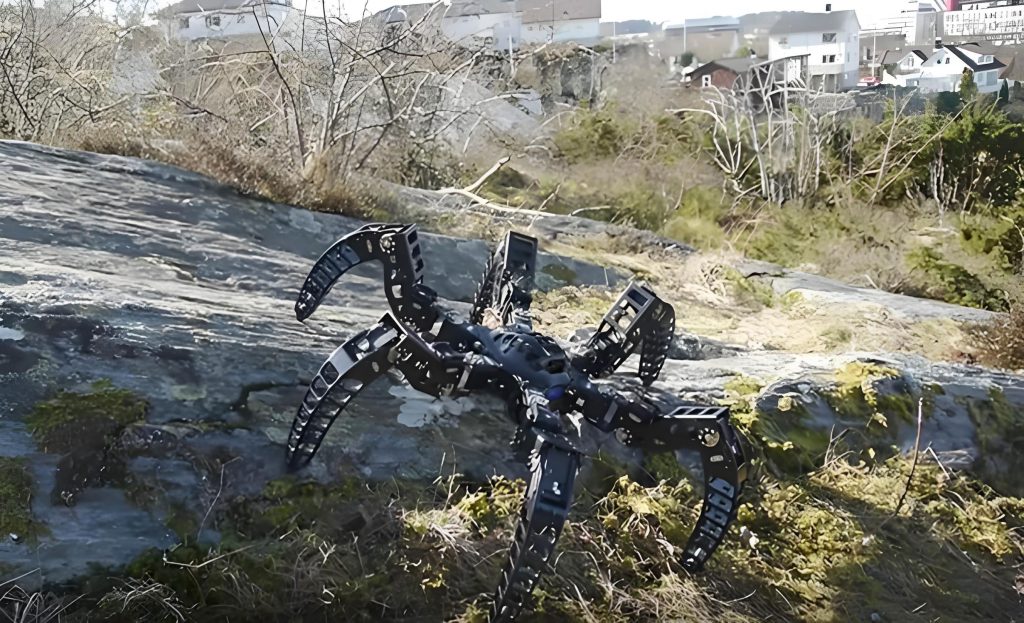
The limbs of the panda bionic robot are constructed using fundamental linkage mechanisms, with revolute joints connecting the links. Both the forelimbs and hindlimbs terminate in curved feet (arc-shaped feet). This design offers full kinematic compatibility with flat ground, increases stride length, and enhances walking stability. The simplified mechanism diagrams are shown below:
The Denavit-Hartenberg (D-H) convention is employed to establish a coordinate frame attached to each link. The relative position and orientation between successive links are described using homogeneous transformation matrices, ultimately allowing the computation of each joint’s pose. The general homogeneous transformation matrix from frame {i-1} to frame {i} is given by:
$$ ^{i-1}_iT = \begin{bmatrix}
\cos\theta_i & -\sin\theta_i \cos\alpha_i & \sin\theta_i \sin\alpha_i & a_i \cos\theta_i \\
\sin\theta_i & \cos\theta_i \cos\alpha_i & -\cos\theta_i \sin\alpha_i & a_i \sin\theta_i \\
0 & \sin\alpha_i & \cos\alpha_i & d_i \\
0 & 0 & 0 & 1
\end{bmatrix} $$
Where the standard D-H parameters are:
– $ \theta_i $: The joint angle (rotation about $z_{i-1}$).
– $ d_i $: The link offset (distance along $z_{i-1}$).
– $ a_i $: The link length (distance along $x_i$).
– $ \alpha_i $: The link twist (rotation about $x_i$).
The D-H parameters for the forelimb and hindlimb of the panda bionic robot are summarized in the following table. Note that $q_i$ in the original text corresponds to the joint variable $\theta_i$.
| Limb | Link (i) | $ \theta_i $ (Joint Var.) | $ d_i $ | $ a_i $ | $ \alpha_i $ |
|---|---|---|---|---|---|
| Forelimb | 1 | $ q_1 $ | 0 | 0 | 90° ($\pi/2$) |
| 2 | $ q_2 $ | 0 | $ h_2 $ | 0 | |
| 3 | $ q_3 $ | 0 | $ h_3 $ | 0 | |
| Hindlimb | 1 | $ q_1 $ | 0 | 0 | 0 |
| 2 | $ q_2 $ | 0 | $ l_1 $ | 0 |
The pose (position and orientation) of the forelimb’s end-effector (foot) relative to the body frame {0} is obtained by the consecutive multiplication of transformation matrices:
$$ ^{0}_{3}T_{fore} = ^{0}_{1}T \cdot ^{1}_{2}T \cdot ^{2}_{3}T = \begin{bmatrix}
R_{fore} & \mathbf{p}_{fore} \\
\mathbf{0}^T & 1
\end{bmatrix} $$
Expanding this product yields the precise position vector $\mathbf{p}_{fore} = [p_x, p_y, p_z]^T$ and rotation matrix $R_{fore}$, which are functions of the joint angles $q_1$, $q_2$, $q_3$ and link lengths $h_2$, $h_3$.
Similarly, the pose of the hindlimb’s end-effector is:
$$ ^{0}_{2}T_{hind} = ^{0}_{1}T \cdot ^{1}_{2}T = \begin{bmatrix}
R_{hind} & \mathbf{p}_{hind} \\
\mathbf{0}^T & 1
\end{bmatrix} $$
Where $\mathbf{p}_{hind}$ and $R_{hind}$ are functions of $q_1$, $q_2$ and $l_1$. These kinematic equations form the basis for controlling the foot placement of the bionic robot.
Gait Planning and Stability Criterion Based on ZMP
Gait planning is a critical step in the design of any legged bionic robot. The quality of the planned gait directly impacts joint torque requirements, walking stability, and even the aesthetic quality of the robot’s posture. The Zero Moment Point (ZMP) is a fundamental concept used for trajectory planning and is a key metric for assessing the dynamic stability of motion in bionic robots.
Definition: The ZMP is defined as the point on the ground contact surface (or within the support polygon) where the resultant moment of the ground reaction forces has zero component in the horizontal plane (i.e., the moments about the x and y axes tangential to the ground are zero). For stable motion, the ZMP must lie within the convex hull of the contact points of the supporting feet—the support polygon. If the ZMP reaches the boundary of this polygon, the robot is at the verge of tipping over.
The overall algorithm for ZMP-based gait planning for our quadrupedal bionic robot follows a specific workflow, integrating stability criteria directly into the motion generation process.
The coordinates of the robot’s Center of Mass (CoM) are denoted as $(x_g, y_g, z_g)$. Assuming the robot walks on a flat horizontal plane, the height $z_g$ can be considered approximately constant for planning purposes. The relationship between the CoM motion and the ZMP location $(x_{zmp}, y_{zmp}, 0)$ is derived from the dynamics of an inverted pendulum model and is given by:
$$ x_{zmp} = x_g – \frac{z_g}{g} \ddot{x}_g $$
$$ y_{zmp} = y_g – \frac{z_g}{g} \ddot{y}_g $$
Where $g$ is the acceleration due to gravity, and $\ddot{x}_g$, $\ddot{y}_g$ are the horizontal accelerations of the CoM. This equation is pivotal for stability-oriented gait planning in a bionic robot. It shows that the ZMP deviates from the vertical projection of the CoM in the direction opposite to the CoM’s acceleration.
For gait planning, we typically start with a desired, stable ZMP trajectory that remains well inside the support polygon throughout the gait cycle. The required CoM motion is then computed from this desired ZMP path. The equation above can be rearranged into a differential equation for the CoM trajectory:
$$ \ddot{x}_g = \frac{g}{z_g} (x_g – x_{zmp}) $$
$$ \ddot{y}_g = \frac{g}{z_g} (y_g – y_{zmp}) $$
Given a planned ZMP trajectory $x_{zmp}(t)$ and $y_{zmp}(t)$, and initial conditions for the CoM, these differential equations can be solved to find the necessary CoM trajectory $x_g(t)$, $y_g(t)$ that will produce the desired stable ZMP. A state-space approach is often used. Defining the state vector for the x-direction as $\mathbf{X} = [x_g, \dot{x}_g]^T$, the system can be written as:
$$ \dot{\mathbf{X}}(t) = A \mathbf{X}(t) + B u(t) $$
With $A = \begin{bmatrix} 0 & 1 \\ \omega^2 & 0 \end{bmatrix}$, $B = \begin{bmatrix} 0 \\ -\omega^2 \end{bmatrix}$, $u(t) = x_{zmp}(t)$, and $\omega = \sqrt{g / z_g}$. The solution involves the state transition matrix $\Phi(t)$:
$$ \mathbf{X}(t) = \Phi(t) \mathbf{X}(0) + \int_{0}^{t} \Phi(t-\tau) B u(\tau) d\tau $$
Where $\Phi(t) = e^{At} = \begin{bmatrix} \cosh(\omega t) & \omega^{-1} \sinh(\omega t) \\ \omega \sinh(\omega t) & \cosh(\omega t) \end{bmatrix}$. A similar process is applied for the y-direction. This formulation allows for the calculation of the CoM trajectory that realizes a pre-planned, stable ZMP path, which is the cornerstone of creating a stable walking pattern for the bionic robot.
Once the stable CoM trajectory $(x_g(t), y_g(t))$ is determined, the footstep locations must be planned accordingly. Assuming the torso/body of the panda bionic robot follows the CoM trajectory, the desired foot positions $\mathbf{p}_{foot, desired}$ relative to the body frame are determined by inverse kinematics. Using the previously derived pose matrices $^{0}_{n}T$, we solve for the joint angles $q_i$ that place the foot at the correct location relative to the moving body to maintain the planned ZMP. For a quadruped in a crawl gait, this is done sequentially for each swinging leg, while ensuring the supporting legs maintain their positions.
The complete ZMP-based planning and control algorithm for the bionic robot can be summarized in the following steps:
| Step | Action |
|---|---|
| 1. Gait Sequence Definition | Define the crawl gait sequence (e.g., LF -> RH -> RF -> LH) and timing (duty factor β). |
| 2. Support Polygon Calculation | At each time instance, calculate the convex hull of the grounded feet. |
| 3. Desired ZMP Trajectory Planning | Plan a smooth ZMP reference path $(x_{zmp,ref}(t), y_{zmp,ref}(t))$ that lies in the center of the moving support polygon. |
| 4. CoM Trajectory Generation | Solve the differential equations (using preview control or state-transition methods) to compute the CoM trajectory $(x_g(t), y_g(t))$ that realizes the desired ZMP path. |
| 5. Foot Trajectory Planning | For the swing leg, plan a smooth liftoff-swing-landing trajectory in Cartesian space relative to the moving body frame. |
| 6. Inverse Kinematics | For all legs, use the derived kinematic models to calculate the joint angle trajectories $q_i(t)$ needed to achieve both the body (CoM) motion and the foot trajectories. |
| 7. Stability Verification | Forward simulate the robot’s dynamics using the planned motions to verify the actual ZMP remains within the support polygon. |
Results and Discussion of the Planned Gait
Implementing the ZMP-based planning method for the panda bionic robot leads to a quantifiably stable gait. The planned CoM motion is smooth and leads the ZMP, ensuring the latter stays safely within the support polygon. The following table contrasts key parameters between a simple, kinematic crawl gait and the ZMP-planned gait:
| Parameter | Simple Kinematic Gait | ZMP-Planned Gait | Improvement / Note |
|---|---|---|---|
| ZMP Margin | Variable, often near polygon edges during leg transfer. | Consistently maintained near the center of the polygon. | Dramatically increased stability margin. |
| CoM Acceleration | Often abrupt, linked directly to leg swing timing. | Smooth and optimized to guide the ZMP along the reference path. | Reduced dynamic forces, smoother motion. |
| Joint Torques (Simulated) | Higher peaks due to uncoordinated accelerations. | Lower and smoother torque profiles. | Potential for smaller actuators and lower energy consumption. |
| Disturbance Rejection | Poor, lacks inherent dynamic balance control. | Inherently more robust due to CoM/ZMP coordination principle. | Foundation for implementing reactive balance controllers. |
The output foot trajectories for the swing legs are also modified. Instead of simple straight-line or cycloidal lifts, the foot placement is subtly adjusted in timing and position to complement the planned CoM motion, ensuring the combined effect keeps the ZMP stable. The primary result is that the panda bionic robot, using this gait, achieves a statically and dynamically stable walking motion, closely mimicking the stable, deliberate pace of its biological counterpart while being governed by formal stability criteria.
Conclusion
This exploration detailed the process of gait planning for a panda-inspired bionic robot, with a central focus on ensuring stability through the Zero Moment Point criterion. The walking pattern of the biological panda was analyzed and classified as a crawl gait, forming the basis for the bionic robot’s leg sequence. A rigorous mathematical model of the robot was developed using the Denavit-Hartenberg convention, providing the kinematic foundation for precise foot placement control.
The core of the method lies in the ZMP-based planning algorithm. By first designing a stable ZMP reference trajectory within the support polygon and then solving for the corresponding Center of Mass motion, the gait is planned “from the ground up” with stability as the primary constraint. This approach ensures that the dynamic forces generated during walking do not cause the robot to tip over. The final joint motions are derived via inverse kinematics from the combined CoM and foot trajectories.
The outcome is a stable, efficient, and biomimetic walking gait for the quadrupedal panda bionic robot. This methodology underscores a fundamental principle in advanced bionic robot locomotion: stability must be planned proactively into the motion trajectories, not just checked reactively. The ZMP provides a powerful and practical criterion for achieving this, enabling the creation of bionic robots that can move with confidence and robustness in their intended environments. Future work may involve integrating this planned gait with real-time sensor feedback to handle unexpected terrain variations, further advancing the autonomy and capability of such bionic robot systems.