
The harmonic drive gear represents a significant advancement in precision transmission technology, operating on the fundamental principle of controlled elastic deformation within a flexible component. Unlike conventional gear systems, this mechanism enables motion transfer through the deliberate deflection of a thin-walled flexspline, offering unparalleled advantages such as exceptional positional accuracy, high torque capacity within a compact volume, and a large number of teeth in simultaneous contact. Among the various flexspline configurations, the cup-type design is prevalent. However, as demand grows for more compact and stiffer transmissions, reducing the axial length of the flexspline becomes necessary. This miniaturization often leads to undesirable taper deformation and significant axial displacement in the tooth-bearing rim section, which deviates from ideal line contact between mating teeth, consequently reducing load distribution uniformity and overall transmission stiffness.
To address this critical issue, the bell-shaped flexspline configuration has been proposed. The unique geometry of a bell-shaped harmonic drive gear is designed to inherently promote planar deformation of its tooth rim. This means the teeth displace primarily in a radial direction while remaining parallel to their original orientation and the central axis, effectively eliminating taper. This characteristic ensures pure line contact along the tooth profile, enhancing engagement quality. Furthermore, a portion of the deformation is absorbed by the contoured shell, leading to minimal displacement at the cup bottom where connection to the output shaft occurs, allowing for simpler flange designs. The uniform load distribution stemming from planar engagement also contributes to a higher load-carrying capacity. Despite its advantages, a clear and accurate theoretical foundation for the geometric parameters that guarantee this planar deformation, along with a practical method for assessing the stress in the critical cup bottom region, has been lacking. This work aims to establish these essential design and analysis tools for the bell-shaped harmonic drive gear.
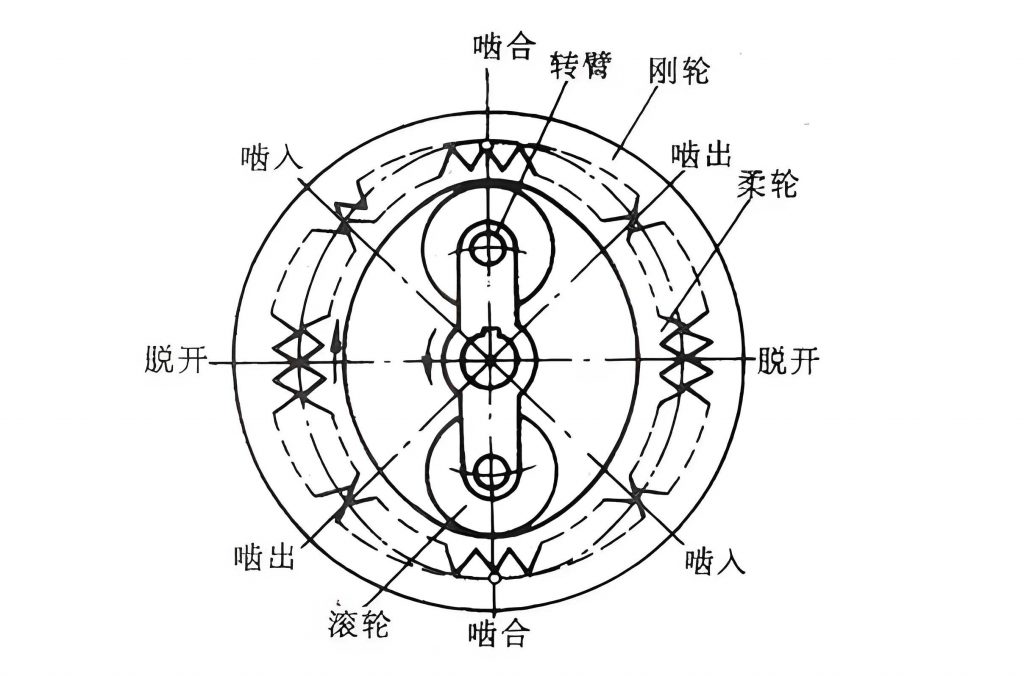
Geometric Structure and Condition for Planar Deformation
The primary objective in designing a bell-shaped harmonic drive gear is to achieve a state where the cylindrical tooth rim undergoes a pure radial, planar displacement when subjected to the wave generator’s force. To derive the necessary condition for this, we begin by examining the geometry and applying principles from elastic shell theory.
Geometric Configuration of the Bell-Shaped Flexspline
The undeformed configuration of a bell-shaped flexspline can be described by its meridional cross-section. The key components are: a cylindrical tooth rim with a mid-surface radius $r_m$ and axial width $b$; a transition shell section of length $L$, whose mid-surface is formed by revolving a circular arc of radius $R$ and central angle $\theta$ about the axis; and a cup bottom comprising a membrane and a flange with radii $R_1$ and $R_2$, respectively. The fundamental geometric parameter governing the shape is the radius ratio $t = r_m / R$. The smooth connection between the cylindrical rim and the bell-shaped shell is crucial for deformation continuity.
Deformation Characteristics and Kinematic Condition
Under the action of an elliptical wave generator, the flexspline deforms. For an ideal bell-shaped harmonic drive gear, the long-axis and short-axis generator contacts induce maximum and minimum radial displacements in the rim, respectively. A defining feature is that points on the cylindrical tooth rim experience negligible axial displacement. This observation is key to formulating the planar deformation condition.
We model the tooth rim section as a cylindrical shell. In the curvilinear coordinate system for a general shell, where $\alpha$ is the meridional coordinate, $\beta$ is the circumferential coordinate, and $\gamma$ is the normal coordinate, the midsurface strain-displacement relationships (geometric equations) are given by:
$$
\begin{aligned}
\varepsilon_1 &= \frac{1}{A} \frac{\partial u}{\partial \alpha} + \frac{1}{AB} \frac{\partial A}{\partial \beta} v + \kappa_1 w, \\[4pt]
\varepsilon_2 &= \frac{1}{B} \frac{\partial v}{\partial \beta} + \frac{1}{AB} \frac{\partial B}{\partial \alpha} u + \kappa_2 w, \\[4pt]
\varepsilon_{12} &= \frac{A}{B} \frac{\partial}{\partial \beta} \left( \frac{u}{A} \right) + \frac{B}{A} \frac{\partial}{\partial \alpha} \left( \frac{v}{B} \right),
\end{aligned}
$$
where $u$, $v$, and $w$ are displacements in the $\alpha$, $\beta$, and $\gamma$ directions, respectively; $A$ and $B$ are Lamé coefficients; $\kappa_1$ and $\kappa_2$ are curvatures; and $\varepsilon_1$, $\varepsilon_2$, $\varepsilon_{12}$ are strains.
For the cylindrical rim, we set $\alpha = z$ (axial coordinate), $\beta = s$ (circumferential coordinate). The relevant parameters become: $A=1$, $B=r_m$, $\kappa_1=0$, $\kappa_2=1/r_m$. The condition for planar deformation, where the rim translates radially without tilting or axial extension, implies that the axial midsurface displacement is zero ($u=0$) and the axial strain is negligible. Applying these to the geometric equations yields the simplified set:
$$
\begin{aligned}
\frac{\partial u}{\partial \alpha} &= 0, \\[4pt]
\frac{1}{r_m} \frac{\partial v}{\partial \beta} + \frac{1}{r_m} w &= 0, \\[4pt]
\frac{\partial v}{\partial \alpha} &= 0.
\end{aligned}
$$
The second equation directly links the radial displacement $w$ to the circumferential derivative of the tangential displacement $v$. More importantly, the condition $u=0$ at the junction between the cylindrical rim and the bell-shaped shell is the kinematic condition for planar deformation. This condition ensures that the curvature change $\chi_1$ (meridional bending) and the twist $\chi_{12}$ of the rim midsurface are zero, confirming a parallel, planar shift of the tooth profile.
Determination of Geometric Relationship and Cup Bottom Stress Calculation
While the kinematic condition $u=0$ is established, it does not provide the specific geometric relationship between the radius ratio $t$ and the arc angle $\theta$ that satisfies this condition. Furthermore, to assess the structural integrity of the bell-shaped harmonic drive gear, calculating the stress in the cup bottom is essential. An analytical solution for this coupled shell problem is exceedingly complex. Therefore, a numerical approach utilizing the Finite Element Method (FEM) is employed to solve for the geometry and extract boundary data for stress analysis.
Iterative Solution for the Planar Deformation Geometry
A parametric finite element model of the bell-shaped flexspline shell, excluding teeth, was developed using ANSYS APDL. The model applies an elliptical displacement field (max radial displacement $w_0$) to the rim’s inner surface to simulate the wave generator’s action. The cup bottom center is fixed. The goal is to find pairs $(t, \theta)$ that minimize the axial displacement at the rim-shell junction. The iterative solution process is summarized in the following table:
| Step | Action |
|---|---|
| 1. Initialization | Set initial values and step sizes for $t$ and $\theta$. Define geometric limits ($\eta$, $\lambda$) and convergence tolerance $\epsilon$ for max axial displacement. |
| 2. Model Build & Solve | For current $(t, \theta)$, build the shell model, apply boundary conditions and enforced radial displacement $w_0$, and solve. |
| 3. Check Condition | Extract the maximum axial displacement $u_{max}$ at the rim-shell junction. Check if $u_{max} < \epsilon$. |
| 4. Parameter Update | If condition not met, update $\theta$ by its step size. If $\theta$ exceeds $\eta$, reset $\theta$ and increment $t$ by its step size. Stop if $t > \lambda$. |
| 5. Output & Fit | Record the $(t, \theta)$ pair that yields the smallest $u_{max}$. Repeat process to generate data set. Fit data to a polynomial. |
This iterative analysis produced the fundamental design curve for the bell-shaped harmonic drive gear. The relationship between the central angle $\theta$ and the radius ratio $t$ was found to be accurately represented by a fifth-order polynomial fit:
$$
\theta = \mathbf{C}^T \mathbf{T}_1,
$$
where
$$
\mathbf{C} = \begin{bmatrix} 8.22527 \\ 101.42802 \\ -134.32174 \\ 149.66555 \\ -87.58647 \\ 21.21395 \end{bmatrix}, \quad \mathbf{T}_1 = \begin{bmatrix} 1 \\ t \\ t^2 \\ t^3 \\ t^4 \\ t^5 \end{bmatrix}.
$$
This equation allows designers to directly determine the required bell-shaped arc angle for a chosen radius ratio to achieve planar engagement. It was also verified that this relationship is largely independent of the absolute scale (cup bottom radius $R_1$) and the magnitude of the enforced radial displacement $w_0$, confirming its generality as a geometric design rule.
Analysis of Deformation at the Shell-Cup Bottom Junction
To calculate stress in the cup bottom, its boundary condition at the junction with the bell-shaped shell must be known. Specifically, the axial displacement $w_{junc}$ at this junction is required. From the finite element models corresponding to the optimal $(t, \theta)$ pairs, we extract this data. Defining a displacement ratio $u_1 = w_{junc} / w_1$, where $w_1$ is the radial displacement at the tooth rim, it was observed that $u_1$ is essentially constant around the circumference (except near 45° and 135° where $w_1$ is very small). This ratio depends primarily on the radius ratio $t$. The empirical relationship was fitted as:
$$
u_1(t) = 0.10387 + 0.92051t – 0.5122t^2 + 0.21205t^3 + 0.03423t^4.
$$
This equation provides the crucial boundary condition for the subsequent analytical stress calculation in the cup bottom of the harmonic drive gear.
Theoretical Calculation of Cup Bottom Stress
The cup bottom is modeled as a thin circular plate. Due to its high in-plane stiffness compared to bending stiffness, its radial displacement is assumed negligible. The primary deformation is bending, characterized by the axial deflection $w_2(r)$. The governing equation for the axisymmetric bending of a thin plate is:
$$
\frac{d^3 w_2}{dr^3} + \frac{1}{r} \frac{d^2 w_2}{dr^2} – \frac{1}{r^2} \frac{d w_2}{dr} = 0.
$$
The general solution for the deflection is:
$$
w_2(r) = C_3 \ln r + C_4 + C_5 r^2,
$$
where $C_3$, $C_4$, and $C_5$ are constants determined by boundary conditions. The relevant boundary conditions are:
- At the connection to the output shaft (radius $r = C R_1$, where $C = R_{shaft}/R_1$): $w_2 = 0$ and $\frac{d w_2}{dr} = 0$ (fixed condition).
- At the junction with the shell (radius $r = R_1$): $w_2 = u_1 w_1$, using the displacement ratio from Eq. (2).
Applying these conditions allows solving for the constants. The bending moments in the plate are:
$$
M_r = -D \frac{d^2 w_2}{dr^2}, \quad M_t = -D \frac{1}{r} \frac{d w_2}{dr}, \quad \text{where} \quad D = \frac{2 E h^3}{3(1-\mu^2)}.
$$
Here, $E$ is Young’s modulus, $\mu$ is Poisson’s ratio, and $h$ is the half-thickness of the cup bottom wall. The resulting bending stress, which is the dominant stress component, can be expressed as a function of the radial coordinate $r$, the geometric parameter $t$, the shaft ratio $C$, and the applied rim displacement $w_1$:
$$
\sigma_r(r, t, C) = \frac{2 h E u_1(t) w_1 (R_1^2 C^2 + r^2)}{[2C^2 \ln(1/C) + C^2 – 1] \, r^2 R_1^2}.
$$
This formula provides a direct method for evaluating the critical stress in the bell-shaped harmonic drive gear‘s cup bottom, which is essential for fatigue life prediction.
Verification of Geometry and Analysis of Stress Results
Validation of the Geometric Condition
The geometric relationship $\theta(t)$ derived from the numerical iterative process was compared with established theoretical curves from foundational literature on harmonic drive gear design. The agreement was found to be excellent, with only minor deviations. This close correlation validates the accuracy and reliability of the finite element-based iterative approach for determining the optimal bell-shaped geometry that guarantees planar tooth engagement. The established polynomial fit (Eq. 1) therefore serves as a practical and accurate design tool.
Parametric Study on Cup Bottom Stress
Using the stress formula (Eq. 3), a key design insight is revealed. The stress in the cup bottom is highly sensitive to the relative size of the output shaft. Plotting the maximum stress against the shaft ratio $C = R_{shaft}/R_1$ for different cup bottom radii shows a consistent trend: for $C < 0.65$, the stress remains at a manageable level. However, as $C$ increases beyond approximately 0.65, the stress begins to rise exponentially. This occurs because a larger shaft restricts the free bending of the cup bottom plate near its center, creating a severe stress concentration. When $C$ approaches 1 (a solid shaft connection), the theoretical stress tends toward infinity, indicating an impractical design. Therefore, a critical design rule for the bell-shaped harmonic drive gear is to maintain the output shaft radius below **0.65 times the cup bottom radius** ($R_{shaft} < 0.65 R_1$) to prevent premature fatigue failure at the cup bottom while still benefiting from planar rim deformation.
Conclusion
This investigation has established a comprehensive methodology for the design and analysis of the bell-shaped harmonic drive gear. The kinematic condition of zero axial displacement at the junction between the cylindrical tooth rim and the contoured shell was rigorously derived from shell theory as the necessary and sufficient condition for achieving planar, taper-free engagement of the gear teeth.
Through an iterative finite element approach, the fundamental geometric relationship between the radius ratio $t = r_m/R$ and the bell-shaped arc central angle $\theta$ was quantified and expressed as a convenient fifth-order polynomial. This relationship provides designers with a direct tool to configure the flexspline geometry for optimal performance.
Furthermore, by coupling numerical results with analytical plate theory, a method for calculating the bending stress in the critical cup bottom region was developed. The analysis yielded a vital design constraint: the output shaft radius must not exceed 0.65 times the cup bottom radius to avoid exponential growth in stress concentration. The geometric condition for planar deformation itself was found to be independent of shaft size, meaning the benefits of planar engagement can be achieved while respecting the stress-based limit on shaft diameter.
In summary, the findings presented herein offer a solid theoretical and practical foundation for designing high-performance, compact bell-shaped harmonic drive gears with predictable stress states, contributing to more reliable and efficient precision transmission systems.