
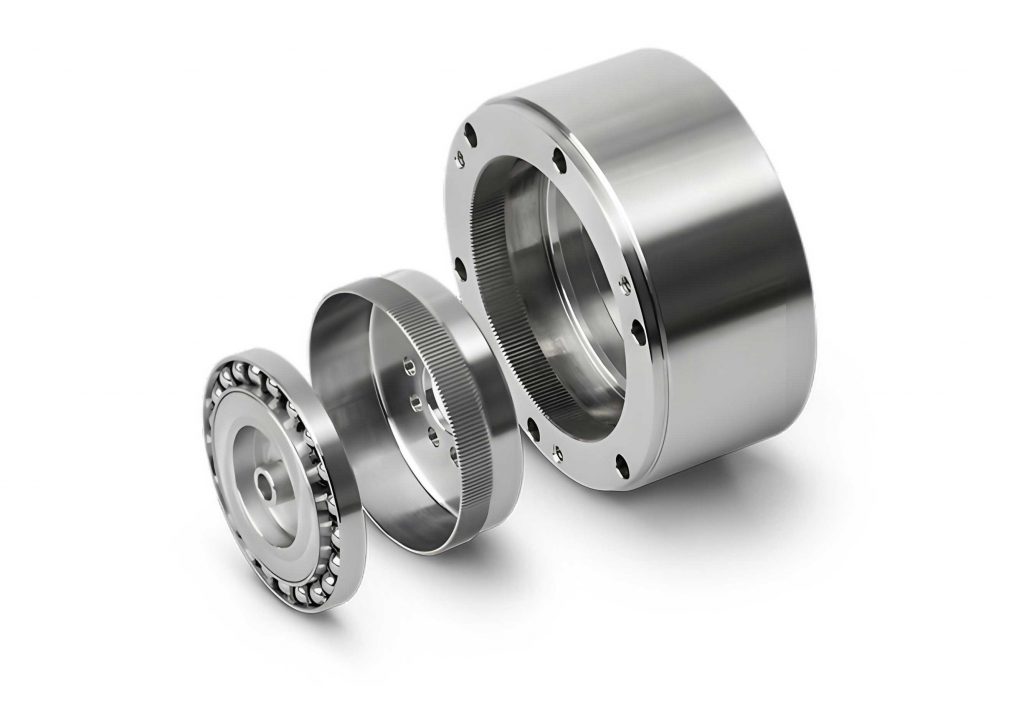
In the field of precision mechanical transmission, harmonic drive gears have revolutionized compact and high-ratio speed reduction due to their unique operating principle. As a researcher focused on advancing these systems, I have observed that the trend towards miniaturization in applications like robotics, aerospace mechanisms, and精密仪器 demands harmonic drive gears with reduced axial dimensions. This reduction inevitably leads to the use of very short cup-shaped and hat-shaped flexsplines, where the ratio of length to diameter (L/D) becomes critically small, often less than 0.5. In such configurations, the stress concentration in the flexspline bottom, rather than the tooth ring, becomes the primary concern for structural integrity and fatigue life. Therefore, in this comprehensive study, I aim to systematically investigate the sensitivity of maximum stress in the bottom region of very short flexsplines to key geometric parameters. The objective is to provide design guidelines that mitigate stress levels, thereby enhancing the reliability and load capacity of ultra-compact harmonic drive gear systems.
The fundamental operation of a harmonic drive gear relies on the controlled elastic deformation of a thin-walled flexspline by a wave generator, typically an elliptical cam. This deformation enables meshing with a rigid circular spline to achieve high reduction ratios. For decades, the design focus has been on standard-length flexsplines where tooth bending stress dominates. However, as the flexspline筒体 length decreases, the axial deformation imposed by the wave generator forces the bottom diaphragm to undergo significant bending, leading to steep stress gradients. This phenomenon is particularly acute in both cup-shaped and hat-shaped flexsplines, which are common configurations for accommodating output connections. While previous studies have addressed stress in short筒柔轮, a detailed parametric sensitivity analysis for the ultra-short regime (L/D < 0.4) remains underexplored, especially for the hat-shaped design which presents distinct structural challenges and opportunities. My investigation fills this gap by employing detailed three-dimensional finite element analysis to decouple the effects of individual geometric features.
To conduct this sensitivity analysis, I developed a parametric finite element modeling framework using a commercial simulation software suite. The models represent one-quarter of the full harmonic drive gear flexspline, exploiting double symmetry to reduce computational cost while maintaining accuracy. Both the cup-shaped and hat-shaped flexspline geometries were parameterized based on key dimensions from a standard harmonic drive gear unit with a reduction ratio of 100 and a nominal size of 25. The tooth ring, which is not the primary focus for bottom stress, was simplified as an equivalent thickness cylindrical shell, allowing us to concentrate computational resources on the critical bottom region. The material properties were defined for a high-strength alloy steel with an elastic modulus E = 207 GPa and a Poisson’s ratio ν = 0.3. The SOLID95 element, a 20-node quadratic brick element, was selected for its accuracy in modeling complex stress gradients and curved geometries.
The geometric parameters chosen for this sensitivity study are the length-to-diameter ratio (l/d₀), the bottom fillet radius (r₁), the diaphragm fillet radius (r₂), and the diaphragm width (l₁). Their baseline values and ranges are summarized in the table below. The inner radius of the筒体, r₀, is held constant as the reference dimension.
| Symbol | Parameter Description | Baseline Value (mm) | Investigated Range (Normalized by r₀) |
|---|---|---|---|
| d₀ = 2r₀ | Inner diameter of筒体 | 61.32 | Constant |
| l | Length of筒体内壁 | 24.528 | l/d₀ = 0.1 to 0.6 |
| r₁ | Bottom fillet radius (between筒体 and diaphragm) | 1.0 | r₁/r₀ = 0.033 to 0.163 |
| r₂ | Diaphragm fillet radius (at flange junction) | 0.5 | r₂/r₀ = 0.013 to 0.147 |
| l₁ | Diaphragm width | 10.14 | l₁/l = 0.1 to 1.8 (varies per design) |
| t₁ | 筒体 wall thickness | 0.48 | Constant |
| tₕ | Equivalent tooth ring thickness | 0.81 | Constant |
Two critical loading conditions were simulated: the assembly state (pure deformation by the wave generator) and the maximum load state (deformation plus full torque transmission). For the assembly state, the radial deformation of the flexspline筒体 middle surface is imposed based on the kinematics of the elliptical wave generator. The maximum radial displacement, w₀, is set equal to the gear module m. The major (a_w) and minor (b_w) semi-axes of the deformed neutral surface are derived from the condition of zero mid-surface elongation, leading to the following relations:
$$ a_w = r_0 + m $$
$$ b_w = \frac{5r_0 – 7m + \sqrt{12r_0(r_0+m) – 4(r_0+m)^2}}{9} $$
The imposed radial displacement w at any angular position θ is then given by:
$$ w(\theta) = \frac{a_w b_w}{\sqrt{a_w^2 \cos^2\theta + b_w^2 \sin^2\theta}} – r_0 $$
This displacement field is applied to the nodes on the mid-surface of the筒体 section. The flange or mounting surfaces are fully constrained. For the load state, the torque transmission is simulated by applying a tangential force distribution on the nodes at the equivalent tooth ring’s mid-surface. The force distribution follows the established engagement pattern for harmonic drive gears. The maximum tangential force F_max is calculated from the rated peak torque T=369 N·m for the reference size. The force per node F(φ) within the engagement zone is:
$$ F(\phi) = F_{max} \cdot \frac{\cos\left(\frac{\pi(\phi – \phi_1)}{\phi_3 – \phi_2}\right)}{\cos \alpha} $$
where φ is the angular coordinate, φ₁ = -15° is the symmetry axis of the load distribution relative to the wave generator’s major axis, φ₂ = -37.5° and φ₃ = 7.5° define the engagement arc, and α=20° is the pressure angle. This approach allows for a realistic simulation of the stress state under operational conditions in a harmonic drive gear.
The core of my analysis involves varying one geometric parameter at a time while holding others at their baseline values, and then extracting the maximum von Mises equivalent stress from the bottom diaphragm region (including the fillets) for both flexspline types and both loading conditions. The results are systematically compared to elucidate sensitivity trends. Let us begin with the most macro parameter: the length-to-diameter ratio.
Influence of Length-to-Diameter Ratio (l/d₀)
The length of the flexspline筒体 is a primary driver of its compliance. As l/d₀ decreases, the筒体 becomes stiffer axially, transferring more bending deformation to the bottom diaphragm. I computed the maximum equivalent stress for l/d₀ ratios from 0.1 to 0.6. The results, along with the theoretical tooth ring stress from standard design manuals, are consolidated in the table below. The stress values clearly demonstrate a transition where diaphragm stress surpasses tooth ring stress as the dominant concern in very short harmonic drive gear flexsplines.
| l/d₀ Ratio | Cup-shaped: Assembly Stress (MPa) | Cup-shaped: Load Stress (MPa) | Hat-shaped: Assembly Stress (MPa) | Hat-shaped: Load Stress (MPa) | Theoretical Tooth Ring Stress (MPa) |
|---|---|---|---|---|---|
| 0.6 | 102.4 | 588.7 | 198.5 | 312.4 | 355.0 |
| 0.5 | 135.7 | 605.2 | 298.1 | 388.9 | 358.2 |
| 0.44 | 162.3 | 615.8 | 401.7 | 468.5 | 360.1 |
| 0.4 | 176.3 | 623.3 | 486.1 | 555.8 | 361.5 |
| 0.33 | 215.8 | 638.1 | 721.4 | 752.3 | 364.0 |
| 0.25 | 298.5 | 665.4 | 1254.7 | 1288.5 | 367.5 |
| 0.1 | 887.2 | 921.5 | 4098.2 | 4125.1 | 380.2 |
The data reveals several critical insights. First, for both types of harmonic drive gear flexsplines, the diaphragm stress increases monotonically and non-linearly as l/d₀ decreases. The increase is exceptionally sharp for the hat-shaped design, exhibiting near-exponential growth, indicating high sensitivity. Second, a cross-over point exists near l/d₀ ≈ 0.44, where the diaphragm stress exceeds the theoretical tooth ring stress. For ultra-short designs (l/d₀ < 0.4), the diaphragm is unambiguously the critical region. Third, under assembly, the hat-shaped flexspline consistently shows higher stress than the cup-shaped one. However, under maximum load, the cup-shaped flexspline exhibits higher stress for l/d₀ > 0.33, while the hat-shaped flexspline’s load stress closely tracks its assembly stress, suggesting different load-carrying mechanisms. This implies that the cup-shaped design might be more limited by operational torque in very short configurations, whereas the hat-shaped design’s limiting factor is primarily the assembly-induced stress. Therefore, for a harmonic drive gear intended for high-torque applications with strict size constraints, the hat-shaped flexspline warrants careful optimization of its bottom geometry.
Influence of Bottom Fillet Radius (r₁)
The fillet radius r₁ at the junction between the cylindrical筒体 and the bottom diaphragm is a critical stress-influencing feature. I varied r₁/r₀ from 0.033 to 0.163. The maximum von Mises stress responses are presented in Table 3. The relationship is not straightforward due to the competing effects of stress concentration reduction and diaphragm compliance change.
| r₁/r₀ | Cup-shaped: Assembly Stress (MPa) | Cup-shaped: Load Stress (MPa) | Hat-shaped: Assembly Stress (MPa) | Hat-shaped: Load Stress (MPa) |
|---|---|---|---|---|
| 0.033 | 176.3 | 623.3 | 486.1 | 555.8 |
| 0.049 | 185.1 | 626.7 | 459.2 | 518.4 |
| 0.065 | 194.0 | 630.0 | 438.5 | 488.7 |
| 0.081 | 202.8 | 633.2 | 422.1 | 465.8 |
| 0.098 | 211.6 | 636.3 | 409.6 | 449.2 |
| 0.114 | 220.4 | 639.4 | 407.0 | 445.5 |
| 0.130 | 229.1 | 642.4 | 411.2 | 448.0 |
| 0.146 | 237.8 | 645.3 | 420.8 | 456.4 |
| 0.163 | 246.5 | 648.1 | 435.4 | 470.1 |
For the cup-shaped harmonic drive gear flexspline, the stress under both assembly and load increases almost linearly with r₁. A larger fillet reduces the local stress concentration but simultaneously shortens the effective flexural length of the diaphragm, making it stiffer and less able to absorb the axial deformation. The net effect is a moderate increase in stress (≈30% in assembly over the range). For the hat-shaped harmonic drive gear flexspline, the behavior is parabolic. Stress first decreases, reaching a minimum around r₁/r₀ = 0.114 for assembly and 0.130 for load, before increasing again. The initial decrease suggests that for small r₁, the sharp corner creates a severe stress concentrator, which is alleviated as the fillet grows. However, beyond the optimum, the stiffening effect dominates, causing stress to rise. This non-monotonic sensitivity is crucial for designers; an optimal r₁ exists that minimizes stress in hat-shaped flexsplines, whereas for cup-shaped ones, the smallest feasible r₁ is generally preferable from a stress perspective.
Influence of Diaphragm Fillet Radius (r₂)
The fillet radius r₂ at the junction of the diaphragm and the output flange or mounting feature also significantly affects stress distribution. I analyzed its effect using the optimal r₁ values identified from the previous section for each design to isolate the influence of r₂. For the cup-shaped flexspline, I used r₁/r₀=0.033 (minimum stress), and for the hat-shaped, r₁/r₀=0.114 (minimum assembly stress). The results for a varying r₂/r₀ are compiled in Table 4.
| r₂/r₀ | Cup-shaped: Assembly Stress (MPa) (r₁/r₀=0.033) |
Cup-shaped: Load Stress (MPa) (r₁/r₀=0.033) |
Hat-shaped: Assembly Stress (MPa) (r₁/r₀=0.114) |
Hat-shaped: Load Stress (MPa) (r₁/r₀=0.130) |
|---|---|---|---|---|
| 0.013 | 176.1 | 623.3 | 404.8 | 445.5 |
| 0.033 | 189.5 | 601.2 | 432.1 | 468.9 |
| 0.049 | 202.8 | 579.8 | 459.4 | 492.3 |
| 0.065 | 216.1 | 559.0 | 486.7 | 515.7 |
| 0.081 | 229.3 | 538.9 | 514.0 | 539.1 |
| 0.098 | 242.5 | 519.5 | 541.3 | 562.5 |
| 0.114 | 255.6 | 500.7 | 568.6 | 585.9 |
| 0.130 | 268.7 | 482.5 | 595.9 | 609.3 |
| 0.147 | 278.8 | 458.3 | 623.2 | 632.7 |
The sensitivity trends for r₂ are opposite for the two flexspline types under load. For the cup-shaped harmonic drive gear flexspline, increasing r₂ monotonically increases assembly stress (similar to r₁) but decreases load stress. The assembly stress increase is due to the reduction in effective diaphragm width, making it stiffer. The load stress decrease, however, is attributed to the increased material volume and smoother load path near the flange connection, which better distributes the transmitted torque. For the hat-shaped harmonic drive gear flexspline, increasing r₂ increases stress under both assembly and load conditions. This suggests that in the hat-shaped design, the detrimental stiffening effect outweighs any potential benefit from reduced stress concentration at the flange junction. The sensitivity coefficients (slopes) are significant, indicating that r₂ is a powerful parameter for tuning stress, but its optimal value depends heavily on the flexspline configuration and the primary loading concern (assembly vs. operational torque).
Influence of Diaphragm Width (l₁)
The width of the diaphragm, l₁, is perhaps the most effective geometric parameter for controlling bending compliance and stress in the bottom region. I investigated its effect over a wide range, expressed as the ratio l₁/l. For the cup-shaped design, the range is limited by the inner杯底 geometry, whereas for the hat-shaped design, the diaphragm can be extended outward significantly. The analysis was conducted using the optimal r₁ and r₂ combinations identified earlier for each loading condition to show the best achievable stress reduction. Results are in Table 5.
| l₁/l Ratio | Cup-shaped: Assembly Stress (MPa) (Min Assembly Config: r₁/r₀=0.033, r₂/r₀=0.023) |
Cup-shaped: Load Stress (MPa) (Min Load Config: r₁/r₀=0.033, r₂/r₀=0.147) |
Hat-shaped: Assembly Stress (MPa) (Min Assembly Config: r₁/r₀=0.114, r₂/r₀=0.013) |
Hat-shaped: Load Stress (MPa) (Min Load Config: r₁/r₀=0.130, r₂/r₀=0.016) |
|---|---|---|---|---|
| ~0.1 | 888.4 | 941.4 | 921.7 | 941.4 |
| 0.2 | 312.5 | 658.2 | 350.2 | 485.7 |
| 0.3 | 204.8 | 523.1 | 210.5 | 360.2 |
| 0.4 | 174.4 | 458.3 | 177.1 | 312.8 |
| 0.5 | 162.3 | 428.1 | 162.5 | 298.5 |
| 0.7 | 158.1 | 415.2 | 158.8 | 295.1 |
| 0.9 | 157.2 | 411.0 | 157.5 | 294.0 |
| 1.2 | N/A | N/A | 156.9 | 293.5 |
| 1.5 | N/A | N/A | 156.7 | 293.3 |
| 1.8 | N/A | N/A | 156.6 | 293.2 |
The data unequivocally shows that increasing diaphragm width is the most effective strategy for reducing stress in both types of harmonic drive gear flexsplines. The reduction is dramatic initially, following a curve of diminishing returns. For very small l₁/l (<0.2), stresses are prohibitively high. As l₁ increases, the diaphragm gains compliance, allowing it to accommodate the axial bending deformation with lower strain energy. A critical finding is the superior capability of the hat-shaped design. Its structure permits a much larger l₁ (l₁/l > 1.0), enabling it to achieve stress levels as low as ~157 MPa under assembly and ~293 MPa under load. In contrast, the cup-shaped design is geometrically constrained to l₁/l ≈ 0.4-0.5, limiting its minimum achievable stress. This represents a fundamental advantage of the hat-shaped configuration for ultra-short harmonic drive gear applications: it provides the designer with a powerful, large-range parameter (l₁) to tailor compliance and bring stress down to acceptable levels, even for very low L/D ratios. The stress values for the hat-shaped design plateau after l₁/l ≈ 0.7, indicating a practical design zone.
Synthesis and Design Implications
Combining the insights from all parametric studies allows me to formulate design guidelines for very short harmonic drive gear flexsplines. The sensitivity analysis reveals that the two configurations have distinct behavioral profiles. The cup-shaped flexspline exhibits simpler monotonic sensitivities to r₁ and r₂ under assembly, and its load stress is more significantly affected by operational torque. Its primary limitation is the constrained diaphragm width. Therefore, for a harmonic drive gear with a very short cup-shaped flexspline intended for moderate loads, the design strategy should prioritize: minimizing the bottom fillet radius r₁, selecting a diaphragm fillet radius r₂ based on a trade-off between assembly and load stress (often a larger r₂ for better load distribution), and maximizing the diaphragm width l₁ within the available geometric envelope.
Conversely, the hat-shaped harmonic drive gear flexspline shows non-monotonic, optimal-value behavior for r₁ and a consistently negative effect of increasing r₂. Its most powerful attribute is the ability to incorporate a very wide diaphragm. Thus, for a high-torque application requiring an ultra-short axial package, the hat-shaped design is highly advantageous. The recommended approach is: first, determine the necessary minimum L/D ratio based on package constraints. Second, exploit the design freedom to set a large diaphragm width (target l₁/l > 0.7). Third, optimize the bottom fillet radius r₁ around the identified optimum (r₁/r₀ ≈ 0.11-0.13). Fourth, keep the diaphragm fillet radius r₂ as small as manufacturing allows to minimize stress. This sequence leverages the inherent strengths of the hat-shaped geometry to manage the high stresses induced in ultra-compact harmonic drive gear systems.
Furthermore, the analysis underscores that for L/D ratios below approximately 0.44, traditional design checks focusing solely on tooth bending stress are insufficient. A dedicated assessment of the diaphragm stress must be performed. The parametric trends provided here can serve as the basis for rapid design iteration or be incorporated into optimization algorithms. It is also worth noting that while this study used linear elastic material models, the very high stress levels predicted for some extreme geometries (e.g., very low L/D or l₁) may involve localized plasticity. Future work could extend this sensitivity analysis to include low-cycle fatigue assessment and the effects of material nonlinearity, which are important for the complete reliability analysis of a harmonic drive gear.
Conclusion
Through a detailed finite element-based parametric study, I have systematically analyzed the sensitivity of maximum stress in the bottom diaphragm of very short cup-shaped and hat-shaped harmonic drive gear flexsplines to key geometric parameters. The length-to-diameter ratio is the primary driver, with stress escalating sharply as L/D falls below 0.4, establishing the diaphragm as the critical region. The bottom fillet radius r₁ has a monotonic increasing effect on stress in cup-shaped designs but exhibits a clear stress-minimizing optimum in hat-shaped designs. The diaphragm fillet radius r₂ increases stress in hat-shaped designs under all conditions, while in cup-shaped designs, it presents a trade-off, increasing assembly stress but decreasing load stress. Most significantly, the diaphragm width l₁ is the most effective parameter for stress reduction, and the hat-shaped configuration offers superior design freedom in this regard, allowing stress to be driven down to manageable levels even for extremely short筒体s.
In summary, for small-load, space-constrained applications where axial length is paramount, an optimized very short cup-shaped harmonic drive gear flexspline can be suitable. However, for applications demanding both high torque and minimal axial footprint, the hat-shaped harmonic drive gear flexspline, with its capacity for a wide, compliant diaphragm and tunable fillet radii, presents a more robust and design-flexible solution. This comprehensive sensitivity analysis provides a valuable roadmap for engineers developing the next generation of compact and high-performance harmonic drive gear transmissions.