
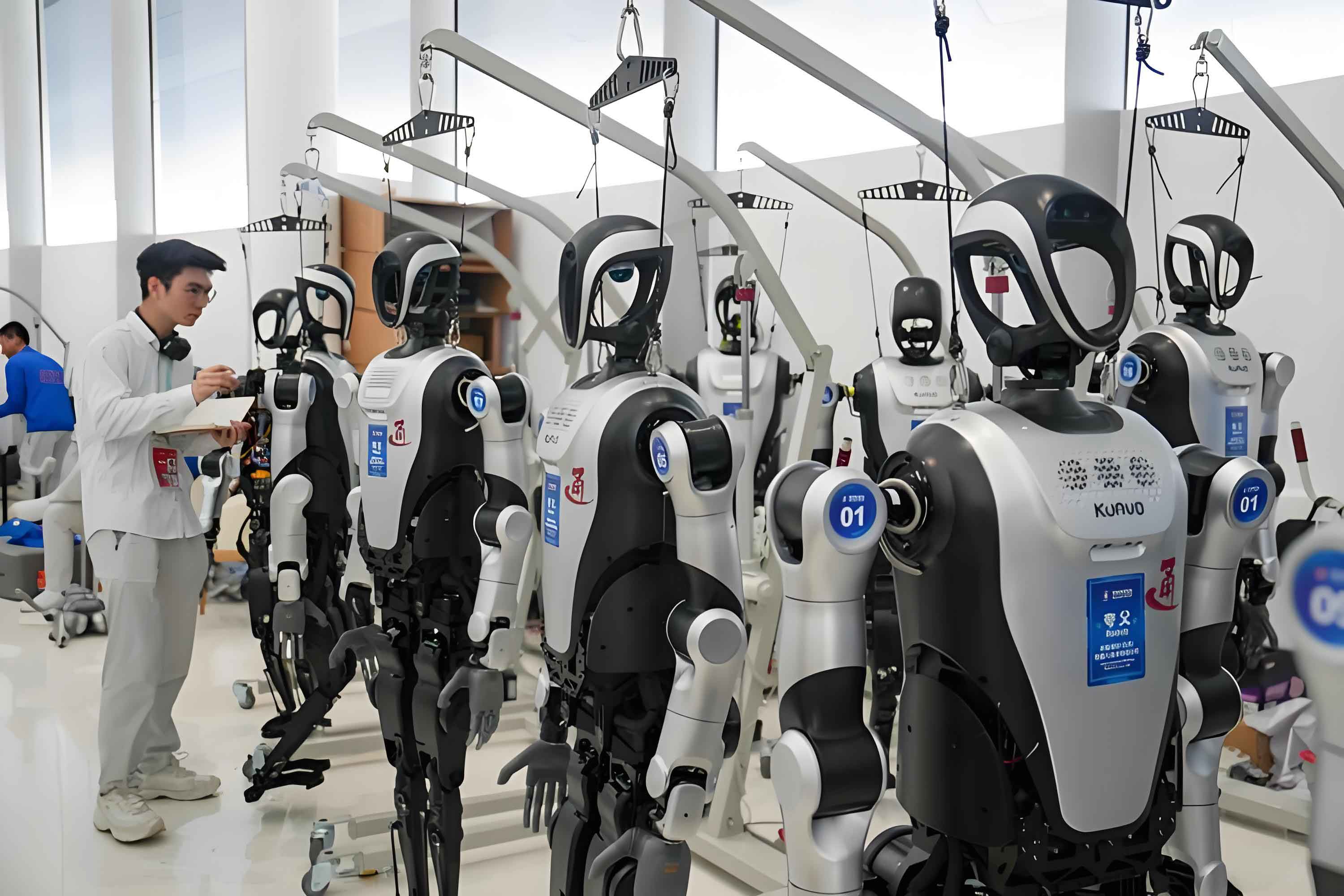
The inaugural World Humanoid Robot Games, held from August 15 to 17 at Beijing’s National Speed Skating Hall “Ice Ribbon” and National Stadium “Bird’s Nest,” brought together over 500 humanoid robots from 280 teams across 16 countries, competing in a spectacle reminiscent of the Olympic Games. These “athletes” of steel and circuits engaged in track and field, soccer, dance, boxing, and specialized labor tasks like cargo handling and medicine sorting, designed to simulate real-world applications in factories, warehouses, hospitals, and hotels. Despite it being a weekday, the venues were nearly full, with audiences gasping at the robots’ dexterity one moment and sighing at their frequent stumbles the next. The event not only highlighted the rapid progress in humanoid robot technology but also underscored the intense global competition and collaboration driving the industry forward, with Chinese firms leveraging such platforms to accelerate innovation and integration into diverse sectors.
On the track, the 1500-meter race stood out as a key test of endurance and autonomy. Hangzhou-based Unitree Robotics’ H1 humanoid robot, famous for its appearance in a Spring Festival Gala performance, clinched victory with a time of 6 minutes and 34 seconds, followed closely by the “Tiangong” humanoid robot from the Beijing Humanoid Robot Innovation Center at 6 minutes and 55 seconds. Notably, “Tiangong” operated fully autonomously without remote control, a significant leap from its earlier semi-autonomous performance in a half-marathon in Beijing’s Yizhuang area. A representative from the center emphasized that the focus has shifted to enhancing the intelligence of humanoid robots, with strides in stability and speed evident compared to previous events. This evolution reflects a broader trend where high-stakes competitions serve as crucibles for refining the capabilities of humanoid robots, pushing them toward practical applications in extreme environments like polar exploration and space missions.
Beyond the races, a table tennis-playing humanoid robot developed by a team led by Shanghang Zhang, a researcher at Peking University’s School of Computer Science and director of the Embodied Large Model Center at Beijing Academy of Artificial Intelligence, drew significant attention. Zhang clarified that this humanoid robot was not built for winning championships but as a “technology carrier” to validate极限 capabilities. “Table tennis demands ultra-fast dynamic capture and millisecond-level response execution,” he explained, “which closely mirrors the technical challenges in high-speed industrial sorting or dynamic environments for deep-space exploration.” The open-source approach adopted by the institute allows partners to quickly deploy tested technologies—such as those for pharmacy services or hotel reception—using a “brain and cerebellum” framework where the brain handles cognitive decisions and the cerebellum ensures precise motion control. Ultimately, Zhang envisions these skills being applied to treacherous terrains like Antarctic ice sheets, deep mines, or even lunar and Martian missions, exploring the true limits of humanoid robots.
However, the frequent mishaps on the field—from robots veering off tracks to sudden falls—highlight the ongoing challenges. Liu Wei, director of the Human-Computer Interaction and Cognitive Engineering Laboratory at Beijing University of Posts and Telecommunications, summarized the industry’s current state as “gaining form but forgetting meaning,” meaning humanoid robots have achieved physical resemblance but lack the nuanced understanding for seamless human-environment interaction. He stressed that artificial intelligence’s potential lies not in mere labor replacement but in reshaping work processes through collaborative partnerships. To overcome bottlenecks, Liu called for interdisciplinary talent development, deeper industry chain coordination, unified technical standards, and stronger intellectual property protection in China’s humanoid robot sector.
1. Event Highlights and Technological Demonstrations
The World Humanoid Robot Games featured a diverse array of competitions that put the robots’ physical and cognitive abilities to the test. In the soccer matches, humanoid robots demonstrated teamwork and agility, while dance performances showcased fluid movements, albeit with occasional technical glitches like detached components. The boxing ring saw robots attempting punches and defenses, though some slipped and fell immediately after the bell. These “failures” were met not with ridicule but with earnest discussions among spectators and experts, who analyzed issues such as high centers of gravity or advanced algorithms in the leading contenders. The emphasis on real-world scenarios—like搬运货物 (cargo handling) and分拣药品 (medicine sorting)—underscored the event’s role in bridging entertainment and practical utility for humanoid robots. For instance, the top performers in田径 (track and field) exhibited improved gait stability and speed, indicating progress in motion control systems that are critical for industrial and service applications.
2. Comparative Analysis: Chinese and Global Humanoid Robot Development Paths
The rise of China’s humanoid robot industry is closely tied to its mature supply chain, particularly in components like motor controllers and high-precision sensors, which benefited from the explosive growth of intelligent new energy vehicles around 2015. According to Shaoshan Liu, director of the Embodied Intelligence Center at the Shenzhen Institute of Artificial Intelligence and Robotics (AIRS), Western companies initially led in core parts and software algorithms but reduced investments due to skepticism about robots being a niche field. In contrast, China’s strategic focus, coupled with a booming manufacturing sector, fostered a robust ecosystem of talent and applications. This advantage is evident in hardware innovations; for example, Acceleration Evolution, a Chinese humanoid robot company, developed proprietary joints with gear backlash control 10 times better than some competitors, at a marginally higher cost of 200 yuan. However, industry insiders note that hardware alone is not a lasting barrier; the key differentiator lies in building a vibrant developer ecosystem, akin to the “Apple model” that integrates hardware, operating systems, and tools.
In the United States, the landscape differs, with Jeff Burnstein, president of the Association for Advancing Automation, highlighting that only two humanoid robots have reached mass production: Agility Robotics’ Digit, which began handling boxes in warehouses in June, and Tesla’s Optimus, which faced production delays. Burnstein acknowledged China’s faster progress in recent years but emphasized that widespread adoption of humanoid robots hinges on delivering efficient, accurate, and low-cost solutions across varied scenarios. The产学研 (industry-university-research) conversion mechanisms also vary: U.S. institutions like UC Berkeley’s RISE Lab thrive on a market-driven model where professors mentor student startups backed by venture capital, spawning unicorns like Databricks. While Chinese universities such as Tsinghua and Beijing Institute of Technology are closing the research gap with MIT, the overall ecosystem still lags in integrating academic breakthroughs into commercial ventures.
3. Application Scenarios: From Industrial Workhorses to Compassionate Companions
Humanoid robots are increasingly being tested in real-world settings, with promising applications in industrial manufacturing, healthcare, and elderly care. At the recent World Robot Conference, companies like Hexagon Manufacturing Intelligence showcased their AEON humanoid robot, which undergoes trials in automotive and aerospace sectors for tasks such as operation, inspection, and reality capture. Wu Wei, from Digital Huaxia Robot Company, noted a shift from simple guide or entertainment roles to more functional applications aimed at commercial viability. For instance, UBTech’s Walker S series of industrial humanoid robots are being trained in partnerships with companies like Dongfeng Liuzhou Auto, Geely, BYD, Foxconn, and SF Express. The latest Walker S2 model demonstrated autonomous battery swapping in just three minutes, enabling potential 24/7 operation—a critical step for boosting industrial efficiency.
In medical and elderly care, humanoid robots are poised to make significant impacts. Fourier Intelligence released a humanoid robot focused on interactive companionship, requiring higher sensitivity, smoother control algorithms, and enhanced safety features compared to industrial models. Researchers from the Chinese Academy of Sciences are testing prototypes in nursing homes that monitor residents’ health around the clock, reducing the burden on human caregivers. Zhong Xinlong, director of the Artificial Intelligence Research Office at the CCID Future Industry Research Center, explained that humanoid robots are transitioning from lab prototypes to commercial use in specific verticals, with breakthroughs in embodied intelligence allowing them to handle complex tasks in semi-structured environments. However, he cautioned that mass adoption faces three core hurdles: high costs, immature core technologies, and underdeveloped application ecosystems. Currently, the price of a high-performance humanoid robot remains prohibitive for most businesses and consumers, driven by expensive components like precision reducers and torque sensors.
4. Global Expansion: Chinese Humanoid Robots Venturing Overseas
Chinese robotics solutions are gaining traction internationally, with industrial robots leading the export charge to markets in Europe, Southeast Asia, and beyond. According to Singapore’s The Straits Times, the surge in new factories across Southeast Asia has driven demand for Chinese industrial robots. Companies like Siasun Robot and Automation, for instance, have seen orders from multinational firms that initially used their products in China and later expanded to facilities in Malaysia, Singapore, and Germany. Zhang Lei, Siasun’s technical director, attributed this to the advantages in ecosystem, supply chain, and cost-effectiveness. Efoto Intelligent Robot Company’s deputy general manager, Zhang Wei, reported successful entries into European and Asian markets, leveraging China’s rich automation scenarios and scale production to offer competitive solutions. In Europe, a traditional automation stronghold, Chinese robots meet stringent CE certification standards and are promoted through partnerships with local integrators.
For humanoid robots specifically, overseas expansion is still in its early stages, focused on brand exposure and technical validation. Zhong Xinlong analyzed that while industrial and service robots dominate exports, humanoid robots are being introduced to high-end markets in the Middle East and North America for research, education, and corporate image purposes. He advised that Chinese firms must adopt a globalized strategy, moving from product-centric thinking to building localized service networks, complying with international standards, and fostering talent with international experience. Challenges include establishing full-chain capabilities—from pre-sales support to after-sales service—and navigating regulatory requirements like Europe’s CE marks. By deepening supply chain and talent localization, companies can transition from “product出海” (product going global) to “brand出海” (brand going global), ensuring long-term growth in the competitive humanoid robot arena.
5. Future Outlook: The Path to Widespread Adoption of Humanoid Robots
Looking ahead, humanoid robots are expected to evolve into standardized intelligent terminals, but their普及 (popularization) will follow a gradual path from commercial to household use. Zhong Xinlong projected that initial growth will concentrate on B2B sectors—such as industry, commerce, and special services—where economic returns can justify high costs. As产业链 (industry chain)成熟 (maturity), scale production drives down prices, and core technologies advance, humanoid robots may become affordable for families, offering indispensable services like household chores or elderly care. However, this requires a comprehensive ecosystem, including modular hardware for easy repairs, standardized software interfaces to attract developers, and extensive sales and service networks. The process will be protracted, demanding collaboration among industry, research, and policy makers.
In summary, the World Humanoid Robot Games not only celebrated athletic feats but also catalyzed discussions on innovation and collaboration. With China’s humanoid robot industry making strides in hardware and ecosystem development, and global players navigating similar challenges, the future holds promise for these machines to transform workplaces and homes. Yet, as experts reiterate, the journey from “form” to “meaning”—from mechanical prowess to true intelligence—will define the next chapter for humanoid robots worldwide.