
The industrialization of the humanoid robot is moving from a distant promise into a tightly organized regional production system in the Greater Bay Area. The route described by Leju Robotics founder Leng Xiaokun is direct and practical: research and development in the center of Shenzhen, pilot manufacturing and process validation in Longhua, and 10,000-unit-level mass production in Foshan. The distance between these stages is just over 100 kilometers, and logistics and information flows can close the loop within the same day. For the humanoid robot sector, this geography is not a minor convenience. It is a structural advantage that shortens the path from a design drawing to a validated process and from a validated process to batch production.
In an interview, Leng described how this “Greater Bay Area journey” for a humanoid robot was formed. It was not the product of a single company building every capability in one place. Instead, it emerged from market division of labor. Shenzhen’s urban core has dense scientific and research talent and abundant application scenarios. The Longhua base handles the “from 1 to 100” stage, turning research results into standard operating procedures through process validation. Foshan, with its high-end manufacturing foundation, handles the “from 100 to 10,000” stage, or scalable mass production. At the Foshan line, a humanoid robot can roll off the line every 30 minutes. With more than 100 kilometers between the sites, logistics and information flow can be closed within a single day, compressing the physical distance among research and development, pilot production, and mass manufacturing to an extreme degree in the Pearl River Delta.
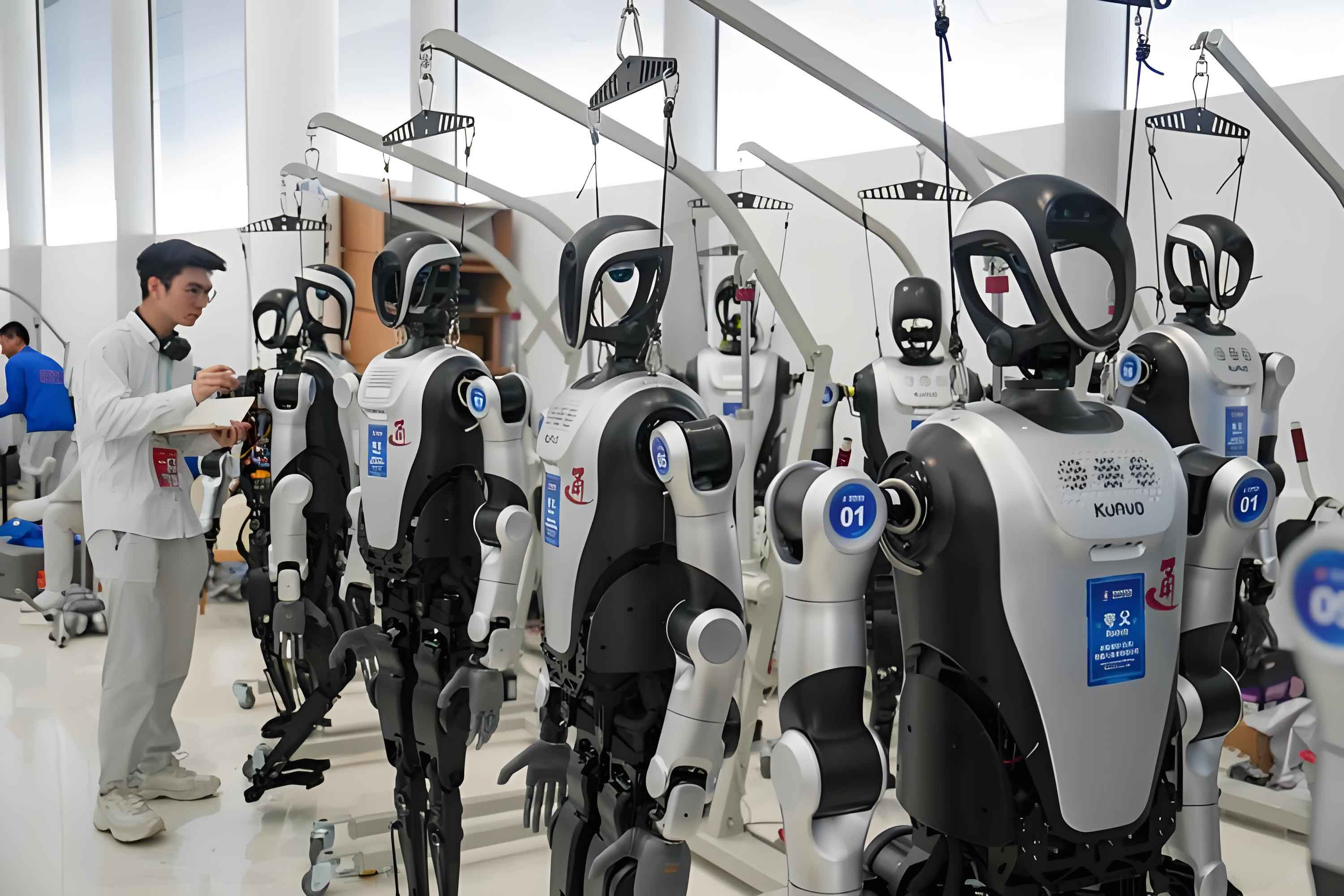
1. A Humanoid Robot Supply Chain Built Across Shenzhen, Longhua, and Foshan
The humanoid robot produced by Leju Robotics, known as Kuafu, has become a reference point for how regional manufacturing can support a complex product. The company’s arrangement is not simply a relocation of production from one city to another. It is a staged system in which each location performs a distinct function. Shenzhen city center provides research talent and diverse scenarios. The Longhua base converts laboratory results into repeatable factory processes. Foshan takes the validated process and scales it into high-volume production. This division allows the humanoid robot to move through development, pilot production, and mass manufacturing without the long delays that often occur when each stage is separated by large distances or disconnected supply chains.
Leng explained that the model is a result of market specialization. Shenzhen’s urban center is suited to research and development because it concentrates scientific talent and application scenarios. Longhua’s pilot base is suited to the “from 1 to 100” stage, where a design must be tested, refined, and converted into standard operating procedures. Foshan’s industrial base is suited to the “from 100 to 10,000” stage, where the humanoid robot must be manufactured at scale with stable quality. The fact that these stages are located within roughly 100 kilometers of one another means that engineers, suppliers, factory teams, and logistics providers can respond quickly. For a humanoid robot, which integrates mechanical, electronic, software, and control technologies, this kind of rapid feedback is essential.
The Greater Bay Area already has a deep manufacturing ecosystem, and the humanoid robot supply chain can draw on it. More than 95 percent of the core components of Kuafu can be sourced or supported within the region, according to Leng. This does not mean that every component is identical or that every technical challenge has been solved. It means that the industrial density of the region allows most of the humanoid robot supply chain to be coordinated nearby. When a design changes, the surrounding supplier network can respond. When a process needs validation, the pilot base can act quickly. When a process is ready for scale, the Foshan factory can absorb it into batch production. This is the practical meaning of compressing the distance among research and development, pilot production, and mass manufacturing.
| Stage in the Humanoid Robot Industrialization Path | Location | Primary Role | Operational Detail |
|---|---|---|---|
| Research and development | Shenzhen city center | Technology sourcing and scenario exploration | Dense research talent and diverse application scenarios support humanoid robot development |
| Pilot production and process validation | Longhua base | “From 1 to 100” process validation | Research results are converted into standard operating procedures for the humanoid robot |
| Mass production | Foshan | “From 100 to 10,000” scalable manufacturing | High-end manufacturing foundation supports 10,000-unit-level production; one humanoid robot can roll off the line every 30 minutes |
| Regional coordination | Greater Bay Area and Pearl River Delta | Same-day logistics and information loop | Sites are more than 100 kilometers apart; logistics and information flow can close within one day |
| Localization | Greater Bay Area supply chain | Nearby supporting capabilities | More than 95 percent of Kuafu core components can be supported by nearby supply chains |
2. The Final Five Percent of Humanoid Robot Localization
The humanoid robot’s core component localization rate of more than 95 percent is a significant marker, but it also highlights the remaining gap. Leng identified high-end chips and edge-side computing as areas where the company and the domestic industry still lag behind the international frontier. The largest gap, he said, is not merely a single hardware component but the developer ecosystem around edge-side computing. For a humanoid robot to become more capable, it needs not only sensors, joints, drives, and structural parts but also a robust computing platform that developers can use efficiently. The final five percent of localization therefore involves both hardware and software ecosystems.
Leju Robotics is working with partners such as HuiXi Intelligent and Weifan Intelligent, and it is using open-source platforms such as OpenLET, to advance the domestic edge-side computing developer ecosystem. The goal is to complete the final piece of the full-stack localization puzzle as quickly as possible. This work is closely connected to the humanoid robot’s evolution. A humanoid robot must process sensory data, control movement, and support application-level intelligence. If the edge-side computing platform is fragmented or difficult to develop for, the pace of innovation for the entire humanoid robot system can slow down. Building an open and usable developer ecosystem is therefore part of the industrialization agenda, not a separate software concern.
At the same time, Leju Robotics is using investment and industrial collaboration to support continuous localization and iteration of core components such as joints and drives. These components are central to the humanoid robot’s motion performance, reliability, and cost. Localization is not a one-time substitution exercise. It requires repeated testing, process improvement, and supplier development. The Greater Bay Area’s dense industrial base gives the humanoid robot sector an advantage in this iterative work because component makers, pilot lines, and mass production teams can coordinate closely. The remaining five percent is thus a focused challenge: high-end chips, edge-side computing, and the developer ecosystem must mature alongside the mechanical and electrical supply chain.
| Humanoid Robot Localization Area | Current Position | Key Challenge | Industry Response |
|---|---|---|---|
| Core components | More than 95 percent localization for Kuafu | Most nearby supporting capabilities can be resolved within the Greater Bay Area | Continue industrial collaboration and supply chain development |
| High-end chips | Still behind the international frontier | Advanced chip capability for the humanoid robot | Work with partners and build domestic capabilities |
| Edge-side computing | Gap remains in the humanoid robot computing platform | Edge-side computing performance and usability | Collaborate with HuiXi Intelligent and Weifan Intelligent |
| Developer ecosystem | Largest gap identified by Leng | Open development environment for humanoid robot applications | Use OpenLET and other open-source platforms to build a domestic ecosystem |
| Joints and drives | Continuous localization and iteration underway | Reliability, performance, and cost at scale | Investment and industrial collaboration to support component makers |
3. Huaqiangbei Logic and the Humanoid Robot Supply Chain
The humanoid robot industry is often compared with the electronics ecosystem of Huaqiangbei, where the phrase “one-meter counter, one-kilometer supporting” describes how a dense cluster of suppliers can support rapid product development. Leng said the comparison is apt. A humanoid robot involves dozens of sub-sectors, including machinery, electronics, control, sensing, and software. It depends heavily on a complete supply chain. In the Greater Bay Area, a structural part design can be changed today, and the next day the Longhua pilot base can complete sample making and assembly testing. Within one week, the Foshan factory can import the optimized plan into batch production. This response speed is a core competitive advantage that Leng described as unique to the Greater Bay Area.
For a humanoid robot, speed is not only about moving parts from one place to another. It is about moving information, decisions, and learning across the supply chain. A design change may require a new fixture, a revised assembly sequence, a different test parameter, or a supplier adjustment. When these activities are distributed across a region with dense manufacturing capabilities, the feedback loop becomes shorter. The humanoid robot can be tested in a realistic process earlier, and problems can be found before they are locked into mass production. This is particularly important for a product that is still evolving and whose mechanical, electronic, and software systems must be integrated repeatedly.
The “one-meter counter, one-kilometer supporting” logic also helps explain why the humanoid robot supply chain can remain flexible. A humanoid robot is not a simple consumer device. It combines precision assembly, motion control, sensors, computing, and application software. The supply chain must support both standardization and customization. In the Greater Bay Area, companies can access a wide range of suppliers within a short distance. This density supports rapid prototyping and iterative improvement, while the Foshan production base provides the scale needed to move from prototype to batch production. The result is a humanoid robot industrialization model that links the speed of an electronics cluster with the discipline of high-end manufacturing.
4. From 1,000 to 10,000: Making Every Humanoid Robot Consistent
Moving from 1,000 units to 10,000 units is a critical threshold for the humanoid robot. Leng said the hardest part is not orders but achieving “10,000 units as one,” meaning consistent quality across a large volume. Mass production of a humanoid robot depends on turning craftsmanship into standards. Leju Robotics has digitalized 24 precision assembly processes, and overall production efficiency has improved by more than 50 percent compared with the traditional model. Each humanoid robot undergoes 77 inspections and 41 automated tests. The MES system provides full-chain traceability, and AI is used to analyze bottleneck processes and feed the results back into process optimization.
These measures address a central challenge in humanoid robot manufacturing: consistency. A humanoid robot has many precision joints, sensors, and electronic components. Small variations in assembly or calibration can affect performance. The transition from pilot production to mass production therefore requires more than a larger factory. It requires a manufacturing system that can reproduce the same process across many units. Digitalized assembly processes, inspection routines, automated testing, and traceability are all part of this system. The use of AI to analyze bottleneck processes adds another layer: production data can be reviewed to identify where the process slows down or where variation appears, and those findings can be used to improve the workflow.
Only after a humanoid robot survives the test of mass production capability, batch stability, and consistency can it be considered to have crossed the industrialization threshold. This standard is demanding, but it reflects the reality of the humanoid robot market. Early units may be built with intensive engineering support. Mass-produced units must be reliable, repeatable, and cost-effective. The Foshan production base is designed to support this transition. The Longhua pilot base provides the process validation that makes the transition possible. Together, they form a humanoid robot manufacturing chain that links process development with scale-up discipline.
| Humanoid Robot Manufacturing Control | Detail | Purpose |
|---|---|---|
| Precision assembly processes | 24 processes digitalized | Turn craft into standard operating procedures for the humanoid robot |
| Production efficiency | More than 50 percent improvement over the traditional model | Support scalable humanoid robot production |
| Inspection | 77 inspections per humanoid robot | Verify quality and consistency |
| Automated testing | 41 automated tests per humanoid robot | Check performance and reliability |
| Traceability | MES full-chain traceability | Record and track production data |
| Process optimization | AI analysis of bottleneck processes | Feed findings back into workflow improvement |
| Industrialization threshold | Mass production capability, batch stability, and consistency | Confirm that the humanoid robot can move beyond pilot production |
5. Data, Scale, and the Humanoid Robot That Can Be Smart and Affordable
Leng has described the breakthrough point for the humanoid robot as reaching a state where it is “as smart as a PhD and as cheap as a home appliance.” The phrase captures two conditions that must be met together. On the intelligence side, the humanoid robot needs to be applied in various fields, such as commercial service inspection and industrial manufacturing, so that sufficient data can be accumulated for learning. On the cost side, the humanoid robot needs a certain production scale so that the cost of the entire supply chain can be amortized and the price can come down. These two conditions are connected. More applications generate more data and more operational experience. Larger production volumes reduce cost and make broader deployment more feasible.
Kuafu has already been put into normal and batch application at customer sites such as Haisen Logistics and Zhaofeng Electromechanical, according to Leng. He said the company has taken the most critical step. This statement is important for the humanoid robot sector because it moves the discussion beyond laboratory demonstrations. Normal application means the humanoid robot is being used in real operational settings. Batch application means more than one unit is being deployed and supported. These settings generate data and feedback that can be used to improve the humanoid robot. They also test whether the humanoid robot can be maintained, integrated, and operated within existing workflows.
The path to a more affordable humanoid robot therefore runs through both application and manufacturing. Applications in commercial service inspection and industrial manufacturing provide the data needed for learning. Mass production and supply chain development provide the scale needed for cost reduction. The Greater Bay Area’s compressed research, pilot production, and mass manufacturing loop supports both sides of this equation. When a humanoid robot design changes, the pilot base can validate the change. When the process is ready, the Foshan factory can scale it. When customers provide feedback, the development team can respond. This cycle is the foundation for the humanoid robot’s next stage of commercialization.
6. Why the 100-Kilometer Loop Matters for the Humanoid Robot
The significance of the 100-kilometer loop is not simply that the sites are close. It is that the loop allows the humanoid robot to be developed and manufactured as an integrated system. In many industries, research and development, pilot production, and mass production are separated by long distances and different organizational cultures. The result can be a slow transfer of knowledge from the laboratory to the factory. In the Greater Bay Area model described by Leng, the stages are distinct but connected. Shenzhen provides research talent and scenarios. Longhua provides process validation. Foshan provides scale. The same-day logistics and information loop keeps the stages aligned.
For a humanoid robot, this alignment matters because the product is still changing. Mechanical design, electronic architecture, control software, and application software all evolve together. A change in one area can affect another. If the feedback loop is slow, the humanoid robot may be tested against outdated assumptions. If the feedback loop is fast, the team can learn from manufacturing and field data more quickly. The ability to change a structural part design today, complete sample making and assembly testing at Longhua tomorrow, and import the optimized plan into batch production in Foshan within a week is a practical example of this advantage. It shows how the humanoid robot supply chain can respond to engineering changes without losing the discipline required for mass production.
The Greater Bay Area’s industrial density also supports the humanoid robot’s component ecosystem. A humanoid robot requires joints, drives, sensors, chips, structural parts, and software. The region’s supplier base can support many of these needs. The remaining gaps, such as high-end chips and edge-side computing, are being addressed through partnerships and open platforms. The localization rate of more than 95 percent for Kuafu’s core components shows how much of the humanoid robot supply chain can be coordinated nearby. The final five percent is a focused challenge, but it sits within a broader system that can iterate quickly. This combination of breadth and speed is central to the humanoid robot’s industrialization in the region.
7. Scaling the Humanoid Robot Ecosystem Through Regional Division of Labor
The regional division of labor described by Leng is a model for humanoid robot industrialization. Shenzhen’s urban center contributes research talent and application scenarios. Longhua’s pilot base contributes process validation and standard operating procedures. Foshan’s manufacturing base contributes high-end production capacity and scale. The supply chain across the Greater Bay Area contributes nearby supporting capabilities. Each part of the system has a clear role, and the connections among them are short enough to support rapid iteration. This is not a centralized model in which one site attempts to do everything. It is a distributed model in which each site does what it does best, while the humanoid robot moves through the stages with speed and consistency.
For the humanoid robot sector, this model has several implications. It suggests that industrialization is not only about building a larger factory. It is about building a coordinated system that connects research, process validation, mass production, and field application. It also suggests that supply chain localization is not only about replacing imported parts. It is about creating a dense network of suppliers, partners, and production teams that can respond to change. The humanoid robot is a complex product, and its competitiveness will depend on how well this network performs. The Greater Bay Area’s advantage lies in the density of that network and in the speed with which information can move through it.
The model also places demands on coordination. A humanoid robot that is developed in one place, validated in another, and mass-produced in a third must have strong process documentation, quality systems, and data links. The digitalization of 24 precision assembly processes, the use of 77 inspections and 41 automated tests, and the MES full-chain traceability all support this coordination. These systems allow the humanoid robot to be manufactured consistently even as it moves across sites. They also allow problems to be traced and corrected. In this sense, the humanoid robot’s industrialization depends on both physical proximity and digital discipline.
8. The Next Stage for Humanoid Robot Industrialization
The humanoid robot is moving toward a stage in which application data and production scale reinforce each other. Commercial service inspection and industrial manufacturing provide real-world settings for the humanoid robot to accumulate data. Mass production in Foshan provides the scale needed to reduce cost. The Longhua pilot base provides the process validation needed to turn design changes into standard operations. Shenzhen’s research talent and scenarios provide the source of new ideas and applications. The Greater Bay Area’s supply chain provides the component ecosystem that supports the entire system. Together, these elements form a humanoid robot industrialization path that is both regional and integrated.
The remaining challenges are clear. High-end chips, edge-side computing, and the developer ecosystem must be strengthened to complete the final piece of full-stack localization. Mass production must continue to improve stability and consistency so that every humanoid robot meets the same quality standard. Applications must expand so that the humanoid robot can accumulate enough data to become more capable. Costs must come down through scale and supply chain development so that the humanoid robot can become more affordable. These challenges are interconnected, and progress in one area can support progress in another. The humanoid robot’s commercialization will depend on how well the industry manages this combination.
The Greater Bay Area’s compressed research, pilot production, and mass manufacturing loop offers a practical foundation for meeting these challenges. The more than 100-kilometer distance among Shenzhen, Longhua, and Foshan is short enough to support same-day logistics and information flow. The humanoid robot can move from design change to sample testing to batch production within a short cycle. The supply chain can support more than 95 percent of core component localization. The Foshan line can produce a humanoid robot every 30 minutes. The manufacturing system can digitalize 24 precision assembly processes, conduct 77 inspections and 41 automated tests, and use MES traceability and AI analysis to improve processes. These are concrete elements of an industrialization system, and they show why the humanoid robot sector is watching the region closely.
The humanoid robot’s future will not be determined by a single breakthrough or a single factory. It will be determined by the ability to connect research, pilot production, mass manufacturing, supply chain development, and real-world application into a continuous loop. The Greater Bay Area model described by Leng is an attempt to build that loop at speed. It treats the humanoid robot as a product that must be developed, validated, manufactured, and improved in close coordination. It uses regional division of labor to compress time and distance. It uses digital systems to maintain consistency. It uses application data and production scale to drive the next stage of cost and capability improvement. For the humanoid robot, this is the meaning of industrialization with a regional imprint and a practical route to scale.