
GUANGDONG, Sept. 12, 2026 – A review of half-year financial reports from 26 Guangdong-based listed companies with robot businesses, including three Hong Kong-listed companies, shows that the province’s robot industry chain is entering a more mature phase. The shift is visible in three connected areas: a supply chain that is moving from gap-filling to volume delivery, humanoid robot applications that are moving from demonstration to formal deployment, and overseas expansion that is moving from product exports toward brand building and capital linkage.
The findings point to a cluster that has already assembled a broad industrial base and is now testing whether that base can convert into scaled orders, repeatable application scenarios and global brand presence. For the humanoid robot sector, the half-year reports offer a clearer view of where commercialization is actually taking place and where bottlenecks remain.
Guangdong remains a major production base for industrial robots and a dense concentration point for the humanoid robot supply chain. In 2025, the province’s industrial robot output reached 336,300 units, ranking first nationally for six consecutive years and accounting for 43.5 percent of the national total. Enterprises in the humanoid robot supply chain in Guangdong accounted for about 57 percent of the national total. Those figures provide the backdrop for the changes disclosed in the 2026 half-year reports.
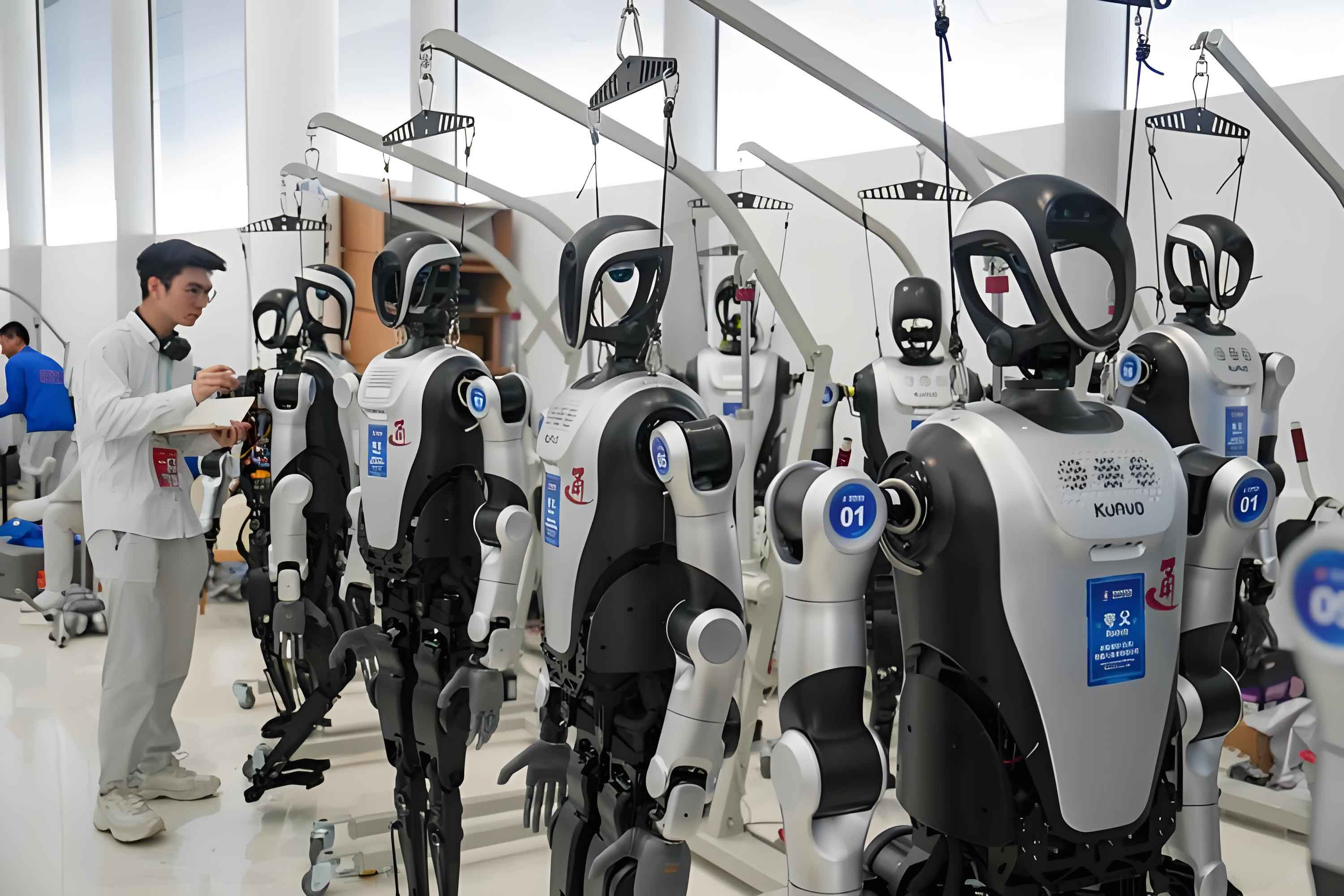
1. Supply Chain: From Filling Gaps to Volume Delivery
If the 2025 annual reports of Guangdong’s robot companies could be summarized as a phase of “filling gaps,” the 2026 half-year reports point to a different keyword: “volume delivery.” The earlier annual reports sketched the basic skeleton of the province’s robot supply chain. Listed companies had taken positions across nine links: robot body, controller, servo, reducer, transmission, vision, sensor, structural parts and system integration. That created a closed-loop industrial structure.
Within that structure, the “brain” links, including controllers and servos, were supported by five Shenzhen companies: Inovance Technology, Leadshine Technology, INVT Electric, Topband and Keli. The humanoid robot original equipment brand link was led by two Hong Kong-listed leaders, UBTech Robotics and Dobot. The chain gradually moved from a structure that was “strong in the middle and weak at both ends” toward a complete loop covering brain, body, execution, perception and integration.
The 2026 half-year reports show that the most significant change is the transition of core components from sample validation to scaled delivery. Leadshine’s order backlog for frameless torque motors exceeded 1 million units during the reporting period. Its planetary joint modules, harmonic joint modules and high-degrees-of-freedom dexterous hands had received orders from nearly 100 mainstream robot customers and had begun volume supply. Changying Precision delivered about 860,000 precision components for humanoid robot applications. Orbbec’s sales revenue from vision solutions for the global robot market reached more than twice the level of the same period a year earlier. Midea’s precision reducer shipments reached 26,000 units, while its heavy-duty servo motor shipments reached 58,000 units, a significant year-on-year increase.
These figures matter because they show that the humanoid robot supply chain is no longer only about concept validation or small-batch samples. Orders and deliveries are beginning to flow through the component layer. For a humanoid robot to move from a demonstration platform to a commercially deployable product, the supply chain must be able to provide consistent quality, predictable delivery and cost reduction at scale. The half-year disclosures suggest that some Guangdong suppliers are now being tested on those requirements.
| Indicator | Reported level | Context |
|---|---|---|
| Guangdong industrial robot output | 336,300 units | 2025; ranked first nationally for six consecutive years |
| Guangdong share of national industrial robot output | 43.5 percent | 2025 |
| Guangdong share of national humanoid robot supply chain enterprises | About 57 percent | 2025 |
| Leadshine frameless torque motor order backlog | More than 1 million units | 2026 half-year |
| Leadshine orders from mainstream robot customers | Nearly 100 customers | 2026 half-year; planetary joint modules, harmonic joint modules and dexterous hands |
| Changying Precision humanoid robot precision components delivered | About 860,000 pieces | 2026 half-year |
| Orbbec vision solution sales revenue | More than 2 times the prior-year level | 2026 half-year; global robot market |
| Midea precision reducer shipments | 26,000 units | 2026 half-year |
| Midea heavy-duty servo motor shipments | 58,000 units | 2026 half-year; significant year-on-year increase |
| UBTech Walker S series revenue | RMB 821 million | 2025; up about 2,204 percent year on year |
| UBTech Walker S series deliveries | 1,079 units | 2025; gross margin 54.6 percent |
| Dobot cumulative collaborative robot shipments | More than 100,000 units | Global No. 1; deployed in more than 100 countries and regions |
The scale-up is supported by the spatial concentration of Guangdong’s robot industry. The province has formed a division-of-labor corridor: Shenzhen Robot Valley, Dongguan Songshan Lake precision manufacturing, Foshan Shunde robot body production and Guangzhou Huangpu system integration. This corridor enables efficient coordination from research and development to mass production. Physical concentration lowers collaboration costs and amplifies the multiplier effect of applications.
At the same time, the reports make clear that shortcomings remain. High-end RV reducers still depend on suppliers outside the region. High-precision absolute encoders and six-axis force sensors still require breakthroughs. These are not minor technical details. They are the kinds of components that determine performance, reliability and cost in advanced humanoid robot systems. The fact that they remain bottlenecks shows that the supply chain is not yet fully self-sufficient at the highest end.
Zhu Keli, founder of the Guoyan New Economy Research Institute and chief expert in intelligent economy, said that component autonomy should not be pursued behind closed doors. It should be driven by scenario demand rather than by a single-minded pursuit of technical indicators. He suggested that Guangdong use its large complete-machine scenario orders to pull batch validation and continuous iteration of reducers, servos, dexterous hands and controllers. Scale orders can dilute research and development costs and support localization. That approach places the humanoid robot supply chain inside a commercial feedback loop rather than treating it as an isolated engineering challenge.
The logic is important for the next stage. A humanoid robot supply chain cannot mature only through laboratory testing. It needs repeated deployment, field data, maintenance experience and cost feedback. Guangdong’s advantage is that it combines component suppliers, complete-machine brands and application scenarios in a relatively concentrated geographic area. If that combination works, it can shorten the cycle from component validation to volume delivery. If it does not, the province could still find itself strong in midstream manufacturing but dependent on outside suppliers for the most critical high-end parts.
The half-year reports therefore show a supply chain in transition. The humanoid robot component layer is no longer only about positioning. It is beginning to record orders, deliveries and customer validation. That is a necessary condition for the next phase of humanoid robot commercialization. The remaining question is whether the volume can be sustained and whether the most difficult components can also be localized at competitive performance levels.
2. Application Scenarios: From Factory Trials to Formal Posts
In the 2025 annual reports, one of the most symbolic signals was that humanoid robots began to “work.” UBTech’s full-size humanoid robot Walker S series generated revenue of RMB 821 million, up about 2,204 percent year on year. It delivered 1,079 units, with a gross margin of 54.6 percent. More than 80 percent of revenue came from industrial scenarios, with customers covering automotive, semiconductor and aviation manufacturing lines.
The 2026 half-year reports show that this trend has become more pronounced. UBTech is aiming for ten-thousand-level delivery within the year. Topstar’s net profit attributable to shareholders rose 262.99 percent in the first half, and its humanoid robot “Xiaotuo” has been deployed in industrial scenarios. Midea’s humanoid robot “Meiluo” is being applied across multiple factories and multiple scenarios. The super-humanoid robot “Meiluo U” has formally taken a post at a high-end washing machine park, accumulating more than two months of work and completing more than 100,000 screw fastenings.
These examples are significant because they shift the discussion from whether a humanoid robot can perform a demonstration to whether it can hold a position in a real production or service process. A demonstration can be scripted and supervised. A formal post requires uptime, safety, task consistency and integration with existing workflows. The movement from factory trials to formal posts is therefore a more meaningful indicator of commercial progress than a one-off showcase.
The application map is also expanding. Several companies’ 2026 half-year reports show that robots are moving from automotive and 3C manufacturing into logistics and warehousing, commercial cleaning, medical surgery and agriculture. KUKA’s product matrix already covers more than 20 industries. Risong Technology and Xinbang Intelligent are deepening their work in automotive body-in-white welding integration. Tech-Long and Hongya CNC are advancing robotization in liquid packaging and woodworking machinery, respectively.
For the humanoid robot sector, this broadening is important but not uniform. The most credible near-term deployments remain in structured environments where tasks can be defined, measured and repeated. A humanoid robot that can work in a standard workstation, move materials in a warehouse or inspect a clean room may not need to replicate every human capability. It needs to be reliable enough, safe enough and cost-effective enough for a specific task. That is why the application path is likely to be gradual rather than universal at once.
Zhu Keli recommended a path that moves from simple to complex tasks, starts with business-to-business scenarios and gradually spills over into broader applications. He prioritized three types of B-end scenarios: standardized workstations in 3C, home appliance and auto parts factories; picking and handling in warehousing and logistics; and high-risk or dull positions such as equipment inspection and clean-room work. These scenarios share a common feature: they can be structured, measured and repeated, which makes them suitable for early humanoid robot deployment.
The Guangdong cluster has an advantage in this regard because it sits close to large manufacturing and logistics markets. Automotive, electronics, home appliances, packaging and warehousing are all present in the province’s industrial base. That proximity allows robot makers to work with customers on site, collect feedback quickly and adjust hardware and software. It also allows component suppliers to see how their parts perform in real deployments. The humanoid robot supply chain and the application side can therefore reinforce each other.
However, the transition from “working” to “working reliably at scale” is not automatic. A humanoid robot deployed in a factory must handle variation, maintenance and integration with other equipment. It must also justify its cost against alternative automation solutions. The half-year reports show progress, but they also imply that scale deployment will depend on service networks, training, safety standards and clear return-on-investment models. The humanoid robot market will not be won by demonstrations alone. It will be won by repeat orders and expandable deployments.
The application trend also changes the competitive landscape. Companies that only supply components may find opportunities in scaled orders, but they will also face pressure on cost and delivery. Companies that supply complete humanoid robot systems will need to build application know-how and customer relationships. The boundary between a robot manufacturer and a system integrator may blur as humanoid robot deployment moves into more specialized scenarios. Guangdong’s dense industrial ecosystem gives companies room to test these models, but it also exposes them to intense competition.
3. Global Expansion: From Product Exports to Brand Building
Guangdong’s robot companies are also upgrading their approach to overseas markets. In the 2025 annual reports, outbound expansion was mainly based on product and supply chain output. Dobot’s collaborative robot cumulative shipments exceeded 100,000 units, ranking first globally, with deployment in more than 100 countries and regions. Core component makers pursued technology exports by positioning themselves in the supply chains of leading customers. Haozhi Electromechanical’s harmonic reducers entered ABB’s supply chain. Leadshine, Changying Precision and others successively entered the supply systems of leading robot manufacturers at home and abroad, embedding themselves in global industrial chains through component output.
In the first half of 2026, the industrial path of going global did not change, but the financial “ammunition” became more abundant. Zhaowei Machinery & Electronics listed in Hong Kong. Inovance Technology is planning an H-share offering. Hong Kong financing platforms are providing funding support for companies such as UBTech and Dobot for humanoid robot mass production and global channel development. That shift is important because global expansion in the humanoid robot sector requires more than product shipments. It requires local service, technical support, spare parts networks and brand investment.
Once the outbound path becomes clear, the challenges also become clearer. The overseas channels and after-sales service systems of Guangdong’s independent complete-machine brands are still at an early stage. UBTech and Dobot have generally directed IPO proceeds toward capacity expansion and overseas markets after listing, which may be a signal that they are preparing to address this gap. For the humanoid robot industry, the next stage of competition will not only be about who can ship units. It will also be about who can support those units in different regulatory, language and customer environments.
Industry participants believe that as humanoid robot mass production advances, the shift from “product exports” to “brand exports” will become a key industrial theme in the next stage. The distinction is not cosmetic. Product exports focus on selling hardware and capturing cost and delivery advantages. Brand exports require a company to build trust, local presence and service capability. For a humanoid robot, which is a complex system involving hardware, software and safety, brand trust is closely linked to service response and long-term reliability.
Zhu Keli said that the current supply-chain-based overseas expansion of Guangdong robot companies is essentially “selling hardware products.” It has advantages in cost and delivery speed, but brand discourse power is weak and profit remains concentrated in the manufacturing link. For Guangdong robots to achieve “brand exports,” three upgrades are needed. The first is to move from selling hardware to selling scenario-based solutions. The second is to treat delivery as only the starting point and build localized sales, technical and spare parts service networks. The third is to participate in the co-construction of international standards and turn mature domestic scenario experience into international standards.
These upgrades are especially relevant to the humanoid robot sector. A humanoid robot is not a standalone product like a conventional machine. It involves interaction with people, integration with workflows, safety protocols and continuous software updates. Overseas customers will need training, maintenance and confidence that the product can operate in their environment. A company that can provide scenario-based solutions and localized support is more likely to build a durable brand than one that only competes on unit price.
The capital linkage between Hong Kong and Guangdong’s robot cluster may help. Hong Kong offers access to international investors and a platform for global talent and partnerships. For humanoid robot companies, that can support research and development, overseas channel building and brand investment. At the same time, capital alone cannot solve the operational challenges of overseas service. The companies that succeed will be those that combine financial resources with disciplined execution in local markets.
The global expansion of Guangdong’s robot cluster also has implications for the humanoid robot supply chain. As complete-machine brands expand overseas, component suppliers may follow them into international markets. That can create a cluster-based export model in which humanoid robot components, software and services move together. But it can also expose suppliers to higher compliance requirements, customer audits and after-sales obligations. The shift from product exports to brand exports therefore affects not only the brand owners but also the entire humanoid robot value chain.
4. Outlook: Scale, Localization and Standards
The three changes identified in the half-year reports are connected. Supply chain volume delivery gives humanoid robot makers more reliable access to components. Application deployment gives component suppliers and complete-machine brands real-world feedback. Global expansion gives the cluster a larger market and a stronger incentive to invest in brand and service. Together, these changes suggest that Guangdong’s robot industry is moving from an early stage of building a complete chain toward a stage of testing commercial scale.
For the humanoid robot sector, the next stage will be defined by several questions. Can core components sustain volume delivery with consistent quality? Can humanoid robot applications move from structured pilot projects to repeatable commercial deployments? Can Guangdong’s brands build overseas service networks and participate in standard-setting? The half-year reports provide early evidence of progress in each area, but they do not yet prove that the transition is complete.
The supply chain still has high-end gaps in RV reducers, absolute encoders and six-axis force sensors. The application side still needs to demonstrate reliability and return on investment across a wider range of scenarios. The global side still needs local service and brand trust. These are not reasons to discount the progress. They are the next set of problems that the cluster must solve if the humanoid robot industry is to move from scale orders to sustainable commercial growth.
Guangdong’s advantage lies in its combination of manufacturing depth, component density and application diversity. The province has industrial robot scale, a humanoid robot supply chain concentration and a broad manufacturing base that can serve as an early market. If companies can use that base to iterate products, reduce costs and build service capability, the humanoid robot sector could move more quickly from pilot deployment to broader adoption. If they cannot, the cluster may remain strong in production but weaker in brand and high-end technology.
The half-year reports therefore mark a useful checkpoint rather than a finish line. The humanoid robot supply chain is beginning to deliver at volume. The humanoid robot application map is beginning to expand. The humanoid robot brand story is beginning to take shape. The next phase will show whether these trends can become durable industrial capabilities. For Guangdong’s robot cluster, the challenge is no longer only to complete the chain. It is to make the chain productive, profitable and globally competitive.