
As the demands of space technology and deep-space exploration continue to evolve, traditional grease lubrication materials are increasingly unable to meet the stringent requirements for harmonic drive gear lubrication within vacuum and wide-temperature-range conditions. In this context, solid lubricant coatings present an exceptionally promising solution. These coatings offer a broad operational temperature window, and their lubricating performance is less susceptible to degradation under variable working conditions, making them a mainstay in space mechanisms. However, comprehensive data on the in-service performance—specifically transmission accuracy and efficiency—of solid-lubricated harmonic drive gear units under the harsh realities of space, including extremely low temperatures, high vacuum, and large thermal cycles, remains scarce. My research has focused on addressing this gap.
My work begins with fundamental investigations into the structure and tribological properties of advanced MoS2-based coatings, such as MoS2/Zn superlattice, TiN+MoS2/Zn multilayer, and a specially engineered MoS2/Pb-Ti nanocomposite (designated as MOSTP) coating. The tribological performance of these coatings was systematically evaluated in high-vacuum environments across a wide temperature spectrum. I also examined the influence of critical factors including substrate material, surface roughness, storage history, sliding speed, and applied load on the coating’s friction and wear behavior.
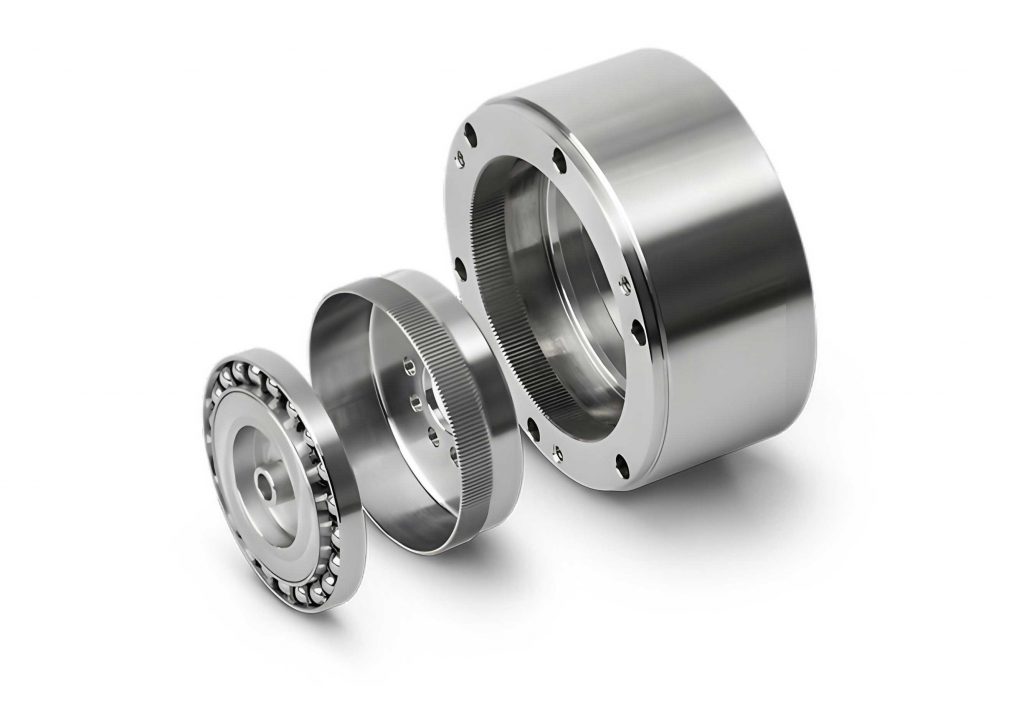
The harmonic drive gear is renowned for its high reduction ratio, exceptional motion accuracy, compact size, and zero-backlash characteristics, making it indispensable for spacecraft drive mechanisms, antenna pointing systems, and other high-precision applications. However, the elastic deformation of its flexspline during meshing can lead to tooth profile interference and significant wear, potentially degrading transmission efficiency and accuracy, and inducing vibrations that compromise mechanism reliability. Therefore, the selection of an appropriate lubrication strategy is paramount for ensuring the longevity and performance of a harmonic drive gear in orbit.
1. Experimental Preparation and Methodology
1.1 Coating Deposition and Sample Preparation
I employed Physical Vapor Deposition (PVD) techniques to fabricate the solid lubricant coatings. Two primary coating systems were developed and applied to two models of harmonic drive gear components: the XBS-40-100 and XBS-60-120. The strategy involved different coating pairs on the mating surfaces (flexspline and circular spline/rigid wheel).
- DLC Coating: Deposited using a Hauzer Flexicoat 850 multi-functional ion plating system. The process involved plasma cleaning, followed by the sequential deposition of Cr adhesive, WC support, and a WC/DLC gradient layer, culminating in a hydrogenated diamond-like carbon (DLC) top layer. The primary reaction gas was high-purity CH4.
- MoS2-based Coatings (MoS2/Zn, TiN+MoS2/Zn, MOSTP): Fabricated using a Teer Plas Mag CF-800 closed-field unbalanced magnetron sputtering system. The process began with argon plasma etching for surface activation. For the MOSTP coating, a Ti bond layer was first applied, followed by a gradient transition layer and the final MoS2/Pb-Ti nanocomposite structure. The superlattice and multilayer variants followed similar principles with different target materials (Zn or TiN).
The substrates were the actual gear materials: 40CrNiMoA for the flexspline and 20Cr13 for the circular spline. Prior to deposition, all substrates underwent rigorous ultrasonic cleaning in acetone and ethanol.
1.2 Structural, Mechanical, and Tribological Characterization
I utilized a suite of characterization tools to evaluate the coatings:
- Microstructure: Cross-sectional morphology and elemental distribution were analyzed using a Zeiss Auriga Field Emission Scanning Electron Microscope (FE-SEM) equipped with an Oxford X-Max 50 EDS system.
- Crystal Structure: X-ray Diffraction (XRD, Bruker D8 Advance) with Cu Kα radiation was used to determine the crystallographic orientation, particularly the preferred (002) basal plane orientation in MoS2-based coatings.
- Mechanical Properties: Nanohardness and elastic modulus were measured via a Nano G200 nanoindenter using the continuous stiffness method at a depth of 200 nm. Adhesion strength was assessed using a Revetest scratch tester.
- Tribological Testing: Vacuum high/low-temperature friction and wear tests were conducted on an Anton Paar HVTRB/CSM tribometer. Tests were run under a 1.5 N load at 5 cm/s sliding speed against a 40CrNiMoA counter-body, simulating the gear contact. The wear rate \(W\) was calculated from the wear track profile measured by a surface profilometer:
$$W = \frac{V}{N \times L}$$
where \(V\) is the wear volume (mm³), \(N\) is the normal load (N), and \(L\) is the total sliding distance (m). - Storage Stability Tests: To simulate pre-launch and orbital thermal cycles, coatings were subjected to environmental storage tests: 1 hour at -70°C (liquid nitrogen bath), followed by tribological testing; then 1 hour at 70°C, followed by another round of testing.
1.3 Full-scale Harmonic Drive Gear Performance Evaluation
The ultimate validation involved testing complete harmonic drive gear assemblies:
- Coating Strategies:
- XBS-40-100: MOSTP coating on BOTH the flexspline and the circular spline (MOSTP & MOSTP pair).
- XBS-60-120: DLC coating on the flexspline and MOSTP coating on the circular spline (DLC & MOSTP pair).
- Performance Metrics:
- Transmission Accuracy (Error and Backlash): Measured before coating, after coating, and after environmental testing, and compared against grease-lubricated (PFPE and MACS) units of the same model.
- Temperature-Varying Efficiency: Transmission efficiency was measured from -90°C to +100°C at specified input speeds and output torques. For XBS-40-100: 500 rpm, torque from 5 to 23 N·m. For XBS-60-120: 500 rpm, torque from 15 to 67 N·m.
- Thermal Vacuum Cycle Test: A simulated space environment test with vacuum better than 6.65 mPa and temperature cycling between -90°C and +100°C. The gear was operated intermittently under load during the cycle.
2. Results and Discussion: From Coating Fundamentals to Gear Performance
2.1 Coating Microstructure, Crystallography, and Mechanical Properties
All deposited coatings exhibited smooth, uniform, and dense microstructures without cracks or voids, irrespective of the substrate material. The XRD analysis confirmed the amorphous nature of the DLC coating. For the MoS2-based coatings, a strong (002) basal plane orientation was observed, which is crucial for low shear strength and effective lubrication. The MOSTP coating showed the most pronounced (002) peak, indicating excellent crystallinity. The introduction of a TiN interlayer in the TiN+MoS2/Zn coating significantly enhanced its mechanical properties compared to the standard MoS2/Zn superlattice coating.
| Coating Type | Average Hardness (GPa) | Average Elastic Modulus (GPa) | Key Structural Feature |
|---|---|---|---|
| DLC | 29.5 | 307.8 | Amorphous carbon network |
| MoS2/Zn Superlattice | 7.5 | 98.5 | Strong (002) orientation |
| TiN+MoS2/Zn Multilayer | 7.7 | 105.7 | TiN layer enhances load support |
| MOSTP Nanocomposite | 6.0 | 71.4 | Highest (002) peak intensity |
The relationship between hardness \(H\) and elastic modulus \(E\) is often considered for wear resistance. A high \(H/E\) ratio is desirable for durable coatings. While DLC excels in absolute hardness, the engineered MoS2-based coatings offer a favorable balance for solid lubrication.
2.2 Environmental Impact on Coating Tribological Performance
The vacuum tribological tests revealed distinct temperature-dependent behaviors. All MoS2-based coatings performed exceptionally well at -100°C, with the MoS2/Zn coating achieving an ultra-low friction coefficient (\(\mu\)) below 0.01. However, at +100°C, its performance degraded (\(\mu \approx 0.04\)). The TiN+MoS2/Zn multilayer showed the best overall performance at high temperature with low wear. The MOSTP coating demonstrated robust and consistent performance across both temperature extremes.
| Coating | Temperature (°C) | Avg. Friction Coeff. (\(\mu\)) | Wear Rate (10-7 mm³/N·m) |
|---|---|---|---|
| MoS2/Zn | +100 | 0.032 | 12.0 |
| -100 | 0.007 | 16.0 | |
| TiN+MoS2/Zn | +100 | 0.020 | 4.0 |
| -100 | 0.009 | 3.1 | |
| MOSTP | +100 | 0.035 | 7.7 |
| -100 | 0.027 | 7.8 |
The storage stability tests were critical. While the XRD structure of all coatings remained unchanged after thermal cycling, their tribological response differed. The friction performance of the TiN+MoS2/Zn coating became unstable and its friction coefficient increased to ~0.05 at 100°C after storage, suggesting diffusion of Zn disrupting the superlattice. In contrast, the MOSTP coating showed remarkable stability, with its friction coefficient virtually unchanged, highlighting its superior environmental adaptability for a harmonic drive gear facing launch and orbital thermal cycles.
Further parametric studies showed that a higher substrate roughness (Ra = 1.6 µm) was beneficial for achieving lower friction, likely by providing better mechanical interlocking and reservoir sites for lubricant transfer. Increasing the sliding speed generally increased the friction coefficient for these solid lubricants.
2.3 Coating Pair Compatibility for Harmonic Drive Gears
Selecting the right coating pair for the flexspline and circular spline is non-trivial. My tests on various combinations yielded a decisive finding: pairings where a soft MoS2-based coating (on the ball) slid against a hard DLC coating (on the disk) led to rapid wear-through of the MoS2 coating, followed by high friction and failure. Therefore, a DLC/MOSTP pair is only viable if the DLC is on the component expected to experience less wear or if the MOSTP coating is sufficiently thick and durable. The most reliable and high-performing pairs were found to be MoS2-based coatings running against themselves or carefully matched with other coatings.
| Flexspline Coating | Circular Spline Coating | Key Observation | Suitability for Harsh Environment |
|---|---|---|---|
| MOSTP | MOSTP | Stable, low wear, good temperature adaptability | Excellent |
| DLC | MOSTP | Good performance if DLC wear is controlled; risk of coating mismatch wear | Good (with design caution) |
| TiN+MoS2/Zn | TiN+MoS2/Zn | Excellent initial performance, degrades after thermal cycling | Moderate (due to storage instability) |
2.4 Full-scale Harmonic Drive Gear Performance: Accuracy and Efficiency
The performance of the coated harmonic drive gear units validated the coating selection.
Transmission Accuracy: Crucially, the application of solid lubricant coatings did not adversely affect the inherent precision of the harmonic drive gear. For the XBS-40-100 unit with MOSTP on both gears, the transmission error and backlash after coating were ≤1’35” and 1’18”, respectively—virtually identical to its pre-coated state and significantly superior to grease-lubricated counterparts (which showed errors >2’30”). This demonstrates that well-engineered coatings do not introduce kinematic inaccuracies.
| Test Condition | Transmission Error | Backlash | Notes |
|---|---|---|---|
| Before Coating (Baseline) | ≤ 1’34” | ≤ 1’29” | — |
| After MOSTP Coating | ≤ 1’35” | ≤ 1’18” | No degradation from coating |
| After Thermal Vacuum Cycle | ≤ 1’29” | ≤ 1’15” | Excellent stability |
| Typical Grease-Lubricated Unit | ≤ 2’30” | ≤ 2’55” | For comparison |
High-Low Temperature Efficiency: This was the most revealing test. The solid-lubricated harmonic drive gear units exhibited outstanding temperature adaptability, maintaining high efficiency across the entire -90°C to +100°C range. This is in stark contrast to grease-lubricated units, whose efficiency plummets at low temperatures due to the drastic increase in lubricant viscosity.
| Gear Model | Lubrication Method (Flexspline / Circular Spline) | Transmission Efficiency Range (-90°C to +100°C) | Notable Low-Temperature Performance |
|---|---|---|---|
| XBS-40-100 | MOSTP / MOSTP | 69.4% to 82.8% | >74% at -70°C |
| PFPE Grease / PFPE Grease | ~32% to 82% | ~30% at -90°C | |
| MACS Grease / MACS Grease | ~15% to 81% | ~15% at -90°C | |
| XBS-60-120 | DLC / MOSTP | 66.2% to 86.7% | >78% at -70°C |
| PFPE Grease / PFPE Grease | ~33% to 82% | ~33% at -90°C | |
| MACS Grease / MACS Grease | ~15% to 82% | ~15% at -90°C |
The efficiency \(\eta\) can be related to the torque loss \(T_{loss}\) which is heavily influenced by friction:
$$\eta = \frac{T_{out}}{T_{in}} = \frac{T_{out}}{T_{out} + T_{loss}}$$
where \(T_{in}\) and \(T_{out}\) are input and output torque. For grease lubrication at cryogenic temperatures, \(T_{loss}\) becomes very large due to viscous drag, causing \(\eta\) to drop dramatically. The solid lubricant coatings, with their temperature-stable shear properties, minimize this loss term \(T_{loss}\), thereby maintaining high efficiency \(\eta\).
3. Conclusions
My comprehensive investigation, spanning from fundamental coating science to full-scale mechanism testing, leads to the following conclusions regarding solid lubricant coatings for harmonic drive gear in harsh space environments:
- Coating Design is Critical: Advanced MoS2-based nanocomposite coatings like MOSTP offer an optimal balance of low friction, good wear resistance, and—most importantly—exceptional stability after exposure to thermal cycling between extreme temperatures. This makes them far more suitable for space applications than coatings susceptible to structural degradation from diffusion (e.g., certain superlattice designs).
- Coating Pair Compatibility Must Be Verified: Simply applying high-performance coatings to both surfaces is insufficient. Tribological pair testing is essential to avoid catastrophic mismatch wear, as seen when soft MoS2-based coatings run against hard DLC without proper design.
- Solid Lubrication Preserves Precision: Properly applied PVD coatings do not degrade the transmission accuracy of a harmonic drive gear. In fact, coated units can meet or exceed the precision of their grease-lubricated equivalents.
- Superior Temperature Adaptability: Solid-lubricated harmonic drive gear units demonstrate unparalleled performance across wide temperature ranges. Their transmission efficiency remains high (e.g., >69% for XBS-40-100, >66% for XBS-60-120) from -90°C to +100°C, dramatically outperforming PFPE and MACS greases, whose efficiency can fall to 30% and 15%, respectively, at cryogenic temperatures. This is governed by the fundamental advantage of solid lubricants whose friction properties are less dependent on temperature compared to the viscosity \(\eta_{grease}(T)\) of liquid lubricants:
$$T_{loss}^{solid} \approx \text{constant} \ll T_{loss}^{grease}(T) \propto \eta_{grease}(T)$$
In summary, for harmonic drive gear systems destined for missions involving deep space, lunar, or Martian environments where extreme cold and large thermal swings are expected, solid lubricant coatings—particularly robust nanocomposite systems like the MOSTP coating—are not just an alternative but a necessary enabling technology. They ensure reliable, precise, and efficient operation where traditional space greases would fail. This work provides a vital experimental foundation and performance envelope data for selecting lubrication strategies in next-generation spacecraft mechanisms.