
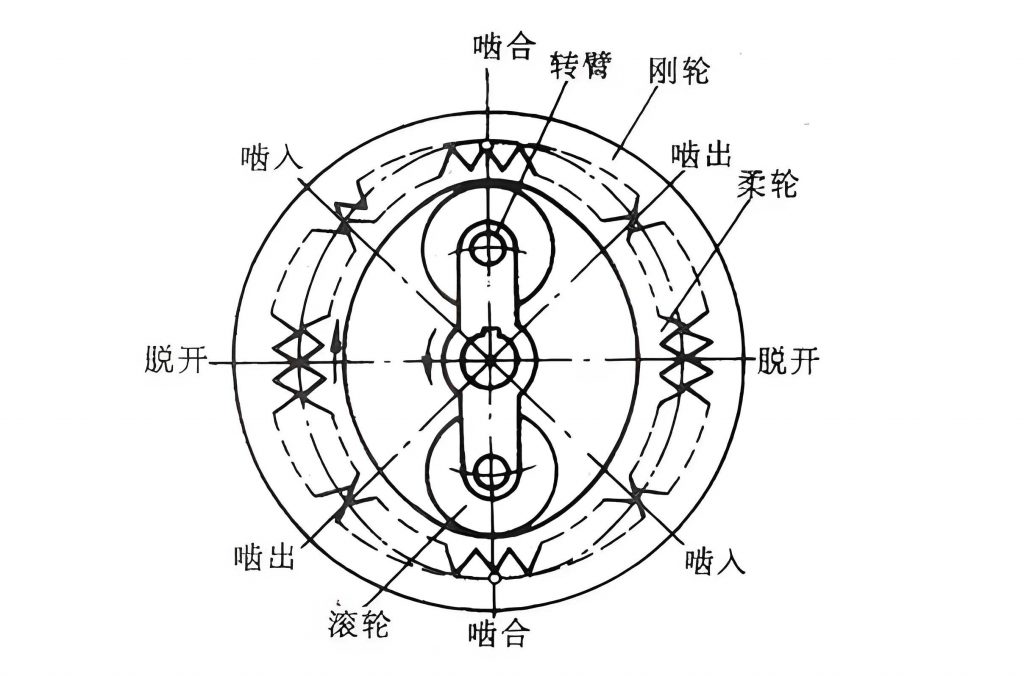
In the field of precision transmission systems, the harmonic drive gear has garnered significant attention due to its compact design, high reduction ratios, and smooth operation. Specifically, the oscillating-tooth end-face harmonic drive gear, which combines the advantages of radial harmonic gear transmission and oscillating-tooth transmission, offers a novel approach to motion control. The tooth surfaces in such systems are typically special Archimedean spiral surfaces, and the meshing pairs often feature symmetric structures. However, by adopting an asymmetric tooth profile—where the arc length corresponding to the working meshing segment is increased while reducing that of the non-working segment—we can achieve a “slow-in, fast-out” motion pattern. This enhances the number of teeth engaged simultaneously during operation, thereby increasing the transmitted power and improving overall efficiency. The necessity for modifying the tooth surfaces in asymmetric meshing pairs arises from the inherent kinematic challenges, such as sudden velocity reversals and infinite accelerations at the tooth crests and roots of the wave generator end face cam. These issues lead to severe inertial impacts, vibration, and noise, which can compromise the performance and lifespan of the harmonic drive gear. Therefore, tooth surface modification becomes crucial to mitigate these effects and ensure reliable operation.
To address these challenges, I explore a method for modifying the tooth surfaces of asymmetric meshing pairs using a secondary curve cluster envelope surface. This approach involves applying segmented quadratic curves to the crest and root regions of the wave generator end face cam, ensuring smooth transitions between modified and unmodified theoretical tooth surfaces. By doing so, we can control the acceleration of the oscillating teeth during direction changes, gradually varying their velocity from a constant value to zero and then to a constant value in the opposite direction. This modification effectively reduces impact and vibration in the harmonic drive gear. The process begins with analyzing the kinematic behavior of the oscillating teeth, which move in axial reciprocating motion within the slot wheel. Without modification, as shown in theoretical models, the displacement of the oscillating teeth is proportional to the rotation angle of the wave generator, resulting in constant velocity and zero acceleration during uniform motion. However, at the crests and roots of the cam, the velocity abruptly reverses, causing infinite acceleration and impulsive forces. Through modification, we aim to transform this discontinuous motion into a continuous and smooth one, enhancing the dynamic performance of the harmonic drive gear.
The modification of the wave generator end face cam tooth surface is performed by dividing it into segments—specifically, the rising segment (working segment) and the falling segment (non-working segment)—each with different lead angles due to the asymmetric profile. For the crest modification, I establish a coordinate system on a cylindrical surface with radius $$r$$ centered on the wave generator axis. An auxiliary coordinate system $$x’-o’-z’$$ is fixed at the crest, with the $$x’$$-axis connecting the modification start point $$-x’_1$$ and end point $$x’_2$$, and the $$z’$$-axis parallel to the wave generator axis, positive from the root to the crest. The quadratic curve equations for the rising and falling segments are defined as follows:
For the rising segment: $$z’_1 = f_1(x’) = a_1 x’^2 + b_1 x’ + c_1$$, where $$a_1$$, $$b_1$$, and $$c_1$$ are undetermined coefficients.
For the falling segment: $$z’_2 = f_2(x’) = a_2 x’^2 + b_2 x’ + c_2$$, where $$a_2$$, $$b_2$$, and $$c_2$$ are undetermined coefficients.
To ensure a smooth transition between the modified and theoretical tooth surfaces, the following conditions must be satisfied:
- $$f_1(-x’_1) = 0$$ and $$f_2(x’_2) = 0$$, indicating that the modification starts and ends at the theoretical surface.
- $$f_1(0) = f_2(0)$$, ensuring continuity at the crest.
- $$f’_1(-x’_1) = k_1$$ and $$f’_2(x’_2) = -k_2$$, where $$k_1$$ and $$k_2$$ are the slopes at the modification boundaries, derived from the theoretical lead angles.
- $$f’_1(0) = 0$$ and $$f’_2(0) = 0$$, ensuring zero slope at the crest for smoothness.
From these conditions, the coefficients are determined as:
$$a_1 = -\frac{k_1}{2x’_1}, \quad b_1 = 0, \quad c_1 = \frac{k_1 x’_1}{2}$$
$$a_2 = -\frac{k_2}{2x’_2}, \quad b_2 = 0, \quad c_2 = \frac{k_2 x’_2}{2}$$
Here, $$k_1 = \tan \theta_1 = \frac{h U}{2\pi r \lambda_W}$$ and $$k_2 = \tan \theta_2 = \frac{h U}{2\pi r (1-\lambda_W)}$$, where $$h$$ is the theoretical lift of the wave generator end face cam (equal to the theoretical tooth height of the end face gear), $$U$$ is the number of waves (or teeth) on the cam, and $$\lambda_W$$ is the tooth profile asymmetry coefficient. The values $$x’_1$$ and $$x’_2$$ are given by:
$$x’_1 = \frac{h_{W1}}{k_1} = \frac{2\pi r \lambda_W h_{W1}}{h U}, \quad x’_2 = \frac{h_{W1}}{k_2} = \frac{2\pi r (1-\lambda_W) h_{W1}}{h U}$$
where $$h_{W1}$$ is the theoretical tooth height corresponding to the crest modification zone. Substituting these into the quadratic equations yields the modified surface equations in the auxiliary coordinate system:
For the rising segment: $$z’_1 = -\frac{p’_{W1}}{r^2} x’^2 + \frac{h_{W1}}{2}, \quad \text{for } -x’_1 \leq x’ \leq 0$$
For the falling segment: $$z’_2 = -\frac{p’_{W2}}{r^2} x’^2 + \frac{h_{W1}}{2}, \quad \text{for } 0 \leq x’ \leq x’_2$$
where $$p’_{W1} = \frac{(h U)^2}{8\pi^2 \lambda_W^2 h_{W1}}$$ and $$p’_{W2} = \frac{(h U)^2}{8\pi^2 (1-\lambda_W)^2 h_{W1}}$$. Transforming these to the wave generator coordinate system $$x_1-o_1-z_1$$, where $$z_1 = z’ + h – h_{W1}$$ and $$x_1 = x’ + \lambda_W \psi_W r$$ with $$\psi_W = 2\pi / U$$ being the central angle per wave, we obtain the crest modification equations in terms of the rotation angle $$\phi_W$$:
For the rising segment: $$z_1 = -p’_{W1} (\phi_W – \lambda_W \psi_W – n \psi_W)^2 + h – \frac{h_{W1}}{2}, \quad \text{for } n = 0,1,2,\ldots,U-1$$ and $$-\lambda_W \psi_W \frac{h-h_{W1}}{h} \leq \phi_W – \lambda_W \psi_W – n \psi_W \leq \lambda_W \psi_W$$
For the falling segment: $$z_1 = -p’_{W2} (\phi_W – \lambda_W \psi_W – n \psi_W)^2 + h – \frac{h_{W1}}{2}, \quad \text{for } n = 0,1,2,\ldots,U-1$$ and $$\lambda_W \psi_W \leq \phi_W – \lambda_W \psi_W – n \psi_W \leq \lambda_W \psi_W + (1-\lambda_W) \psi_W \frac{h_{W1}}{h}$$
Similarly, for the root modification of the wave generator end face cam, I establish an auxiliary coordinate system $$x”-o”-z”$$ fixed at the root. Using the same method, the root modification equations are derived as:
For the rising segment: $$z_1 = p”_{W1} (\phi_W – n \psi_W)^2 + \frac{h_{W2}}{2}, \quad \text{for } n = 0,1,2,\ldots,U-1$$ and $$0 \leq \phi_W – n \psi_W \leq \lambda_W \psi_W \frac{h_{W2}}{h}$$
For the falling segment: $$z_1 = p”_{W2} (n \psi_W – \phi_W)^2 + \frac{h_{W2}}{2}, \quad \text{for } n = 1,2,\ldots,U$$ and $$\psi_W \frac{h – (1-\lambda_W) h_{W2}}{h} \leq n \psi_W – \phi_W \leq \psi_W$$
where $$p”_{W1} = \frac{(h U)^2}{8\pi^2 \lambda_W^2 h_{W2}}$$, $$p”_{W2} = \frac{(h U)^2}{8\pi^2 (1-\lambda_W)^2 h_{W2}}$$, and $$h_{W2}$$ is the theoretical tooth height corresponding to the root modification zone. These equations form a family of quadratic curves on cylindrical surfaces of different radii, enveloping a modified tooth surface that depends only on the rotation angle $$\phi_W$$, independent of radius $$r$$. This characteristic simplifies the design and manufacturing of the harmonic drive gear, as the modification can be applied uniformly across the tooth profile.
After modification, the tooth surface of the wave generator end face cam is divided into six segments: rising segment root modification zone, rising segment theoretical non-modification zone, rising segment crest modification zone, falling segment crest modification zone, falling segment theoretical non-modification zone, and falling segment root modification zone. The equations for the $$z_1$$ coordinate in each segment are summarized below:
| Segment | Range in $$\phi_W$$ | Equation for $$z_1$$ | Parameters |
|---|---|---|---|
| Rising Root Modification | $$0 \leq \phi_W – n\psi_W \leq \lambda_W \psi_W \frac{h_{W2}}{h}$$ | $$z_1 = p”_{W1} (\phi_W – n\psi_W)^2 + \frac{h_{W2}}{2}$$ | $$p”_{W1} = \frac{(h U)^2}{8\pi^2 \lambda_W^2 h_{W2}}$$ |
| Rising Theoretical Non-modification | $$\lambda_W \psi_W \frac{h_{W2}}{h} \leq \phi_W – n\psi_W \leq \lambda_W \psi_W \frac{h-h_{W1}}{h}$$ | $$z_1 = p_{W1} (\phi_W – n\psi_W)$$ | $$p_{W1} = \frac{h U}{2\pi \lambda_W}$$ |
| Rising Crest Modification | $$-\lambda_W \psi_W \frac{h-h_{W1}}{h} \leq \phi_W – \lambda_W \psi_W – n\psi_W \leq \lambda_W \psi_W$$ | $$z_1 = -p’_{W1} (\phi_W – \lambda_W \psi_W – n\psi_W)^2 + h – \frac{h_{W1}}{2}$$ | $$p’_{W1} = \frac{(h U)^2}{8\pi^2 \lambda_W^2 h_{W1}}$$ |
| Falling Crest Modification | $$\lambda_W \psi_W \leq \phi_W – \lambda_W \psi_W – n\psi_W \leq \lambda_W \psi_W + (1-\lambda_W) \psi_W \frac{h_{W1}}{h}$$ | $$z_1 = -p’_{W2} (\phi_W – \lambda_W \psi_W – n\psi_W)^2 + h – \frac{h_{W1}}{2}$$ | $$p’_{W2} = \frac{(h U)^2}{8\pi^2 (1-\lambda_W)^2 h_{W1}}$$ |
| Falling Theoretical Non-modification | $$\lambda_W \psi_W + (1-\lambda_W) \psi_W \frac{h_{W1}}{h} \leq n\psi_W – \phi_W \leq \psi_W \frac{h – (1-\lambda_W) h_{W2}}{h}$$ | $$z_1 = p_{W2} (n\psi_W – \phi_W)$$ | $$p_{W2} = \frac{h U}{2\pi (1-\lambda_W)}$$ |
| Falling Root Modification | $$\psi_W \frac{h – (1-\lambda_W) h_{W2}}{h} \leq n\psi_W – \phi_W \leq \psi_W$$ | $$z_1 = p”_{W2} (n\psi_W – \phi_W)^2 + \frac{h_{W2}}{2}$$ | $$p”_{W2} = \frac{(h U)^2}{8\pi^2 (1-\lambda_W)^2 h_{W2}}$$ |
To analyze the effects of this modification on the harmonic drive gear, I examine the kinematic behavior of the oscillating teeth. Assuming the slot wheel is fixed, the wave generator is the driving component, and the end face gear is the driven component, the oscillating teeth undergo axial reciprocating motion. Without modification, the displacement $$z_1$$ is proportional to $$\phi_W$$, velocity $$\dot{z}_1$$ is constant, and acceleration $$\ddot{z}_1$$ is zero during uniform motion, but becomes infinite at the crests and roots due to sudden velocity reversals. With modification, as derived from the above equations, the velocity changes gradually, preventing abrupt reversals and limiting acceleration to finite values. This significantly reduces impact and vibration in the harmonic drive gear.
For a quantitative analysis, consider an example with the following parameters: number of waves $$U = 2$$, theoretical lift $$h = 12 \, \text{mm}$$, asymmetry coefficient $$\lambda_W = 0.8$$, and modification heights $$h_{W1} = h_{W2} = 2 \, \text{mm}$$. The wave generator rotates at a speed $$n \, \text{rpm}$$, with angular velocity $$\dot{\phi}_W = \frac{2\pi n}{60} \, \text{rad/s}$$. The velocity and acceleration of the oscillating teeth in one wave period are calculated for each segment and summarized in the table below. This demonstrates how modification smooths the motion in the harmonic drive gear.
| Segment | Range in $$\phi_W$$ (rad) | Velocity $$\dot{z}_1$$ (mm/s) | Acceleration $$\ddot{z}_1$$ (mm/s²) | Example Values (for $$n$$ rpm) |
|---|---|---|---|---|
| Rising Root Modification | 0 to $$\frac{4\pi}{30}$$ | $$2 p”_{W1} \phi_W \dot{\phi}_W$$ | $$2 p”_{W1} \dot{\phi}_W^2$$ | At start: 0; mid: $$\frac{n}{4}$$; end: $$\frac{n}{2}$$; accel: $$\frac{15n}{4\pi}$$ |
| Rising Theoretical Non-modification | $$\frac{4\pi}{30}$$ to $$\frac{20\pi}{30}$$ | $$p_{W1} \dot{\phi}_W$$ | 0 | Constant: $$\frac{n}{2}$$; accel: 0 |
| Rising Crest Modification | $$\frac{20\pi}{30}$$ to $$\frac{24\pi}{30}$$ | $$-2 p’_{W1} (\phi_W – \lambda_W \psi_W) \dot{\phi}_W$$ | $$-2 p’_{W1} \dot{\phi}_W^2$$ | At start: $$\frac{n}{2}$$; mid: $$\frac{n}{4}$$; end: 0; accel: $$-\frac{15n}{4\pi}$$ |
| Falling Crest Modification | $$\frac{24\pi}{30}$$ to $$\frac{25\pi}{30}$$ | $$-2 p’_{W2} (\phi_W – \lambda_W \psi_W) \dot{\phi}_W$$ | $$-2 p’_{W2} \dot{\phi}_W^2$$ | At start: 0; mid: $$-n$$; end: $$-2n$$; accel: $$-\frac{60n}{\pi}$$ |
| Falling Theoretical Non-modification | $$\frac{25\pi}{30}$$ to $$\frac{29\pi}{30}$$ | $$-p_{W2} \dot{\phi}_W$$ | 0 | Constant: $$-2n$$; accel: 0 |
| Falling Root Modification | $$\frac{29\pi}{30}$$ to $$\pi$$ | $$-2 p”_{W2} (\psi_W – \phi_W) \dot{\phi}_W$$ | $$2 p”_{W2} \dot{\phi}_W^2$$ | At start: $$-2n$$; mid: $$-n$$; end: 0; accel: $$\frac{60n}{\pi}$$ |
From this analysis, it is evident that after modification, the velocity of the oscillating teeth varies gradually across segments, without sudden jumps. The acceleration is confined to finite values, such as $$\frac{15n}{4\pi}$$ or $$-\frac{60n}{\pi}$$ in the example, compared to infinite acceleration in the unmodified case. This reduction in acceleration minimizes inertial forces, thereby decreasing impact and vibration in the harmonic drive gear. The smooth motion profile enhances the transmission stability and longevity, making the asymmetric meshing pair more practical for high-power applications.
Furthermore, the modification method using quadratic curve clusters ensures that the envelope surface is independent of the cylindrical radius $$r$$, simplifying the manufacturing process. The tooth surface equations depend solely on the rotation angle $$\phi_W$$, allowing for consistent profiling across the gear. This approach not only addresses the kinematic issues but also maintains the axial relative position between the wave generator and end face gear, crucial for preserving normal meshing in unmodified zones. To achieve this, corresponding modifications must be applied to the end face gear and both ends of the oscillating teeth, with modification heights proportionally related. For instance, if the wave generator crest is modified by $$h_{W1}$$, the end face gear root should be modified accordingly to maintain the meshing clearance. This coordinated modification ensures that both meshing pairs—wave generator to oscillating tooth and oscillating tooth to end face gear—operate smoothly without interference, optimizing the performance of the harmonic drive gear.
In conclusion, the tooth surface modification of asymmetric meshing pairs in oscillating-tooth end-face harmonic drive gears is essential for mitigating dynamic challenges. By applying quadratic curve clusters to the crests and roots of the wave generator end face cam, we can control the acceleration of oscillating teeth, reducing impact and vibration. The derived equations provide a practical framework for designing modified tooth surfaces, and kinematic analysis confirms the effectiveness of this approach. The harmonic drive gear benefits from increased engagement teeth, higher power transmission, and improved operational smoothness. Future work could explore optimization of modification parameters, such as $$h_{W1}$$ and $$h_{W2}$$, to further enhance performance or investigate thermal and wear effects. Overall, this modification strategy advances the reliability and efficiency of harmonic drive gears in precision mechanical systems, underscoring their versatility in modern engineering applications.
To elaborate on the broader implications, the harmonic drive gear is widely used in robotics, aerospace, and industrial automation due to its compactness and high torque capacity. The asymmetric meshing design, coupled with tooth surface modification, pushes the boundaries of these applications by enabling higher load-bearing capabilities and reduced noise. For example, in robotic joints, where smooth motion is critical, modified harmonic drive gears can minimize jerks and improve positioning accuracy. Similarly, in satellite mechanisms, where reliability is paramount, the reduced vibration extends component lifespan. The mathematical modeling presented here—using coordinate transformations, quadratic equations, and kinematic principles—serves as a foundation for customizing harmonic drive gears for specific needs. By integrating these modifications into computer-aided design (CAD) and manufacturing (CAM) systems, engineers can efficiently produce gears with tailored profiles, enhancing the adaptability of harmonic drive technology. Thus, the ongoing development of tooth surface modification techniques continues to drive innovation in transmission systems, solidifying the harmonic drive gear’s role as a key component in advanced machinery.