
The harmonic drive gear, commonly known as a strain wave gear or harmonic drive reducer, represents a revolutionary advancement in precision power transmission. Its unique operating principle, which relies on controlled elastic deformation rather than purely rigid body kinematics, enables performance characteristics unattainable by conventional gear systems. I will delve into the fundamental composition, working principle, distinctive advantages, and wide-ranging applications of the harmonic drive gear. Subsequently, I will provide an in-depth exposition on the design philosophy and methodologies for its core component—the flexspline—covering the critical aspects of diaphragm, cylinder, tooth profile, and tooth alignment design.
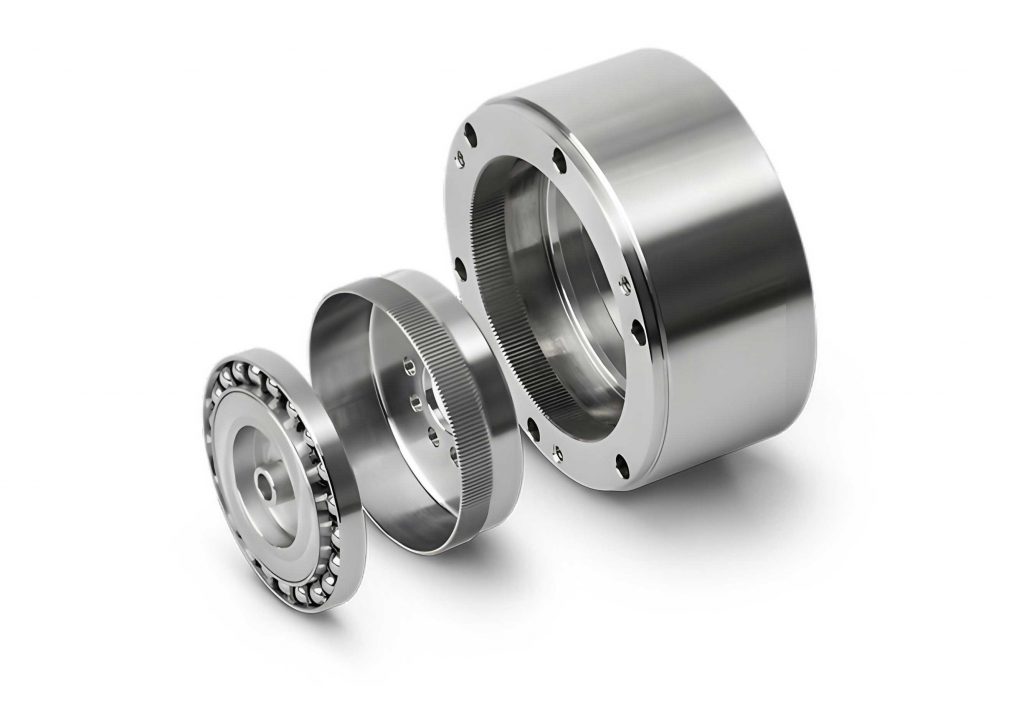
A standard harmonic drive gear assembly is elegantly simple in concept, comprising three fundamental components: the Flexspline, the Circular Spline, and the Wave Generator. This triad works in concert to achieve high-ratio motion reduction.
1. The Three Core Components:
- The Flexspline: This is a thin-walled, flexible external gear. Typically crafted from high-strength alloy steel, it is designed to undergo controlled elastic deformation. Its inner diameter is matched to the outer race of a flexible bearing. In most configurations, the harmonic drive gear output is taken from the flexspline.
- The Circular Spline: This is a rigid, stationary internal gear, usually fixed to the housing of the reducer. A key design feature is that the circular spline possesses two more teeth than the flexspline ($$Z_c = Z_f + 2$$). This tooth difference is fundamental to the motion generation mechanism.
- The Wave Generator: Serving as the input element, the wave generator is responsible for deforming the flexspline. It typically consists of an elliptical cam over which a specially designed “Flexible Bearing” is mounted. The bearing’s inner race is fixed to the cam, while its outer race, fitted inside the flexspline, conforms to the elliptical shape, forcing the flexspline to assume a similar profile.
2. Operational Principle:
The magic of the harmonic drive gear unfolds during operation. As the wave generator rotates, it imposes a traveling elastic wave onto the flexspline. The flexspline’s rim deforms into a predictable elliptical shape. At the major axis of this ellipse, the teeth of the flexspline fully engage with the tooth spaces of the circular spline. At the minor axis, the teeth are completely disengaged. The regions between the major and minor axes represent zones of partial engagement—either meshing-in or meshing-out.
The critical kinematic action stems from the tooth differential. For each complete 360-degree revolution of the wave generator (input), the elliptical deformation pattern also completes one revolution. However, because the circular spline has two extra teeth and is held stationary, the flexspline must rotate slightly in the opposite direction to the wave generator to reconcile the positional mismatch of its teeth. This relative motion, known as “differential indexing” or “tooth skipping,” results in a very high reduction ratio in a compact space. The reduction ratio ($$i$$) for a standard configuration is given by:
$$i = -\frac{Z_f}{Z_c – Z_f} = -\frac{Z_f}{2}$$
where $$Z_f$$ is the number of teeth on the flexspline and $$Z_c$$ on the circular spline. The negative sign indicates the reversal in rotation direction between the wave generator (input) and the flexspline (output).
3. Distinctive Characteristics and Advantages:
The unique kinematic and structural nature of the harmonic drive gear bestows upon it a set of remarkable performance characteristics when compared to conventional gear reducers like planetary or spur gear sets.
| Characteristic | Description | Typical Value / Implication |
|---|---|---|
| High Reduction Ratio | Single-stage reduction offers a wide range of high ratios. | 50 to 500 (Can exceed 1000 with special wave generators). |
| High Torque Capacity & Load Distribution | A large percentage of teeth share the load simultaneously. | 30% to 40% of total teeth are engaged under nominal load. |
| Exceptional Positioning Accuracy & Repeatability | High torsional stiffness and multi-tooth engagement minimize backlash. | Accuracy is typically one grade higher than conventional gears of similar manufacturing precision. Near-zero or adjustable backlash is achievable. |
| High Efficiency | Low sliding friction due to controlled rolling motion between conjugated tooth profiles. | Single-stage efficiency ranges from 65% to 90%, depending on ratio and load. |
| Compactness & Light Weight | High ratio in a single stage eliminates multiple gear stages. | Volume and mass can be reduced by 1/3 to 1/2 compared to equivalent conventional reducers. |
| Smooth & Quiet Operation | Controlled elastic meshing with no sudden tooth engagement/disengagement. | Vibration and noise levels are significantly lower. |
The dynamic behavior of a harmonic drive gear can be modeled considering its torsional stiffness ($$K_t$$), damping ($$C_t$$), and moment of inertia. A simplified equation of motion for the output under an input torque ($$T_{in}$$) and load torque ($$T_{load}$$) is:
$$ J_{eq}\ddot{\theta}_o + C_t\dot{\theta}_o + K_t \theta_o = \frac{T_{in}}{i} – T_{load} $$
where $$J_{eq}$$ is the equivalent inertia reflected to the output shaft and $$\theta_o$$ is the output angular displacement.
4. Broad Spectrum of Applications:
The unparalleled combination of high ratio, precision, compactness, and zero-backlash performance has cemented the role of the harmonic drive gear as an enabling technology across cutting-edge and demanding industries. Its applications are vast and critical.
- Aerospace & Aviation: Actuation systems for flight control surfaces, antenna positioning, and satellite solar array drives.
- Robotics: The quintessential joint actuator for industrial, collaborative, and humanoid robots, providing precise motion in a compact package.
- Medical & Surgical Equipment: Used in MRI-guided robots, surgical manipulators, and prosthetics where precision and reliability are paramount.
- Semiconductor Manufacturing: Precision stages, wafer handling robots, and photolithography equipment.
- Optical & Instrumentation Systems: Telescope mounts, precision rotary stages, and laser steering mechanisms.
- Machine Tools & Factory Automation: Rotary tables, indexing heads, and high-precision CNC axes.
5. In-Depth Design of the Flexspline: The Heart of the Harmonic Drive Gear
The flexspline is undoubtedly the most critical and complex component within the harmonic drive gear. It operates under a state of perpetual cyclic elastic deformation, directly governing the reducer’s torsional stiffness, fatigue life, positional accuracy, and load capacity. Its design is a sophisticated balance of structural elasticity and gear geometry.
5.1. Structural Configuration:
Common flexspline configurations include the Cup Type and the Hat (or Top Hat) Type. The cup-type flexspline, featuring an integrated diaphragm and cylindrical body (or “cylinder” portion) terminating in an external gear rim, is a prevalent design due to its favorable stiffness and load-bearing characteristics.
5.2. Diaphragm and Cylinder Design:
The diaphragm and cylinder act as the compliant members that absorb the periodic elliptical deformation induced by the wave generator. Their geometry is paramount to ensuring a smooth stress distribution and maximizing fatigue life.
Diaphragm Profile: The diaphragm is typically constructed from a series of tangent circular arcs to create a smooth, optimized thickness transition. Let the nominal diaphragm thickness at its root (near the mounting flange) be $$t_a$$. The thickness tapers towards the cylinder. A primary design guideline is:
$$ 0.01D \leq t_a \leq 0.025D $$
where $$D$$ is the pitch diameter of the flexspline. Furthermore, the thickness ratio at the end of the diaphragm taper should satisfy $$t_b / t_a \leq \frac{1}{3}$$. The geometry is defined by consecutive arcs with radii ratios relative to a base arc radius ($$R_{base}$$). A conceptual parameter set is shown below.
| Arc Segment | Center | Radius Ratio (Relative) | Function |
|---|---|---|---|
| Root Arc | O1 | 1 | Provides structural rigidity at the interface. |
| Transition Arc 1 | O2 | $$R_1$$ | Initiates the smooth thickness reduction. |
| Transition Arc 2 | O3 | $$R_2$$ | Controls the stress concentration gradient. |
| Diaphragm End Arc | O4 | $$R_3$$ | Blends into the cylinder connection. |
Cylinder Design: The cylinder (or “barrel”) is the thin-walled section connecting the diaphragm to the gear rim. Its length ($$L_{cyl}$$) is divided into a crowned section ($$L_3$$) and a parallel section ($$L_4$$). The parallel section has a constant wall thickness $$t_d$$. The crowned section, with a radius centered at O7, has a minimum thickness $$t_c$$ at its midpoint to accommodate bending. A typical relationship is $$t_c / t_d = N/1$$, where N is a design factor less than 1. The radius ratio for the crowned section is defined relative to the base arc: $$R_{cyl} / R_{base} = R_4$$.
Connection Zone: The junction between the diaphragm and the cylinder is a critical stress area. It is designed with generous fillet radii (centered at O5 and O6 for inner and outer walls, respectively) to mitigate stress concentration. The size of these fillets is also expressed as a ratio: $$R_{fillet} / R_{base} = M$$.
5.3. Tooth Profile Design Evolution and Considerations:
The tooth profile of a harmonic drive gear is not a standard involute. It must account for the continuous motion of the meshing zone along the deformed flexspline rim. The goal is to ensure conjugate action, maximize contact area, minimize wear and stress, and facilitate lubrication.
- Historical Profiles: Early designs used simple straight-sided (trapezoidal) teeth. Involute profiles offered improvement but were not optimal for the elliptical deformation.
- Advanced Profiles: Modern harmonic drive gear systems employ sophisticated, proprietary profiles. These include:
- Double-Arc (or S-shaped) Profile: Features two conjugate circular arcs, promoting favorable rolling contact and high load capacity.
- IH (Involute-Hooke) Profile: A specialized profile developed to optimize contact conditions under deformation.
- ES (Enhanced Stress) Profile: An example of continued innovation focused on maximizing contact ratio and minimizing root bending stress through optimized tooth flank geometry.
The fundamental design parameters are determined by the required reduction ratio ($$R$$). The flexspline tooth count is $$Z_f = 2R$$, and the circular spline tooth count is $$Z_c = Z_f + 2$$. The detailed tooth flank coordinates are then generated based on the conjugate action theory for the specific wave generator curve (often an ellipse with a defined radial deformation, $$w_0$$). The basic radial displacement of the flexspline neutral line can be described as:
$$ w(\phi) = w_0 \cos(2\phi) $$
where $$\phi$$ is the angular position along the flexspline circumference relative to the wave generator’s major axis.
5.4. Tooth Alignment (Longitudinal Crowning):
Due to the “conical” deformation or opening angle of the flexspline cup under load, the radial deformation is not constant along the tooth face width. The rim tilts slightly, meaning the effective mesh plane varies axially. To prevent edge loading at the ends of the tooth and to ensure a broad, central contact pattern, the teeth are not straight in the axial direction. Instead, a slight longitudinal crown or helix angle ($$\alpha$$) is applied. The theoretical value for this angle is derived from the geometry of deformation:
$$ \alpha = \arctan\left(\frac{w_0}{L}\right) $$
where:
- $$w_0$$ is the maximum radial deformation at the gear rim (a function of wave generator geometry and required clearance).
- $$L$$ is the effective axial distance from the center of the flexible bearing balls to the cup diaphragm’s root.
This crowning ensures that under operational load, the contact pattern is centered on the tooth flank, optimizing load distribution and longevity of the harmonic drive gear.
6. Material and Manufacturing Considerations:
The flexspline material must exhibit high fatigue strength, good toughness, and consistent mechanical properties. Commonly used materials include high-grade alloy steels such as AISI 4340, 35NCD16, or similar, often subjected to case hardening (carburizing or nitriding) to provide a hard, wear-resistant surface over a tough, ductile core. Precision machining, followed by specialized heat treatment and finishing processes like honing or grinding of the tooth profile, are essential to achieve the required dimensional accuracy and surface integrity for reliable, long-life performance of the harmonic drive gear.
7. Conclusion:
The harmonic drive gear stands as a pinnacle of precision mechanical design, transforming the principle of elastic deformation into a highly advantageous kinematic solution. Its defining characteristics—exceptional reduction ratios in a single stage, high positional accuracy with near-zero backlash, compactness, and smooth operation—make it indispensable in advanced technological fields from robotics to aerospace. The heart of this system, the flexspline, requires a multidisciplinary design approach that intricately blends structural mechanics (for the diaphragm and cylinder) with advanced gear geometry (for the tooth profile and alignment). Continuous innovation in materials, profile design, and analysis techniques ensures that the harmonic drive gear will remain a critical enabling technology for high-performance motion control systems, pushing the boundaries of precision, miniaturization, and reliability.