
In the pursuit of advanced power transmission systems that combine high reduction ratios with substantial torque capacity, my analysis focuses on a particularly innovative variant: the oscillating teeth end face harmonic drive gear. This mechanism ingeniously synthesizes the principles of traditional harmonic drives and oscillating tooth transmissions, resulting in a spatially compact yet powerful architecture. While conventional designs employ symmetric tooth profiles for both the wave generator and the flex gear, my investigation delves into the superior potential of asymmetric profiles. This design modification fundamentally alters the temporal and spatial engagement characteristics, allowing for a pronounced “slow-in, fast-out” motion cycle. This paper, from my perspective, aims to systematically derive the precise mathematical conditions for constant instantaneous transmission ratio and the complete set of tooth surface equations governing all meshing pairs in an asymmetric tooth profile harmonic drive gear system.
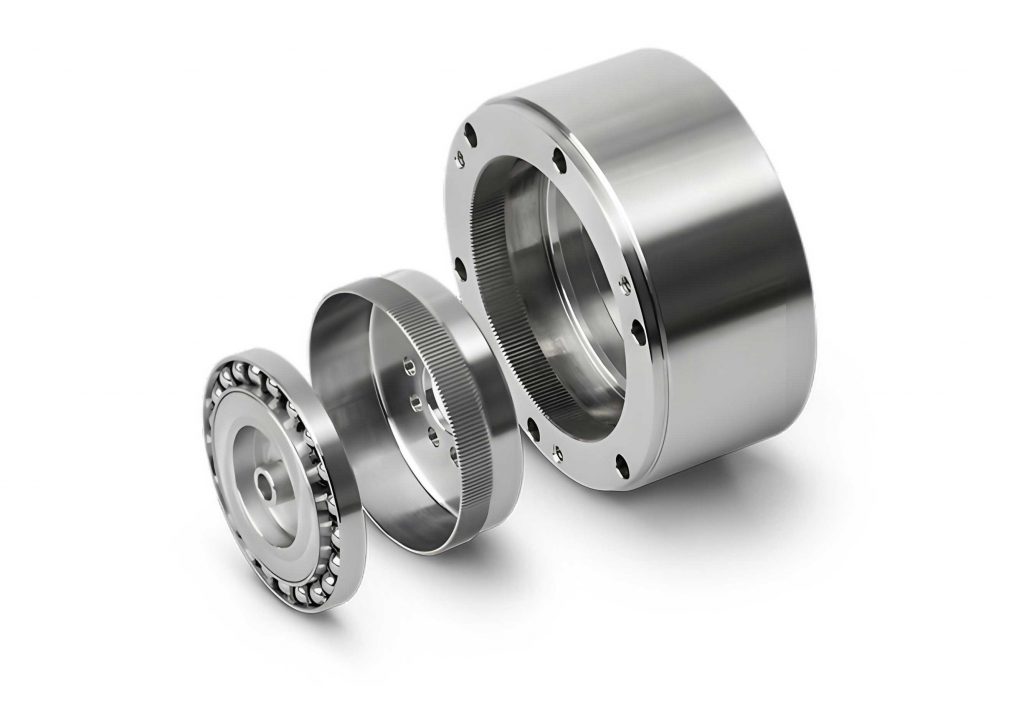
The core structure of the oscillating teeth end face harmonic drive gear comprises four primary components: the end face gear (flex gear), the wave generator, the oscillating teeth (or活齿), and the槽轮 (carrier slot wheel). For the purpose of elucidating the meshing theory, we can consider a simplified unilateral transmission model. In this configuration, each oscillating tooth forms two critical meshing pairs: Pair A, between its rear end and the wave generator’s cam surface, and Pair B, between its front end and the tooth surface of the end face gear. In a symmetric design, both engaging profiles are mirror images across their respective pitch lines. However, the transition to an asymmetric harmonic drive gear introduces distinct profiles for the working (rising) flank and the non-working (returning) flank on all three active elements: the wave generator cam, the oscillating teeth ends, and the end face gear teeth.
The primary motivation for adopting asymmetric profiles in a harmonic drive gear is to enhance power density. By increasing the angular extent (and thus the time duration) of the working engagement arc while decreasing that of the non-working arc, a greater number of teeth can be in simultaneous contact during the power-transmitting phase of the cycle. This effectively distributes the load across more contact points, thereby increasing the torque capacity without necessarily enlarging the physical dimensions of the harmonic drive gear assembly.
Quantifying Asymmetry: The Tooth Profile Asymmetry Coefficient
To mathematically describe and analyze the asymmetric harmonic drive gear, I introduce a key parameter: the tooth profile asymmetry coefficient, denoted as $\lambda$. This coefficient provides a precise measure of the deviation from symmetry for any of the engaging components.
- Wave Generator Asymmetry Coefficient ($\lambda_W$): For the wave generator cam, $\lambda_W$ is defined as the ratio of the arc length corresponding to one working (rising) flank on a cylinder of radius $r$ to the total arc length of one complete wave on the same cylinder. For a symmetric cam, $\lambda_W = 0.5$.
- End Face Gear Asymmetry Coefficient ($\lambda_E$): For the end face gear, $\lambda_E$ is defined as the ratio of the arc length corresponding to one working flank on a cylinder of radius $r$ to the total arc length of one tooth on the same cylinder. For symmetric gear teeth, $\lambda_E = 0.5$.
- Oscillating Tooth Asymmetry Coefficient ($\lambda_O$): The oscillating tooth must simultaneously mate with both the wave generator and the end face gear. For correct meshing throughout the cycle, its asymmetry must be compatible. Therefore, a fundamental condition for a functional asymmetric harmonic drive gear is:
$$\lambda_O = \lambda_W = \lambda_E = \lambda$$
This condition ensures kinematic compatibility between all meshing pairs.
Consider the geometric layout of the meshing pairs unfolded on a cylindrical surface of radius $r$. Let $h$ be the theoretical lift of the wave generator cam (equal to the theoretical tooth height of the end face gear), $U$ be the number of waves on the generator (typically $U=2$), and $z_E$ be the number of teeth on the end face gear. The lead angles for the wave generator’s working and non-working flanks are $\theta_1$ and $\theta_2$, respectively. The pressure angles (or flank angles) for the end face gear’s working and non-working flanks are $\alpha_1$ and $\alpha_2$, respectively. From the unfolded geometry, we establish the following relationships:
$$\tan\theta_1 = \frac{hU}{2\pi r \lambda}, \quad \tan\theta_2 = \frac{hU}{2\pi r (1-\lambda)}$$
$$\tan\alpha_1 = \frac{2\pi r \lambda}{z_E h}, \quad \tan\alpha_2 = \frac{2\pi r (1-\lambda)}{z_E h}$$
From these equations, the ratio of the tangents is derived as:
$$\frac{\tan\theta_1}{\tan\theta_2} = \frac{1-\lambda}{\lambda} = \frac{\tan\alpha_2}{\tan\alpha_1}$$
A crucial finding is the product rule, which emerges from combining these equations and applying the condition $\lambda_W = \lambda_E$:
$$\tan\theta_1 \tan\alpha_1 = \tan\theta_2 \tan\alpha_2 = \frac{U}{z_E}$$
This product, $\tan\theta \tan\alpha$, must be constant across all cylindrical sections (i.e., for all radii $r$) to ensure a constant instantaneous velocity ratio in a harmonic drive gear. Therefore, the fundamental condition for constant transmission ratio in an asymmetric harmonic drive gear is:
$$
\boxed{\tan\theta_1(r) \cdot \tan\alpha_1(r) = \tan\theta_2(r) \cdot \tan\alpha_2(r) = \frac{U}{z_E} = \text{constant}}
$$
This elegantly generalizes the condition for symmetric harmonic drive gears (where $\lambda=0.5$, $\theta_1=\theta_2$, $\alpha_1=\alpha_2$). Once the design parameters $h$, $U$, $z_E$, and the chosen asymmetry coefficient $\lambda$ are specified, the unique lead and pressure angles at any radius can be determined.
Mathematical Derivation of Tooth Surface Equations
The engaging surfaces in this harmonic drive gear are all special types of Archimedean helicoids, where the generatrix is a straight line perpendicular to and intersecting the axis. The asymmetry is incorporated by allowing different helical parameters for the working and non-working flanks. I will now derive the equations for each component in their respective coordinate systems.
1. Wave Generator Cam Surface
I establish a right-handed coordinate system $O_1 – x_1y_1z_1$ fixed to the wave generator. The $z_1$-axis coincides with the generator’s axis of rotation. The cam surface is a multi-start ($U$-start) helicoid. For a general asymmetric profile, the surface equations are split for the right-hand (working) and left-hand (non-working) flanks.
Right-Hand (Working) Flank Helicoid:
$$
\begin{cases}
x_1 = r \cos \varphi_W \\
y_1 = r \sin \varphi_W \\
z_1 = p_{W1} (\varphi_W – n\psi_W)
\end{cases}
$$
where:
$$R_f \le r \le R_a, \quad n = 0, 1, 2, …, U-1, \quad 0 \le \varphi_W – n\psi_W \le \lambda \psi_W$$
Here, $\varphi_W$ is the rotation angle of the wave generator, $\psi_W = 2\pi/U$ is the central angle per wave, and $p_{W1}$ is the helical parameter for the working flank:
$$p_{W1} = \frac{hU}{2\pi\lambda}$$
Left-Hand (Non-Working) Flank Helicoid:
$$
\begin{cases}
x_1 = r \cos \varphi_W \\
y_1 = r \sin \varphi_W \\
z_1 = p_{W2} (n\psi_W – \varphi_W)
\end{cases}
$$
where:
$$R_f \le r \le R_a, \quad n = 1, 2, …, U, \quad 0 \le n\psi_W – \varphi_W \le (1-\lambda) \psi_W$$
The helical parameter for the non-working flank is:
$$p_{W2} = \frac{hU}{2\pi(1-\lambda)}$$
It is evident that when $\lambda = 0.5$, we have $p_{W1} = p_{W2} = hU/\pi$, and the angular bounds become $\psi_W/2$, reducing the equations to the symmetric harmonic drive gear case.
2. End Face Gear Tooth Surface
I establish a coordinate system $O_2 – x_2y_2z_2$ fixed to the end face gear, with the $z_2$-axis along its rotation axis. The gear tooth surface is a multi-start ($z_E$-start) helicoid.
Right-Hand Flank Helicoid:
$$
\begin{cases}
x_2 = r \cos \varphi_E \\
y_2 = r \sin \varphi_E \\
z_2 = p_{E1} (\varphi_E – n\psi_E)
\end{cases}
$$
where:
$$R_f \le r \le R_a, \quad n = 0, 1, 2, …, z_E-1, \quad 0 \le \varphi_E – n\psi_E \le \lambda \psi_E$$
Here, $\varphi_E$ is the rotation angle of the end face gear, $\psi_E = 2\pi/z_E$ is the central angle per tooth, and $p_{E1}$ is its helical parameter:
$$p_{E1} = \frac{h z_E}{2\pi\lambda}$$
Left-Hand Flank Helicoid:
$$
\begin{cases}
x_2 = r \cos \varphi_E \\
y_2 = r \sin \varphi_E \\
z_2 = p_{E2} (n\psi_E – \varphi_E)
\end{cases}
$$
where:
$$R_f \le r \le R_a, \quad n = 1, 2, …, z_E, \quad 0 \le n\psi_E – \varphi_E \le (1-\lambda) \psi_E$$
The corresponding helical parameter is:
$$p_{E2} = \frac{h z_E}{2\pi(1-\lambda)}$$
Again, symmetry ($\lambda=0.5$) yields $p_{E1} = p_{E2} = h z_E/\pi$.
3. Oscillating Tooth Engagement Surfaces
The oscillating tooth has two active ends. I define coordinate system $O_3 – x_3y_3z_3$ fixed to the rear end (meshing with the wave generator) and $O_4 – x_4y_4z_4$ fixed to the front end (meshing with the end face gear).
Rear End (Wave Generator Pair) Surface Equations:
For the right-hand flank in $O_3$:
$$
\begin{cases}
x_3 = r \cos \varphi_O \\
y_3 = r \sin \varphi_O \\
z_3 = p_{OW1} \varphi_O
\end{cases}
\quad \text{for } 0 \le \varphi_O \le \lambda \psi_O
$$
where $\varphi_O$ is the oscillating tooth’s angular coordinate ($\varphi_O = \varphi_E$), $\psi_O = 2\pi/z_E$, and the helical parameter must match the wave generator’s: $p_{OW1} = p_{W1} = \dfrac{hU}{2\pi\lambda}$.
For the left-hand flank in $O_3$:
$$
\begin{cases}
x_3 = r \cos \varphi_O \\
y_3 = r \sin \varphi_O \\
z_3 = p_{OW2} (\psi_O – \varphi_O)
\end{cases}
\quad \text{for } 0 \le \psi_O – \varphi_O \le (1-\lambda) \psi_O
$$
with $p_{OW2} = p_{W2} = \dfrac{hU}{2\pi(1-\lambda)}$.
Front End (End Face Gear Pair) Surface Equations:
For the right-hand flank in $O_4$:
$$
\begin{cases}
x_4 = r \cos \varphi_O \\
y_4 = r \sin \varphi_O \\
z_4 = -p_{OE1} \varphi_O
\end{cases}
\quad \text{for } 0 \le \varphi_O \le \lambda \psi_O
$$
The negative sign indicates the opposite hand of the helicoid relative to the rear end, and $p_{OE1} = p_{E1} = \dfrac{h z_E}{2\pi\lambda}$.
For the left-hand flank in $O_4$:
$$
\begin{cases}
x_4 = r \cos \varphi_O \\
y_4 = r \sin \varphi_O \\
z_4 = -p_{OE2} (\psi_O – \varphi_O)
\end{cases}
\quad \text{for } 0 \le \psi_O – \varphi_O \le (1-\lambda) \psi_O
$$
with $p_{OE2} = p_{E2} = \dfrac{h z_E}{2\pi(1-\lambda)}$.
The complete set of equations for the asymmetric harmonic drive gear is summarized in the table below, contrasting them with the symmetric case.
| Component & Flank | Symmetric ($\lambda=0.5$) | Asymmetric ($\lambda \neq 0.5$) |
|---|---|---|
| Wave Generator Right-Hand Flank Helical Param. ($p_{W1}$) |
$$\frac{hU}{\pi}$$ | $$\frac{hU}{2\pi\lambda}$$ |
| Wave Generator Angular Bound |
$$0 \le \varphi_W – n\psi_W \le \frac{\psi_W}{2}$$ | $$0 \le \varphi_W – n\psi_W \le \lambda \psi_W$$ |
| Wave Generator Left-Hand Flank Helical Param. ($p_{W2}$) |
$$\frac{hU}{\pi}$$ | $$\frac{hU}{2\pi(1-\lambda)}$$ |
| Wave Generator Angular Bound |
$$0 \le n\psi_W – \varphi_W \le \frac{\psi_W}{2}$$ | $$0 \le n\psi_W – \varphi_W \le (1-\lambda)\psi_W$$ |
| End Face Gear Right-Hand Flank Helical Param. ($p_{E1}$) |
$$\frac{h z_E}{\pi}$$ | $$\frac{h z_E}{2\pi\lambda}$$ |
| End Face Gear Angular Bound |
$$0 \le \varphi_E – n\psi_E \le \frac{\psi_E}{2}$$ | $$0 \le \varphi_E – n\psi_E \le \lambda \psi_E$$ |
| End Face Gear Left-Hand Flank Helical Param. ($p_{E2}$) |
$$\frac{h z_E}{\pi}$$ | $$\frac{h z_E}{2\pi(1-\lambda)}$$ |
| End Face Gear Angular Bound |
$$0 \le n\psi_E – \varphi_E \le \frac{\psi_E}{2}$$ | $$0 \le n\psi_E – \varphi_E \le (1-\lambda)\psi_E$$ |
| Condition for Constant Transmission Ratio | $$\tan\theta \cdot \tan\alpha = \frac{U}{z_E}$$ | $$\tan\theta_1 \tan\alpha_1 = \tan\theta_2 \tan\alpha_2 = \frac{U}{z_E}$$ |
Design Implications and Performance Considerations
The derivation of these equations provides a complete mathematical framework for designing and manufacturing an asymmetric tooth profile harmonic drive gear. The asymmetry coefficient $\lambda$ becomes a powerful new design variable. Selecting $\lambda > 0.5$ extends the working engagement arc for both meshing pairs. For instance, with $\lambda = 0.7$, the working flank occupies 70% of the wave or tooth period, theoretically allowing up to 40% more teeth to be in the load-bearing phase simultaneously compared to the symmetric case ($\lambda=0.5$). This directly translates to a higher load-sharing factor and increased torque capacity for the harmonic drive gear.
However, this advantage comes with trade-offs that must be carefully managed. A larger $\lambda$ increases the lead angle $\theta_1$ on the wave generator’s working flank ($\tan\theta_1 \propto 1/\lambda$), which may lead to higher contact pressures and steeper pressure angles $\alpha_1$ on the gear tooth. Conversely, the non-working flanks become very steep ($\theta_2$ and $\alpha_2$ increase as $\lambda$ increases), which must be checked for interference and manufacturability. The helical parameters $p$ also become functions of $\lambda$, affecting the axial dimensions and the kinematics of the oscillating teeth. Therefore, optimizing the value of $\lambda$ requires a balanced analysis considering stress, wear, efficiency, and manufacturing constraints specific to the harmonic drive gear application.
The constant transmission ratio condition, $\tan\theta_1 \tan\alpha_1 = U/z_E$, imposes a strict relationship between the lead angles and pressure angles at every radial position $r$. This condition ensures that the velocity ratio between the wave generator input and the end face gear output remains absolutely constant, a hallmark of precision harmonic drive gear systems, eliminating velocity fluctuation that could cause vibration and noise.
Conclusion
My detailed analysis establishes a rigorous foundation for the asymmetric tooth profile oscillating teeth end face harmonic drive gear. By introducing the asymmetry coefficient $\lambda$, I have successfully generalized the meshing theory from the symmetric case. The key outcomes are:
- The precise mathematical condition for constant instantaneous velocity ratio in the asymmetric configuration: $\tan\theta_1 \tan\alpha_1 = \tan\theta_2 \tan\alpha_2 = U/z_E$.
- The complete set of tooth surface equations for all three engaging components (wave generator, end face gear, and oscillating teeth), explicitly incorporating $\lambda$ into the helical parameters ($p_{W1}, p_{W2}, p_{E1}, p_{E2}$) and the angular bounds of the flanks.
This mathematical model reveals that the symmetric profile is merely a special case of the more general asymmetric harmonic drive gear family, obtained by setting $\lambda = 0.5$. The asymmetric design provides engineers with a valuable degree of freedom to tailor the engagement characteristics, primarily to increase the simultaneous contact ratio and boost the power density of the harmonic drive gear. Future work leveraging these equations can focus on topological optimization of the tooth surfaces for stress minimization, dynamic modeling of the engagement with asymmetric profiles, and the development of specialized manufacturing techniques to accurately produce these sophisticated helicoidal surfaces. The potential for this advanced harmonic drive gear architecture in demanding applications such as robotics, aerospace, and high-performance industrial machinery is significant.