
For decades, the external and internal gear pump has served as a workhorse in hydraulic systems, prized for its straightforward construction, compactness, and robust tolerance for fluid contamination. However, a fundamental and persistent flaw has limited its progression towards higher pressures and broader applications: unbalanced radial forces. This paper introduces a conceptual leap by integrating the elegant principles of harmonic drive gear transmission into the domain of positive displacement pumps. This novel architecture, which we term the Harmonic Gear Pump, promises to resolve the perennial issue of radial force imbalance, thereby paving the way for more durable, efficient, and high-performance hydraulic pumping solutions.
The Inherent Limitation: Radial Force in Conventional Gear Pumps
In a traditional gear pump, whether external or internal, fluid pressure is not uniformly distributed around the gear periphery. The high-pressure fluid in the discharge port acts on the gear teeth and root areas, while the low-pressure fluid in the suction port exerts a much lower force. This pressure differential, acting across the gear’s circumference, results in a net radial force vector directed from the high-pressure zone toward the low-pressure zone. This force is ultimately borne by the pump’s shaft and bearings.
The consequences are well-documented and detrimental:
- Bearing Overload: The radial force significantly increases the load on support bearings, leading to accelerated wear and premature failure, which is the primary life-limiting factor for high-pressure gear pumps.
- Shaft Deflection: The shaft bends under load, altering critical clearances between gear tips and the housing (radial clearance) and between gear sides and side plates (axial clearance).
- Increased Internal Leakage: Altered clearances create paths for internal leakage from the high-pressure discharge back to the low-pressure suction, causing a drop in volumetric efficiency, especially at higher pressures.
- Contact and Wear: In severe cases, shaft deflection can cause the gears to contact the pump housing, leading to friction, scoring, and catastrophic failure.
Traditional mitigation strategies—such as pressure-balancing grooves in side plates, reducing the bearing span, or optimizing port sizes—only partially alleviate the symptom without addressing the root cause: the inherent asymmetry of pressure distribution on a symmetrically built gear pair. A paradigm shift in design philosophy is required to achieve true force symmetry.
Inspiration from Harmonic Drive Gear Transmission
The harmonic drive gear, renowned for its high reduction ratio, compactness, and precision in robotics and aerospace, operates on a fascinating principle. It typically consists of three key elements:
- A rigid circular spline (or “ring gear”).
- A flexible spline (or “flexspline”), a thin-walled external gear capable of elastic deformation.
- A wave generator, usually an elliptical cam or a bearing assembly, that deforms the flexible spline.
As the wave generator rotates, it forces the flexible spline to engage with the rigid spline at two diametrically opposite regions along the major axis of the ellipse, while the teeth disengage along the minor axis. The kinematic result is a large speed reduction between the wave generator input and the flexible spline output.
The conceptual breakthrough for pumps lies not in the speed reduction, but in the synchronous, multi-point meshing and the creation of two symmetric, sealed zones of engagement and disengagement. By reimagining the flexible spline as the pumping element and the rigid spline as the stationary housing element (or a counter-rotating element), we can create a pump with two symmetric suction and two symmetric discharge chambers.
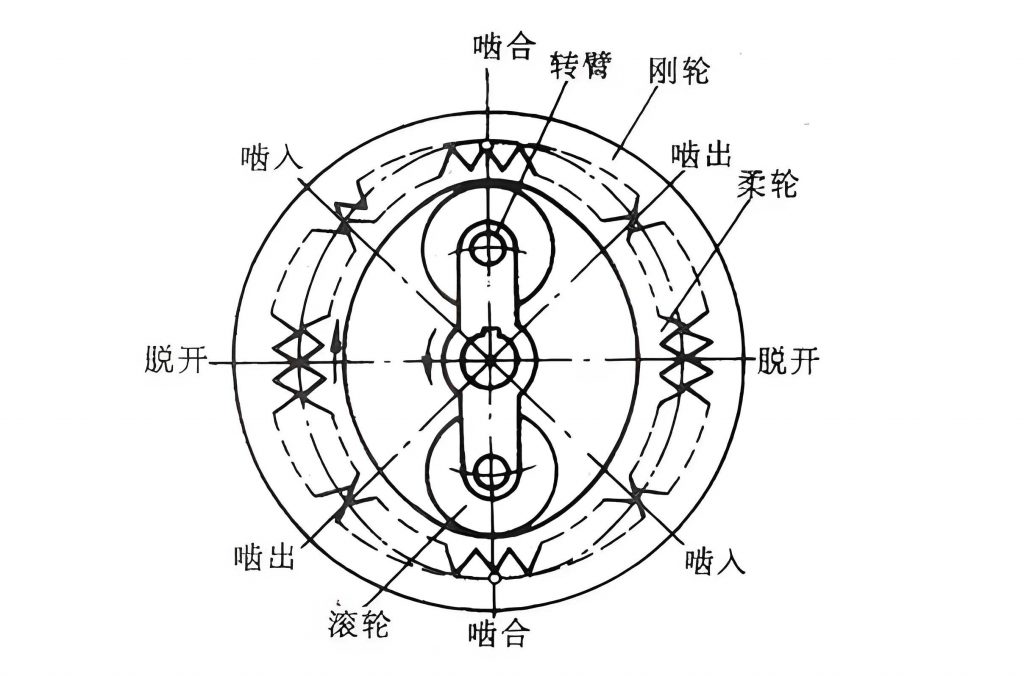
Architecture of the Harmonic Gear Pump
The proposed Harmonic Gear Pump is an internal gear pump variant that fundamentally redefines its core components. Its main constituents are detailed below and their relationship is summarized in Table 1.
| Component | Role & Description | Analogy in Traditional Pump / Harmonic Drive |
|---|---|---|
| Flexible Gear (Flexspline) | The deformable, external pumping gear. It is a thin-walled cylindrical gear that elastically deforms into an elliptical shape. | Replaces the rigid external/internal gear. Analogous to the flexspline in a harmonic drive gear. |
| Rigid Internal Gear (Circular Spline) | The rigid, internal stationary gear (or rotating driver). Its teeth mesh with the flexible gear. | Analogous to the ring gear in an internal gear pump and the circular spline in a harmonic drive gear. |
| Wave Generator | A mechanism (e.g., an elliptical cam or a two-roller assembly on an arm) that induces controlled elliptical deformation in the flexible gear. | Unique to this design. Replaces the simple shaft of a driving gear. Core principle from harmonic drive gear. |
| Radial Sealing Blocks | Fixed, crescent-shaped seals positioned at the minor axis tips of the deformed flexible gear. They isolate the high and low-pressure zones. | Functional equivalent of the crescent seal in a standard internal gear pump. |
| Housing, Side Plates, Ports | The stationary structure containing the assembly, providing axial sealing, and featuring two suction and two discharge ports. | Similar function, but with dual, symmetric porting. |
The assembly is housed within a rigid body. The wave generator, mounted on the main drive shaft, is positioned inside the flexible gear. Its elliptical profile forces the flexible gear to conform, pushing its teeth into full mesh with the rigid internal gear at two opposing points (the ends of the major axis) and causing full disengagement at the two opposing points of the minor axis. The radial sealing blocks are fixed to the side plates and contact the flexible gear’s outer surface at the minor axis locations, effectively creating four distinct chambers.
Operational Principle
Consider the rigid internal gear as the stationary element (it could also be configured to rotate). As the drive shaft rotates the wave generator clockwise, the elliptical deformation zone propagates through the flexible gear. Referring to the deformation state, we can identify four quadrants (see Figure 1 for reference).
- Quadrants I & III (Suction Chambers): Located around the ends of the major axis, the teeth of the flexible gear are disengaging from the rigid gear’s teeth. This increasing inter-tooth volume creates a vacuum, drawing fluid from the respective suction port connected to these quadrants.
- Quadrants II & IV (Discharge Chambers): Located around the ends of the minor axis (adjacent to the sealing blocks), the teeth are engaging. This decreasing inter-tooth volume pressurizes the trapped fluid and expels it through the connected discharge ports.
One complete revolution of the wave generator causes each tooth space on the flexible gear to undergo two complete filling and emptying cycles—once per each suction and each discharge chamber it passes. The flow from the two discharge chambers can be combined for a single high-flow output or used independently for dual-circuit applications. The kinematic relationship for the theoretical flow rate $Q_t$ can be derived from the geometry of the harmonic gear pump. A simplified formula considering the flexible gear’s deformation is:
$$ Q_t = 2 \cdot \left[ \pi \cdot (R_{fg,out}^2 – R_{fg,in}^2) – N_{fg} \cdot A_{tooth} \right] \cdot b \cdot n \cdot \eta_v $$
where:
$R_{fg,out}$ = Outer radius of flexible gear tooth tip
$R_{fg,in}$ = Inner radius of flexible gear root
$N_{fg}$ = Number of teeth on the flexible gear
$A_{tooth}$ = Cross-sectional area of a single tooth
$b$ = Gear width (axial length)
$n$ = Rotational speed of the wave generator
$\eta_v$ = Volumetric efficiency
The factor of 2 accounts for the dual-chamber action per revolution.
This dual-action principle is the cornerstone for both increased flow and radial force balance.
Mathematical Analysis of Radial Force Balance
The primary advantage of the harmonic gear pump is the inherent symmetry of its pressure field. We will analyze the radial hydraulic forces acting on the flexible gear. The forces on the rigid gear follow a symmetric logic. The total radial force $F_r$ on a gear is the vector sum of the pressure forces acting on its entire tooth-tip circumference. In a conventional pump, this integral yields a net force. In our design, we demonstrate it sums to zero.
Assumptions for Simplified Model:
1. Fluid pressure acts uniformly across the gear width $b$.
2. Pressure distribution around the circumference is piecewise linear between chambers (a common simplification in pump analysis).
3. The angular positions defining chamber boundaries ($\theta_1, \theta_2, …$) are constant for a given, static deformation state.
4. The high and low pressures are $p_d$ (discharge) and $p_s$ (suction), with $\Delta p = p_d – p_s$.
5. The diameter at the tooth tip of the flexible gear is $D_f$.
Figure 2 shows the pressure distribution $p(\theta)$ around the flexible gear’s tip circumference over one full revolution ($0$ to $2\pi$). Due to dual symmetric chambers, the profile from $0$ to $\pi$ is a mirror image of the profile from $\pi$ to $2\pi$.
Let’s define the profile for $0 \leq \theta \leq \pi$:
– From $\theta=0$ to $\theta=\theta_1$: Pressure is $p_s$ (suction).
– From $\theta=\theta_1$ to $\theta=\theta_2$: Pressure ramps linearly from $p_s$ to $p_d$.
– From $\theta=\theta_2$ to $\theta=\theta_3$: Pressure is $p_d$ (discharge).
– From $\theta=\theta_3$ to $\theta=\pi$: Pressure ramps linearly from $p_d$ back to $p_s$.
The symmetry imposes: $p(\theta) = p(\theta + \pi)$ for $0 \leq \theta \leq \pi$.
The radial force component on a differential element of the gear surface at angle $\theta$ is:
$$ dF = p(\theta) \cdot \left( \frac{D_f}{2} d\theta \cdot b \right) $$
This force vector points radially outward. Its components in the x and y directions (where x is aligned with the major axis) are:
$$ dF_x = dF \cdot \cos\theta = p(\theta) \cdot \frac{D_f b}{2} \cdot \cos\theta \, d\theta $$
$$ dF_y = dF \cdot \sin\theta = p(\theta) \cdot \frac{D_f b}{2} \cdot \sin\theta \, d\theta $$
Net Force in the X-Direction:
We integrate $dF_x$ over the entire circumference ($0$ to $2\pi$). Due to symmetry, we can integrate from $0$ to $\pi$ and double the result, noting the pressure function’s periodicity.
$$ F_x = \int_{0}^{2\pi} dF_x = \frac{D_f b}{2} \int_{0}^{2\pi} p(\theta) \cos\theta \, d\theta $$
Splitting the integral into the four segments defined earlier for the half-cycle and using symmetry:
$$ F_x = \frac{D_f b}{2} \left[ \int_{0}^{\theta_1} p_s \cos\theta \, d\theta + \int_{\theta_1}^{\theta_2} p(\theta) \cos\theta \, d\theta + \int_{\theta_2}^{\theta_3} p_d \cos\theta \, d\theta + \int_{\theta_3}^{\pi} p(\theta) \cos\theta \, d\theta \right] + \frac{D_f b}{2} \left[ \int_{\pi}^{2\pi} p(\theta) \cos\theta \, d\theta \right] $$
The second integral from $\pi$ to $2\pi$ is equal to the first integral from $0$ to $\pi$ because $p(\theta+\pi)=p(\theta)$ and $\cos(\theta+\pi) = -\cos\theta$. Therefore, the two halves are equal in magnitude but opposite in sign. Consequently:
$$ F_x = 0 $$
Net Force in the Y-Direction:
Following the same logic for $F_y$:
$$ F_y = \int_{0}^{2\pi} dF_y = \frac{D_f b}{2} \int_{0}^{2\pi} p(\theta) \sin\theta \, d\theta $$
Here, the symmetry property is $p(\theta+\pi)=p(\theta)$ and $\sin(\theta+\pi) = -\sin\theta$. The two half-cycle integrals again cancel each other out.
$$ F_y = 0 $$
Thus, the resultant radial hydraulic force vector on the flexible gear is:
$$ \vec{F}_r = F_x \hat{i} + F_y \hat{j} = \vec{0} $$
A similar analysis for the rigid internal gear yields an identical result of perfect radial force balance. This theoretical proof confirms that the symmetric dual-chamber architecture, inspired by the harmonic drive gear, fundamentally eliminates the net radial hydraulic force. The remaining forces are gear meshing forces, which are significantly smaller and also benefit from the multi-tooth engagement characteristic of harmonic gearing.
Comparative Advantages and Performance Characteristics
The harmonic gear pump concept offers a compelling set of advantages over conventional gear pumps, stemming directly from its harmonic drive gear-inspired design and symmetric operation.
| Feature | Conventional Gear Pump | Harmonic Gear Pump |
|---|---|---|
| Radial Force | Substantial, unbalanced net force. Primary cause of bearing wear and shaft deflection. | Theoretically zero net hydraulic radial force. Drastically reduced bearing load. |
| Flow Output & Pulsation | Single discharge chamber. Flow pulsation frequency is $f = n \cdot N$, where $N$ is tooth count. Pulsation amplitude is relatively high. | Dual discharge chambers. Effective flow rate is doubled per shaft revolution ($Q \propto 2n$). Pulsation frequency is doubled ($f = 2n \cdot N_{mesh}$), and amplitude is significantly reduced due to phase offset between chambers. |
| Pressure Capability | Limited by radial load on bearings. High-pressure designs require robust, costly bearings and pressure-balancing features. | Potential for higher pressure ratings due to eliminated radial load. Life limited by fatigue of flexible gear and seal integrity rather than bearing load. |
| Noise & Vibration | Moderate to high, due to flow pulsation, trapped volume phenomena, and meshing impacts. | Potentially lower noise due to reduced flow pulsation and the smoother, multi-tooth rolling contact of harmonic mesh. |
| Gear Contact | Primarily single or double tooth pair contact. High contact stress, sliding friction. | Simultaneous multi-tooth engagement (up to 15-30% of teeth engaged). Load distribution over many teeth reduces contact stress. Predominant rolling motion reduces friction. |
| Design Flexibility | Fixed flow per revolution based on gear geometry. | Inherent dual-circuit capability. Flow can be split or combined. Potential for variable displacement by adjusting wave generator eccentricity. |
Detailed Discussion of Key Advantages:
1. Superior Durability and Potential for Higher Pressure: The elimination of the dominant radial hydraulic force is the most transformative benefit. Bearings are sized for shaft alignment and meshing forces only, not for sustaining high-pressure fluid loads. This can lead to exceptionally long service life or, alternatively, the ability to operate at system pressures far exceeding those of conventional gear pumps without bearing-related failures.
2. High Flow Density and Smooth Flow: The pump acts as two pumps in one, effectively doubling the flow output per unit of envelope volume compared to a traditional single-chamber pump of similar size. The phase difference between the flow outputs of the two chambers results in partial overlap, leading to a much smoother total flow with lower ripple amplitude. The flow ripple factor $RF$ can be approximated as:
$$ RF_{harmonic} \approx \frac{\Delta Q_{single}}{2 \cdot \bar{Q}_{single}} $$
where $\Delta Q_{single}$ and $\bar{Q}_{single}$ are the peak-to-peak ripple and mean flow of one individual chamber, which is similar to a small traditional pump. This represents a theoretical reduction in ripple amplitude by about 50% compared to a single-chamber pump of equivalent total displacement.
3. Smooth and Robust Meshing: The engagement in a harmonic drive gear system is characterized by a progressive, rolling contact of many teeth simultaneously. This spreads the transmitted load over a larger area, minimizing bending stress at the tooth root and contact (Hertzian) stress on the tooth flank. The reduced sliding velocity also minimizes wear. These characteristics directly translate to the harmonic gear pump, promising higher endurance and reliability of the gear set itself.
Design Considerations, Challenges, and Potential
While the theoretical benefits are profound, realizing a practical harmonic gear pump involves addressing several unique engineering challenges, primarily centered on the flexible gear.
| Challenge | Description | Potential Research & Design Directions |
|---|---|---|
| Flexible Gear Fatigue Life | The core component undergoes cyclic elastic deformation (bending) at operational frequency (e.g., 1000-3000 cycles per minute). High-cycle fatigue is the primary life-limiting factor. | Material science: High-strength, high-fatigue-limit alloys (e.g., maraging steel, premium nitriding steels). Advanced surface treatments (shot peening, nitriding). Precise finite element analysis (FEA) to optimize stress distribution and eliminate stress concentrators. |
| Efficient Sealing | The radial seals must maintain contact with the continuously deforming surface of the flexible gear without causing excessive wear or friction losses. | Use of low-friction, compliant seal materials (e.g., PTFE composites, engineered thermoplastics). Hydrodynamic seal design to promote lubricating film. Careful control of the wave generator profile to minimize radial velocity at the seal contact point. |
| Heat Management | Elastic hysteresis in the flexible gear and friction at the seals/wave generator generate heat within a compact space. | Integrated cooling channels in the housing. Optimizing deformation geometry to minimize hysteresis. Efficient internal lubrication paths. |
| Manufacturing Precision | The flexible gear requires extremely precise gear teeth on a thin, cylindrical substrate that must deform predictably. | Advanced machining (wire EDM, precision hobbing of thin-walled parts). Potential for additive manufacturing (3D printing) to create optimized, complex geometries unattainable with machining. |
| Torque Requirements | The wave generator must overcome the stiffness of the flexible gear and the friction from seals. Input torque may be higher than for a rigid gear of similar size. | Optimizing flexible gear wall thickness for a balance of stiffness and deformation force. Using a rolling-element wave generator (e.g., cam follower bearings) to minimize friction. |
Potential Configurations and Applications:
The basic principle allows for several configurations:
- Stationary Rigid Gear: The classic model described, with the rigid gear fixed to the housing. The wave generator is the input, and the flexible gear orbits and rotates, driving an output shaft.
- Rotating Rigid Gear: Both the rigid gear and the wave generator can be driven, allowing for differential speed control and potentially variable displacement.
- Multi-Flex Gear Designs: Conceptually, nested harmonic stages could be explored for specialized applications requiring extremely high pressure or unique flow characteristics.
Potential application domains are vast, wherever the limitations of traditional gear pumps are felt: high-pressure hydraulic systems for industrial machinery and presses, durable and quiet pumps for mobile hydraulics, compact and reliable pumps for aerospace and defense, and high-efficiency units for energy-sensitive applications.
Conclusion
The harmonic gear pump represents a fundamental re-imagination of gear pump technology by transplanting the synergistic principles of harmonic drive gear transmission into the realm of fluid power. This conceptual fusion successfully addresses the most intractable problem plaguing conventional gear pumps—unbalanced radial forces—through an elegantly symmetric dual-chamber architecture. The resultant theoretical benefits are substantial: perfect radial hydraulic force balance enabling higher pressure capability and longevity, doubled flow output per revolution, significantly reduced flow pulsation, and smoother, low-wear multi-tooth meshing action.
The path from this promising concept to a commercial product is paved with significant engineering challenges, most notably ensuring the infinite fatigue life of the flexible gear under cyclic deformation and achieving efficient, low-wear dynamic sealing. These are formidable but not insurmountable hurdles; they invite focused research in materials science, precision manufacturing, tribology, and mechanical design optimization.
By providing a novel and theoretically sound pathway to overcome the radial force barrier, the harmonic gear pump concept opens a new frontier in positive displacement pump design. It stands not merely as an incremental improvement, but as a potential paradigm shift that could redefine performance expectations for gear pumps, leading to a new generation of more compact, efficient, durable, and high-pressure hydraulic power sources for the machinery of tomorrow.