
The advancement of legged locomotion represents a significant frontier in robotics, offering superior mobility over unstructured terrains compared to wheeled or tracked platforms. Among legged configurations, quadrupedal bionic robots strike an optimal balance between the inherent stability of multi-legged systems and the mechanical simplicity desirable for practical implementation. The core intelligence of any such sophisticated bionic robot lies in its control system, which must seamlessly integrate perception, decision-making, and actuation in real-time. This article details the design and implementation of a novel hierarchical real-time control system developed for a hydraulically actuated quadruped bionic robot. The system architecture is engineered to meet the stringent demands of high-degree-of-freedom coordination, multi-sensor fusion, and computationally intensive gait generation, ensuring stable and adaptive locomotion.
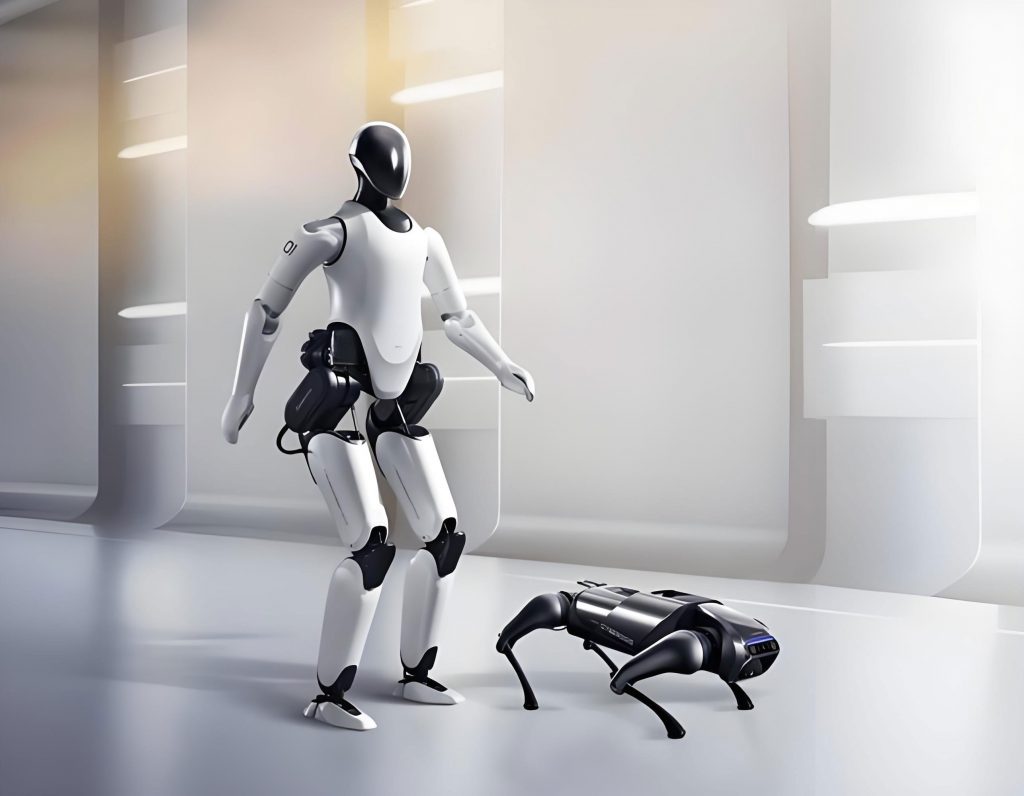
The physical platform for this research is a 65 kg hydraulically actuated quadruped bionic robot. It features a mammal-inspired leg configuration with three active degrees of freedom per leg: hip abduction-adduction (roll), hip flexion-extension (pitch), and knee flexion-extension (pitch), resulting in a total of 12 independently controlled joints. This design provides the necessary agility for dynamic motions but introduces formidable control challenges due to the system’s multi-input, multi-output, strongly coupled, and highly nonlinear dynamics. Achieving fast and stable walking on uneven ground mandates a control system capable of executing complex control strategies while maintaining hard real-time performance for sensor data processing and joint-level servo control. Traditional centralized or master-slave architectures often struggle with the computational load and latency, while standard motion controller cards lack the integrated intelligence for high-level perception and adaptive gait planning required by an autonomous bionic robot.
To address these challenges, we propose a three-tiered hierarchical control architecture, effectively distributing functional responsibilities across dedicated processing layers. This decomposition enhances system robustness, simplifies software development, and crucially, guarantees the real-time performance necessary for dynamic stability. The core layers are the Environment Perception Layer, the Control Execution Layer, and the Remote Control Layer. Each layer operates on dedicated hardware and software modules, communicating through deterministic, low-latency protocols.
| Layer | Primary Function | Key Components/Technologies | Real-Time Criticality |
|---|---|---|---|
| Environment Perception Layer | Acquisition and processing of exteroceptive sensor data to model the external world. | Laser scanners, vision sensors, GPS, QNX processes, Named Pipes. | High (for reactive behaviors) |
| Control Execution Layer | Proprioceptive sensing, state estimation, gait generation, and real-time joint servo control. | Force/position sensors, IMU, gait algorithms, QNX real-time kernel, Socket server. | Highest (directly affects stability) |
| Remote Control Layer | Bridge for human interaction, data logging, and non-critical system monitoring. | Remote terminal, MySQL database, Socket client. | Low |
System Architecture and Real-Time Communication Design
The foundation of a responsive bionic robot control system is its inter-process and inter-layer communication fabric. Our design is built upon the QNX Neutrino real-time operating system, renowned for its microkernel architecture and superior real-time performance metrics, such as fast context switching and predictable interrupt latency. The choice of QNX is pivotal for the Control Execution Layer, where timing jitter in control loop execution is unacceptable.
Communication within and between layers employs a hybrid approach optimized for different data flows. For high-priority, time-sensitive data—such as joint sensor feedback from the Control Execution Layer’s internal processes and high-level motion commands—we utilize shared memory and message passing primitives native to QNX. For communication between the distinct layers (e.g., sending laser data from the Perception Layer to the Execution Layer), we implement a client-server model using Berkeley sockets over a local network. The Socket server is embedded within the real-time critical Control Execution Layer, while the Environment Perception and Remote Control layers act as clients. This design ensures that the control layer, responsible for the bionic robot’s immediate stability, can promptly receive external perception data and operator commands without being blocked by client connection handling.
The real-time performance of the communication backbone and the OS kernel is quantified. Key metrics critical for a dynamic bionic robot are listed below, demonstrating the system’s capability to handle high-frequency control loops.
| Operation | Time (μs) | Impact on Bionic Robot Control |
|---|---|---|
| Kernel Call | 0.236 | Determines baseline overhead for system services. |
| Context Switch (Thread-to-Thread) | 0.283 | Critical for multi-threaded gait and servo control tasks. |
| Context Switch (Process-to-Process) | 0.648 | Important for isolated sensor driver processes. |
| Timer Set/Trigger | ~0.5 | Essential for precise periodic control loop execution. |
Environment Perception Layer: Modular Sensor Integration
For a bionic robot to navigate intelligently, it must perceive its environment. The Perception Layer is responsible for managing all exteroceptive sensors. To maintain system flexibility and real-time performance, we adopted a modular approach using Named Pipes (FIFOs). Each sensor, such as a 2D laser rangefinder (e.g., HOKUYO URG-LX04) or a vision system, is driven by an independent, self-contained process. These processes acquire raw data, perform necessary preprocessing (e.g., coordinate transformation, noise filtering), and then write formatted data packets into a well-known Named Pipe.
A central manager process within the Perception Layer reads from this pipe. A unified communication protocol, which prefixes each data packet with a unique sensor equipment ID, allows the manager to demultiplex the stream and identify the source. This architecture, summarized by the data flow equation below, allows for “hot-plugging” of sensors. Adding a new sensor to the bionic robot simply involves developing its driver process to adhere to the protocol and updating the central equipment ID table.
$$ \text{Data}_{pipe} = \{ \text{ID}_{sensor} \} \| \{ \text{Timestamp} \} \| \{ \text{Payload}_{data} \} $$
Where \( \| \) denotes concatenation. The processed environmental data (e.g., obstacle maps, terrain slope) is then packaged and sent via the Socket client to the Control Execution Layer, where it informs gait adaptation and foothold planning.
Control Execution Layer: The Real-Time Core
This layer is the central nervous system of the bionic robot. It hosts all proprioceptive sensing (joint encoders, force/torque sensors, inertial measurement unit – IMU), performs dynamic state estimation, runs the core gait generation algorithms, and outputs precise commands to the hydraulic servo valves. Given its critical role, all software components here are designed with the highest priority and determinism in mind.
The kinematic model of each leg is fundamental for control. For a leg with hip pitch (\( \theta_{hp} \)), hip roll (\( \theta_{hr} \)), and knee pitch (\( \theta_{kp} \)) joints, the position of the foot tip \( \mathbf{p}_{foot} = [x, y, z]^T \) relative to the hip is given by the forward kinematics function \( FK \):
$$ \mathbf{p}_{foot} = FK(\theta_{hp}, \theta_{hr}, \theta_{kp}; \mathbf{l}_{thigh}, \mathbf{l}_{shin}) $$
where \( \mathbf{l}_{thigh} \) and \( \mathbf{l}_{shin} \) are the lengths of the thigh and shin links, respectively. Inverse kinematics is used to compute the joint angles required to place the foot at a desired location during swing or stance phase.
A primary task validated on this layer is the generation of a dynamic Trot gait. The Trot is a diagonal-paired gait suitable for medium-speed locomotion of a quadruped bionic robot. The desired trajectory for each foot in the swing phase is typically defined by a parametric curve (e.g., a Bezier curve or a cycloid) to ensure smooth liftoff and touchdown. The body trajectory and the phase relationship between the four legs are planned by a central pattern generator (CPG) or a state machine. The joint-level reference trajectories \( \mathbf{q}_{ref}(t) \) are then derived and fed to the joint servo controllers, which can be modeled as:
$$ \mathbf{u}(t) = \mathbf{K}_p (\mathbf{q}_{ref}(t) – \mathbf{q}(t)) + \mathbf{K}_d (\dot{\mathbf{q}}_{ref}(t) – \dot{\mathbf{q}}(t)) + \mathbf{f}_{comp}(\mathbf{q}, \dot{\mathbf{q}}, \mathbf{F}_{ext}) $$
where \( \mathbf{u}(t) \) is the control output (e.g., valve command), \( \mathbf{K}_p, \mathbf{K}_d \) are gain matrices, and \( \mathbf{f}_{comp} \) represents model-based compensation terms for dynamics and external forces \( \mathbf{F}_{ext} \) measured by foot sensors. The control loop for this entire process runs at a high frequency (1 kHz in our implementation), ensuring smooth and stable motion of the hydraulic bionic robot.
Remote Control Layer and Data Management
While not real-time critical, the Remote Control Layer provides essential supervision and data services. It hosts a graphical user interface for human operators to send high-level commands (e.g., “walk forward,” “turn left”) and monitor the bionic robot’s status. More importantly, it manages long-term data logging via a MySQL database. All sensor data, internal states, and command histories streamed from the other two layers can be asynchronously inserted into the database for post-mission analysis, algorithm debugging, and machine learning dataset creation. This separation ensures that the vital real-time control loops are never burdened with disk I/O operations.
Experimental Integration and Validation
The efficacy of the hierarchical control system was validated through the integration of key sub-modules. First, the laser scanner process was successfully mounted on the Environment Perception Layer. The driver process continuously acquired range scans, formatted them according to the protocol, and wrote them to the Named Pipe. The manager process read and forwarded these scans, demonstrating the low-latency, modular sensor integration capability essential for a perceptive bionic robot.
Second, a Trot gait control algorithm was embedded into the Control Execution Layer. The algorithm generated coordinated joint trajectories for all 12 actuators at 1 Hz (gait cycle frequency), interpolating 1000 setpoints per cycle for smooth servo control. The bionic robot executed stable, continuous trotting gaits. Data logged during these tests, such as the trajectory of the robot’s center of mass, confirmed the stability and the real-time performance of the control system. The system’s ability to maintain a 1 kHz servo rate while executing gait computations confirms that the hierarchical design successfully isolates time-critical tasks from less critical ones.
Conclusion and Future Directions
This article presented the comprehensive design of a hierarchical real-time control system for a hydraulically actuated quadruped bionic robot. The three-layer architecture—comprising Environment Perception, Control Execution, and Remote Control—effectively decomposes the complex control problem into manageable, coherent units. By leveraging the real-time capabilities of the QNX Neutrino OS and implementing efficient communication schemes using Sockets and Named Pipes, the system meets the stringent demands for deterministic, high-frequency control required for dynamic legged locomotion. The modular sensor integration framework and the centralized data logging facility further enhance the system’s versatility and utility for research.
The successful demonstration of sensor process mounting and stable Trot gait generation validates the core architectural principles. The developed platform serves as a robust foundation for the quadruped bionic robot. Future work will focus on implementing more advanced, terrain-adaptive gaits using the perceived environmental data, integrating whole-body dynamics control for enhanced stability on rough terrain, and employing machine learning techniques within this hierarchical framework to improve the autonomy and robustness of the bionic robot in completely unstructured environments.