
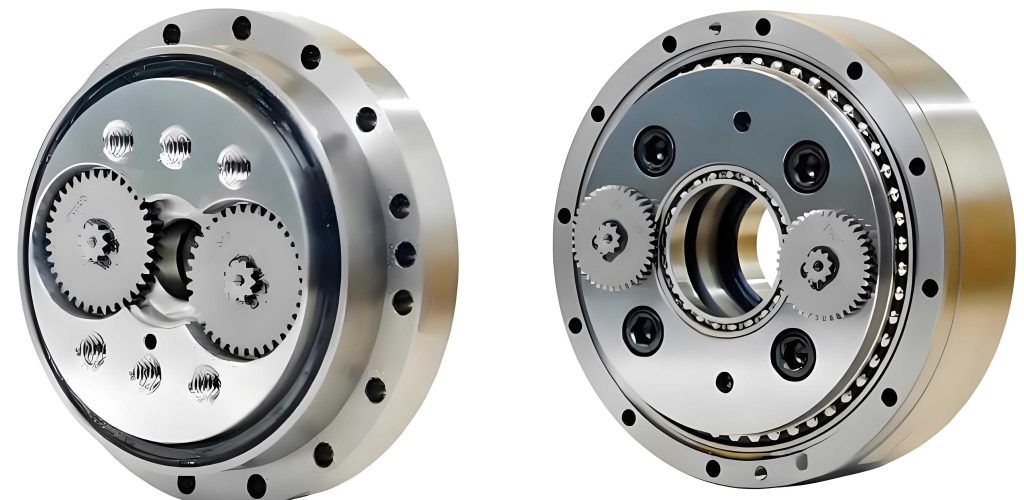
As a core component of industrial robots, the RV reducer is prized for its compact size, high transmission ratio, excellent torsional stiffness, and precision. However, its complex structure, comprising a first-stage planetary gear train and a second-stage cycloidal-pin gear mechanism, makes its transmission accuracy susceptible to numerous factors, including manufacturing tolerances, assembly errors, load-induced deformations, and thermal effects. Traditional methods for evaluating transmission error (TE) often rely on rotary encoders or resolvers to obtain instantaneous angular position. While functional, these sensors have inherent limitations in resolution, are sensitive to installation misalignment, and may not be suitable for ultra-high-speed or very low-speed applications. This article presents a novel, high-resolution technique for TE measurement in RV reducers based on the principle of eccentric modulation for instantaneous phase detection. This method offers significant advantages in precision, robustness, and suitability for a wider operational range.
Transmission error is fundamentally defined as the deviation between the actual output shaft position and its theoretical position when the input shaft rotates uniformly. It serves as a critical metric for evaluating the kinematic accuracy and dynamic performance of gear transmissions. For an RV reducer with a theoretical reduction ratio \(i\) (commonly 121, 141, etc.), the TE can be expressed in two primary forms:
1. As an angular error at the output shaft:
$$ \Delta \theta = \theta_2 – \frac{\theta_1}{i} $$
where \(\theta_1\) and \(\theta_2\) are the measured instantaneous rotation angles of the input and output shafts, respectively.
2. As a deviation from the theoretical transmission ratio:
$$ \Delta i = \frac{\theta_1}{\theta_2} – i $$
Accurate measurement of \(\theta_1\) and \(\theta_2\) is therefore paramount. The proposed method shifts the measurement paradigm from direct angular sensing to high-precision displacement measurement, which is then converted into instantaneous phase.
The core innovation lies in the use of an eccentric sleeve (cam) attached to the shaft whose phase needs to be measured (input or output shaft of the RV reducer). A non-contact displacement sensor, such as a laser triangulation sensor or an eddy current sensor, is fixed opposite the eccentric sleeve. As the shaft rotates, the varying distance between the sensor head and the sleeve surface creates a modulated displacement signal. This principle is derived from cam-follower kinematics, where the follower’s motion traces the cam profile. For a perfectly circular eccentric sleeve, the theoretical displacement output is a pure sinusoid.
The geometric relationship for instantaneous phase extraction is illustrated in the figure below. Let \(O\) be the center of rotation of the shaft, and \(O_2\) be the center of the eccentric sleeve’s outer surface. The eccentricity is denoted by \(e\). The fixed distance from the sensor’s reference point to the shaft center \(O\) is \(h\). The instantaneous distance measured by the sensor is \(s\), and the outer radius of the sleeve is \(r\).
Applying the law of cosines to triangle \(OO_2M\) yields:
$$ r^2 = (h – s)^2 + e^2 – 2e(h – s)\cos\theta $$
Solving for the instantaneous phase angle \(\theta\) gives the fundamental conversion formula:
$$ \theta = \arccos\left(\frac{(h – s)^2 + e^2 – r^2}{2e(h – s)}\right) $$
The fixed distance \(h\) can be determined from the minimum measured displacement \(s_{min}\):
$$ h = r + e + s_{min} $$
By continuously sampling the displacement signal \(s(t)\) at a high frequency, the instantaneous phase \(\theta(t)\) and hence the instantaneous angular velocity \(\omega(t) = d\theta/dt\) of the shaft can be calculated with high resolution.
Resolution and Precision Analysis
The resolution and precision of this eccentric modulation method are superior to many standard encoders. The key factors are the sensor’s intrinsic resolution (\(\epsilon\)) and the modulation depth, which is twice the eccentricity (\(2e\)). The effective number of measurement steps over one full revolution is given by the ratio of the modulation range to the sensor resolution.
$$ \text{Effective Steps, } N = \frac{2e}{\epsilon} $$
The corresponding angular resolution \(\sigma\) is:
$$ \sigma = \frac{360^\circ}{N} = \frac{360^\circ \cdot \epsilon}{2e} $$
For a typical setup using a high-precision laser sensor with \(\epsilon = 0.5 \mu m\) and an eccentric sleeve with \(e = 4 mm\), the calculation is:
$$ N = \frac{2 \times 4 \times 10^{-3} m}{0.5 \times 10^{-6} m} = 16{,}000 $$
$$ \sigma = \frac{360^\circ}{16{,}000} = 0.0225^\circ $$
This represents a very high resolution for phase measurement. Furthermore, the precision can be enhanced by increasing the eccentricity \(e\) or using a sensor with finer resolution. This method is inherently robust to minor axial movements of the shaft, a common drawback of traditional encoder-based systems.
| Method | Principle | Typical Resolution | Advantages | Disadvantages |
|---|---|---|---|---|
| Optical Encoder | Optical grating / photoelectric detection | ~0.01° to 0.1° (depends on lines) | Mature, direct digital output | Bulky, sensitive to contamination & mounting, limited max speed |
| Resolver | Electromagnetic induction | ~0.1° to 0.5° | Robust, works in harsh environments | Analog signal requires RDC, lower resolution, complex wiring |
| Eccentric Modulation (Proposed) | Displacement modulation & geometric conversion | ~0.02° (configurable) | Very high resolution, non-contact, compact sensor head, immune to axial play | Requires signal processing, sensitive to radial runout of sleeve |
Dynamics and Application Range
To ensure reliable operation, the dynamic characteristics of the measurement system must be considered. The eccentric sleeve-sensor system must faithfully track the shaft’s rotation without introducing signal distortion. The primary dynamic constraint is that the sensor’s maximum sampling rate and bandwidth must be significantly higher than the frequency of the modulated signal. For an RV reducer input shaft rotating at a speed of \(n\) RPM, the fundamental frequency \(f\) of the displacement signal is:
$$ f = \frac{n}{60} \quad \text{(Hz)} $$
For a high-speed test at \(n = 6000\) RPM, \(f = 100\) Hz. Modern laser displacement sensors offer bandwidths in the kilohertz range, easily meeting this requirement. Furthermore, the eccentric sleeve must be well-balanced to avoid introducing significant vibration. The system is typically designed for a safe operating range of 0 to 2000-3000 RPM for the shaft where the sensor is mounted, which covers the vast majority of RV reducer testing scenarios. A critical advantage is its applicability at very low speeds, even approaching zero speed, where traditional encoders may fail to provide a stable signal.
Experimental Platform for RV Reducer TE Evaluation
A dedicated test bench was constructed to validate the eccentric modulation method for RV reducer transmission error detection. The platform integrates high-precision phase measurement on both the input and output shafts of the RV reducer under test.
| Component | Model/Specification | Key Parameters |
|---|---|---|
| RV Reducer (Test Specimen) | RV-20E type | Theoretical reduction ratio \(i = 121\) |
| Drive Motor | AC Servo Motor | Rated speed: 3000 RPM, Torque: 2.39 Nm |
| Loading Unit | Adjustable Magnetic Powder Brake | Capable of applying static and dynamic loads |
| Instantaneous Phase Sensor (x2) | Custom-built based on eccentric modulation | Laser sensor resolution: 0.5 µm, Eccentricity: 4 mm |
| Data Acquisition System | NI DAQ Card | Simultaneous sampling @ 50 kHz, 16-bit resolution |
| Signal Processing | Software (e.g., LabVIEW) | Real-time calculation of \(\theta_1(t)\), \(\theta_2(t)\), and \(\Delta \theta(t)\) |
The test procedure is as follows: The servo motor drives the input shaft of the RV reducer. The magnetic powder brake applies a controlled load to the output shaft, simulating real-world operating conditions. The two instantaneous phase sensors, one on the input shaft and one on the output shaft, continuously record displacement data \(s_1(t)\) and \(s_2(t)\). These signals are processed in real-time using the geometric conversion formula to obtain \(\theta_1(t)\) and \(\theta_2(t)\). Finally, the transmission error \(\Delta \theta(t)\) is calculated according to its definition.
Measurement Results and Analysis
The system was tested on an RV-20E reducer. Data was collected under different input speeds and load conditions. The raw displacement signals from both shafts exhibit clean sinusoidal modulation. After conversion to phase, the instantaneous velocities can be analyzed.
A highly effective method for directly calculating the actual transmission ratio and visualizing error components is through frequency domain analysis. The spectra of the input phase \(\Theta_1(f)\) and output phase \(\Theta_2(f)\) reveal dominant frequencies corresponding to their rotational speeds. Let \(F_1\) be the fundamental rotational frequency of the input shaft and \(F_2\) be the fundamental frequency of the output shaft. For a theoretically perfect RV reducer with ratio \(i\), \(F_2 = F_1 / i\). The actual ratio \(i_{act}\) can be estimated from the spectral peaks:
$$ i_{act} \approx \frac{F_1}{F_2} $$
In our tests, for an input speed of 600 RPM (\(F_1 = 10\) Hz), the measured output frequency \(F_2\) was approximately 0.0832 Hz, yielding:
$$ i_{act} \approx \frac{10}{0.0832} \approx 120.2 $$
This closely aligns with the theoretical ratio of 121, indicating good general kinematic performance. The precise time-domain transmission error \(\Delta \theta(t)\) provides deeper insight. The plot typically shows a complex waveform composed of:
- Long-period (low-frequency) error: Often corresponds to one revolution of the output shaft, related to cumulative pitch errors, assembly eccentricities, or bearing runout.
- Short-period (high-frequency) error: Usually linked to the meshing frequency of the gears (cycloid-pin meshes and planetary gear meshes). For the RV reducer, the dominant high-frequency content is often at the number of pins (\(Z_p\)) times the output shaft frequency: \(f_{mesh} = Z_p \cdot f_{output}\).
- Very high-frequency components: These may indicate structural resonances or other dynamic phenomena.
The root-mean-square (RMS) value or the peak-to-peak value of \(\Delta \theta(t)\) serves as a quantitative single-number metric for the transmission error of the RV reducer. The high resolution of the eccentric modulation method allows for the clear identification and quantification of these subtle error components, which might be lost with lower-resolution sensors.
Conclusion and Outlook
The eccentric modulation-based instantaneous phase detection technology presents a powerful alternative for high-precision transmission error measurement in RV reducers. Its key advantages—extremely high resolution (configurable via eccentricity and sensor choice), non-contact nature, robustness to axial play, and suitability for a wide speed range from near-zero to high RPM—make it particularly attractive for quality assessment in manufacturing and advanced research and development.
The experimental results confirm the method’s feasibility and accuracy, successfully capturing both the overall transmission ratio and the detailed composition of the transmission error waveform. This detailed error signature is invaluable for diagnosing specific manufacturing flaws in an RV reducer, such as imperfections in cycloid gear grinding, pin position errors, or bearing preload issues.
Future work involves the integration of this phase measurement technique with torque sensing on the same platform. Since the eccentric sleeve modifies the shaft’s radial stiffness slightly, it can also be engineered to function as a highly sensitive torque sensor based on the principle of torsional strain-induced phase shift between two such modulation marks. This would enable the creation of a fully integrated, high-precision test bench capable of simultaneously measuring the critical performance parameters of an RV reducer: transmission error, torsional stiffness, hysteresis (lost motion), and starting torque. Such comprehensive testing is essential for driving the quality improvement and advancement of RV reducer technology, supporting the development of next-generation high-precision industrial robots.