
As artificial intelligence technology continues to advance and expand, I believe that the humanoid robot will gradually emerge as a new generation of disruptive technological product. It is poised to become a key driving force in the next wave of scientific revolution and industrial transformation. Therefore, accelerating the planning and layout of this industry is imperative. In this article, I will explore practical paths for fostering high-quality development of the humanoid robot industry. Through in-depth research and analysis of the global and domestic development status, industrial policies, and the foundational conditions and significance of developing the humanoid robot industry, I propose several development strategies. These include accelerating industrial policy布局, advancing core technology research and development, constructing product service and manufacturing systems, innovating application scenarios, and strengthening要素支撑. My aim is to provide valuable insights for the growth of the humanoid robot industry.
Keywords: humanoid robot, industrial layout, high-quality development, practical paths
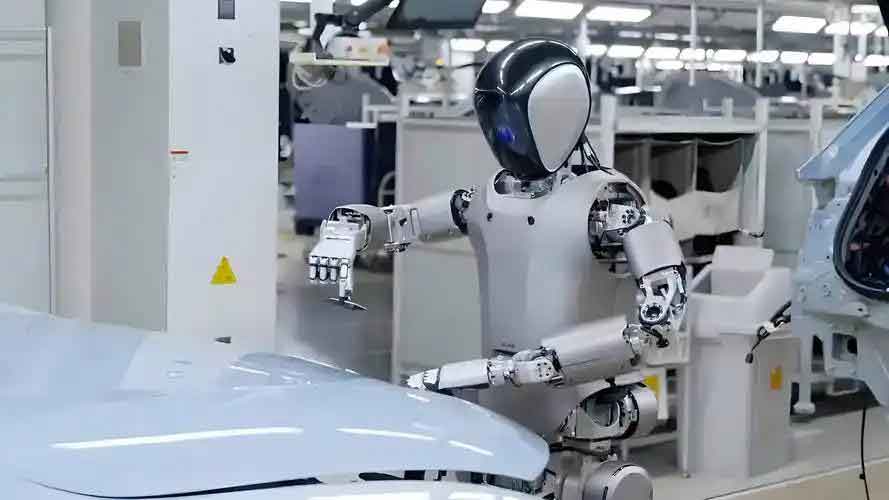
The humanoid robot represents an advanced integration of technologies such as artificial intelligence, high-end manufacturing, and new materials. It has the potential to become the next groundbreaking product following computers, smartphones, and new energy vehicles. Currently, the humanoid robot industry is experiencing rapid growth, with increasing生态活力. According to data from the International Federation of Robotics, the global market for humanoid robots is growing at an annual rate exceeding 20%. It is projected to reach tens of billions of dollars by 2025. A report released at the 2024 World Artificial Intelligence Conference predicts that the Chinese humanoid robot market will reach approximately 2.76 billion yuan by 2024, expand to 75 billion yuan by 2029, accounting for 32.7% of the global market, and potentially reach 300 billion yuan by 2035. These figures indicate that the humanoid robot industry has entered a phase of rapid development. I argue that China should leverage its strengths to accelerate布局, thereby supporting new industrialization and high-quality economic and social development.
Current Development Status of the Humanoid Robot Industry Globally and Domestically
A humanoid robot refers to an intelligent robot with human-like cognitive forms and运动方式. Research on humanoid robot technology began around the 1960s, with Japan achieving significant early成果. The development stages of the humanoid robot industry can be delineated based on运动 and交互水平,大致经历了三个阶段: early起步, mid-term integration, and intelligent development. Currently, humanoid robots are in the intelligent development stage and are expected to enter a highly or super-intelligent phase in the near future.
International Development of Humanoid Robots
From a national perspective, countries like the United States, Japan, the United Kingdom, and Germany have an early start in the humanoid robot field, giving them a相对领先 position. These nations possess mature R&D teams and systems, establishing advantages in complex computation,深度感知, intelligent design, and深度学习. For instance, Japan initiated a humanoid robot R&D project in 1967 and developed the world’s first full-size humanoid intelligent robot, WABOT-1, in 1972, capable of basic walking and simple语音交流.
At the enterprise level, prominent U.S. companies such as Boston Dynamics, Tesla, and Agility Robotics dominate the humanoid robot landscape. Tesla, for example, has projected that humanoid robots will become主力军 in industrial development, with numbers potentially exceeding humans, targeting annual production of 1 billion units and aiming to capture over 10% of the global market. Other players like Japan’s SoftBank Robotics and Norway’s 1X Robotics also hold strong market competitiveness.
To summarize the global market trends, I present the following table:
| Region | Key Players | Market Growth Rate | Notable Achievements |
|---|---|---|---|
| United States | Tesla, Boston Dynamics | >20% annually | Leadership in AI integration and运动控制 |
| Japan | SoftBank,早期研发机构 | Steady innovation | Pioneering in bipedal walking and交互 |
| Europe | 1X Robotics, various research institutes | Growing investment | Advances in感知 and safety standards |
Domestic Development in China
Compared to developed countries, China’s R&D in humanoid robots started relatively late. In 2000, China developed its first bipedal walking humanoid robot, “Xianxingzhe,” which could simulate human walking and had basic language functions. Since then, numerous universities, enterprises, and research institutes have engaged in关键技术研发. Recent years have seen significant progress in运动控制,仿生识别, and智能感知. As of November 2023, China has accumulated 6,618 patent applications for humanoid robot technology, the highest in the world. Overall, China is at an国际先进水平 in hardware technology, though gaps in智能化水平和操作能级 are narrowing.
At the enterprise level, companies like Ubtech, Xiaomi, and Fourier have launched humanoid robots with independent intellectual property. Since 2022, a surge of domestic humanoid robot enterprises and products has emerged, advancing运动控制,智能感知, and决策分析. For instance, Ubtech released China’s first commercial bipedal humanoid robot, Walker, in 2018, which has evolved through iterations to exhibit enhanced运动灵活性 and交互功能. Many tech and automotive firms are also engaging in跨界布局, accelerating technological and application development.
I use the following formula to represent the motion control dynamics often employed in humanoid robot development, which is crucial for stability and efficiency:
$$ \tau = M(q)\ddot{q} + C(q,\dot{q})\dot{q} + g(q) $$
Here, $\tau$ represents the joint torques, $M(q)$ is the inertia matrix, $C(q,\dot{q})$ accounts for Coriolis and centrifugal forces, $g(q)$ denotes gravitational forces, and $q$, $\dot{q}$, $\ddot{q}$ are the joint positions, velocities, and accelerations, respectively. This equation underpins the control strategies for many humanoid robots.
Analysis of Industrial Policies for Humanoid Robots
International Industrial Policies
In countries like the U.S., Japan, South Korea, and European nations, policies focus on promoting the application of humanoid robots. They encourage joint R&D among universities, enterprises, and research institutes through incentives such as tax breaks, funding support, and land优惠. Additionally, some countries, notably the U.S., emphasize establishing safety standards and addressing ethical and privacy concerns. For example, guidelines have been issued to ensure that humanoid robot design adheres to安全标准 and伦理规范.
To compare international policies, I present this table:
| Country/Region | Policy Focus | Key Measures | Ethical Considerations |
|---|---|---|---|
| United States | Innovation and safety | R&D grants, tax incentives | Privacy and ethics frameworks |
| Japan | Practical application | Government-industry collaboration | Human-robot interaction guidelines |
| European Union | Standards and ethics | Funding for interdisciplinary research | Comprehensive regulatory approaches |
Domestic Industrial Policies in China
With the rise of intelligent manufacturing, China has actively supported the humanoid robot industry. Since 2021, a series of policy documents have been released, including the “14th Five-Year Plan for Robot Industry Development” and the “Guiding Opinions on Innovative Development of Humanoid Robots.” The latter, issued by the Ministry of Industry and Information Technology in October 2023, sets goals for 2025: establishing an initial innovation system, breaking through key technologies like “brain, cerebellum, and limbs,” ensuring supply of core components, achieving international advanced levels in整机产品, and promoting示范应用 in特种,制造, and民生服务 scenarios.
At the local level, regions like Beijing, Zhejiang, Shanghai, Guangdong, Jiangsu, and Hubei have introduced guiding policies for humanoid robot产业发展. In 2024, Anhui and Shandong provinces also布局 plans. For instance, Anhui’s draft action plan aims to build an innovation system and产业生态 by 2027, while Shandong’s implementation方案 seeks to strengthen整机企业培育.
I summarize the domestic policy timeline in this table:
| Year | Policy Document | Key Objectives | Impact on Humanoid Robot Industry |
|---|---|---|---|
| 2021 | 14th Five-Year Plan for Robot Industry | Promote robotics innovation | Laid foundation for humanoid robot focus |
| 2023 | Guiding Opinions on Humanoid Robot Innovation | Breakthroughs in core technologies by 2025 | Accelerated R&D and application efforts |
| 2024 | Local plans (e.g., Anhui, Shandong) | Regional ecosystem development | Enhanced industrial clustering and specialization |
Advantages for Developing the Humanoid Robot Industry in China
Based on my analysis, China possesses several strengths that can propel the growth of the humanoid robot industry.
Rapid Development of Advanced Equipment Manufacturing
China has cultivated a robust advanced equipment manufacturing sector, covering areas like通用装备制造,交通运输装备制造, and电子机械器材制造. Products such as精密数控机床 and光学电子设备 are at国际领先水平. Industrial production is steadily growing, with high-tech manufacturing playing a significant role. In the first half of 2024, the value-added of high-tech manufacturing increased by 8.7% year-on-year, 2.7 percentage points higher than the overall industrial average, accounting for 15.8% of the total. From January to October 2024, equipment制造业增加值 accounted for 34.0% of all规模以上工业, serving as a稳定器.
To quantify this advantage, I use a formula for industrial growth contribution:
$$ G_{\text{contribution}} = \frac{\Delta V_{\text{high-tech}}}{\Delta V_{\text{total}}} \times 100\% $$
Where $G_{\text{contribution}}$ is the contribution rate of high-tech manufacturing to overall industrial growth, $\Delta V_{\text{high-tech}}$ is the change in value-added of high-tech manufacturing, and $\Delta V_{\text{total}}$ is the change in total industrial value-added. This highlights the pivotal role of advanced sectors.
Accelerating Improvement in Intelligent Manufacturing Levels
China boasts the world’s most complete and largest industrial system, with 41 industrial categories, 207 medium categories, and 666 sub-categories, making it the only country with all industrial classifications according to联合国产业分类. Intelligent manufacturing is a new engine for transformation, with projects spanning advanced equipment制造,生物医药,电子信息,新材料, and绿色食品. Numerous smart factories and数字化车间 have emerged, enhancing数字化,可视化, and智能化 levels.
I represent the efficiency gain from intelligent manufacturing using a productivity formula:
$$ P_{\text{smart}} = P_0 \times (1 + \alpha)^t $$
Here, $P_{\text{smart}}$ is the productivity after implementing smart technologies, $P_0$ is the initial productivity, $\alpha$ is the annual improvement rate due to automation and AI, and $t$ is time in years. This illustrates how humanoid robots can boost manufacturing efficiency.
Upgrading Development Capacity of New Materials Industry
The new materials industry is a critical foundation for humanoid robot development. China has formed complete industrial chains for稀贵金属 materials, with rapid value chain extension. National and provincial R&D centers, such as those for贵金属材料工程技术, support innovation. Leveraging resources like tin, indium, germanium, titanium, and液态金属, the稀贵金属新材料 industry is growing rapidly, fostering协同创新体系.
To model material performance in humanoid robots, I consider strength-to-weight ratio, crucial for lightweight design:
$$ R_{\text{SW}} = \frac{\sigma}{\rho} $$
Where $R_{\text{SW}}$ is the specific strength, $\sigma$ is the tensile strength, and $\rho$ is the density. Advanced materials with high $R_{\text{SW}}$ are essential for agile humanoid robots.
Policy Recommendations for Accelerating the Development of China’s Humanoid Robot Industry
Drawing from my research, I propose the following practical paths to achieve high-quality development in the humanoid robot industry.
Accelerate the Formulation and Improvement of Industrial Layout and Development Policy Plans
I recommend establishing specialized teams to study and design policy plans tailored to domestic conditions. In regions with strong development foundations like Beijing, Guangzhou, Shanghai, and Zhejiang,布局 technology R&D and equipment manufacturing demonstration centers. Attract leading humanoid robot enterprises to collaborate with local智能制造,电子信息, and新材料 firms. In areas like Yunnan, Fujian, and Henan, pilot “humanoid robot + tourism,” “humanoid robot + consumer services,” and “humanoid robot + agriculture” integrated application scenarios. Encourage other regions to learn from these pilots, conduct investment promotion, and form特色产业发展新模式, gradually完善产业链条.
To prioritize regions, I propose a scoring model based on factors like infrastructure, talent pool, and policy support:
$$ S_{\text{region}} = w_1 I + w_2 T + w_3 P $$
Where $S_{\text{region}}$ is the composite score for region selection, $I$ is infrastructure index, $T$ is talent availability, $P$ is policy effectiveness, and $w_1, w_2, w_3$ are weighting factors summing to 1. This aids in strategic布局 for humanoid robot hubs.
Accelerate Core Technology Research and Development Breakthroughs
Focus on key areas such as the “brain” (AI决策), “cerebellum” (运动协调), “limbs” (结构设计), and “joints” (驱动技术), along with运动控制技术,伺服控制技术,感知技术, and仿生技术. For domains with existing R&D基础, leverage local advantages to accelerate攻关. For weaker areas, attract capable R&D institutions and enterprises for joint efforts. Establish dedicated humanoid robot核心技术研发聚集区 in high-tech parks to foster innovation. Encourage enterprises to adopt “引进来” and “走出去” strategies:引入 international talent for breakthroughs, and form teams to learn from global R&D hubs.
In terms of AI for humanoid robots, the training of deep learning models can be expressed as:
$$ \min_{\theta} L(\theta) = \mathbb{E}_{(x,y) \sim \mathcal{D}}[\ell(f_\theta(x), y)] + \lambda R(\theta) $$
Here, $L(\theta)$ is the loss function, $f_\theta(x)$ is the model prediction, $\ell$ is a per-sample loss (e.g., cross-entropy), $\mathcal{D}$ is the data distribution, $R(\theta)$ is a regularization term, and $\lambda$ controls regularization strength. Advances in such algorithms are vital for humanoid robot intelligence.
Expedite the Construction and Improvement of Product Production and Service Systems
In regions with strong智能制造基础 and resource concentration, build humanoid robot product manufacturing parks. Accelerate investment promotion across the industrial chain’s upstream, midstream, and downstream, attracting定制设计 and零部件生产加工 enterprises to collaborate with local manufacturers. Analyze domestic and international market trends to identify consumption hotspots, and produce customized humanoid robots that meet demand. Establish示范效应 in advanced provinces to spur new scenarios and product services,不断完善应用服务体系. Ensure tight linkage between production systems and core technology R&D, forming a良性发展格局 where “研发促产品, 产品助研发.”
To optimize production, consider an economic order quantity model for components:
$$ Q^* = \sqrt{\frac{2DS}{H}} $$
Where $Q^*$ is the optimal order quantity, $D$ is annual demand, $S$ is ordering cost per order, and $H$ is holding cost per unit per year. This minimizes costs in humanoid robot manufacturing.
Accelerate the Expansion and Application of Application Scenarios
Leverage regional industrial characteristics to pilot humanoid robot applications in tourism,高原特色农业, industrial加工制造业, and高危作业 sectors. Encourage government and enterprise procurement, especially in public spaces like stations, hospitals, shopping malls, and热门旅游景区, to provide定制化需求服务. Create典型应用场景 to enhance public awareness and acceptance of humanoid robots. Through multi-stakeholder联动 involving government, industry, and consumers, maximize the advantages of humanoid robots in key sectors, promoting产业融合发展. Collect feedback from pilots to inform the design of more adaptable and feature-rich humanoid robots, increasing their影响力 and引导力.
For scenario efficiency, I model task completion time for a humanoid robot:
$$ T_{\text{task}} = \sum_{i=1}^n (t_{\text{exec},i} + t_{\text{comm},i}) $$
Where $T_{\text{task}}$ is total task time, $t_{\text{exec},i}$ is execution time for subtask $i$, and $t_{\text{comm},i}$ is communication or coordination time. Minimizing this through better algorithms enhances application viability.
Strengthen Financial Support and Talent Guarantees
First, increase financial support across all critical stages of the humanoid robot industry. Establish operational service companies to provide effective services for enterprise development,成果转化, and运营管理. Set up dedicated humanoid robot industry development funds to support key R&D and manufacturing projects. Second, enhance talent cultivation. In universities and research institutes with strengths in智能制造, introduce programs and majors related to humanoid robot development. Encourage知名大型 humanoid robot R&D firms to set up training branches to nurture practical talent. Third, strengthen standard system support. Learn from international best practices, promote China’s participation in global standard-setting for humanoid robot technology, and accelerate the完善 of中试实验平台, key technology and core component evaluation systems, and伦理标准规范体系. This will drive product quality upgrades and协调 technological innovation with科技伦理.
To assess talent impact, I propose a knowledge growth model:
$$ K(t) = K_0 e^{rt} + \beta A(t) $$
Where $K(t)$ is the knowledge stock over time, $K_0$ is initial knowledge, $r$ is the intrinsic growth rate, $\beta$ is the absorption coefficient, and $A(t)$ represents external knowledge inflow from collaborations. This underscores the importance of talent in advancing humanoid robot technology.
Conclusion
In conclusion, the humanoid robot industry holds immense potential for driving economic and technological progress. Through my analysis, I have outlined the current status, policy landscape, advantages, and practical paths for high-quality development. By accelerating policy布局, advancing core technologies, building robust production systems, expanding applications, and strengthening support要素, China can position itself as a leader in the global humanoid robot market. The integration of advanced manufacturing, intelligent systems, and innovative materials will be crucial. As the industry evolves, continuous focus on research, collaboration, and ethical standards will ensure sustainable growth. I believe that with concerted efforts, the humanoid robot will become a transformative force, contributing significantly to新型工业化和 high-quality societal development.
To encapsulate the growth trajectory, I present a final table summarizing key metrics for the humanoid robot industry:
| Aspect | Current Status | 2029 Projection | 2035 Vision |
|---|---|---|---|
| Global Market Size | Rapid growth (>20% annually) | Hundreds of billions USD | Expanded integration across sectors |
| Chinese Market Share | Growing domestic innovation | 32.7% of global market | Leadership in应用 scenarios |
| Technology Maturity | Hardware at advanced level | Breakthroughs in AI and control | Highly intelligent systems |
| Policy Support | National and local guidelines | Established innovation ecosystems | Global standard influence |
The future of the humanoid robot industry is bright, and by following these paths, we can harness its full potential for the benefit of all.