
The pursuit of high precision in mechanical power transmission has led to the widespread adoption of harmonic drive gear systems in demanding applications such as aerospace robotics, precision instrumentation, and industrial automation. The exceptional advantages of harmonic drive gears, including high single-stage reduction ratios, compactness, superior load capacity, and minimal backlash, hinge critically on the manufacturing accuracy of their core components: the circular spline, the wave generator, and the flexspline. Among these, the flexspline presents a unique manufacturing challenge. It is a thin-walled component featuring involute teeth with an exceptionally large addendum modification coefficient, often around x = 3. This characteristic places it outside the standard regime for conventional gear hobbing.
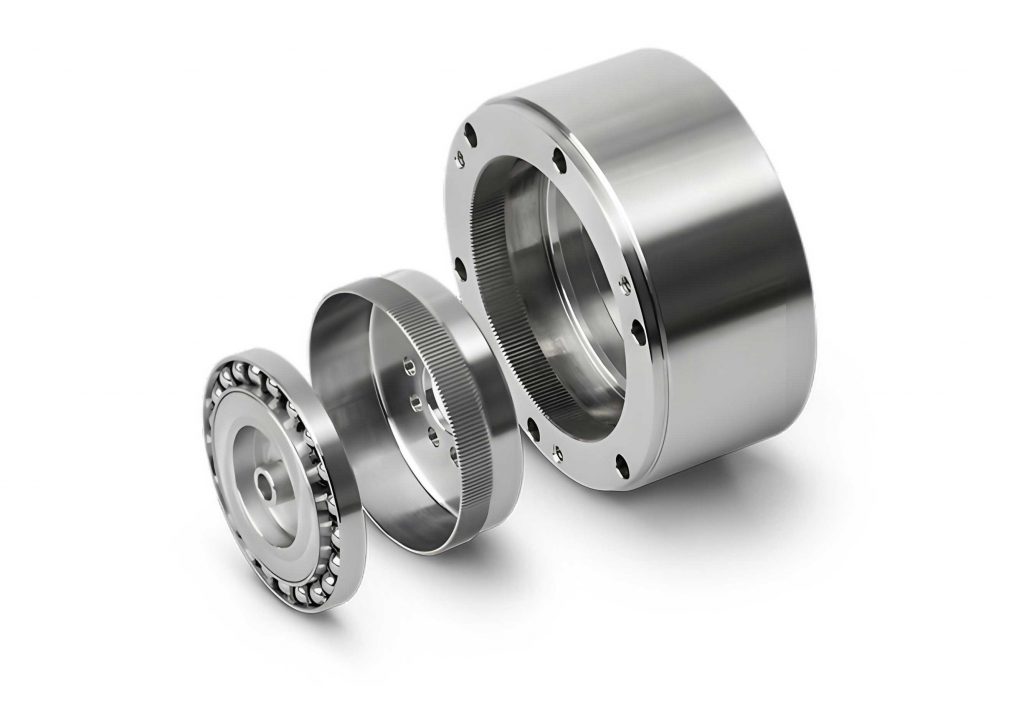
Hobbing remains the primary method for generating the teeth of the harmonic drive gear flexspline. However, employing a standard off-the-shelf hob to machine a large-modification flexspline leads to significant theoretical errors. The fundamental issue is that the standard hob’s geometry is designed for gears where the pitch circle lies within the tooth body. For a large-modification harmonic drive gear flexspline, the theoretical pitch circle is significantly smaller than the root circle, meaning the hob tooth is much “thinner” than the required gear tooth space. Consequently, the central cutting edges of a standard hob cannot envelop the final tooth profile, leading to severe undercutting near the tooth tip if the hob length is insufficient. While custom elongated hobs can mitigate this, they are expensive and inefficient, as wear is unevenly distributed across the many cutting edges, leading to premature tool retirement before most edges are fully utilized.
This investigation focuses on analyzing the root cause of these hobbing errors in large-modification harmonic drive gear flexsplines through precise simulation and developing a novel hob design principle to achieve high-precision machining with standard-length hobs, thereby improving tool life and cost-effectiveness.
Establishing the Hobbing Simulation and Error Evaluation Model
To precisely analyze the forming mechanism and theoretical errors, a digital twin of the hobbing process for modified gears is constructed. This model encompasses a parametric hob, the spatial kinematics of the hobbing machine, the theoretical gear tooth surface, and a method for evaluating deviations.
1. Parametric Mathematical Model of the Hob
The cutting edges of an Archimedes hob are derived from its axial profile. This profile, consisting of straight lines and circular arcs, is defined in the hob coordinate system \( S_h(O_h-X_hY_hZ_h) \), where the \( X_h \)-axis coincides with the hob axis.
The axial profile, parameterized by \( t \) (the \( X_h \)-coordinate), is given by:
$$ \mathbf{E_h}(t) = (t, Y_h(t), 0, 1)^T $$
where \( Y_h(t) \) defines the profile geometry. For a standard profile with module \( m_n \), axial pressure angle \( \alpha \), and axial pitch \( p \), the segments are:
$$
Y_h(t) =
\begin{cases}
r_h – h_f & \text{for } x_b \leq |t| \leq p/2 \quad \text{(Root segment)} \\
r_h + (p/4 – t)\cot\alpha & \text{for } x_c \leq |t| < x_b \quad \text{(Side flank)} \\
D_h/2 – r_a + \sqrt{r_a^2 – (t – x_d)^2} & \text{for } x_d \leq |t| < x_c \quad \text{(Tip fillet)} \\
D_h/2 & \text{for } -x_d \leq t < x_d \quad \text{(Top land)}
\end{cases}
$$
Here, \( r_h \) is the hob pitch radius, \( D_h \) is the hob outer diameter, \( r_a \) is the tip fillet radius, \( h_f = m_n \) is the dedendum, and \( h_a = 1.25m_n \) is the addendum. The transition points \( x_b, x_c, x_d \) are calculated as:
$$ x_b = p/4 + h_f \tan\alpha, \quad x_c = p/4 – [h_a – r_a(1-\sin\alpha)]\tan\alpha, \quad x_d = x_c – r_a \cos\alpha $$
The cutting edges are formed by gashes. If the hob has \( Z_k \) gashes, each successive cutting edge is rotated by \( \Delta\theta = 2\pi/Z_k \) and translated by \( \Delta x = p / Z_k \) relative to the previous one. The equation for the \( k \)-th cutting edge (with \( k=0, \pm1, \pm2, \ldots \)) in the hob coordinate system is:
$$ \mathbf{E_h^k}(t) = \mathbf{T_h^k} \cdot \mathbf{E_h}(t) $$
with the transformation matrix:
$$
\mathbf{T_h^k} =
\begin{bmatrix}
1 & 0 & 0 & k\Delta x \cdot \lambda/|\lambda| \\
0 & \cos(k\Delta\theta) & -\sin(k\Delta\theta) & 0 \\
0 & \sin(k\Delta\theta) & \cos(k\Delta\theta) & 0 \\
0 & 0 & 0 & 1
\end{bmatrix}
$$
where \( \lambda \) is the hob lead angle (positive for right-handed).
2. Hobbing Simulation Model for Modified Gears
The complex spatial relationship and relative motion between the hob and the workpiece during hobbing are modeled using a series of coordinate transformations, as illustrated in the kinematic chain. The key parameters are the center distance \( a \) and the hob swivel angle \( \delta \).
The center distance for machining a gear with addendum modification coefficient \( x \) is:
$$ a = r_g + r_h + x m_n $$
where \( r_g \) is the gear’s pitch radius.
The swivel angle for a spur harmonic drive gear flexspline ( \( \beta = 0 \) ) is:
$$ \delta = -\lambda $$
The axial feed \( \zeta \) of the hob is linked to its rotation angle \( \varphi \):
$$ \zeta(\varphi) = \pm \frac{N f}{2\pi z} \varphi $$
where \( N \) is the number of hob starts, \( f \) is the axial feed per workpiece revolution, and \( z \) is the number of gear teeth. The sign depends on climb vs. conventional hobbing.
The workpiece rotation \( \psi \) is synchronized with the hob rotation:
$$ \psi(\varphi) = \pm \frac{N}{z} \varphi $$
The family of surfaces generated by the \( k \)-th cutting edge in the workpiece coordinate system \( S_g \) is:
$$ \mathbf{G_g^k}(t, \varphi) = \mathbf{T_g^3} \cdot \mathbf{T_2^3} \cdot \mathbf{T_1^2} \cdot \mathbf{T_h^1} \cdot \mathbf{E_h^k}(t) $$
The transformation matrices \( \mathbf{T_h^1}, \mathbf{T_1^2}, \mathbf{T_2^3}, \mathbf{T_g^3} \) account for hob rotation, swivel, center distance/axial feed, and workpiece rotation, respectively. The envelope of all these surfaces constitutes the machined tooth space.
3. Mathematical Model of the Theoretical Tooth Surface
The ideal involute tooth surface of the harmonic drive gear flexspline serves as the reference for error calculation. An involute curve on the transverse plane can be expressed as:
$$ \mathbf{L}(\theta) =
\begin{bmatrix}
\pm (r_b \sin\theta – r_b \theta \cos\theta) \\
r_b \cos\theta + r_b \theta \sin\theta \\
0 \\
1
\end{bmatrix}
$$
where \( r_b \) is the base radius, \( \theta \) is the involute roll angle, and the \( \pm \) sign corresponds to the right/left flank.
This curve is rotated and extruded along the gear axis to form the full tooth slot surface for the \( i \)-th tooth space:
$$ \mathbf{F^i}(\theta, \xi) = \mathbf{M^i} \cdot \mathbf{M}(\Delta) \cdot \mathbf{L}(\theta) $$
where \( \xi \) is the axial coordinate, \( \Delta \) is a constant rotation angle to position the involute correctly in the tooth space, and \( \mathbf{M^i} \) rotates the slot to its position around the gear ( \( i\Omega \), with \( \Omega = 2\pi/z \) ).
The surface normal vector \( \mathbf{n^i}(\theta, \xi) \) is obtained from the cross product of the partial derivatives:
$$ \mathbf{n^i}(\theta, \xi) = \frac{\partial \mathbf{F^i}}{\partial \theta} \times \frac{\partial \mathbf{F^i}}{\partial \xi} $$
4. Tooth Surface Deviation Evaluation Model
The theoretical machined surface is the envelope of the hob cutting edge surfaces. The deviation at any point on the ideal tooth surface is defined as the shortest distance from that point to the envelope family, measured along the theoretical surface normal. A structured grid of points \( \mathbf{F^i}(\theta_l, \xi_m) \) is defined on the ideal surface. For each point, distances to all relevant hob edge trajectories at their respective generating phases are calculated. The minimum signed distance (positive if the envelope is outside the ideal surface) is recorded as the local deviation \( \delta(\theta_l, \xi_m) \). Interpolating these values yields the complete deviation function \( \delta(\theta, \xi) \) for the tooth surface. By fixing \( \xi \) or \( \theta \), the profile deviation and helix deviation can be extracted, respectively.
Error Simulation Calculation and Analysis for the Flexspline
Applying the developed model to a typical large-modification harmonic drive gear flexspline reveals the limitations of standard hobs. The key parameters for the flexspline and a standard hob are summarized below.
| Parameter | Value |
|---|---|
| Normal Module, \( m_n \) | 0.5 mm |
| Number of Teeth, \( z \) | 200 |
| Pressure Angle, \( \alpha_n \) | 20° |
| Addendum Modification Coeff., \( x \) | 3 |
| Tip Diameter, \( d_a \) | 104.00 mm |
| Root Diameter, \( d_f \) | 101.65 mm |
| Parameter | Value |
|---|---|
| Normal Module, \( m_{nh} \) | 0.5 mm |
| Normal Pressure Angle, \( \alpha_{nh} \) | 20° |
| Number of Starts, \( N \) | 1 |
| Number of Gashes, \( Z_k \) | 12 |
| Outside Diameter, \( D_h \) | 32 mm |
| Hand of Helix | Left |
The simulation assumes a standard hob with 73 effective cutting edges and an axial feed \( f = 1.5 \) mm/rev. The computed tooth surface deviation for the right flank of the first tooth space shows a characteristic pattern. Along the profile direction, the error increases dramatically near the tooth tip. Along the lead direction, a wavy pattern appears due to the intermittent feed of the hob.
The root cause is visualized in the hobbing simulation top view. The final tooth profile (theoretical) is not generated by the central cutting edges (e.g., edge #0) of the standard hob. Instead, it is enveloped by edges far from the center (e.g., positive-numbered edges for the right flank, negative-numbered for the left). This happens because the standard hob’s pitch circle corresponds to the gear’s theoretical pitch circle, which for this large-modification harmonic drive gear lies far inside the root circle. Therefore, the hob tooth is too slender to fill the gear space at the final cutting depth. If the hob is not long enough to include the required extreme cutting edges, undercutting occurs at the tooth tip.
Quantitative analysis determines the minimum hob length required for complete generation. For the tooth tip diameter (104 mm), the simulation shows that cutting edges up to #41 and down to #-41 are needed to fully form the profile. This implies a minimum of 83 effective cutting edges are required for the standard hob to machine this harmonic drive gear flexspline without undercut, necessitating a very long and specialized tool.
Design of a Novel Hob for Large-Modification Harmonic Drive Gears
The solution is to redesign the hob based on the fundamental meshing condition during hobbing: equality of the normal base pitch between the hob and the generated harmonic drive gear. For a standard hob, this condition is satisfied at the gear’s standard pitch diameter. For a large-modification gear, we can choose a new “hobbing pitch circle” that lies within the actual tooth depth, leading to a hob with different module and pressure angle.
The design procedure is as follows:
- Determine the Hobbing Pitch Circle Diameter (\(d’\)): A logical starting point is the mid-tooth height:
$$ d’ \approx \frac{d_a + d_f}{2} $$ - Calculate the Corresponding Pressure Angle (\( \alpha_n’ \)) and Module (\( m_n’ \)):
$$ \alpha_n’ = \arccos\left(\frac{d_b}{d’}\right); \quad d’ = \frac{d_b}{\cos \alpha_n’}; \quad m_n’ = m_n \frac{\cos \alpha_n}{\cos \alpha_n’} $$
where \( d_b \) is the gear base diameter. \( \alpha_n’ \) is then rounded to a standard value, and \( d’ \) is recalculated precisely. - Define the New Hob’s Basic Parameters:
$$ m_{nh}^{new} = m_n’, \quad \alpha_{nh}^{new} = \alpha_n’ $$ - Calculate the New Hob’s Pitch Diameter (\( d_{nh}^{new} \)): To maintain the same outer diameter \( D_h \):
$$ d_{nh}^{new} = D_h – (d’ – d_f) $$ - Calculate the New Hob’s Normal Tooth Thickness (\( S_{nh}^{new} \)): This ensures proper meshing at the new pitch circle.
$$ S_n = \frac{\pi m_n}{2} + 2 x m_n \tan \alpha_n $$
$$ S_n’ = S_n \left( \frac{d’}{d} \right) – d’ (\text{inv} \alpha_n’ – \text{inv} \alpha_n) $$
$$ S_{nh}^{new} = \pi m_n’ – S_n’ $$
where \( d \) is the gear’s standard pitch diameter and inv denotes the involute function.
Applying this procedure to our example harmonic drive gear flexspline yields the following novel hob parameters, compared to the standard hob.
| Parameter | Standard Hob | Novel Hob |
|---|---|---|
| Normal Module, \( m_{nh} \) | 0.5000 mm | 0.5143 mm |
| Normal Pressure Angle, \( \alpha_{nh} \) | 20.00° | 24.00° |
| Pitch Diameter, \( d_{nh} \) | 30.7500 mm | 30.8878 mm |
| Normal Tooth Thickness, \( S_{nh} \) | 0.7854 mm | 0.8620 mm |
| Outside Diameter, \( D_h \) | 32.0000 mm | 32.0000 mm |
The axial profile of the novel hob is notably “fatter” than that of the standard hob. The center distance for hobbing with the new tool is adjusted to:
$$ a’ = \frac{d’}{2} + \frac{d_{nh}^{new}}{2} $$
Simulation of the hobbing process with the novel hob reveals its efficacy. The central cutting edges (e.g., edge #0) now closely approximate the final tooth profile of the harmonic drive gear. The tooth space is completely generated by a small cluster of edges near the center. This means a standard-length hob with far fewer active edges can machine the large-modification flexspline without undercut. Practically, this allows for the hob to be shifted axially during its life, engaging fresh sets of cutting edges and dramatically improving tool utilization and lifespan compared to a fixed-usage elongated hob.
Comparative Analysis of Hobbing Errors: Standard vs. Novel Hob
1. Helix Line Deviation Comparison
The helix deviation is primarily influenced by the axial feed rate \( f \). Simulations for both hobs at different feeds show that the peak-to-valley magnitude of the helix wave error is similar for both tools and scales with the feed. The error, \( \delta_H \), can be conceptually related to the discrete feed steps:
$$ \delta_H \propto f $$
However, the error pattern generated by the novel hob is often more uniform across the face width. The table below summarizes the approximate maximum helix form error for the subject harmonic drive gear.
| Axial Feed, \( f \) (mm/rev) | Max Helix Error (Standard Hob) | Max Helix Error (Novel Hob) |
|---|---|---|
| 1.5 | ~5.8 μm | ~5.8 μm |
| 1.0 | ~2.5 μm | ~2.5 μm |
| 0.5 | ~0.6 μm | ~0.6 μm |
2. Tooth Profile Deviation Comparison
The critical improvement lies in the profile accuracy. The simulation extracts profile deviations at different circumferential positions (tooth spaces #1, #60, #120, #180) to sample different phases of the hob feed cycle.
Standard Hob (when theoretically long enough for complete generation): The profile error \( \delta_P \) shows a pronounced increase towards the tooth tip, a residual characteristic of the non-ideal generating action even with sufficient edges. The error \( \delta_P^{tip} \) at the tip can be significant.
Novel Hob: The profile deviation \( \delta_P \) is consistently small and relatively uniform from root to tip. There is no catastrophic undercut error. Importantly, the magnitude of the profile error across the entire flank is generally smaller than the best-case error from a fully-generating standard hob. This is because the novel hob’s generating pitch circle is located within the active tooth depth of the harmonic drive gear, leading to a more favorable contact condition during the virtual hobbing process. The profile error function \( \delta_P(r) \) for the novel hob is both lower in amplitude and flatter than that of the standard hob \( \delta_P^{std}(r) \):
$$ \max_{r \in [r_f, r_a]} |\delta_P^{novel}(r)| < \max_{r \in [r_f, r_a]} |\delta_P^{std}(r)| $$
$$ \frac{d}{dr}\delta_P^{novel}(r) \approx 0 \quad \text{(more uniform)} $$
Conclusion
This investigation into the precision hobbing of large-modification harmonic drive gear flexsplines yields three principal conclusions that bridge theoretical analysis and practical tool design:
- The substantial theoretical profile errors observed when machining high-tooth-count, large-modification harmonic drive gear flexsplines with standard hobs are fundamentally caused by a mismatch in the generating geometry. The standard hob’s “thin” tooth, aligned with the gear’s non-physical standard pitch circle, necessitates an impractically large number of cutting edges to fully envelop the tooth space, leading to inevitable undercutting near the tip with tools of conventional length.
- A novel hob design philosophy, grounded in the principle of equal normal base pitch at a strategically chosen hobbing pitch circle within the actual tooth depth, resolves this issue. This redesigned hob possesses a different normal module and pressure angle. Its key practical advantage is that it can achieve complete generation of the harmonic drive gear tooth profile using only a small cluster of central cutting edges on a standard-length hob body. This enables axial repositioning of the hob during its service life, promoting even wear distribution and significantly extending tool utilization compared to single-purpose elongated hobs.
- Simulation-based error analysis confirms that the proposed novel hob not only eliminates the severe undercutting error but also produces a tooth surface with marginally smaller overall theoretical deviations compared to the profile generated by a fully-enveloping (and much longer) standard hob. The profile error is more uniform, and the helix error is comparable and controllable via axial feed rate. This validates the new design as a superior and more economical solution for manufacturing high-precision harmonic drive gear components.
The models and methodologies presented provide a critical framework for controlling hobbing accuracy in specialized gear manufacturing. The findings offer manufacturers of harmonic drive gear systems a clear path towards optimizing their tooling strategy, balancing precision, cost, and tool life effectively.