
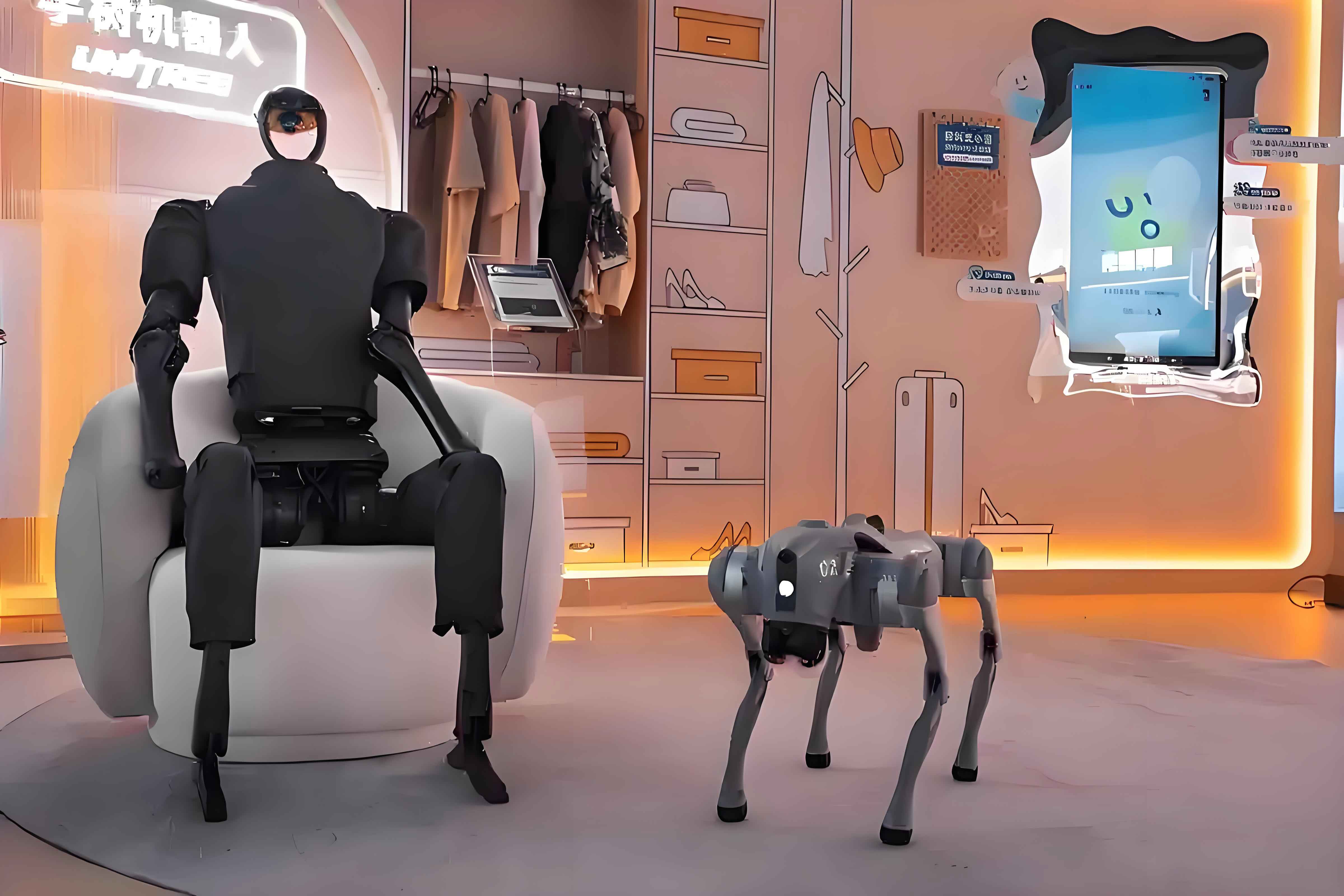
In recent times, humanoid robots have been frequently showcased at various exhibitions and events, capturing significant attention with their technologically advanced performances. Amidst the excitement, a core question remains: when will these rapidly evolving humanoid robots transition from demonstration stages to real-world applications and start performing substantive tasks? Currently, there is a consensus among many companies regarding the deployment path for humanoid robots. The strategy involves initially切入 industrial scenarios, where technical refinement and cost optimization can be achieved by addressing actual production needs. Subsequently, the application of humanoid robots is expected to expand into commercial services and home life, ultimately realizing the long-term vision of humanoid robots serving as household assistants. Lang Xulin, Chief Scientist at Yuejiang Technology, stated in an interview that in the next 10 years, every family will have a robot, just as every household now owns a refrigerator or washing machine, highlighting the potential future ubiquity of humanoid robots.
-
Commercialization Path Becomes Clearer
Following the Beijing Winter Olympics, public attention has once again focused on the National Speed Skating Oval, known as the “Ice Ribbon,” where humanoid robots took center stage in recent events. Compared to the half-marathon for humanoid robots held four months prior, the运动 capabilities of these humanoid robots have advanced rapidly. “In the half-marathon, many humanoid robots walked unsteadily, some even fell and had to be dragged by staff. It’s surprising how fast humanoid robots have evolved in just a few months,” said Wen Zhe from Zhengzhou after watching the 2025 World Humanoid Robot Games. The development speed of humanoid robots exceeds expectations, demonstrating significant progress in their physical abilities and stability.
Competitions test the stability of humanoid robots in high-speed movements and their adaptability to complex environments, allowing technical teams to validate technology in real settings and promote product upgrades. Beyond the arena, as the capabilities of humanoid robots continue to improve, the challenge for companies is to transition from “performance” to “work,” ensuring that humanoid robots can handle practical tasks in diverse scenarios. Zhong Xinlong, Director of the Artificial Intelligence Research Center at CCID Consulting, pointed out that the success of humanoid robot commercialization depends on whether they can precisely select and penetrate high-value application scenarios that generate quantifiable returns on investment. “Only by anchoring rigid demand scenarios and solving actual pain points can they cross the technological chasm, achieve commercial retention, and continuous iteration. Just as facial recognition once opened a breakthrough for artificial intelligence landing, the robot industry is experiencing a critical stage from technology verification to value closure,” said Tang Jian, Chief Technology Officer of the Beijing Humanoid Robot Innovation Center, emphasizing the importance of focused application for humanoid robots.
The strategic path of transitioning from industrial to commercial and home use is a common choice for many companies promoting the commercial landing of humanoid robots. Currently, there are numerous cases of humanoid robot applications in industrial scenarios. Yuejiang’s embodied intelligent robots have secured orders from international industrial and commercial giants including Mazak, ASKA, Aurotek, etc., showcasing the growing adoption of humanoid robots in manufacturing and other sectors. These humanoid robots are designed to perform tasks that require precision and endurance, reducing human labor in repetitive or hazardous environments.
Moja Robots, incubated by Chery, have achieved commercial applications in Indonesia, the UAE, South Africa, Hong Kong China, and other regions. These humanoid robots perform reception duties, model explanations, and more within Chery’s global sales network, somewhat enhancing store operational efficiency and user experience. The deployment of humanoid robots in such settings demonstrates their potential to handle customer-facing roles, though they are still limited to specific, structured tasks. A representative from Moja Robots told Securities Times that after achieving landing applications in 4S scenarios, Moja Robots will further enter supermarkets, government halls, and other venues, indicating a gradual expansion of humanoid robot applications into broader commercial spaces.
This progression from industrial to commercial use is seen as a stepping stone toward eventually introducing humanoid robots into homes. As humanoid robots become more capable and cost-effective, their integration into daily life could transform how households manage chores, care, and entertainment, but this requires overcoming current limitations in technology and affordability. The consensus among industry leaders is that humanoid robots must first prove their value in controlled environments before moving into more dynamic and unpredictable home settings.
-
Versatility Challenges and Cost Issues
Although the landing applications of humanoid robots have begun to emerge in some scenarios, large-scale adoption still faces many challenges, primarily centered around versatility and cost. Insufficient versatility keeps humanoid robots “nailed” to single scenarios. “They can open cans but not peel apples,” Tang Jian noted. The general-purpose large models for humanoid robots are not yet mature, and their ability to generalize tasks across scenarios is weak, making it difficult for them to flexibly handle unexpected situations in unstructured environments such as homes or complex factories. The “ChatGPT moment” for humanoid robots has not yet arrived, meaning that these robots lack the adaptive intelligence needed for broad, real-world applications.
Tang Jian emphasized that breaking through the versatility bottleneck core lies in algorithm innovation. By reconstructing algorithm logic adapted to the physical world, the ability of robots to integrate into real-world scenarios can be enhanced. This technological breakthrough will also bring new opportunities to the industry; small teams that develop breakthrough algorithms have the potential to achieve overtaking and drive the entire industry’s technical level to new heights. However, achieving this requires significant research and development efforts, as current humanoid robot models struggle with tasks that humans find simple, such as navigating cluttered spaces or understanding contextual commands.
Price is another key variable determining the普及 range of humanoid robots. Currently, the overall selling price of humanoid robots is generally as high as 300,000 to 400,000 yuan, far from being able to widely enter the household market. This high cost is a major barrier to the mass adoption of humanoid robots, as most consumers cannot afford such expensive devices for home use. “Without mass production, talking about cost reduction is empty talk,” multiple industry insiders emphasized in interviews. Cost control is a core prerequisite for the large-scale landing of humanoid robots, but the industry is currently stuck in the dual challenges of insufficient mass production scale and difficulty in compressing the hard costs of core components.
Zhong Xinlong analyzed that, learning from the cost reduction paradigm of the new energy vehicle industry, humanoid robots can achieve cost reduction within 3-5 years through dual strategies of modular design and supply chain localization. This approach could streamline production and reduce expenses, making humanoid robots more accessible. Wang Xingxing, CEO of Yushu Technology, stated that from a practicality perspective, the simpler the hardware design, the more it can significantly reduce design and manufacturing difficulties, thereby lowering costs and improving production efficiency for humanoid robots. By focusing on essential functions and avoiding over-engineering, companies can make humanoid robots more affordable without compromising performance.
More棘手的是 the incompressible “hard costs.” Zhong Xinlong pointed out that high-precision harmonic reducers used in the core joints of robots, six-dimensional torque sensors that achieve precise force control, and NVIDIA Jetson high-computing system-on-chips that support the operation of complex AI large models on the robot side are the three major “hard costs” of robots. These components are critical for the functionality of humanoid robots but are expensive due to their advanced technology and limited production scales. “These components cannot be reduced in cost simply by scaling up; it requires breakthroughs in upstream basic technologies to achieve price reductions,” admitted a R&D负责人 from a robot company, highlighting the need for foundational innovations to make humanoid robots economically viable.
Fortunately, current humanoid robot products on the market have shown a trend of price reduction: in June of this year, Youliqi launched the “Steel Nanny” priced at 88,000 yuan; in July, Yushu Technology reduced its product price to within 40,000 yuan, accelerating the “price band” of humanoid robots towards the consumer market. These developments indicate that cost pressures are being addressed, but further reductions are necessary for humanoid robots to become commonplace in households. As prices drop, the accessibility of humanoid robots could increase, paving the way for their integration into everyday life, but versatility issues must be resolved simultaneously to ensure they can handle a wide range of home tasks.
The interplay between cost and versatility means that progress in one area can influence the other. For instance, if humanoid robots become more versatile, they could justify higher costs by performing multiple functions, but if costs remain high, versatility alone may not drive adoption. Therefore, a balanced approach focusing on both technological advancement and economic feasibility is essential for the future of humanoid robots.
-
Policy and Funding Need Precise Relay
“Robot performances can attract audiences but hardly generate revenue,” industry consensus shows. Although high-value scenarios for embodied intelligence have emerged, such as automotive assembly in industrial manufacturing, warehouse sorting in commercial logistics, and inspection and rescue in hazardous environments, most companies remain skeptical about the return on investment from “replacing human labor with robots,” which means that the development of humanoid robots still requires long-term accompaniment from policies and capital. This skepticism stems from the high initial costs and uncertain benefits of deploying humanoid robots, especially in sectors where human labor is readily available and cheaper.
Zhong Xinlong believes that the policy and funding support for the humanoid robot industry from major global economies has reached an unprecedented level, sufficient to support leading companies in completing the critical stage from cutting-edge R&D to commercial scenario verification. However, to achieve true large-scale落地, a more long-term and systematic support system仍需构建. Governments and institutions must provide sustained incentives to encourage innovation and adoption of humanoid robots, similar to how subsidies and regulations have boosted other emerging technologies like electric vehicles.
However, the leap from “commercial verification” to “large-scale落地” requires a capital intensity comparable to the new energy vehicle industry. This means that significant financial resources are needed to scale up production, improve technology, and market humanoid robots effectively. Yan Shiye, Partner at Global Law Office,认为 that humanoid robots belong to technology-intensive and capital-intensive industries, requiring substantial upfront capital investment. Founder self-raised funds are难以支撑 the long-term development and technological breakthroughs of enterprises, while debt financing is less suitable for early-stage companies in startup and R&D phases. Government subsidies can provide some funding support but are limited by subsidy amounts and application conditions, unable to serve as a long-term stable funding source for enterprises. In contrast, equity financing can provide sufficient capital and comprehensive resource support for humanoid robot companies, meeting their funding needs during technology R&D and market expansion stages, and is an important driving force for rapid enterprise development.
Zhong Xinlong认为 that in the future, it is necessary to guide more capital forces with a long-term perspective, such as government-led industry funds, large industrial capital, etc., to enter, forming a capital relay covering the entire lifecycle from “R&D-mass production-application.” This approach would ensure that humanoid robot companies have access to continuous funding at different stages of growth, reducing the risk of stagnation due to financial constraints. By aligning investment with developmental milestones, the industry can accelerate the maturation of humanoid robot technologies and their deployment in various sectors.
At the same time, policy support also needs to shift from universal R&D subsidies to more targeted application牵引. For example, by establishing large-scale application demonstration projects in key industries such as elderly care services and special industries, providing equipment procurement subsidies, leading the establishment of industry technical standards and safety certification systems, etc., to create real and sustainable market demand for large-scale落地, thereby completing the “last mile” of industrial development. Such measures would not only validate the practical benefits of humanoid robots but also build consumer and business confidence in their use, driving broader adoption.
The combination of policy initiatives and financial investments is crucial for overcoming the current barriers facing humanoid robots. Without coordinated efforts, the progress of humanoid robots could be slow, delaying their potential to revolutionize industries and households. Therefore, stakeholders including governments, investors, and companies must collaborate to create an ecosystem that fosters innovation and scalability for humanoid robots.
In conclusion, the path to humanoid robots becoming household assistants is marked by significant advancements in performance and initial commercial applications, but it is fraught with challenges related to versatility, cost, and the need for robust policy and funding support. The industry’s consensus on a gradual approach—from industrial to commercial and finally home use—provides a clear roadmap, but realizing this vision requires continuous innovation in algorithms, cost reduction strategies, and sustained capital infusion. As humanoid robots evolve, their potential to transform daily life remains immense, but overcoming the existing hurdles will determine how soon they can transition from exhibition curiosities to essential home companions. The journey of humanoid robots is a testament to human ingenuity, and with collaborative efforts, the dream of every family owning a humanoid robot may indeed become a reality within the next decade.