
Humanoid robots have garnered significant attention due to their bipedal locomotion, enhanced obstacle-crossing capabilities, and human-like appearance, which facilitate integration into human society. The development of humanoid robots involves addressing complex challenges in motion control, particularly in achieving dynamic tasks such as aerial jumping. This article presents a comprehensive experimental design that leverages human motion capture technology to enable humanoid robots to perform aerial jumping motions. The approach involves capturing human movement data, establishing mapping relationships between human and robot joint trajectories, modeling the jumping process, and implementing compliant control strategies for landing. By integrating theoretical modeling, algorithm design, and experimental verification, this method provides a robust framework for mimicking human-like motions in humanoid robots.
The core of this experiment lies in utilizing motion capture systems to record human jumping sequences, which are then processed and scaled to suit the kinematic constraints of humanoid robots. A key aspect is the development of a variable stiffness landing buffer strategy to mitigate impact forces during touchdown. Optimization algorithms, such as particle swarm optimization and multi-objective genetic algorithms, are employed to refine motion parameters for stability and energy efficiency. Throughout this process, the term “humanoid robots” is emphasized to underscore the focus on bipedal systems that emulate human biomechanics. The following sections detail the experimental principles, design, and results, with mathematical formulations and tables used to summarize key concepts.
Human motion capture technology enables the precise recording of joint positions, velocities, and accelerations during dynamic activities like jumping. In this experiment, an optical motion capture system with infrared cameras and reflective markers is used to collect data from a human subject performing aerial jumps. The captured data includes trajectories of major joints, such as the hips, knees, and ankles, which are essential for generating reference motions for humanoid robots. The mapping between human and robot joint positions is established using scaling factors to account for differences in limb lengths and mass distribution. For instance, the hip joint position mapping can be represented as:
$$ \begin{bmatrix} x’_{\text{hip}} \\ y’_{\text{hip}} \\ z’_{\text{hip}} \end{bmatrix} = \begin{bmatrix} \frac{R_1}{H_1} & 0 & 0 \\ 0 & \frac{R_2}{H_2} & 0 \\ 0 & 0 & \frac{R_3}{H_3} \end{bmatrix} \begin{bmatrix} x_{\text{hip}} \\ y_{\text{hip}} \\ z_{\text{hip}} \end{bmatrix} $$
where \( (x_{\text{hip}}, y_{\text{hip}}, z_{\text{hip}}) \) denotes the human hip position, \( (x’_{\text{hip}}, y’_{\text{hip}}, z’_{\text{hip}}) \) represents the robot hip position, and \( R_i / H_i \) are scaling ratios based on limb dimensions. This mapping ensures that the generated trajectories preserve the essential characteristics of human motion while adapting to the robot’s structure. The overall control framework for humanoid robots in this experiment involves trajectory planning, inverse kinematics, and impedance control, as summarized in the following table:
| Component | Description |
|---|---|
| Motion Capture | Acquisition of human joint trajectories using optical systems |
| Trajectory Mapping | Scaling human data to robot dimensions via kinematic constraints |
| Jump Planning | Phased approach: crouch, takeoff, aerial, and landing |
| Landing Control | Variable stiffness impedance model for impact reduction |
| Optimization | Multi-objective algorithms to enhance stability and efficiency |
The aerial jumping process for humanoid robots is divided into four phases: crouch, takeoff, aerial, and landing. During the crouch phase, the robot lowers its center of mass to store energy, similar to human preparatory movements. The takeoff phase involves accelerating upward to achieve liftoff, while the aerial phase focuses on posture adjustment mid-air. Finally, the landing phase requires compliant control to absorb impact forces. The position \( Z_{\text{hip}}(t) \), velocity \( \dot{Z}_{\text{hip}}(t) \), and acceleration \( \ddot{Z}_{\text{hip}}(t) \) of the hip joint during takeoff must satisfy specific constraints:
$$ Z_{\text{hip}}(t) = \begin{cases} h_{t_0}, & t = t_0 \\ h_{t_1}, & t = t_1 \\ h_{t_2}, & t = t_2 \end{cases} $$
$$ \dot{Z}_{\text{hip}}(t) = \begin{cases} 0, & t = t_0 \\ 0, & t = t_1 \\ v, & t = t_2 \end{cases} $$
$$ \ddot{Z}_{\text{hip}}(t) = \begin{cases} 0, & t = t_0 \\ 0, & t = t_1 \\ -g, & t = t_2 \end{cases} $$
where \( t_0 \), \( t_1 \), and \( t_2 \) represent initial, lowest crouch, and takeoff moments, respectively; \( h_{t_0} \), \( h_{t_1} \), and \( h_{t_2} \) are corresponding hip heights; and \( v \) is the takeoff velocity. These constraints ensure smooth and stable transitions between phases, critical for humanoid robots to mimic human jumping dynamics.
To address landing impact, an equivalent impedance control model is implemented for humanoid robots. The leg is modeled as a system with variable stiffness, where the overall impedance coefficient \( k \) is derived from the stiffness of thigh and shank segments (\( k_1 \)) and the knee joint (\( k_2 \)). The relationship is given by:
$$ k = \frac{k_1 k_2}{2k_2 \sin^2\left(\frac{\beta}{2}\right) + \frac{k_1}{l_1^2} \cos^2\left(\frac{\beta}{2}\right)} $$
where \( \beta \) is the knee bend angle, and \( l_1 \) is the thigh length. The dynamics of the equivalent leg length \( L \) during landing are described by:
$$ \dot{L} = \frac{F – k(L_0 – L) – D(\dot{L}_0 – \dot{L})}{m} $$
Here, \( F \) is the ground reaction force, \( L_0 \) is the initial leg length, \( D \) is the damping coefficient, and \( m \) is the mass of the lower body. By integrating \( \dot{L} \), the hip position correction is computed to achieve compliant landing for humanoid robots.
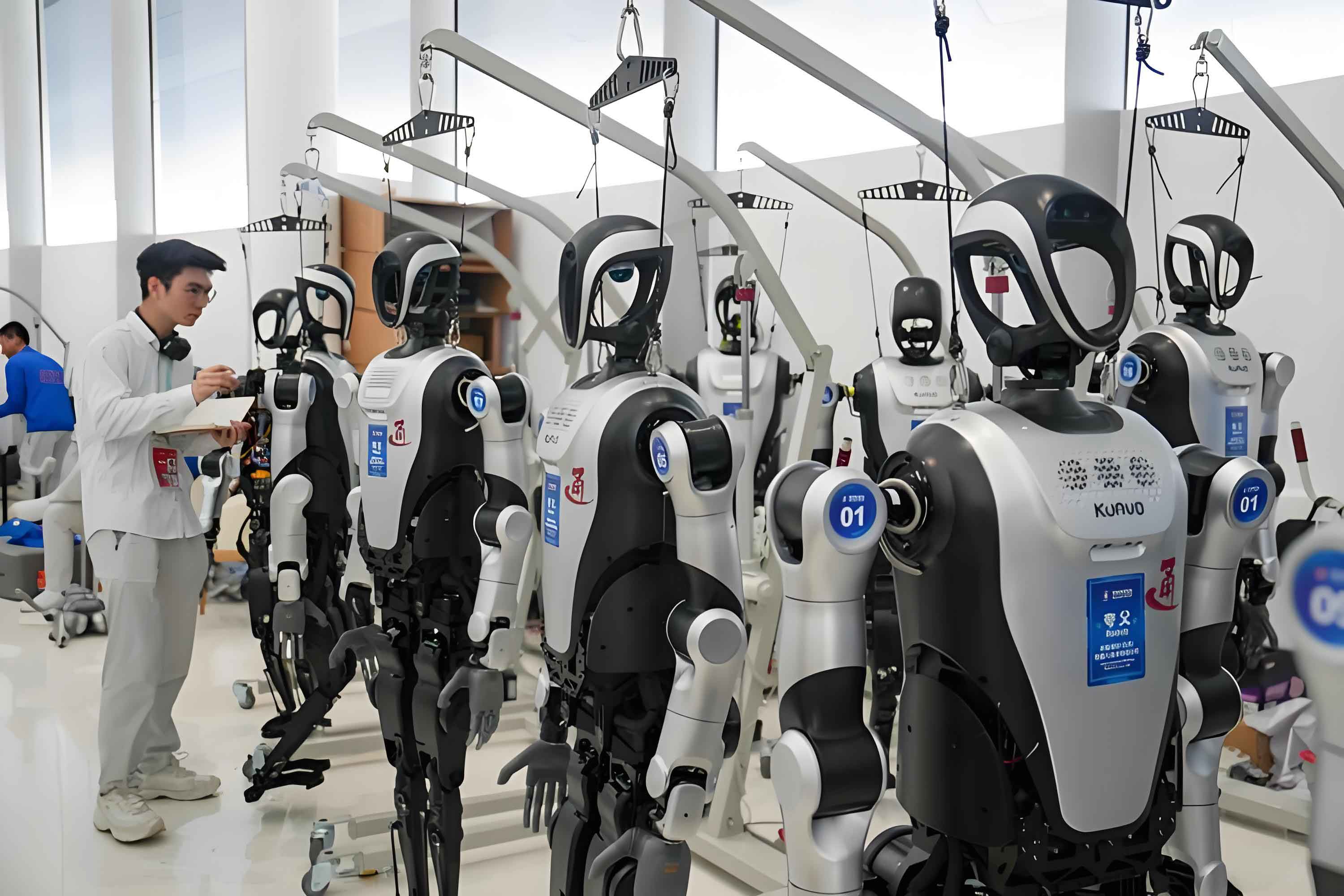
Optimization plays a vital role in enhancing the performance of humanoid robots during jumping. A multi-objective function is defined to maximize stability and minimize energy consumption. The stability is evaluated using the zero-moment point (ZMP) criterion, where the distance from the ZMP to the support polygon center indicates robustness. The energy efficiency is measured based on joint torques and velocities. The objective function \( J \) is formulated as:
$$ J = \alpha J_{\text{ZMP}} + (1 – \alpha) J_P $$
with \( J_{\text{ZMP}} = (x_{\text{zmp}} – x_c)^2 + (y_{\text{zmp}} – y_c)^2 \) and \( J_P = \frac{1}{N} \sum_{i=1}^{N} \tau_i(j) \dot{\theta}_i(j) \), where \( \alpha \) is a weighting factor, \( (x_c, y_c) \) is the support foot center, and \( \tau_i(j) \) and \( \dot{\theta}_i(j) \) are the torque and angular velocity of joint \( i \) at time \( j \). Optimization algorithms like NSGA-II and MOPSO are applied to tune parameters such as crouch depth, takeoff duration, and stiffness coefficients, as shown in the following table comparing pre- and post-optimization values for humanoid robots:
| Parameter | Pre-Optimization | PSO | MOPSO | NSGA-II |
|---|---|---|---|---|
| Crouch Height \( h_{t_1} \) (cm) | 270 | 262 | 256 | 250 |
| Crouch Duration \( T_1 \) (s) | 0.58 | 0.56 | 0.60 | 0.61 |
| Takeoff Duration \( T_2 \) (s) | 0.26 | 0.15 | 0.17 | 0.20 |
| Takeoff Velocity \( v \) (m/s) | 2.23 | 1.92 | 1.93 | 2.23 |
Experimental validation is conducted using a virtual prototype of humanoid robots in a simulation environment. The optimized trajectories are applied to the robot model, and inverse kinematics computes joint angles for motion execution. Results demonstrate that humanoid robots successfully replicate human-like jumping motions with high similarity in joint trajectories. The ZMP trajectories remain within the support polygon, indicating stability, and energy consumption is reduced post-optimization. The following table compares performance metrics for different optimization methods applied to humanoid robots:
| Optimization Method | ZMP Stability RMSE | Energy Efficiency (W) |
|---|---|---|
| NSGA-II | 0.88 | 9.51 |
| MOPSO | 0.99 | 10.20 |
| PSO | 0.85 | 10.90 |
The similarity between human and robot joint trajectories is quantified using correlation analysis, revealing high coherence in hip, knee, and ankle angles. This confirms the effectiveness of the motion capture-based approach for humanoid robots. Additionally, the variable stiffness landing strategy significantly reduces peak impact forces by up to 30%, enhancing the durability and performance of humanoid robots during repetitive jumping tasks.
In conclusion, this experimental design integrates human motion capture technology with advanced control strategies to enable humanoid robots to perform aerial jumping. The method involves detailed trajectory mapping, phased jump planning, and optimized compliant landing, ensuring stable and efficient motions. The use of multi-objective optimization further refines parameters for real-world applications. This approach not only advances the capabilities of humanoid robots in dynamic environments but also provides a scalable framework for other complex tasks. Future work will focus on real-time adaptation and learning-based methods to improve the autonomy of humanoid robots.