
A newly published study in the Journal of Machine Design, Vol. 42, No. 10, October 2025, presents a structured method for improving the appearance of humanoid robots used in daily life and commercial service settings. The study, titled “Humanoid Robot Affinity Appearance Exploration and Stable Diffusion Model Training,” was authored by Deng Jun, Li Xiaoyu, and Yuan Jiajun of the School of Urban Design at Wuhan University in Wuhan, Hubei. The paper reports that humanoid robot acceptance and trust can be strengthened when affinity is treated not as a vague stylistic preference but as a measurable set of design features linked to shape, material, texture, and color. The work combines Kansei engineering with artificial intelligence assisted design, specifically the training of Stable Diffusion models, to generate large numbers of humanoid robot appearance concepts with higher affinity.
The study defines humanoid robots as robots with human-like exterior form that imitate human functions and intelligence. As humanoid robots move into broader service domains, more frequent collaboration between people and humanoid robots is expected. Appearance influences users’ emotional and functional perception of a humanoid robot. However, the paper notes that current humanoid robot design is often driven by an engineering perspective, resulting in exteriors that can appear cold, rigid, and lacking in affinity. A humanoid robot with low affinity may trigger user resistance and reduce willingness to use the system. Improving exterior affinity is therefore described as an urgent design problem.
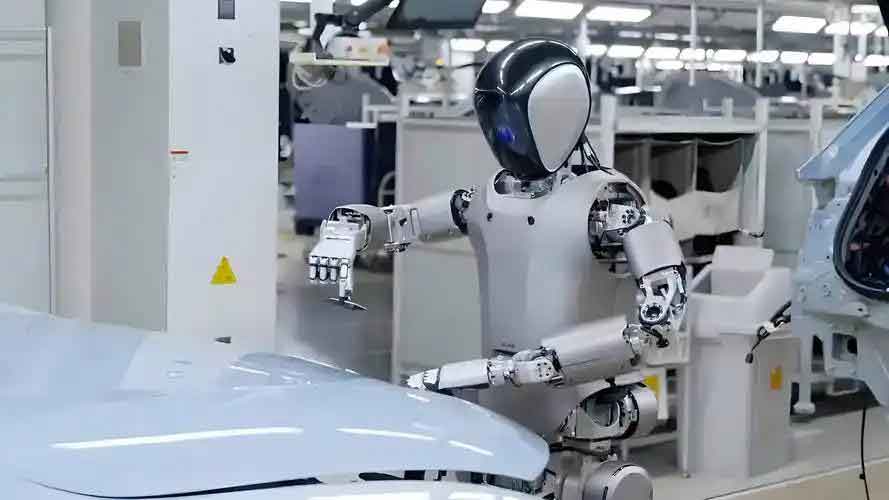
Affinity design emphasizes alignment between a product and users’ physiological and psychological factors, creating pleasant, comfortable, and relaxed emotional experiences. The affinity of a product is expressed through external features. Among theories exploring product-emotion relationships, Kansei engineering is presented as representative because it translates affective perception into engineering design elements. This allows affinity to be expressed through a humanoid robot’s shape, material, color, and other design elements. Earlier work cited in the paper suggests that coordinated overall proportions, smooth contours, simple shapes, and a cute style can give a humanoid robot affinity. Other research indicates that gentle color tones can create an affinity-oriented and bright visual atmosphere, while soft materials can produce feelings of affinity and safety. Artificial intelligence is rapidly entering design fields, and Stable Diffusion has become a favored tool because of its openness and adjustability. Stable Diffusion is an AI image-generation technology based on latent diffusion models, with text-to-image and image-to-image functions. It includes a text encoder such as CLIP, a latent diffusion model including U-Net, and an autoencoder decoder such as VAE. Its principle is to repeatedly denoise an average noise image through a model function until a clear image is obtained. Nevertheless, Stable Diffusion alone, guided only by prompts, struggles to generate humanoid robot designs with reliable affinity and cannot satisfy detailed or specific content requirements. This creates a challenge for further innovation.
The study addresses this gap by building quantitative indicators for humanoid robot affinity design features and using them to guide Stable Diffusion model optimization. The goal is to generate more affinity-rich humanoid robot design schemes, increase user acceptance, and improve willingness to use humanoid robots. The research process begins with Kansei engineering to explore affinity appearance design features. It uses a design paradigm and shape analysis to extract design elements such as modeling, material, texture, and color. Semantic differential methods measure the relationship between affinity feelings and design elements. Questionnaire surveys and data analysis produce affinity features and score tables for different design elements. These tables guide the selection and production of Stable Diffusion training samples. The samples are imported into a trainer, parameters are set, and multiple rounds of iterative training generate several Stable Diffusion models. The best model is selected. It can be used alone or with other style models to generate an affinity appearance scheme matrix. The score table then helps locate high-affinity design schemes.
1. Questionnaire Design and Affinity Dimensions for Humanoid Robot Appearance
To determine measurement dimensions for affinity, the study collected 30 pairs of image words related to affinity. Based on dictionary semantic explanations, the pairs were divided into three groups: social impression, which describes closeness in the relationship between people and a humanoid robot; temperament style, which describes the style and temperament of a humanoid robot; and vitality, which describes the life force and activity level of a humanoid robot. The image word pairs and votes are summarized below.
| Social impression | Votes | Temperament style | Votes | Vitality | Votes |
|---|---|---|---|---|---|
| Indifferent–affinity | 14 | Cold-hard–gentle | 10 | Serious–lively | 11 |
| Cold–intimate | 4 | Cold–mild | 6 | Dull–vivid | 6 |
| Cold–enthusiastic | 2 | Solemn–easygoing | 3 | Stiff–active | 5 |
| Fierce–charitable | 2 | Icy–warm | 3 | Slow–agile | 2 |
| Distant–close | 2 | Hoarse–sweet | 2 | Heavy–relaxed | 1 |
| Abrupt–harmonious | 1 | Green–sweet | 1 | Turbid–fresh | 0 |
| Delicate–humble | 0 | Strong–soft | 0 | Sad–pleased | 0 |
| Irritable–peaceful | 0 | Common–elegant | 0 | Dim–bright | 0 |
| Tense–relaxed | 0 | Awkward–comfortable | 0 | Crude–refined | 0 |
| Uncomfortable–smooth | 0 | Rough–gentle | 0 | Delicate–rough | 0 |
After professional group discussion, word pairs with similar meanings, obscure terms, or difficulty in evaluating humanoid robot design elements were removed. Twenty-five design professionals voted. From each group, the pairs “indifferent–affinity,” “cold-hard–gentle,” and “serious–lively” were selected as the most suitable for describing humanoid robot affinity design characteristics. These correspond to affinity, gentleness, and liveliness. Affinity directly measures the closeness a humanoid robot brings to users. Gentleness serves as an auxiliary evaluation dimension and reflects the care and consideration conveyed by the humanoid robot from a temperament and style perspective. Liveliness, also auxiliary, presents the vividness and activity of the humanoid robot from a vitality perspective. A questionnaire collected user feedback on these three dimensions. During analysis, the study examined differences and associations among the three dimensions to provide concrete guidance for improving the affinity of design elements.
The humanoid robot appearance questionnaire materials were abstracted to precisely investigate how each design element influences affinity. For the head, common shapes were summarized as square, circle, vertical racetrack circle, horizontal racetrack circle, and semicircle. For the eyes, four shapes were used: circle, square, vertical racetrack circle, and horizontal racetrack circle. Body proportions were drawn as flat shapes referencing infant, child, adolescent, and adult forms. These were divided into slim and sturdy types. Shell materials included plastic, cloth, metal, and transparent material, and each material had two surface effects. Colors included three cool hues, three warm hues, and neutral colors of white, gray, and black. Saturation and brightness were adjusted for each hue.
2. Statistical Analysis of Humanoid Robot Affinity Responses
The study collected 645 valid questionnaires. According to data type and research purpose, appropriate statistical methods were used. The influence of design elements on affinity, from high to low, was head shape, facial expression, color, material, and body proportion. This ordering positions head shape and facial expression as leading factors in humanoid robot affinity perception, while color, material, and body proportion remain important supporting elements.
2.1. Relationships Among the Three Affinity Dimensions
For head shape, eye shape, body proportion, material and surface treatment, and color, the three affinity dimensions are equidistant ordered grade variables. Kendall correlation analysis was therefore used to examine relationships among the dimensions. The results are shown below. In the table, a single asterisk indicates P is less than 0.05, and a double asterisk indicates P is less than 0.01. In general, a P value below 0.05 indicates significant correlation, while below 0.01 indicates very significant correlation.
| Design element | Affinity–gentleness | Affinity–liveliness | Gentleness–liveliness |
|---|---|---|---|
| Head shape | 0.356** | 0.303** | 0.284** |
| Eye shape | 0.318** | 0.345** | 0.368** |
| Body proportion | 0.160** | 0.113** | 0.152** |
| Plastic | 0.048** | -0.006 | -0.060** |
| Cloth | -0.016 | -0.006 | -0.020 |
| Metal | 0.029 | -0.010 | 0.028 |
| Transparent | -0.001 | 0.013 | -0.032 |
| White, gray, black | 0.294** | 0.319** | 0.301** |
| High-saturation warm colors | 0.055** | 0.006 | 0.038* |
| Low-saturation warm colors | -0.020 | 0.004 | -0.003 |
| High-saturation cool colors | 0.047** | -0.020 | -0.007 |
| Low-saturation cool colors | 0.032 | 0.006 | -0.019 |
Because material type and warm or cool tone are normally distributed continuous variables across the three affinity dimensions, Pearson correlation analysis was used to examine their relationships. The results are shown below.
| Design element | Affinity–gentleness | Affinity–liveliness | Gentleness–liveliness |
|---|---|---|---|
| Four materials | 0.501** | 0.148** | 0.143** |
| Warm color high versus low saturation | 0.144** | -0.062* | 0.007 |
| Cool color high versus low saturation | 0.121** | 0.016 | 0.035 |
| White versus high saturation | 0.280** | 0.158** | 0.180** |
| White versus low saturation | 0.155** | 0.128** | 0.134** |
The data show that head shape, eye shape, body proportion, material type, and color have strong consistency across the three affinity dimensions. Affinity, gentleness, and liveliness show strong positive correlations. This indicates that the three measurement dimensions selected in the questionnaire are sufficient to accurately describe affinity. For material surface treatment and warm color high versus low saturation, affinity and liveliness show negative correlations. In other words, affinity can increase when liveliness decreases for those specific design aspects.
2.2. Evaluations of Samples Across the Three Affinity Dimensions
For head shape, eye shape, and body proportion, multi-group rank score differences were compared. The Kruskal-Wallis H non-parametric test was used. Values greater than 3 were treated as positive evaluations. The results are shown below. In the table, M(P25, P75) represents the median, with the 25th percentile and 75th percentile in parentheses.
| Design element | Category | Affinity M(P25, P75) | Gentleness M(P25, P75) | Liveliness M(P25, P75) |
|---|---|---|---|---|
| Head shape | A1 | 6(5, 7) | 6(5, 7) | 6(5, 7) |
| Head shape | A2 | 6(5, 6) | 6(5, 6) | 6(5, 6) |
| Head shape | A3 | 3(2, 4) | 3(2, 4) | 4(3, 5) |
| Head shape | A4 | 6(5, 7) | 6(5, 7) | 6(5, 7) |
| Head shape | A5 | 3(2, 4) | 3(2.5, 4.5) | 4(3, 5) |
| Eye shape | B1 | 4(4, 5) | 4(3, 5) | 4(3, 5) |
| Eye shape | B2 | 4(4, 5) | 4(4, 5) | 4(4, 5) |
| Eye shape | B3 | 6(5, 7) | 6(5, 7) | 6(5, 7) |
| Eye shape | B4 | 3(2, 3) | 3(2, 3) | 2(2, 3) |
| Slim body | C1 | 6(5, 6) | 5(5, 6) | 5(5, 6) |
| Slim body | C3 | 6(5, 7) | 6(5, 7) | 6(5, 6) |
| Slim body | C4 | 6(4, 6) | 5(5, 6) | 5(4, 6) |
| Sturdy body | C2 | 5(4, 6) | 5(4, 6) | 5(4, 6) |
| Sturdy body | C5 | 5(4, 6) | 6(5, 6) | 5(3, 5) |
| Sturdy body | C6 | 4(3, 5) | 4(3, 5) | 4(3, 5) |
| Sturdy body | C7 | 4(3, 5) | 3(2, 4) | 4(3, 5) |
For head shape, the horizontal racetrack circle, identified as A4, had the strongest affinity, followed by the circle, identified as A2. The other head shapes did not show affinity. For eye shape, the vertical racetrack circle, B3, had the strongest affinity, followed by the circle B1 and the square B2. The horizontal racetrack circle B4 did not show affinity. For body proportion, affinity from high to low followed this order: infant body C1, child slim body C3, adolescent slim body C4, child sturdy body C2, adolescent sturdy body C5, and adult sturdy body C6 and C7.
For material and surface treatment, two-group rank score differences were compared using the Mann-Whitney U non-parametric test. Values greater than 3 were treated as positive evaluations. The results are shown below.
| Design element | Category | Affinity M(P25, P75) | Gentleness M(P25, P75) | Liveliness M(P25, P75) |
|---|---|---|---|---|
| Plastic | D1 | 4(3, 5) | 4(3, 5) | 5(4, 5) |
| Plastic | D2 | 5(4, 5) | 5(4, 5) | 4(3, 5) |
| Cloth | D3 | 6(5, 7) | 6(5, 7) | 5(4, 6) |
| Cloth | D4 | 6(5, 7) | 6(4, 6) | 5(4, 6) |
| Metal | D5 | 2(1, 3) | 2(1, 3) | 4(2, 5) |
| Metal | D6 | 2(1, 4) | 2(1, 4) | 4(3, 6) |
| Transparent | D7 | 4(3, 5) | 4(2, 5) | 5(4, 6) |
| Transparent | D8 | 4(4, 5) | 4(3, 5) | 4(3, 5) |
For surface material, cloth D3 and D4 had the strongest affinity, and plush texture D3 was higher than textile texture D4. Plastic D1 and D2 and transparent material D7 and D8 had comparable affinity, and matte surfaces were higher than smooth surfaces. Metal material D5 and D6 had relatively high liveliness but did not show affinity. For different material surface treatments, affinity and liveliness were negatively correlated. Increasing surface roughness can therefore improve affinity.
Spearman correlation analysis was used to examine changes in evaluations across height from low to high, neutral colors from white to black, warm colors from right to left in the HSB chart, and cool colors from left to right in the HSB chart. The within-group results are shown below.
| Design element | Affinity | Gentleness | Liveliness |
|---|---|---|---|
| Overall height from low to high | -0.340** | -0.427** | -0.340** |
| Slim body from low to high | -0.011 | -0.037 | -0.089** |
| Sturdy body from low to high | -0.379** | -0.541** | -0.355** |
| Neutral color from white to black | -0.613** | -0.622** | -0.633** |
| High-saturation warm color from right to left | 0.102** | 0.068** | 0.054** |
| Low-saturation warm color from right to left | 0.071** | 0.095** | 0.095** |
| High-saturation cool color from left to right | 0.220** | 0.228** | -0.072** |
| Low-saturation cool color from left to right | 0.067** | 0.145** | -0.078** |
The analysis shows that greater height corresponds to lower affinity for a humanoid robot. As height increases, the decrease in affinity for sturdy body proportions is more significant than for slim body proportions. Among neutral colors, white has the greatest affinity, followed by gray, while black has the least. For warm colors, a position farther to the left corresponds to greater affinity. For cool colors, a position farther to the right corresponds to greater affinity.
For warm and cool color evaluations, one-way linear regression analysis was used to compare groups. The comparison group was the independent variable, and scores on the three dimensions were dependent variables. A regression model was established to explore correlations between the three dimension scores and the comparison groups. The results are shown below. In the table, values greater than 0 indicate that the latter of the two compared sides has a more significant positive influence on affinity, while values less than 0 indicate that the former has a more significant influence.
| Comparison group | Affinity | Gentleness | Liveliness |
|---|---|---|---|
| High versus low saturation, warm color | 0.867 | 0.672 | -0.208 |
| High versus low saturation, cool color | 0.855 | 0.668 | -0.012 |
| White versus high-saturation cool color | -1.633 | -1.647 | -0.705 |
| White versus high-saturation warm color | -0.466 | -0.273 | 0.421 |
| White versus low-saturation cool color | -0.778 | -0.979 | -0.717 |
| White versus low-saturation warm color | 0.401 | 0.399 | 0.213 |
The regression analysis indicates that the average affinity of low-saturation colors is higher than that of high-saturation colors. Affinity from high to low follows this order: low-saturation warm color, white, high-saturation warm color, low-saturation cool color, and high-saturation cool color.
3. Humanoid Robot Affinity Appearance Design Feature Summary
In terms of shape, simple, smooth, and rounded forms generally give users a friendly and gentle visual experience. A horizontal racetrack circular face, vertical racetrack circular eyes, and a slim adolescent body proportion have a more significant positive influence on affinity. For a humanoid robot, these shape features can help the exterior read as approachable rather than mechanical or distant.
In terms of material, soft materials with texture can produce stronger affinity. Surface treatment can increase texture and roughness and reduce the coldness brought by smooth surfaces, thereby improving affinity. Multiple affinity materials can be combined to enrich the visual effect, making the humanoid robot more three-dimensional and vivid.
In terms of color, higher brightness and lower saturation can make humanoid robot affinity higher. Warm colors such as beige and light orange give a warm and comfortable feeling. Increasing brightness and reducing saturation can increase the affinity of cool colors.
To quantify the affinity level of training samples, the study produced an affinity score table for each design feature based on the conclusions. This table provides a basis for screening and producing training samples. The table is shown below.
| Code | Score | Code | Score | Code | Score | Code | Score |
|---|---|---|---|---|---|---|---|
| A1 | 3 | B4 | 0 | D1 | 1 | E1 | 4 |
| A2 | 3 | C1 | 3 | D2 | 2 | E2 | 2 |
| A3 | 0 | C2 | 2 | D3 | 3 | E3 | 2 |
| A4 | 3 | C3 | 4 | D4 | 3 | E4 | 1 |
| A5 | 0 | C4 | 3 | D5 | 0 | E5 | 3 |
| B1 | 1 | C5 | 2 | D6 | 0 | E6 | 0 |
| B2 | 1 | C6 | 1 | D7 | 1 | E7 | 0 |
| B3 | 3 | C7 | 0 | D8 | 1 | — | — |
- For humanoid robot head design, the horizontal racetrack circle and circle are associated with higher affinity, while square and semicircle forms are not.
- For humanoid robot eye design, the vertical racetrack circle is strongest, followed by circle and square, while the horizontal racetrack circle is not affinity-oriented.
- For humanoid robot body proportion, infant, child slim, and adolescent slim forms rank above sturdy adult forms; height increases are associated with reduced affinity, especially for sturdy proportions.
- For humanoid robot materials, cloth and plush or textile textures are stronger than plastic, transparent, or metal; matte finishes outperform smooth finishes; metal may appear lively but not affinity-oriented.
- For humanoid robot color, white is strongest among neutrals; low-saturation warm colors rank highly; high-saturation cool colors rank lowest; higher brightness and lower saturation generally improve affinity.
4. Stable Diffusion Model Training for Humanoid Robot Affinity
The study then used the affinity score table to guide Stable Diffusion model training. Based on differences in pixel RGB values, noise of different concentrations is gradually added to samples on a source model until the image becomes an average noise image. A new function is fitted to obtain a trained model. The main training methods include Dreambooth and LoRA. Dreambooth adjusts the weights of all layers in the Stable Diffusion model neural network and learns features and styles from sample images to meet design requirements. LoRA is a method that trains a model with a small number of images. Its principle is to insert a new computation layer into U-Net to influence image generation. Compared with Dreambooth, a LoRA model is smaller and faster to train.
The study used Dreambooth to train the main model and generate different types of design schemes. It trained multiple LoRA models as style models to assist in generating schemes with different characteristics, balancing model training quality and efficiency. For the model to learn the characteristics of humanoid robot design elements, multiple rounds of training were required. The process can be divided into four steps: training sample production, training sample labeling, training iteration, and model screening and use.
- Create training samples that meet affinity features while varying details to support generalization.
- Label samples automatically and then manually for overall shape, detail shape, style, material, surface treatment, and color.
- Iterate training rounds, scoring samples with the affinity table and modifying samples when generated results drift away from desired humanoid robot features.
- Screen Epoch models by Loss value and XY cross plots, then use the selected model alone or with LoRA style models to generate and evaluate humanoid robot schemes.
4.1. Training Sample Production for Humanoid Robot Affinity
Training samples determine the image generation effect. When selecting samples, the study ensured that samples matched affinity features and had similar styles, while differing in details, so that a model with generalization ability could be trained. To ensure training quality, the study used Stable Diffusion modules such as ControlNet, image-to-image, and local repainting, combined with Photoshop software, to optimize initial materials from overall form to details. Through multiple rounds of model training, image generation, and modification, the materials gradually met the affinity element features.
4.2. Training Sample Labeling for Humanoid Robot Affinity
After automatic sample labeling, manual labeling was performed to ensure the accuracy of affinity design feature labels. The labeling covered overall shape, detailed shape, shape style, material and surface treatment, and color. For example, one humanoid robot sample was labeled as: “affinity robot, minimalism, organic form, science fiction, humanoid robot, oval head, vertical eyes, yellow eyes, no mouth, white body, plastic material, shiny joints, teenage figure, full body, standing, arms at sides.” This kind of detailed labeling helps the model associate specific humanoid robot features with affinity outcomes.
4.3. Training Iteration for Humanoid Robot Affinity
During training, samples were modified in each round according to the model generation effect. Each round of training samples was scored with reference to the affinity score table to improve the affinity of each round’s training results. In the first round, the training samples and results matched the head and facial features of an affinity humanoid robot, but they were too cartoonish and lacked realism. In the second round, more realistic samples were added, but the generated body proportions became too short. In the third round, the samples were modified so that the humanoid robot’s body proportion matched the slim adolescent body with the highest affinity score, and more different design details were added. After training, the generated results basically met the design requirements. The representative training sample affinity scores for each round are shown below.
| Round | Head shape | Eye shape | Body proportion | Material type | Overall tone | Score |
|---|---|---|---|---|---|---|
| 1 | A4 | B2 | C3 | D1 | E1 | 12 |
| 2 | A4 | B3 | C1 | D2 | E5 | 14 |
| 3 | A4 | B3 | C3 | D2 | E1 | 16 |
The main training parameters included Learning Rate, Iteration, Batch Size, Epoch, Optimizer, Scheduler, DIM, and Alpha. After testing, the training parameters were set as shown below.
| Parameter name | Parameter | Parameter name | Parameter |
|---|---|---|---|
| Learning Rate | 1×10^-4 | Optimizer | 8bit-Adam |
| Iteration | 10 | Scheduler | Cosine |
| Batch Size | 5 | DIM | 128 |
| Epoch | 10 | Alpha | 64 |
4.4. Model Screening and Use for Humanoid Robot Design
When evaluating training results, the Loss value is an important numerical indicator. After model training, the model from each Epoch is output, and the dynamic change in Loss value is recorded. Loss value has a dynamic process of going from large to small and then becoming large again. When the Loss value decreases to around 0.08 at the 7th to 9th Epoch, it is an ideal reference value. The Loss value change curve can be improved by adjusting training parameters and increasing sample size so that it approaches the ideal state.
An XY cross plot can generate Epoch model images under different weights to verify actual effects. Combining the affinity score table to score and screen the XY cross plot showed that the 6th Epoch model used with a weight of 0.6 to 0.8 produced the best effect. The affinity scores of schemes in the XY cross plot are shown below.
| Epoch | Loss value | Weight 0.2 | Weight 0.4 | Weight 0.6 | Weight 0.8 | Weight 1.0 |
|---|---|---|---|---|---|---|
| 3 | 0.089 | 9 | 13 | 13 | 13 | 13 |
| 6 | 0.075 | 9 | 9 | 14 | 14 | 13 |
| 9 | 0.068 | 9 | 11 | 12 | 12 | 12 |
Affinity emphasizes personalization and diversification. By pairing with different style models to generate many schemes with different styles, the schemes can be organized into a style matrix. Combined with the affinity score table for evaluation, high-affinity schemes can be quickly identified among many schemes. In the style matrix, the first scheme in each style had the highest affinity score. The affinity scores of the style matrix are shown below.
| Style number | Scheme 1 | Scheme 2 | Scheme 3 | Scheme 4 | Scheme 5 |
|---|---|---|---|---|---|
| 1 | 15 | 12 | 10 | 9 | 8 |
| 2 | 15 | 14 | 14 | 14 | 14 |
| 3 | 15 | 14 | 14 | 12 | 12 |
| 4 | 14 | 12 | 12 | 9 | 9 |
5. Conclusions and Implications for Humanoid Robot Development
The study used Kansei engineering to conduct quantitative analysis of the affinity concept. From the three dimensions of affinity, gentleness, and liveliness, it revealed the exterior design features of an affinity humanoid robot and formed precise design requirements and evaluation mechanisms. This provides a method and guidance for humanoid robot design. With AI-assisted design tools, a series of affinity humanoid robot appearance design models were trained according to affinity design requirements. This allows Stable Diffusion to generate large numbers of design schemes with different styles in a short time, form a style matrix, and quickly screen schemes.
The method can significantly improve the efficiency and quality of humanoid robot appearance design. It provides a new technical path for emotional design of robots, offers a reference for future affinity appearance design of humanoid robots, promotes the application and popularization of humanoid robots in life and business service scenarios, and can improve user acceptance and willingness to use humanoid robots.
The paper also notes limitations. The questionnaire sample group was relatively concentrated, and the universality of the results requires validation by a larger range of users. Future work can expand in directions such as cross-cultural research, diversified style generation, and integrated research on appearance and interactive behavior. These efforts can lead to a more universal and scalable design methodology and help humanoid robots achieve a higher level of affinity in multiple scenarios.
6. Publication Information and Research Context
The study appears in the Journal of Machine Design, Vol. 42, No. 10, October 2025. The article is identified by DOI 10.13841/j.cnki.jxsj.2025.10.026. It was received on 2024-11-14 and revised on 2025-04-25. The article number is 1001-2354(2025)10-0218-07. The authors are Deng Jun, Li Xiaoyu, and Yuan Jiajun of the School of Urban Design, Wuhan University, Hubei, Wuhan 430072. The work was supported by the Wuhan University “351 Talent Plan” teaching post construction project, WDBZ202234. The paper is classified under TB472 and has document code A.
7. Design Team Takeaways for Humanoid Robot Affinity Programs
- Treat humanoid robot affinity as a multi-dimensional target: affinity, gentleness, and liveliness.
- Prioritize head shape and facial expression, because they had the highest influence on affinity in the study, followed by color, material, and body proportion.
- Use the score table as a screening tool before and after AI generation.
- Combine Dreambooth for main models and LoRA for style models to balance quality and speed.
- Evaluate generated humanoid robot schemes with the same score table to avoid subjective selection.
- Consider cross-cultural validation and interaction behavior in later stages.
8. Limitations and Future Research for Humanoid Robot Affinity
The study acknowledges that its questionnaire sample group was relatively concentrated. The universality of the findings therefore requires validation with a larger range of users. For humanoid robot developers, this means that affinity preferences identified in the study should be tested across different user groups, service contexts, and cultural settings before being treated as universal design rules.
Future research can expand in several directions. Cross-cultural research can examine whether the same humanoid robot shapes, materials, and colors produce similar affinity responses in different regions. Style diversification generation can explore how trained Stable Diffusion models and LoRA style models can produce a wider range of humanoid robot appearances while retaining high affinity scores. Integrated research on appearance and interactive behavior can investigate how a humanoid robot’s visual affinity interacts with motion, voice, gesture, and service behavior. These directions can support a more universal and scalable design methodology and help humanoid robots achieve higher affinity in multiple scenarios.
For designers and developers working on humanoid robots, the reported framework suggests that affinity should be engineered through measurable design choices rather than left to chance. For a humanoid robot intended for daily life or commercial service, head shape, eye shape, body proportion, material surface, and color saturation all contribute to perceived affinity. By linking those features to an affinity score table and then training Stable Diffusion models with carefully labeled samples, the design process can produce many humanoid robot appearance concepts and evaluate them against a consistent standard. The result is not only a larger quantity of humanoid robot design options but also a more disciplined way to identify which humanoid robot concepts are most likely to be accepted, trusted, and used by people in real service environments.
The study’s emphasis on humanoid robot affinity also points toward a broader shift in humanoid robot design. Instead of treating appearance as a final cosmetic layer, the research positions humanoid robot appearance as an early design variable that can be quantified, scored, and optimized with AI. This is especially relevant as humanoid robots move from controlled industrial settings into shared human spaces. In those spaces, a humanoid robot must communicate safety, approachability, and warmth before any verbal interaction begins. The reported method offers a way to build that communication into the humanoid robot’s form, materials, and color palette while retaining the ability to generate diverse design directions. For future humanoid robot programs, the integration of Kansei engineering and Stable Diffusion may help balance emotional design goals with the speed and scale required by contemporary product development.