
As I reflect on the technological landscape of recent years, I am struck by the accelerating pace at which humanoid robots are transitioning from futuristic concepts to tangible realities. My journey into observing and analyzing this field has revealed a dynamic ecosystem where innovation, market forces, and societal needs converge. The commercialization of humanoid robots is not merely a technical endeavor; it is a multifaceted evolution that promises to reshape industries and daily life. In this exploration, I will delve into the current state, opportunities, and hurdles from my perspective, employing data, formulas, and structured analyses to unpack the complexities.
The genesis of widespread interest in humanoid robots can often be traced to their public demonstrations, where they transcend pure functionality to engage in cultural or artistic expressions. I recall witnessing a performance where a group of humanoid robots danced alongside human performers, their movements synchronized with precision. This event was more than entertainment; it was a testament to the advanced integration of artificial intelligence and mechanical engineering in humanoid robots. Such showcases highlight that humanoid robots are capable of complex, programmed tasks beyond industrial settings, serving as ambassadors for technology’s role in cultural preservation and creative fusion. This visibility fuels public anticipation and underscores the potential for humanoid robots to operate in diverse, unstructured environments.
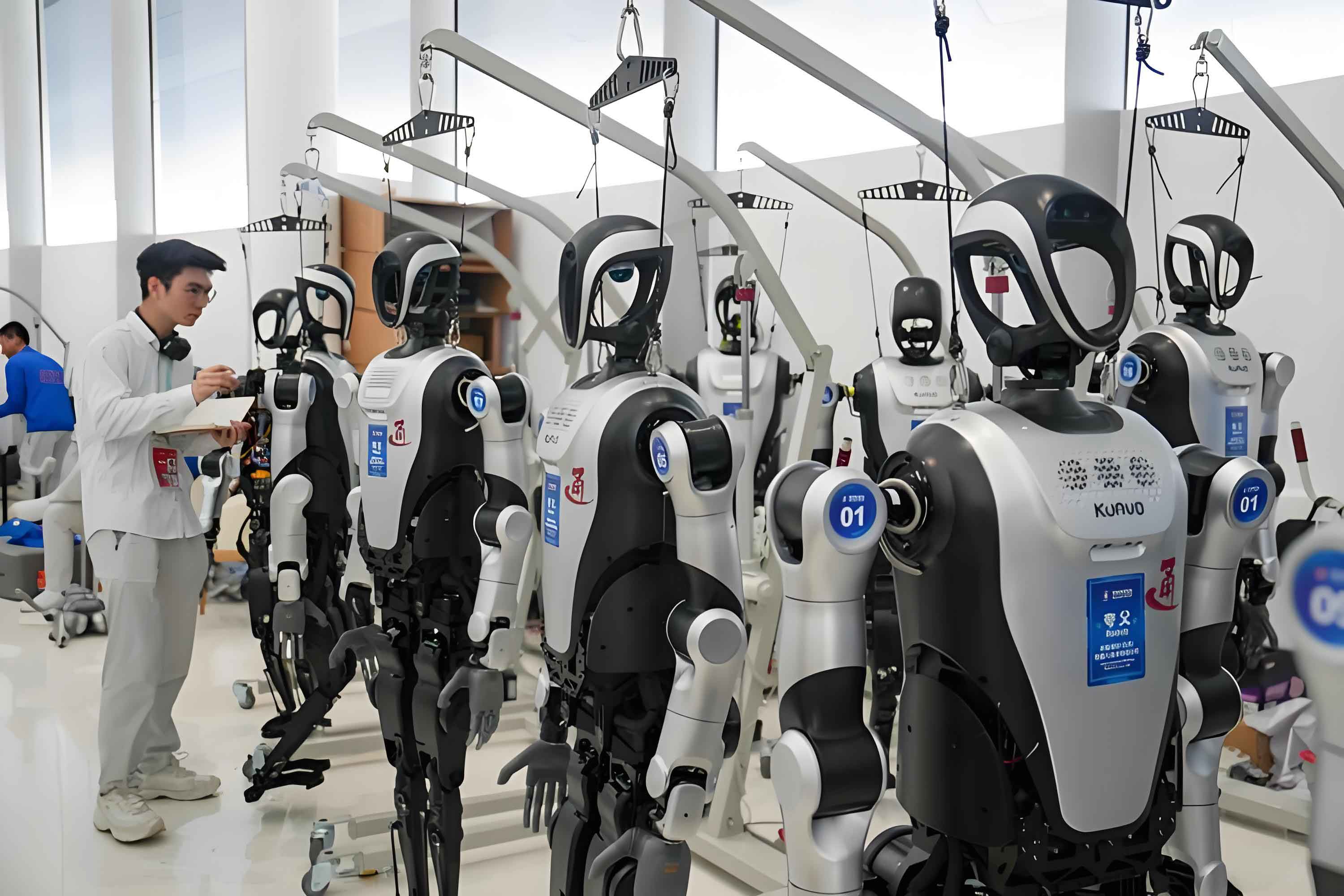
Turning to the industrial landscape, I have observed that the humanoid robot sector has grown exponentially. The global market is expanding at a remarkable rate, with numerous companies entering the fray. To quantify this, let me present a table summarizing key market forecasts and enterprise distribution based on industry reports I’ve analyzed.
| Metric | Value | Time Frame | Source/Note |
|---|---|---|---|
| Global Humanoid Robot Companies | Over 160 | As of mid-2024 | Incomplete global survey |
| Companies Based in One Region | Over 60 (leading globally) | As of mid-2024 | Highest concentration worldwide |
| Global Market CAGR | 71% | 2021-2030 | International association projection |
| Regional Market Size Projection | ~¥870 billion (local currency) | By 2030 | Local institute forecast |
| Global Value Chain Share | 63% for leading region | Current estimate | From financial analyst report |
The data illustrates a robust growth trajectory. The compound annual growth rate (CAGR) is particularly staggering. We can express this growth mathematically. If the market size in 2021 is denoted as $S_{2021}$, and the projected size in 2030 as $S_{2030}$, the CAGR of 71% implies:
$$S_{2030} = S_{2021} \times (1 + 0.71)^9$$
This exponential growth underscores the intense interest and investment flowing into humanoid robot technologies. Furthermore, the concentration of companies in one region suggests a strategic advantage, possibly driven by policy support and capital influx. In my assessment, this regional leadership is pivotal for scaling humanoid robot production and innovation.
From a policy standpoint, I have noted that governmental frameworks are actively fostering humanoid robot development. Initiatives aim to establish innovation systems, achieve batch production, and promote widespread application in sectors like manufacturing and services by 2025. Such policies reduce uncertainty and provide a roadmap for enterprises, accelerating the commercialization of humanoid robots. The alignment of industrial goals with national strategies creates a fertile ground for breakthroughs, making humanoid robots a cornerstone of future technological infrastructure.
The applications of humanoid robots are diversifying rapidly, which I find exhilarating. Initially confined to theoretical or limited industrial roles, humanoid robots now penetrate multiple domains. Below is a table categorizing primary application areas and their specific demands, based on my observations and market analyses.
| Application Domain | Key Requirements | Examples of Functions | Market Maturity |
|---|---|---|---|
| Industrial Manufacturing | High precision, efficiency, repeatability | Assembly,搬运 (handling), quality inspection | Growing, with pilot deployments |
| Commercial Services | Interaction capability, service awareness | Reception, guidance, customer assistance | Emerging, in controlled environments |
| Medical Rehabilitation | Health monitoring,辅助护理 (assistive care) | Therapy, mobility aid, vital signs detection | Experimental, with niche products |
| Home Companionship | Emotional interaction, daily assistance | Cleaning,陪伴 (companionship), safety monitoring | Nascent, high potential |
In industrial settings, the efficacy of a humanoid robot can be modeled using efficiency metrics. For instance, if a humanoid robot performs a task with output $O$ (e.g., units assembled per hour) and requires input $I$ (e.g., energy consumed, maintenance cost), its efficiency $E$ is:
$$E = \frac{O}{I}$$
Optimizing this ratio is crucial for adoption. Humanoid robots offer flexibility over traditional industrial robots, as they can adapt to varied tasks without extensive reprogramming. I believe this adaptability will drive their uptake in small-batch manufacturing and complex workflows.
The expansion into services and healthcare is particularly promising. Market data indicates steady growth in commercial service robots, with projections suggesting explosive increases in coming decades. For example, one forecast estimates global sales in manufacturing and home service could reach millions of units by 2035, with a CAGR near 98%. This can be expressed as:
$$Sales_{2035} = Sales_{2025} \times (1 + CAGR)^{10}$$
where $CAGR = 0.982$. Such growth implies humanoid robots becoming mainstream智能终端 (smart terminals). In healthcare, I’ve seen prototypes capable of multifaceted support, from physical therapy to emotional engagement, though cost remains a barrier. The vision is to create affordable humanoid robot companions that enhance quality of life, especially for the elderly or disabled.
However, the path to widespread commercialization of humanoid robots is fraught with challenges, often termed the “last mile.” From my perspective, these hurdles are interconnected and must be addressed holistically. I categorize them into four core areas: technological突破, cost optimization, market expansion, and regulatory/ethical alignment. Each area demands strategic focus to propel humanoid robots into everyday use.
First, technological突破 is the bedrock. Despite advances, humanoid robots still grapple with issues like high-precision localization in dynamic environments, low-latency control systems, and robust adaptation to unpredictability. As an observer, I note that innovation in actuators, sensors, and AI algorithms is critical. We can frame control stability using a feedback loop model. If the desired trajectory is $x_d(t)$ and the actual output is $x(t)$, the error $e(t)$ is:
$$e(t) = x_d(t) – x(t)$$
Minimizing this error over time requires advanced controllers, often involving proportional-integral-derivative (PID) or neural network approaches. Research投入 in such areas is essential. Collaborative efforts between academia and industry, which I strongly advocate, can accelerate progress. For instance, shared platforms for testing humanoid robot locomotion in varied terrains could spur innovations.
Second, cost presents a significant barrier. The high expense of developing and producing humanoid robots limits accessibility. From my analysis, cost control hinges on production scaling, material selection, and process efficiency. We can model unit cost $C_u$ as:
$$C_u = \frac{F}{Q} + V$$
where $F$ is fixed cost (R&D, capital), $Q$ is production volume, and $V$ is variable cost per unit. To reduce $C_u$, we must increase $Q$ through规模化生产 (scale production) and decrease $V$ via cheaper components or design simplifications. The table below outlines strategies I’ve identified for cost optimization.
| Strategy | Description | Potential Impact on Cost |
|---|---|---|
| Process Automation | Implement smart manufacturing lines | Reduces labor costs, improves consistency |
| Material Substitution | Use lightweight composites or recycled materials | Lowers material expenses without compromising durability |
| Modular Design | Create interchangeable parts for different models | Cuts R&D and inventory costs, enables mass customization |
| Supply Chain Localization | Source components regionally to reduce logistics | Decreases transportation costs and lead times |
Aiming for a target cost below a certain threshold, as some enterprises plan, is vital for market penetration. I estimate that economies of scale could drive prices down dramatically within a few years, making humanoid robots viable for small businesses and households.
Third, market expansion requires精准挖掘需求 (precise demand mining). Current applications of humanoid robots are often limited to pilot projects or niche uses. To unlock broader adoption, we must identify and cultivate diverse scenarios. From my engagement with industry trends, I see potential in sectors like education, where humanoid robots could serve as personalized tutors, or in retail, enhancing customer experiences. The demand $D$ for humanoid robots in a sector can be modeled as a function of utility $U$, price $P$, and替代品 availability $S$:
$$D = f(U, P, S)$$
By increasing $U$ through multifunctional designs and lowering $P$, we can boost $D$. Surveys and data analytics, as I recommend, help tailor solutions. For example, a humanoid robot for elderly care might integrate health monitoring with social interaction, addressing both physical and emotional needs.
Fourth, regulatory and ethical considerations are paramount. As humanoid robots become more autonomous, issues of privacy, safety, and societal impact arise. In my view, proactive engagement with policymakers is crucial. Establishing standards for human-robot interaction, data security, and ethical deployment will build public trust. For instance, guidelines on how humanoid robots handle sensitive information or make decisions in critical situations must be developed. This alignment ensures that the commercialization of humanoid robots proceeds responsibly, mitigating risks of misuse or public backlash.
To synthesize these challenges, I propose a holistic framework for overcoming the “last mile.” The convergence of technology, cost, market, and regulation can be visualized as interdependent vectors driving commercialization. If we denote progress in each area as $T$ (technology), $C$ (cost), $M$ (market), and $R$ (regulation), the overall commercialization success $S$ might be approximated by a weighted sum:
$$S = w_T \cdot T + w_C \cdot C + w_M \cdot M + w_R \cdot R$$
where $w_i$ are weights reflecting relative importance. Balancing these factors is key; for example, a technological breakthrough in humanoid robot mobility ($T \uparrow$) may not yield success if costs remain high ($C \downarrow$). Thus, integrated strategies are essential.
Looking ahead, I am optimistic about the future of humanoid robots. The trajectory suggests that within 10-15 years, humanoid robots could become ubiquitous, serving as collaborators in factories, caregivers in homes, and assistants in public spaces. The innovation cycle is accelerating, with new models continuously pushing boundaries. From my perspective, the tipping point will come when humanoid robots achieve a balance of affordability, reliability, and usefulness across multiple contexts.
In conclusion, the commercialization of humanoid robots is a complex yet thrilling journey. As I’ve outlined through data, formulas, and personal insights, the industry stands on the cusp of transformative growth. By addressing technological hurdles, optimizing costs, exploring diverse markets, and navigating ethical landscapes, we can usher in an era where humanoid robots are integral to society. The humanoid robot revolution is not a distant dream—it is unfolding before our eyes, and I am committed to tracking its progress as it reshapes our world.
To further illustrate the technological advancements, consider the role of quality inspection in humanoid robot manufacturing. Ensuring each component meets stringent standards is vital for reliability. Advanced imaging and AI-driven检测 systems are employed to verify precision, as depicted in the embedded figure. This attention to detail exemplifies the rigorous processes required to produce high-performance humanoid robots that can withstand real-world demands.
Throughout this exploration, the term humanoid robot has been central, reflecting its significance as both a technological marvel and a societal tool. The repeated emphasis on humanoid robot capabilities, humanoid robot markets, and humanoid robot challenges underscores their multifaceted role. As we move forward, continuous innovation in humanoid robot design, coupled with strategic collaborations, will unlock new possibilities. I remain convinced that the humanoid robot ecosystem will evolve rapidly, driven by human curiosity and the relentless pursuit of progress.