
In recent years, the advancement of humanoid robots has captured global attention as a transformative technology poised to reshape production and lifestyle paradigms. As an integration of artificial intelligence, advanced manufacturing, and new materials, the humanoid robot represents a disruptive product that could follow in the footsteps of computers, smartphones, and electric vehicles. The global market for humanoid robots is projected to grow at a compound annual growth rate (CAGR) of over 70% in the coming decade, driven by technological breakthroughs and expanding application scenarios in service, healthcare, education, and beyond. This rapid growth underscores the strategic importance of fostering innovation in the humanoid robot sector, which requires a systematic approach to identify key targets and chart effective development pathways.
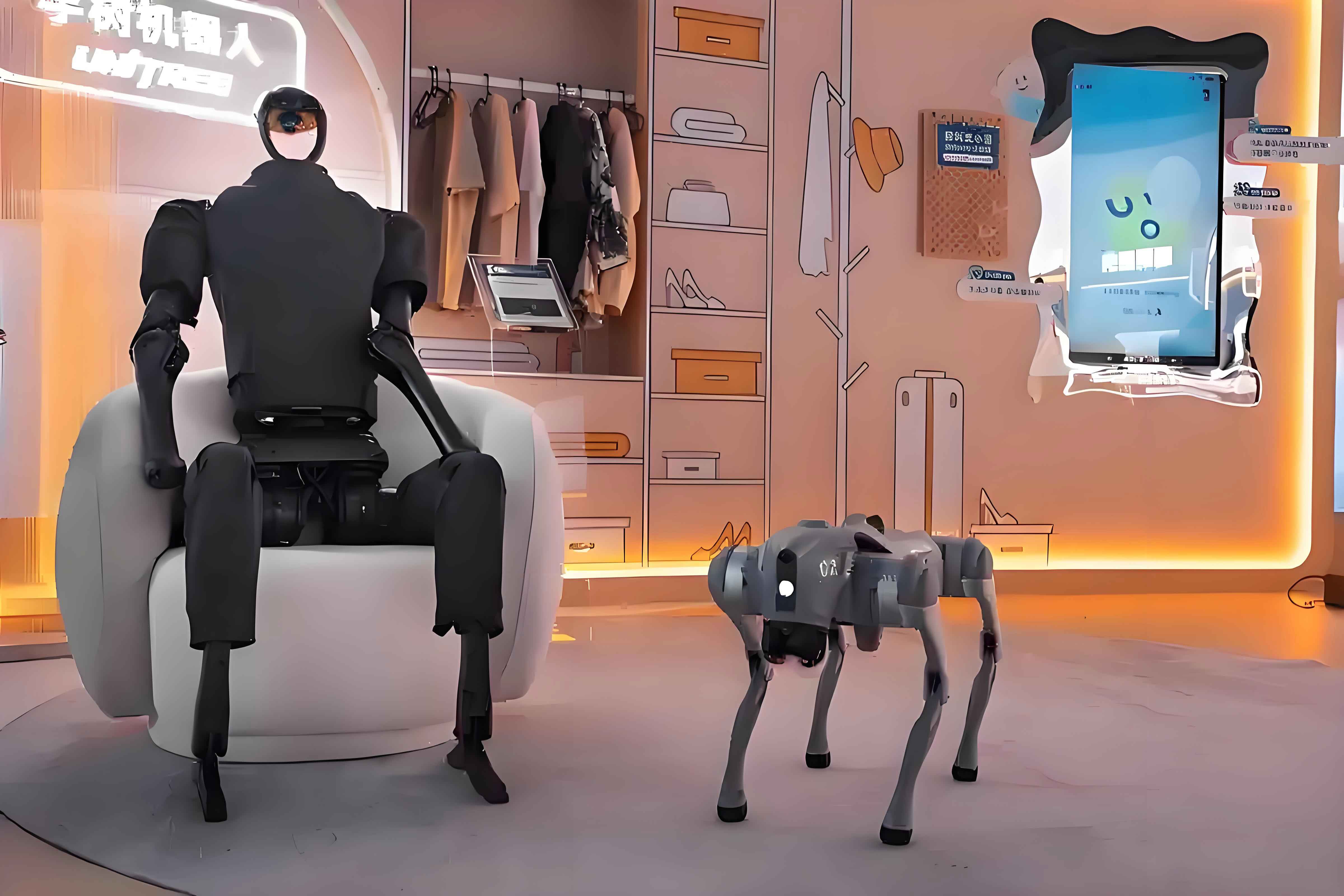
From my perspective, the development of humanoid robots hinges on addressing critical bottlenecks in technology, industry, and market domains. I believe that by focusing on these key targets, stakeholders can accelerate progress and unlock the full potential of humanoid robots. In this article, I will delve into the current landscape, outline the essential targets, propose viable pathways, and discuss challenges and recommendations for the humanoid robot ecosystem. Throughout, I will emphasize the recurring theme of ‘humanoid robot’ to highlight its centrality, and I will employ tables and formulas to summarize and clarify complex aspects.
The current state of the humanoid robot industry reveals both promise and hurdles. Generally, the industry is characterized by a growing number of enterprises involved in robotics, with clusters forming around research hubs and manufacturing bases. For instance, upstream components like reducers, servo systems, and controllers have seen incremental improvements, yet gaps persist in high-performance sensors and specialized chips. In terms of product innovation, humanoid robots capable of dynamic movement and adaptive walking have emerged, showcasing capabilities such as jumping and terrain navigation. These advancements are often supported by collaborative efforts between academia and industry, fostering innovation in control algorithms, mechanical structures, and application scenarios. However, the industry faces issues like a lack of dominant players, insufficient capital investment, and fragmented policy support, which I will explore further.
To structure the discussion, I define key targets across three dimensions: technology, industry, and market. These targets serve as focal points for strategic intervention, guiding efforts toward sustainable growth for humanoid robots.
Key Targets for Humanoid Robot Development
The evolution of humanoid robots depends on achieving specific milestones in technology, industry, and market realms. Below, I summarize these targets in a table to provide a clear overview.
| Dimension | Key Targets | Description |
|---|---|---|
| Technology | Advanced AI and Learning Algorithms | Enhance autonomy through machine learning and natural language processing for better decision-making and human-robot interaction. |
| Technology | Motion Control and Actuation Systems | Improve precision in motors, transmissions, and force feedback to enable fluid movements and complex manipulations. |
| Technology | Environmental Perception and HRI | Integrate multi-modal sensors (visual, auditory, tactile) and intuitive interfaces for real-time environment understanding and natural communication. |
| Industry | Supply Chain Integration | Consolidate core components and system integration to ensure technological self-sufficiency and reduce costs. |
| Industry | Localization of Key Parts | Promote domestic production of critical零部件 like motors and sensors to enhance supply chain resilience. |
| Industry | Standardization and Regulations | Establish unified technical standards and certification systems to ensure compatibility, safety, and scalability. |
| Market | User Needs Analysis | Conduct thorough market research to identify functional requirements and pain points in sectors like healthcare and education. |
| Market | Market Acceptance Enhancement | Address barriers such as cost, usability, and ethical concerns through design improvements and user education. |
| Market | Brand Building and Promotion | Develop effective marketing strategies and success stories to build trust and expand market reach. |
In the technology domain, the humanoid robot must achieve breakthroughs in intelligence and physical capabilities. For example, the integration of AI can be quantified using metrics like the autonomy index, which I express as: $$ A = \frac{\sum_{i=1}^{n} (T_i \cdot L_i)}{E} $$ where \( A \) is autonomy, \( T_i \) represents task complexity, \( L_i \) is learning efficiency, and \( E \) denotes environmental variability. This formula highlights how improving algorithms boosts the humanoid robot’s adaptability. Similarly, motion control relies on optimizing kinematic equations, such as: $$ \tau = J^T F + M(q)\ddot{q} + C(q,\dot{q}) + G(q) $$ where \( \tau \) is joint torque, \( J \) is the Jacobian matrix, \( F \) is external force, \( M \) is inertia, \( C \) is Coriolis force, and \( G \) is gravity. Enhancing these parameters allows the humanoid robot to perform delicate operations, from walking on uneven surfaces to manipulating tools.
From an industry standpoint, the humanoid robot ecosystem requires robust collaboration. A key metric is the localization rate, defined as: $$ LR = \frac{P_d}{P_t} \times 100\% $$ where \( LR \) is localization rate, \( P_d \) is domestically produced parts, and \( P_t \) is total parts. Increasing \( LR \) reduces dependency on imports and stabilizes costs. Moreover, standardization efforts can be modeled using compatibility scores: $$ CS = \frac{N_c}{N_t} $$ where \( CS \) is compatibility score, \( N_c \) is number of compatible components, and \( N_t \) is total components. Higher \( CS \) values facilitate interoperability among humanoid robot systems, accelerating industry growth.
In the market dimension, understanding demand is crucial. I propose a demand forecasting model for humanoid robots: $$ D = \alpha \cdot P^{\beta} \cdot I^{\gamma} \cdot T^{\delta} $$ where \( D \) is demand, \( P \) is price elasticity, \( I \) is income level, \( T \) is technological advancement, and \( \alpha, \beta, \gamma, \delta \) are coefficients. This equation helps predict adoption rates in various sectors. Additionally, market acceptance can be measured through surveys, with scores reflecting user trust in humanoid robots.
Development Pathways for Humanoid Robots
Based on the key targets, I outline pathways for advancing humanoid robots, categorized into technology, industry, and market approaches. These pathways are interdependent and should be pursued simultaneously.
Technology Pathways
In technology, two primary pathways exist: core technology R&D and collaborative innovation. Core technology R&D involves foundational research into AI, sensing, and actuation. For instance, investing in neural networks for humanoid robot perception can yield algorithms that process sensor data more efficiently, as shown in: $$ \text{Accuracy} = \frac{TP + TN}{TP + TN + FP + FN} $$ where \( TP \) is true positives, \( TN \) is true negatives, \( FP \) is false positives, and \( FN \) is false negatives. Improving accuracy enhances the humanoid robot’s reliability in dynamic environments.
Collaborative innovation fosters partnerships between universities, research institutes, and companies. This pathway accelerates knowledge transfer, as seen in joint projects focusing on humanoid robot ethics or control systems. A success metric here is the innovation output rate: $$ IOR = \frac{P_a}{R_d} $$ where \( IOR \) is innovation output rate, \( P_a \) is patents or publications, and \( R_d \) is R&D expenditure. Higher \( IOR \) indicates effective collaboration, driving breakthroughs for humanoid robots.
Industry Pathways
For industry, pathways include enterprise incubation and ecosystem building. Enterprise incubation supports startups through funding and mentorship, nurturing humanoid robot ventures from ideation to market entry. A growth model can be: $$ G = k \cdot S \cdot M $$ where \( G \) is growth rate, \( k \) is a constant, \( S \) is support level, and \( M \) is market potential. This underscores the importance of tailored programs for humanoid robot innovators.
Ecosystem building involves creating clusters that integrate upstream, midstream, and downstream activities. Table below summarizes the elements of a humanoid robot industry ecosystem.
| Ecosystem Layer | Components | Role in Humanoid Robot Development |
|---|---|---|
| Upstream | Component Suppliers (sensors, actuators) | Provide critical parts for humanoid robot assembly, driving innovation in materials and miniaturization. |
| Midstream | Manufacturers and Integrators | Assemble and test humanoid robot systems, ensuring quality and functionality. |
| Downstream | Application Developers and Service Providers | Deploy humanoid robots in fields like retail or healthcare, creating value and feedback loops. |
| Support | Research Centers and Standards Bodies | Offer testing facilities and set guidelines for humanoid robot safety and interoperability. |
Strengthening this ecosystem enhances the resilience of the humanoid robot supply chain, as quantified by the ecosystem health index: $$ EHI = \frac{D + C + I}{3} $$ where \( EHI \) is ecosystem health index, \( D \) is diversity of firms, \( C \) is collaboration intensity, and \( I \) is innovation activity. A high \( EHI \) suggests a thriving environment for humanoid robot development.
Market Pathways
Market pathways encompass demonstration projects and international expansion. Demonstration projects, such as piloting humanoid robots in hospitals or schools, validate practicality and build user confidence. The impact can be measured via adoption curves: $$ A(t) = \frac{K}{1 + e^{-r(t – t_0)}} $$ where \( A(t) \) is adoption at time \( t \), \( K \) is maximum adoption, \( r \) is growth rate, and \( t_0 \) is inflection point. Early demonstrations accelerate the diffusion of humanoid robot technologies.
International expansion involves entering global markets through exports and partnerships. A market penetration model for humanoid robots is: $$ MP = \frac{S_g}{T_g} \times 100\% $$ where \( MP \) is market penetration, \( S_g \) is global sales of humanoid robots, and \( T_g \) is total global market size. Strategies like participating in trade shows can boost \( MP \), leveraging the humanoid robot’s competitive advantages in precision or cost-efficiency.
Challenges and Barriers in Humanoid Robot Advancement
Despite progress, the humanoid robot sector faces significant obstacles. I identify four major challenges: technological bottlenecks, lack of leading enterprises, capital shortages, and inadequate policy frameworks. These issues are interconnected and can hinder the scalability of humanoid robot solutions.
Technologically, humanoid robots struggle with balancing strength, speed, and cost in hardware, while software limitations affect generalization and fine motor control. For example, the torque-speed trade-off in actuators can be expressed as: $$ \tau \cdot \omega \leq P_{max} $$ where \( \tau \) is torque, \( \omega \) is angular velocity, and \( P_{max} \) is maximum power. Overcoming this requires advances in materials and design for humanoid robot joints.
In terms of enterprises, the absence of dominant players leads to fragmentation, reducing economies of scale. A concentration ratio can illustrate this: $$ CR_n = \sum_{i=1}^{n} s_i $$ where \( CR_n \) is concentration ratio for top \( n \) firms, and \( s_i \) is market share of firm \( i \). Low \( CR_n \) values indicate a dispersed humanoid robot industry, complicating coordination.
Capital constraints limit R&D and commercialization. The funding gap for humanoid robot projects can be modeled as: $$ FG = C_d – C_a $$ where \( FG \) is funding gap, \( C_d \) is demanded capital, and \( C_a \) is available capital. Bridging \( FG \) requires innovative financing mechanisms for humanoid robot ventures.
Policy-wise, inconsistent regulations delay deployment. A policy effectiveness score might be: $$ PES = \frac{I_c}{I_t} $$ where \( PES \) is policy effectiveness score, \( I_c \) is implemented policies, and \( I_t \) is total proposed policies. Higher \( PES \) ensures a conducive environment for humanoid robot innovation.
Recommendations for Fostering Humanoid Robot Growth
To address these challenges, I propose targeted recommendations. These should be implemented holistically to propel the humanoid robot sector forward.
First, establish dedicated policies and planning frameworks. This includes formulating strategic documents that outline goals for humanoid robot development, such as setting targets for localization rates or innovation indices. Policies should incentivize collaboration and provide tax breaks for humanoid robot R&D.
Second, accelerate technology breakthroughs and product diversification. Focus on core areas like AI chips for humanoid robot brains or flexible sensors for skin-like perception. Encourage prototyping through grants, with success metrics like time-to-market: $$ TTM = \frac{\sum (t_e – t_s)}{n} $$ where \( TTM \) is average time-to-market, \( t_e \) is launch time, \( t_s \) is start time, and \( n \) is number of humanoid robot products. Reducing \( TTM \) speeds up innovation cycles.
Third, strengthen industrial ecosystems through alliances and clusters. Form consortia that link component makers, manufacturers, and end-users of humanoid robots. This enhances knowledge sharing, as quantified by the network density: $$ ND = \frac{2L}{N(N-1)} $$ where \( ND \) is network density, \( L \) is number of links, and \( N \) is number of nodes. Higher \( ND \) in humanoid robot networks fosters resilience.
Fourth, enhance financial support via funds and investments. Create venture capital funds specifically for humanoid robot startups, and use public-private partnerships to de-risk projects. The return on investment (ROI) for humanoid robot initiatives can be calculated as: $$ ROI = \frac{V_f – V_i}{V_i} \times 100\% $$ where \( V_f \) is final value and \( V_i \) is initial investment. Positive ROI attracts more capital into humanoid robot development.
Moreover, promote international cooperation to access global markets. Engage in standardization bodies to influence norms for humanoid robots, ensuring compatibility worldwide. This aligns with the broader goal of making humanoid robots a ubiquitous technology.
Conclusion
In conclusion, the journey toward advanced humanoid robots is multifaceted, requiring concerted efforts across technology, industry, and market spheres. By focusing on key targets such as AI integration, supply chain localization, and user acceptance, stakeholders can navigate complexities and unlock transformative potential. The pathways I outlined—ranging from collaborative R&D to ecosystem building—provide a roadmap for sustainable growth. However, challenges like technological bottlenecks and capital gaps demand proactive solutions, including policy support and financial incentives. As the humanoid robot landscape evolves, continuous adaptation and innovation will be crucial. I am confident that by embracing these strategies, we can accelerate the development of humanoid robots, paving the way for a future where they enhance productivity and quality of life globally. Ultimately, the success of humanoid robots hinges on our ability to align technological prowess with societal needs, ensuring that every advancement brings us closer to seamless human-robot coexistence.
Throughout this discussion, I have emphasized the centrality of the humanoid robot as a disruptive force. From technical formulas to market models, the interplay of factors underscores the need for a holistic approach. As we move forward, monitoring metrics like autonomy indices and ecosystem health will guide progress. I encourage researchers, investors, and policymakers to prioritize the humanoid robot sector, fostering an environment where innovation thrives. The potential of humanoid robots is vast, and by addressing key targets and following strategic pathways, we can harness this potential for economic and social benefit. Let us commit to advancing humanoid robot technologies, ensuring they become integral to our collective future.