
In this analysis, we delve into the rapidly evolving landscape of humanoid robots, a field that represents the cutting-edge fusion of artificial intelligence and robotics. These advanced machines hold tremendous potential for transforming industries, from manufacturing to healthcare, and are poised to drive significant economic growth. As we explore the current state of humanoid robot development, we focus on the technological advancements, patent strategies, and产业化 challenges faced by key players globally. The proliferation of humanoid robots is not merely a technological pursuit; it is a strategic imperative for nations aiming to lead in the global tech arena. Throughout this discussion, we will emphasize the term humanoid robots to underscore their centrality in this discourse.
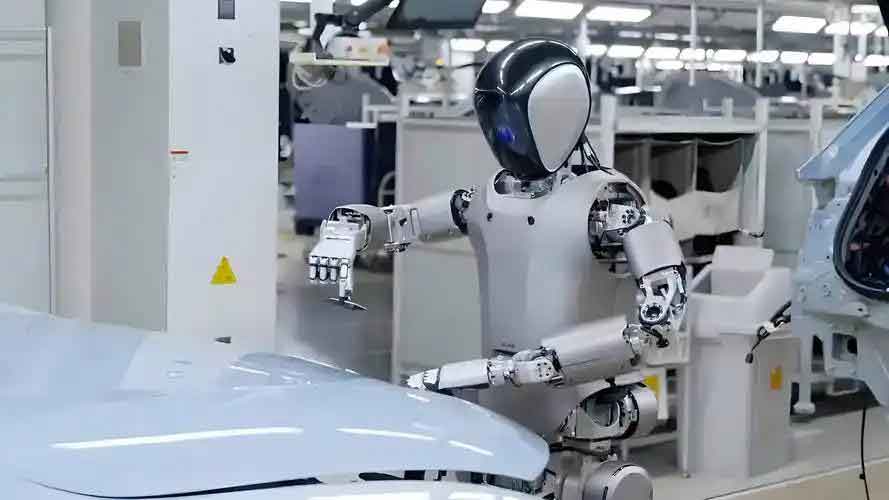
We begin by examining the policy environment that fuels the growth of humanoid robots. In many regions, governments have enacted supportive measures to accelerate innovation. For instance, recent guidelines target the establishment of a robust innovation system by 2025, with breakthroughs in core technologies such as the “brain,” “cerebellum,” and “limbs” of humanoid robots. These policies aim to ensure a secure supply chain for essential components and foster an internationally competitive ecosystem. By 2027, the vision is to achieve world-class capabilities in humanoid robot technology, emphasizing embodied intelligence as a pivotal future industry. This governmental backing is crucial for scaling the production and application of humanoid robots, as it incentivizes research and development while addressing infrastructure needs.
As we assess the competitive dynamics, we observe that several enterprises are leading the charge in humanoid robot development. These companies can be categorized based on their technological focus and market strategies. For example, one group excels in mass production and multi-scene applications, another in high-speed performance and cost-effectiveness, and a third in pioneering motion control and intelligent decision-making. To illustrate, we present a comparative table of product parameters, which highlights the diversity in capabilities among these entities. The data underscores how humanoid robots are evolving to meet varied demands, from industrial tasks to dynamic movements.
| Enterprise Category | Speed (m/s) | Maximum Torque (Nm) | Demonstrated Capabilities | Mass Production Status |
|---|---|---|---|---|
| Category A (Production-Focused) | 0.83 – 1.11 | 200 – 250 | Complex terrain navigation, stair climbing, hand-eye coordination, industrial operations | Yes |
| Category B (Performance-Oriented) | 2.0 – 3.3 | 120 – 360 | Jumping, backflips, dancing, welding, cooking tasks | Yes |
| Category C (Innovation Leader) | 5.59 | Not disclosed | Backflips, agile jumping, complex terrain adaptation, precision assembly | No |
In our evaluation of technological strengths, we note that humanoid robots rely on three core branches: the “brain” for environmental perception and decision-making, the “cerebellum” for motion coordination and balance, and the “limbs” for mechanical execution. For instance, the “brain” component often incorporates advanced algorithms for tasks like visual recognition and path planning. We can model the decision-making process using reinforcement learning frameworks, where the value function is defined as:
$$ Q(s,a) = \mathbb{E} \left[ R(s,a) + \gamma \max_{a’} Q(s’,a’) \right] $$
Here, \( s \) represents the state of the humanoid robot, \( a \) denotes the action taken, \( R \) is the reward function, and \( \gamma \) is the discount factor for future rewards. This equation is fundamental for enabling humanoid robots to learn optimal behaviors in dynamic environments. Similarly, the “cerebellum” involves control algorithms for stability, which can be expressed through dynamics equations like:
$$ \tau = M(q) \ddot{q} + C(q, \dot{q}) \dot{q} + G(q) $$
where \( \tau \) is the torque applied to joints, \( M(q) \) is the inertia matrix, \( C(q, \dot{q}) \) accounts for Coriolis and centrifugal forces, and \( G(q) \) represents gravitational effects. These formulas are critical for achieving the seamless movement that defines advanced humanoid robots.
Turning to intellectual property, we analyze patent layouts to understand strategic positioning. The table below summarizes patent data, revealing disparities in global coverage and technology focus. Humanoid robot companies often prioritize hardware-related patents, but gaps remain in software and intelligent systems. For example, while some entities have extensive patent portfolios domestically, their international presence is limited, potentially hindering global competitiveness. This imbalance could impact the long-term innovation and market share of humanoid robots.
| Enterprise Type | Total Patent Applications | Overseas Patent Percentage | Covered Technology Branches |
|---|---|---|---|
| Type X (Domestic Leader) | Approx. 2600 | 5.1% | Brain, Cerebellum, Limbs |
| Type Y (Agile Innovator) | Approx. 110 | 46.7% | Brain, Limbs |
| Type Z (Global Benchmark) | Approx. 650 | 49.5% | Brain, Cerebellum, Limbs |
We also consider the evolution of patent filings over time, particularly for key technology branches. For instance, a leading global entity shows a steady increase in patents related to “limbs” and “cerebellum,” with a recent surge in “brain” technologies. This trend reflects a strategic shift towards enhancing the intelligence of humanoid robots. The growth can be modeled using a simple exponential function:
$$ P(t) = P_0 e^{kt} $$
where \( P(t) \) is the number of patents at time \( t \), \( P_0 \) is the initial count, and \( k \) is the growth rate constant. Such models help predict future innovation trajectories in the humanoid robot sector.
Despite these advancements, we identify several core challenges in the industrialization of humanoid robots. First, there is a significant gap in intelligent decision-making capabilities. Many humanoid robots excel in physical mobility but lack the cognitive functions for complex task execution. This shortfall stems from insufficient integration of large models with embodied intelligence, limiting their ability to adapt to unpredictable environments. For example, the performance gap in multi-modal interactions can be quantified using a metric like task success rate \( S \), defined as:
$$ S = \frac{\text{Number of successfully completed tasks}}{\text{Total tasks attempted}} $$
In comparative studies, humanoid robots from benchmark entities often achieve higher \( S \) values due to advanced AI algorithms, whereas others struggle with basic commands.
Second, the localization of core components remains a hurdle. Key parts such as precision reducers, high-torque motors, and tactile sensors are often imported, leading to supply chain vulnerabilities. The cost impact can be expressed as:
$$ C_{\text{total}} = C_{\text{local}} + C_{\text{import}} + C_{\text{integration}} $$
where \( C_{\text{total}} \) is the total cost, \( C_{\text{local}} \) represents domestically sourced components, \( C_{\text{import}} \) covers imported items, and \( C_{\text{integration}} \) includes assembly expenses. Reducing \( C_{\text{import}} \) is essential for affordability and scalability of humanoid robots.
Third, mass production and cost control pose dual bottlenecks. Current production scales for many humanoid robot manufacturers are in the thousands, far below the tens of thousands targeted by industry leaders. The cost per unit can be modeled as:
$$ C_{\text{unit}} = \frac{F}{Q} + V $$
with \( F \) being fixed costs, \( Q \) the production quantity, and \( V \) variable costs per unit. As \( Q \) increases, \( C_{\text{unit}} \) decreases, highlighting the need for economies of scale in humanoid robot manufacturing.
Fourth, the disconnection between innovation and industrial chains slows progress. Academic institutions produce valuable research on humanoid robots, but conversion into commercial products is low. This can be represented by a technology readiness level (TRL) score, where many projects stall at mid-levels due to lack of testing platforms. Strengthening this link is vital for accelerating the deployment of humanoid robots.
Fifth, patent布局 deficiencies expose companies to risks. As shown in Table 2, overseas patent applications are often inadequate, and key areas like intelligent decision-making are under-protected. This weakens the global positioning of humanoid robot technologies and increases vulnerability to infringement claims.
To address these challenges, we propose several strategic pathways. For intelligent decision systems, we advocate for collaborative platforms involving government, industry, and academia. Such initiatives can foster innovation in humanoid robots by pooling resources and expertise. The effectiveness of collaboration can be measured using a synergy index \( I_s \):
$$ I_s = \alpha R_{\text{gov}} + \beta R_{\text{ind}} + \gamma R_{\text{acad}} $$
where \( R \) represents resource contributions from each sector, and \( \alpha, \beta, \gamma \) are weighting factors. Higher \( I_s \) values correlate with faster development cycles for humanoid robots.
For core component localization, policy incentives like subsidies and tax breaks can boost domestic production. The impact on cost reduction can be estimated as:
$$ \Delta C = k_{\text{subsidy}} \cdot A_{\text{investment}} $$
where \( \Delta C \) is the cost reduction, \( k_{\text{subsidy}} \) is a subsidy efficiency constant, and \( A_{\text{investment}} \) is the investment amount. This approach can make humanoid robots more accessible to broader markets.
To enhance innovation chain integration, we recommend establishing shared pilot testing facilities. These platforms can reduce the time-to-market for humanoid robot technologies by providing validation environments. The time savings \( T_s \) can be calculated as:
$$ T_s = T_{\text{without}} – T_{\text{with}} $$
where \( T_{\text{without}} \) and \( T_{\text{with}} \) are development times without and with such facilities, respectively. Additionally, creating “technology supermarkets” can bridge research and application, facilitating the transfer of innovations in humanoid robots.
In terms of new opportunities, we highlight the potential of dexterous hand modules as a growth area. These components are crucial for enhancing the operational capabilities of humanoid robots, enabling tasks like precise grasping and manipulation. The development cost for dexterous hands \( C_{\text{hand}} \) can be lower than full-body systems, making them an attractive entry point for innovators. A simplified cost model is:
$$ C_{\text{hand}} = \sum_{i=1}^{n} c_i d_i $$
where \( c_i \) is the cost of sub-components and \( d_i \) is the design complexity factor. Focusing on such modules could democratize access to humanoid robot technologies.
Finally, strengthening intellectual property部署 is critical. We suggest forming patent alliances to share core technologies and mitigate risks. The benefit of such alliances can be expressed as a risk reduction factor \( R_f \):
$$ R_f = 1 – \frac{P_{\text{dispute}}}{P_{\text{total}}} $$
where \( P_{\text{dispute}} \) is the number of potential disputes and \( P_{\text{total}} \) is the total patent portfolio. Increasing overseas patent filings and supporting small enterprises with IP guidance will fortify the global stance of humanoid robot developers.
In conclusion, the journey toward widespread adoption of humanoid robots is fraught with challenges but rich with opportunities. By addressing intelligent system shortcomings, localizing core components, scaling production, integrating innovation chains, and bolstering IP strategies, stakeholders can unlock the full potential of humanoid robots. As we continue to innovate, these machines will play an increasingly vital role in shaping future societies, driven by collaborative efforts and strategic investments. The repeated emphasis on humanoid robots throughout this analysis underscores their transformative impact across multiple domains.