
As I delve into the realm of AI human robot technology, I am struck by its transformative potential to reshape global industries and daily life. In this analysis, I explore the high-quality development of the humanoid robot industry, drawing from extensive research and observations. The convergence of artificial intelligence, advanced manufacturing, and new materials has positioned AI human robots as pivotal entities capable of mimicking human morphology and behavior, potentially emerging as independent productive forces. With global aging populations, declining labor forces, and rising wage costs, the shift toward “machines replacing humans” is accelerating, making the AI human robot sector a focal point of innovation and economic strategy. I aim to provide a comprehensive overview of the current landscape, identify key opportunities, address challenges, and propose strategies for sustainable growth, all while emphasizing the critical role of AI human robot advancements.
The global market for AI human robots is expanding rapidly, driven by demographic shifts and technological progress. According to various forecasts, the worldwide market size for humanoid robots is projected to exceed $20 billion by 2026 and could reach up to $200 billion by 2030, with China potentially accounting for $50 billion of that. By 2035, optimistic estimates suggest a market value of $1.54 trillion, reflecting a compound annual growth rate (CAGR) of up to 94% from 2025 to 2035. This growth is fueled by applications in healthcare, logistics, and personal services, where AI human robots are expected to enhance efficiency and address labor shortages. For instance, in healthcare, they could assist with patient care, while in logistics, they might optimize warehouse operations. The table below summarizes key market projections and application areas, highlighting the immense potential of AI human robots.
| Year | Global Market Size (USD Billion) | Key Application Areas | Expected CAGR (%) |
|---|---|---|---|
| 2026 | 20+ | Healthcare, Logistics | ~50 |
| 2030 | 200+ | Commercial Services, Personal Use | ~70 |
| 2035 | 380-1540 | Industrial Manufacturing, Home Assistance | Up to 94 |
On the technological front, I observe significant advancements in AI human robot capabilities, particularly in areas like motion control, environmental perception, and decision-making. Internationally, countries like the United States and Japan have led in areas such as joint design, power drives, and control systems, with Japan excelling in precision reducers and controllers. The U.S., leveraging its AI and computing strengths, has introduced foundational models like Project GR00T, which enhance the generalization of AI human robots. Domestically, institutions and companies have made strides in basic components, new materials, and recognition algorithms, transitioning from catch-up innovation to pioneering efforts. However, challenges remain in core components, operating systems, and overall product ecosystems. For example, the cost breakdown of a single AI human robot reveals high dependencies on imported parts: frameless torque motors (21% of cost, 70% import reliance), reducers (16%, 55%), force sensors (16%, 78%), and others. This underscores the need for localized production and innovation. The integration of large language models has been a game-changer, equipping AI human robots with “brains” for better interaction and task execution. A key formula representing the motion control in AI human robots can be expressed using Lagrangian dynamics:
$$ L = T – V $$ where \( T \) is the kinetic energy and \( V \) is the potential energy of the system, governing the robot’s movement and stability. This is crucial for achieving high mobility and balance in AI human robots.
Policy support has been instrumental in accelerating the AI human robot industry. Various nations have incorporated humanoid robots into their strategic plans, with China issuing guidelines that emphasize industrialization, core component supply, and international competitiveness. Regions like Shenzhen, Beijing, Shanghai, and Anhui have implemented incentives to foster innovation clusters, aiming for industrial scales of up to $100 billion. This policy-driven approach helps mitigate risks and promotes collaboration, but it also highlights the intense global competition. As I analyze these developments, I see a pressing need for standardized regulations and ethical frameworks to address societal concerns, such as privacy and job displacement, which could hinder the adoption of AI human robots.
Turning to opportunities, I identify three major drivers for the AI human robot industry. First, the success of the new energy vehicle (NEV) sector offers a blueprint for rapid scaling and cost reduction. By leveraging existing supply chains and manufacturing expertise from NEVs, companies can reduce AI human robot production costs by over 50%, similar to how Tesla’s Optimus robot benefited from automotive design principles. This cross-industry synergy enables faster iteration and commercialization, positioning AI human robots for a “curve-overtaking” growth path. Second, the iterative evolution of large language models (LLMs) has empowered AI human robots with enhanced cognitive abilities. These models facilitate multi-modal perception and task decomposition, allowing robots to understand and respond to complex environments. The relationship between AI model performance and robot capability can be modeled as:
$$ C = f(M, D, E) $$ where \( C \) is the robot’s capability, \( M \) represents the model complexity, \( D \) denotes data quality, and \( E \) is environmental factors. This equation highlights how advancements in AI directly boost the functionality of AI human robots. Third, the influx of heavyweight players, including automotive manufacturers, tech giants, and startups, has created a vibrant ecosystem. These entities bring diverse strengths, from hardware manufacturing to software algorithms, accelerating product launches and market penetration. For instance, collaborations between robot makers and automotive plants have demonstrated practical applications in quality inspection and assembly lines, though full-scale deployment remains a work in progress.
Despite these opportunities, I must address the challenges facing the AI human robot industry. In the innovation chain, core technologies are still immature. Key components like high-precision sensors, actuators, and chips rely heavily on imports, with domestic alternatives lagging in precision and stability. The patent landscape shows a concentration in low to mid-tier areas, such as structural design, while high-end domains like autonomous learning and human-robot interaction are underdeveloped. This technological gap can be quantified using an innovation index formula:
$$ I_i = \sum_{j=1}^{n} w_j \cdot t_j $$ where \( I_i \) is the innovation index for component \( i \), \( w_j \) is the weight of technology \( j \), and \( t_j \) is the level of technological advancement. Currently, for AI human robots, this index is lower in critical areas, hindering breakthroughs. In the industrial chain, the ecosystem requires optimization. Regional disparities in innovation hubs—such as Beijing, Guangdong, and Shanghai dominating in enterprises, research institutions, and patents—lead to fragmented development. Application scenarios are limited, with pilot projects in manufacturing and services not yet scaled. The table below illustrates the distribution of key players and resources, pointing to the need for more balanced growth.
| Region | Number of Core Enterprises | Innovation Institutions | Patent Share (%) | Investment Proportion (%) |
|---|---|---|---|---|
| Beijing | 9 | 12 | 27.3 | 36.4 |
| Guangdong | 11 | 22 | 18.9 | 31.8 |
| Shanghai | 7 | 10 | 14.7 | 27.3 |
| Zhejiang | 3 | 13 | 9.7 | ~5 |
| Jiangsu | 2 | 31 | 4.8 | ~5 |
| Anhui | 1 | 16 | 2.2 | ~5 |
In the demand chain, societal acceptance poses a significant barrier. Public skepticism about AI human robots replacing human jobs, coupled with ethical concerns over privacy and safety, can slow adoption. Cost is another issue; current AI human robot prices range from $20,000 to $100,000, making mass commercialization challenging. For example, some models have been deployed in factories for tasks like quality checks, but widespread use in homes or public spaces is limited by affordability and trust issues. I believe that addressing these challenges requires a multi-faceted approach, including education, transparent regulations, and cost-reduction initiatives.
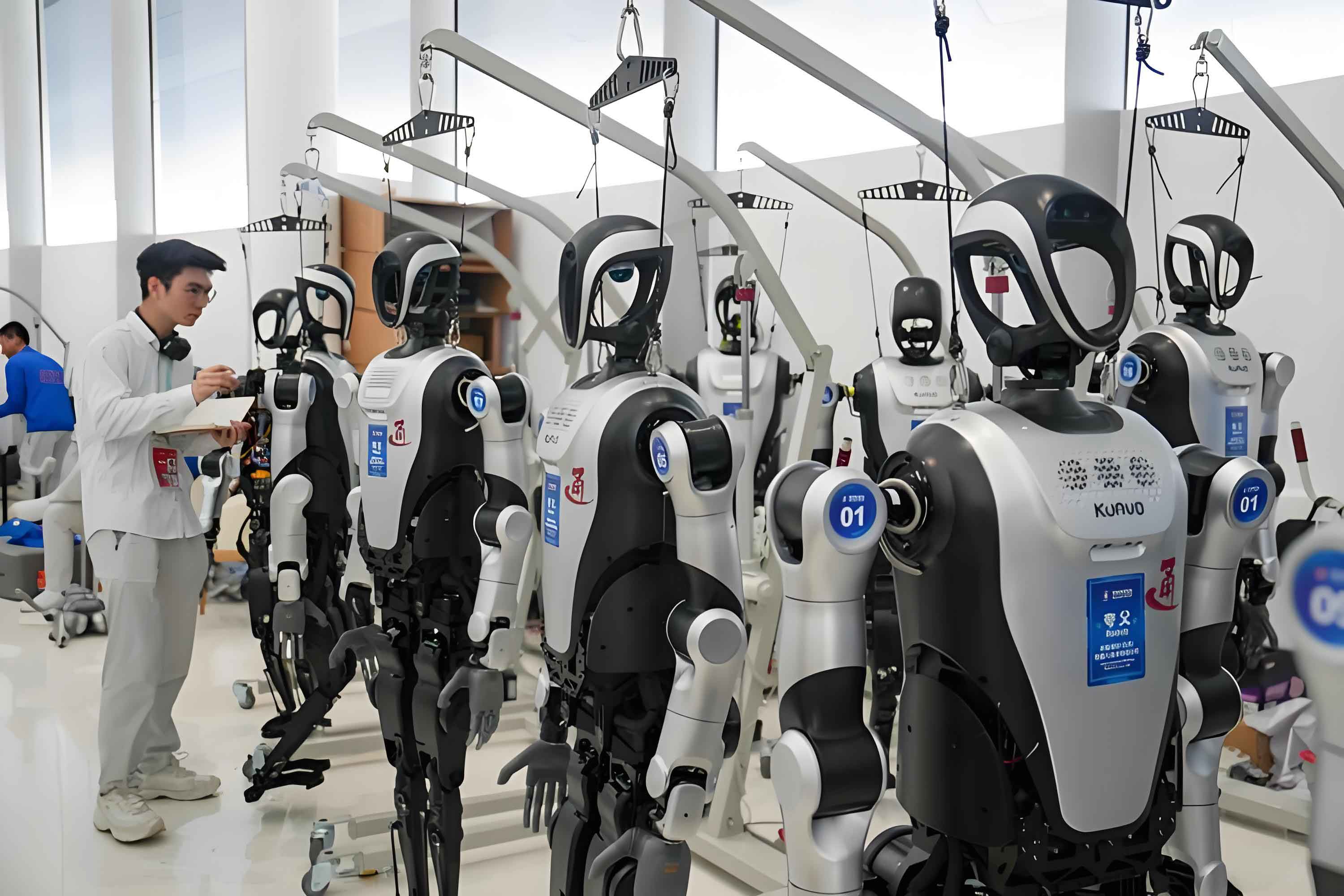
To overcome these hurdles and foster high-quality development, I propose several strategies focused on technology, ecology, and leadership. First, we must concentrate on key technologies to build a “first-mover advantage.” This involves accelerating R&D in common technologies like lightweight materials, advanced algorithms, and energy management. For instance, improving the autonomy of AI human robots can be modeled with a battery life equation:
$$ E_{\text{total}} = \int P(t) \, dt $$ where \( E_{\text{total}} \) is the total energy available, and \( P(t) \) is the power consumption over time. By optimizing this, we can extend operational durations. Additionally, tackling core software and hardware components—such as specialized chips and control systems—through collaborative platforms and “mission-oriented” projects can reduce import dependencies. Second, we should focus on industrial ecology to create a “developmental edge.” This means integrating resources across regions and sectors, such as linking AI human robot development with NEV and AI industries. Supporting龙头 enterprises and SMEs through incentives and shared platforms can foster a cohesive supply chain. Opening up application scenarios—from retail to emergency response—will provide real-world testing grounds, as seen in pilot programs where AI human robots perform tasks in supervised environments. Third, strategic guidance is essential for “lane leadership.” Policies should outline clear roadmaps for technology and product development, while standards for safety, ethics, and performance ensure consistency and public trust. Military-civil fusion could also spur innovation by leveraging dual-use technologies.
In conclusion, the AI human robot industry stands at a pivotal juncture, with immense potential driven by technological convergence and market needs. As I reflect on this analysis, I am optimistic about the future of AI human robots, but success hinges on addressing innovation gaps, building robust ecosystems, and fostering societal acceptance. By implementing the proposed strategies, we can navigate the complexities and unlock the full benefits of AI human robots, ultimately contributing to economic growth and human well-being. The journey ahead requires collaboration, investment, and a forward-looking vision to ensure that AI human robots evolve from niche applications to ubiquitous partners in our daily lives.