
The humanoid robot sector has recently experienced multiple catalysts, with the upcoming 2025 World Robot Conference and the inaugural global humanoid robot sports event signaling accelerated industrial progress. According to Wind data, the Wind Humanoid Robot Concept Index has shown strong performance, rising by 14.95% cumulatively since July 11. Analysts believe that this year marks the first year of mass production for humanoid robots, with the core trading logic gradually shifting from thematic investment to industrial implementation. The sector boasts strong growth expectations and is poised to become a key investment theme in 2025, underscoring its long-term investment value.
Industry catalysts are emerging continuously. Wind data indicated that on August 6, the Wind Humanoid Robot Concept Index increased by 2.83%. Among the index components, Robot Company and Objenius-UW both rose by over 14%, while Zhongma Transmission and Zhongda Lide hit the daily limit up. Companies like Changsheng Bearing, Kingfa Science and Technology, and Wolong Electric Drive also saw gains. The news backdrop includes the 2025 World Robot Conference, organized by the China Electronics Society and the World Robot Cooperation Organization, scheduled for August 8 to 12 at the Beijing Economic-Technological Development Area’s Beiren Yichuang International Convention and Exhibition Center. The conference, themed “Making Robots Smarter, Embodied Intelligence More Intelligent,” will gather over 200 domestic and international robotics companies, including KUKA, Festo, Estun, Unitree Robotics, and Galaxy General, showcasing more than 1,500 exhibits, with over 100 new product launches. Notably, 50 humanoid robot整机 enterprises will present their latest exhibits and industry solutions, setting a record for the number of humanoid robot整机 participants in similar events.
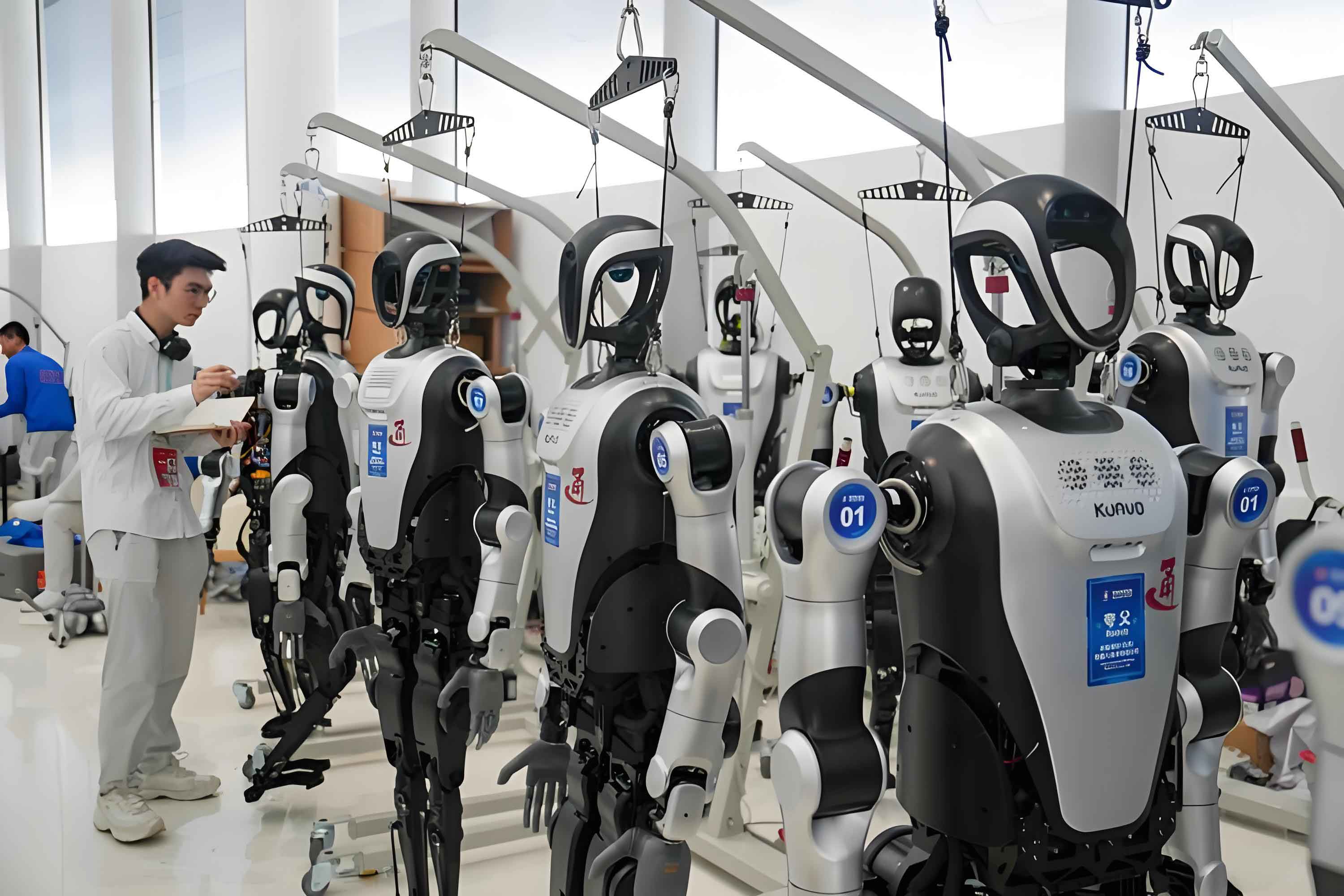
In a related development, Jiang Guangzhi, Director of the Beijing Municipal Bureau of Economy and Information Technology, provided details on the World Humanoid Robot Sports Games during a press conference in May. He stated that this global event, the first of its kind for humanoid robots, will take place from August 15 to 17 at the National Stadium and the National Speed Skating Oval. The competition is divided into main events and peripheral events. The main events focus on humanoid robot skill contests, including track and field, football, dance, as well as material handling and medicine sorting tasks. Peripheral events emphasize fun and audience interaction, featuring badminton, table tennis, basketball, and more. Meng Pengfei, Chief Analyst of Machinery at Kaiyuan Securities, highlighted that at the 2025 World Artificial Intelligence Conference, humanoid robots surpassed 150 units in a single display, covering industrial, service, and medical scenarios. Additionally, the Ministry of Industry and Information Technology announced plans to deepen the “AI+” initiative. If follow-up industrial support and subsidy policies are implemented, China’s advantages in application scenarios and complete industrial chains could drive the humanoid robot industry into its first high-growth phase.
Frequent order announcements further underscore the positive trends in the humanoid robot industry. Recent successes include Ubtech winning a robotics equipment procurement project from MiYi (Shanghai) Automotive Technology Co., Ltd. valued at 90.5115 million yuan, marking Ubtech’s largest procurement order to date. Zhiyuan Robot and Unitree Robotics were awarded a humanoid bipedal robot OEM service procurement project by China Mobile (Hangzhou) Information Technology Co., Ltd., with a total value of 124 million yuan. Leju Robotics expects annual humanoid robot deliveries to reach the thousand-unit level, while Songyan Power has total orders exceeding 2,500 units, with contract amounts surpassing 100 million yuan. The “2025 Blue Paper on the Development of the Humanoid Robot Industry” released by the Prospective Industry Research Institute shows that the global humanoid robot market continues to expand, with the 2023 market size approximately $2.16 billion and projected growth to $32.4 billion by 2029. In China, policy focus is shifting from technology to industrialization, with the 2024 market size around 2.76 billion yuan, demonstrating immense growth potential for humanoid robots.
Lü Juan, Head of the High-End Manufacturing Research Group and Chief Analyst of High-End Manufacturing at China Securities Co., Ltd., noted that positive changes are occurring in the domestic humanoid robot industry chain. The密集落地 of humanoid robot OEM service procurement projects indicates that exploration of terminal commercial scenarios for humanoid robots is gradually entering the implementation phase. As the industry chain’s software and hardware capabilities improve further, the application scenarios for humanoid robots are expected to broaden. Zhou Zipeng, Executive General Manager of the China International Capital Corporation Limited Research Institute, emphasized that humanoid robots, as a technology-intensive and complex emerging field, require both underlying technological breakthroughs and cost optimization through scaled applications and data accumulation. China, with its complete supply chain and diverse scenario data potential, has the opportunity to shift from “technological catch-up” to “ecological leadership,” establishing a “Chinese paradigm” in the global humanoid robot industry.
The humanoid robot industry is witnessing rapid advancements in technology, application scenarios, and industrial chain collaboration, moving from technical validation to scenario implementation. Looking ahead, the humanoid robot sector maintains a solid position as a technology theme, with strong growth expectations and long-term investment value that deserves attention. Qiu Shiliang, Co-Head of the Research Institute and Leader of the Large Manufacturing Group at Zhejiang Securities, stated that the entire humanoid robot industry chain offers vast market space, with downstream application demand continuously opening up and supply chain structures becoming more refined. He recommended focusing on leading companies with certainty and undervalued targets. Xing Tian, Machinery Industry Analyst at Hualong Securities, added that the humanoid robot sector’s industry trends remain unchanged, entering a “golden cycle” of technological breakthroughs, mass production cost reductions, and scenario penetration. It is expected to become a core investment theme in 2025. For the future market,配置 around three main lines is advised:
- High-value components, including lead screws, sensors, motors, and reducers, which are critical for humanoid robot functionality.
- Directions with potential for scenario implementation, such as home services, extreme operations (e.g., power inspection, mining), medical rehabilitation, and smart logistics, where humanoid robots can be deployed.
- Mergers and acquisition targets under policy catalysts, as consolidation may drive further growth in the humanoid robot ecosystem.
The humanoid robot industry’s progression is supported by a combination of technological innovation, market demand, and policy initiatives. As humanoid robots evolve, they are expected to play increasingly significant roles across various sectors, enhancing productivity and enabling new applications. The ongoing developments in conferences, sports events, and order placements highlight the dynamic nature of this field, reinforcing the investment appeal of humanoid robots. With global market projections indicating substantial growth and China’s strategic positioning, the humanoid robot sector is set to redefine industrial and service landscapes, offering lucrative opportunities for investors and stakeholders alike. The emphasis on humanoid robots in major events and procurement deals underscores their transition from experimental prototypes to practical tools, paving the way for broader adoption and economic impact.
In summary, the humanoid robot industry is at a pivotal juncture, with multiple factors driving its growth. From technological demonstrations at international conferences to real-world orders and policy support, the sector is gaining momentum. Investors should monitor key areas such as component manufacturing, scenario-based applications, and strategic mergers to capitalize on the expanding humanoid robot market. As the industry continues to mature, the focus on humanoid robots will likely intensify, solidifying their role as a transformative technology in the coming years. The integration of humanoid robots into diverse environments promises to unlock new efficiencies and capabilities, making them a cornerstone of future technological advancements and investment portfolios.