
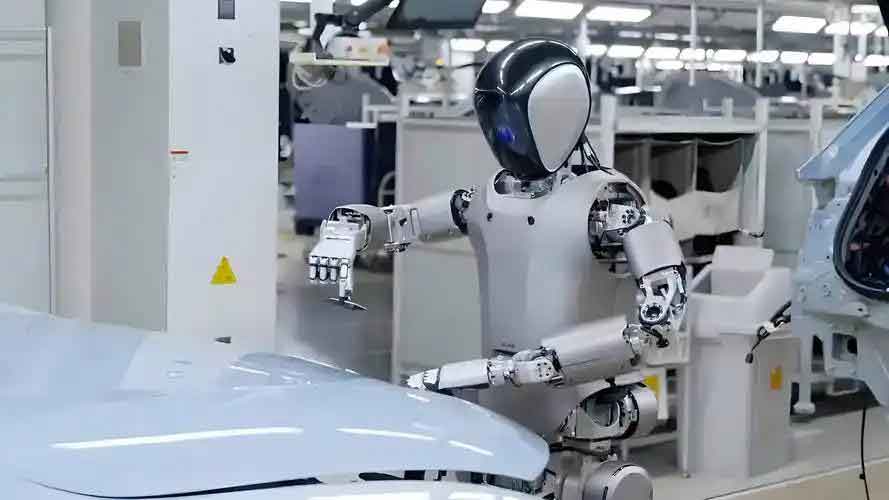
The second World Humanoid Robot Games closed on August 26, marking another high-profile moment for humanoid robot technology. During the event, humanoid robots competed in sprint, high jump, long jump and other disciplines, repeatedly delivering performances that organizers presented as surpassing human world records. The competition drew attention to rapid advances in mobility, balance, control and machine intelligence. Yet the more consequential story may be unfolding away from the track and field venue. Across factories, warehouses, medical rehabilitation rooms and elderly care settings, humanoid robots are moving from demonstrations to early deployment. They are being tested as component assembly workers on production lines, sorting staff in warehouse logistics centers, rehabilitation assistants in healthcare, and caregiving helpers in elderly support services. This shift from moving well to quietly taking up posts is opening a new phase for the humanoid robot industry, one in which safety, reliability, scalability and commercial viability are being examined as closely as athletic performance.
As humanoid robot applications multiply, insurance is emerging as a critical part of the supporting infrastructure. Insurers are developing robot insurance and embodied intelligence insurance products that cover not only application-side risks, such as hardware damage, electrical failures and cybersecurity threats, but also body loss and third-party liability. The protection is also extending into research and development, manufacturing and other parts of the full humanoid robot value chain. This broader insurance network is intended to help embodied intelligence leave the laboratory and enter real-world commercial environments with fewer unresolved worries. For robot developers, manufacturers, leasing platforms, operators and end users, insurance can translate technical promise into practical confidence.
1. Event protection shows how tailored insurance can support humanoid robot competition
The second World Humanoid Robot Games provided a visible test case for specialized insurance. As a strategic partner of the event, PICC took into account the distinctive risk characteristics of humanoid robot competition and, building on experience from the first games, customized a comprehensive risk protection plan. The plan innovatively configured products including embodied intelligence humanoid robot body loss insurance, embodied intelligence humanoid robot third-party liability insurance and artificial intelligence service liability insurance. These products formed a multi-dimensional protection system covering property and material loss, third-party liability, accidental personal injury and cybersecurity risks.
PICC’s involvement illustrates how insurance for humanoid robot events must address risks that differ from ordinary sporting events. Humanoid robots are machines with complex hardware, software, sensors, actuators and communication systems. They can fall, collide, malfunction or create hazards for people and property around them. A competition environment adds pressure, speed and unpredictability. The insurer therefore designed coverage that combined event-time protection with everyday protection. In underwriting, the solution used a competition plus daily combined insurance approach. In claims, it established a green channel for rapid response. In services, it provided full-cycle and high-efficiency professional technical support to help ensure seamless event operations.
An on-site service team remained present throughout the event, following the progress of each competition, monitoring venue conditions and handling risk reminders, consultation and on-site surveys. If a person suffered accidental injury or a humanoid robot or other equipment was damaged, the team was expected to respond immediately, simplify coordination procedures and quickly complete on-site loss assessment and verification. The goal was to protect event personnel and equipment and remove concerns for participating teams so they could focus on technical competition.
This event protection is a vivid example of insurance safeguarding technology. A competition, however, is only a proving ground for commercial use. The larger opportunity for humanoid robot deployment lies outside the arena. The insurance arrangements developed for the games offer a preview of how risk transfer can support humanoid robot operations in more complex and less controlled environments.
2. Market projections point to a vast humanoid robot economy and a corresponding need for insurance
A research report on humanoid robot industry development released by the China Academy of Information and Communications Technology estimates that by 2035 the market for complete humanoid robot units will reach 50 billion yuan. By 2045, the complete-unit market scale could reach 10 trillion yuan, and the number of robots could exceed 100 million units. These projections point to a future in which humanoid robots become far more than exhibition pieces or competition participants. They could become a broad platform for labor, services, mobility and human-machine interaction.
Such a large potential market cannot be unlocked by technological progress alone. It also requires safety, reliability, accountability and financial protection. The release of enormous market potential depends on full-chain and full-lifecycle insurance support. Humanoid robot risks begin long before a machine is sold or leased. They appear during concept validation, prototyping, testing, certification, production, supply chain management, logistics, deployment, maintenance, repair, refurbishment and eventual decommissioning. They also appear in the interaction between humanoid robots and people, property, data and public spaces.
Recognizing this, several leading insurers are accelerating their layouts for embodied intelligence robots and other emerging technologies. They are developing industry-specific insurance products and providing professional underwriting services to humanoid robot companies. Their focus is not limited to a single accident or a single asset. Instead, they are examining risks across the entire humanoid robot industrial chain.
PICC, for example, has built six major protection systems. Its insurance solutions cover six dimensions: robot products, technology research and development, supply chain, production operations, liability, and research and development personnel. The company provides six categories of systemic protection: robot product protection, technology research and development protection, supply chain protection, production and operations protection, liability protection and research and development personnel protection. This structure is designed to address industry risk pain points with professional risk management capabilities and to support high-quality development of China’s embodied intelligence industry.
The logic is straightforward. A humanoid robot is not a conventional machine. It combines mechanical systems, electrical systems, sensors, actuators, batteries, communication modules, control software, artificial intelligence models and data connections. A failure in any one layer can create losses in another. A hardware defect may lead to an accident. A software error may cause erratic movement. A cybersecurity breach may disrupt operations or compromise information. A third-party injury may trigger liability questions that involve multiple parties. Insurance products must therefore be modular, adaptable and connected across the lifecycle.
3. Research and pilot-stage protection helps move humanoid robot technology from laboratory to production line
One of the less visible but important parts of humanoid robot risk management is the research and pilot stage. Before a humanoid robot can be deployed at scale, it must move through concept validation, small-scale trials, pilot testing and iterative improvement. These stages are often expensive and uncertain. A failed experiment, a damaged prototype, an interrupted trial or an unexpected technical problem can consume time and capital. Insurers are beginning to design products that address these early-stage risks.
PICC has introduced concept verification and small-trial comprehensive expense loss insurance and pilot-testing comprehensive expense loss insurance. These products provide dedicated risk protection for key research and development projects undertaken by technology enterprises and scientific research institutions. Their purpose is to help scientific and technological achievements move from laboratory proposals to production-line products. By covering certain expense losses associated with early validation and pilot testing, such insurance can reduce the financial shock of failure and encourage more structured experimentation.
This matters for the humanoid robot sector because the distance between a working prototype and a reliable commercial product is often underestimated. A humanoid robot that can run, jump or complete a scripted task in a controlled environment may still struggle with unstructured workplaces. It may encounter uneven floors, moving people, unpredictable obstacles, changing lighting, network interruptions or unexpected object shapes. Each new environment creates new risks. Insurance that supports research and pilot testing can help companies document failures, improve safety and continue development without abandoning promising paths after a single setback.
In this sense, insurance is not only a financial instrument. It can also be a risk-discovery mechanism. When insurers work with research teams and manufacturers, they must identify potential failure modes, assess safety controls and estimate possible losses. That process can reveal weaknesses that technical teams may not have prioritized. It can also encourage better documentation, testing standards and incident reporting. For a young industry such as humanoid robotics, these practices can improve the quality of the entire ecosystem.
4. Commercial deployment and leasing create demand for body loss and third-party liability coverage
As humanoid robots move into commercial use, the most immediate insurance needs often relate to body loss and third-party liability. A humanoid robot is an expensive asset. Its components, including actuators, sensors, computing units, batteries and precision joints, can be costly to repair or replace. If a humanoid robot is damaged in a collision, falls from a height, suffers a transmission failure or experiences an electrical fault, the repair bill may be high. For leasing platforms and robot operators, repeated repair costs can undermine the economics of deployment.
PICC’s embodied intelligence comprehensive protection plan addresses these risks. It covers body loss caused by traditional disaster causes, human operational negligence, electrical reasons and network reasons. It also covers third-party liability caused by accidents. This combined approach recognizes that a humanoid robot can be both a valuable asset and a potential source of harm. The insurer gave an example from a robot leasing platform in the Yangtze River Delta region. The platform’s first batch of several hundred humanoid robots is covered. If a humanoid robot is damaged due to a collision or a broken transmission device, each unit can receive up to nearly 400,000 yuan in repair cost compensation. This helps resolve the problem of high maintenance costs.
CPIC P&C has also designed a dedicated insurance product for humanoid robot commercial applications called Jizhi Bao. The product connects risk protection across the full chain of production, sales, leasing and use. It applies a risk anthropomorphic concept to achieve integrated protection for body loss, third-party personal injury and property loss. Its term is flexible and breaks through the traditional annual policy limitation. It supports daily, weekly and monthly insurance periods, precisely adapting to diverse commercial scenarios. Such flexibility is important because humanoid robot deployments may be short-term, seasonal, project-based or experimental. A leasing company may need coverage for a single event, a trial period or a temporary deployment. A factory may need coverage for a specific production line. A healthcare provider may need coverage for a rehabilitation program. Flexible insurance terms can match the actual risk period rather than forcing all users into a one-year policy.
These products show that insurers are moving from generic liability coverage toward humanoid robot-specific solutions. They are considering the unique exposure of machines that can move autonomously, interact with people and operate in shared spaces. They are also considering the commercial models that are emerging around humanoid robots, including leasing, robotics-as-a-service, shared platforms and managed operations.
| Protection area | Typical coverage examples | Intended beneficiaries | Relevance to humanoid robot deployment |
|---|---|---|---|
| Body loss | Hardware damage, electrical faults, network-related loss, collision damage, transmission device failure | Robot owners, leasing platforms, operators | Reduces the financial impact of high repair and replacement costs for humanoid robots |
| Third-party liability | Accidental injury to people or damage to property caused by a humanoid robot | Manufacturers, lessors, users, service providers | Provides a financial response when humanoid robots operate near workers, patients, visitors or the public |
| Artificial intelligence service liability | Liability linked to artificial intelligence service failures or related risks | Service providers, technology companies, platform operators | Addresses risks that arise when humanoid robots rely on AI services for perception, planning or interaction |
| Cybersecurity and network risk | Network-related loss, system vulnerabilities, data or service disruption risks | Manufacturers, operators, users, data handlers | Recognizes that connected humanoid robots can be exposed to cyber threats and network failures |
| Research and pilot expense loss | Concept verification, small trials, pilot testing expense losses | Technology enterprises, research institutions, developers | Supports humanoid robot innovation before commercial launch |
| Supply chain and production operations | Supply chain disruption, production-related risks, operational losses | Manufacturers, suppliers, integrators | Helps stabilize the humanoid robot industrial chain as production scales |
| Research and development personnel | Protection for R&D personnel and related risks | Laboratories, engineering teams, technology companies | Recognizes that humanoid robot development depends on skilled people and safe working conditions |
5. Humanoid robot risk has new characteristics that challenge traditional insurance models
Humanoid robots are new entities, and their risk exposure is distinctive. Historical claims data for humanoid robots is almost blank. This creates a challenge for insurers because traditional pricing often relies on past loss experience. Without sufficient data, insurers must find new ways to understand, quantify and price risk. They must also design coverage that can adapt as the technology evolves.
A humanoid robot is dynamic, intelligent and capable of interacting with people. Its risk profile has several new characteristics. First, risk sources are composite. A loss may not come only from natural disasters, fire, explosion or hardware failure. It may also come from algorithm bias, system vulnerabilities, software errors, sensor misclassification or unexpected interactions with the environment. A humanoid robot may make a decision that seems reasonable in one context but dangerous in another. It may follow a learned policy that fails under a new condition. It may receive corrupted data or lose network connectivity. These possibilities make risk assessment more complex than for conventional machinery.
Second, the definition of responsible parties is complicated. If an accident occurs, should responsibility be attributed to the hardware manufacturer, the software developer, the artificial intelligence model provider, the data supplier, the maintenance provider or the user? In traditional mechanical equipment accidents, the chain of causation may be relatively clear. In humanoid robot accidents, hardware, software, data, environment and human supervision may all play a role. Determining liability can be far more complex. Insurers must therefore consider contractual relationships, control points, logs, updates, maintenance records and operational procedures.
Third, emerging risks such as cybersecurity, algorithm safety and information leakage are not easily covered by traditional enterprise property insurance. A humanoid robot may collect visual, audio, location and biometric data. It may connect to cloud services, fleet management platforms, production systems or healthcare records. A cyber incident could disrupt operations, expose private information, damage reputation or cause physical harm. An algorithm failure could lead to unsafe behavior. Traditional property policies may not address these exposures adequately. New insurance products and risk management services are required.
These characteristics mean that insurers cannot simply copy and paste existing robot insurance products. They need new capabilities in data collection, risk modeling, underwriting, claims handling and loss prevention. They also need to work with technology companies, regulators, research institutions and users to understand how humanoid robots actually behave in the field.
6. Dynamic assessment and cross-border cooperation form the basis for humanoid robot underwriting
To address these challenges, PICC has adopted a model of dynamic assessment and cross-border cooperation. At the early stage of humanoid robot business, the insurer refers to underwriting data accumulated from mature categories such as industrial robots, service robots and special robots. It combines that data with dimensions specific to humanoid robots, including safety levels, operating scenarios and maintenance costs, to dynamically improve pricing accuracy. This approach recognizes that humanoid robot risk is not static. It changes with technology generations, software updates, deployment environments and user practices.
PICC has also taken a hands-on approach. Its teams visit laboratories and production workshops and cooperate deeply with humanoid robot manufacturers. They work with upstream and downstream enterprises in the industrial chain and with scientific research institutions to conduct joint health checks for robots. They break risk down into the robot’s brain, cerebellum and body. The brain relates to perception, decision-making and artificial intelligence. The cerebellum relates to motion control, balance and coordination. The body relates to mechanical structure, actuators, power systems and sensors. By examining each layer, the insurer can build a more complete risk picture.
This layered approach is important because a humanoid robot’s failure modes are not confined to one subsystem. A problem in perception may lead to a wrong decision. A problem in motion control may cause a fall. A problem in the body may cause a hardware failure. A problem in connectivity may interrupt supervision. A problem in data may bias learning. The insurer’s dynamic risk assessment system is intended to grow with the technology and to incorporate new evidence as humanoid robots are deployed in more scenarios.
Cross-border cooperation also helps address the liability complexity of humanoid robots. When hardware makers, software developers, AI service providers and users all contribute to an outcome, insurance solutions must clarify roles and responsibilities. Cooperation across disciplines can help create better contracts, better incident investigation and better loss prevention. It can also help establish industry standards for data sharing, safety testing and incident reporting.
7. Agile iteration and modular design support insurance for evolving humanoid robot technology
Ping An P&C has developed a model of dynamic adaptation and agile iteration for emerging risks such as humanoid robots. The company established an emerging technology risk laboratory composed of technical experts, insurance actuaries and industry researchers. The laboratory continuously tracks humanoid robot technology evolution and application trends. This enables the insurer to update its understanding of risk as robots become more capable, more connected and more autonomous.
In product design, Ping An P&C relies on modular and parameterized design. It breaks coverage responsibilities into basic modules and optional modules. This allows the insurer to quickly adjust coverage scope and pricing parameters as technology iterates and application scenarios change. For example, a humanoid robot used in a controlled factory environment may have a different risk profile from one used in a public hospital or an elderly care facility. A robot that operates on a fixed route may differ from one that moves freely among people. A robot with limited autonomy may differ from one with advanced decision-making. Modular insurance can respond to these differences without redesigning an entire policy from scratch.
Ping An P&C has also set up a technology iteration risk-sharing clause. In the contract, it reserves a mechanism for regular review and pricing optimization based on actual loss data. This ensures that the product can cover current risks while adapting to future development. Such a mechanism is valuable in a field where historical data is limited and technology changes quickly. It allows both insurer and insured to learn from experience and adjust the risk-sharing arrangement over time.
This approach reflects a broader shift. Insurers are not only selling policies after a product is mature. They are becoming partners in the development and deployment of humanoid robots. They are participating in risk assessment, product design, testing, data collection and incident response. Their involvement can help humanoid robot companies demonstrate safety and reliability to customers, regulators and investors.
8. Insurance is becoming part of the commercial infrastructure for humanoid robots
The commercial case for humanoid robots depends on more than technical capability. It depends on whether businesses, hospitals, care providers, warehouses and factories can adopt them without unacceptable risk. A factory manager considering a humanoid robot for assembly work needs to know what happens if the robot damages equipment, injures a worker or stops production. A hospital considering a rehabilitation assistant needs to know how liability is handled if a patient is harmed. A leasing platform needs to know whether it can recover repair costs when a humanoid robot is damaged. An elderly care provider needs to know whether a humanoid robot can operate safely around vulnerable people. Insurance helps answer these questions.
By covering body loss, third-party liability, cybersecurity, research and pilot expenses, supply chain risks and production operations, insurers are building a protection network around the humanoid robot lifecycle. This network can reduce the hesitation that often slows adoption of new technology. It can also improve the quality of risk management. When an insurer requires safety controls, maintenance schedules, incident reporting or operator training, it creates incentives for better practices. When an insurer investigates a claim, it generates data that can be used to prevent future losses. When an insurer works with manufacturers, it can feed risk insights back into product design.
For the humanoid robot industry, this is especially important because public trust is still developing. High-profile accidents, cybersecurity breaches or liability disputes could slow adoption. A robust insurance ecosystem cannot eliminate all risks, but it can provide a transparent framework for handling them. It can ensure that injured parties have a route to compensation. It can protect innovators from catastrophic financial loss. It can help leasing platforms and users calculate the cost of risk. It can support regulators by creating documentation and accountability.
9. Remaining challenges require collaboration across the humanoid robot ecosystem
Despite rapid progress, significant challenges remain. Historical claims data for humanoid robots is almost blank. Insurers must build models from limited information. They must estimate the frequency and severity of losses that may not yet have occurred. They must account for rapid changes in hardware, software and artificial intelligence. They must understand how humanoid robots behave in different environments and how human behavior around robots affects risk.
Liability allocation is another challenge. A single incident may involve the robot manufacturer, the software provider, the AI model provider, the data provider, the maintenance company, the leasing platform, the operator and the user. Contracts must define responsibilities. Incident investigations must determine what happened. Insurance policies must respond without excessive dispute. This requires collaboration among legal experts, engineers, insurers and regulators.
Cybersecurity and algorithm safety are also evolving threats. A connected humanoid robot can be attacked remotely. Its sensors can be spoofed. Its data can be stolen. Its behavior can be manipulated. Its software can be updated in ways that change risk. Traditional property insurance may not cover these exposures. New products and services are needed, including cyber coverage, algorithm liability coverage, data breach response and security assessments.
Standardization is another area that may require attention. Data formats, incident reporting, safety testing, maintenance records and operational logs can vary across manufacturers and users. Common standards could help insurers assess risk more accurately and process claims more efficiently. They could also help regulators oversee humanoid robot deployment. Such standards would need to be developed through cooperation among industry participants, research institutions and public authorities.
10. The path from competition arena to commercial workplace depends on trust and risk transfer
The closing of the second World Humanoid Robot Games is not the end of the story. It is a milestone in a longer journey. The event showed what humanoid robots can do in controlled, high-energy competition. The next challenge is to show what they can do reliably in factories, warehouses, hospitals, homes and public spaces. That challenge is not only technical. It is also financial, legal and social. Humanoid robots must be safe, insurable and accountable.
Insurance is helping to build that foundation. Products for humanoid robot body loss, third-party liability, artificial intelligence service liability, cybersecurity, research and pilot expense loss, supply chain, production operations and research personnel are expanding. Insurers are using dynamic assessment, cross-border cooperation, modular design, parameterized pricing and agile iteration to keep pace with the technology. They are working with robot manufacturers, leasing platforms, research institutions and users to understand risk and improve safety.
The humanoid robot market may grow from billions of yuan to trillions of yuan, with more than 100 million units projected by 2045. If that future materializes, insurance will be part of the infrastructure that makes it possible. It will not remove every danger. It will not answer every ethical or legal question. But it can provide financial protection, encourage responsible deployment and create confidence for investment and adoption. As humanoid robots move from sporting to working, the insurance network being woven around them may prove to be one of the most important enablers of embodied intelligence in the real economy.
For insurers, the opportunity is significant, but so is the responsibility. Humanoid robot risk is dynamic, intelligent and interactive. It crosses hardware, software, data, people and environments. It requires new capabilities and sustained collaboration. For robot developers and users, insurance is becoming a practical condition for scale. For society, it offers a way to share the benefits of humanoid robots while managing the uncertainties. The next phase of the humanoid robot era will be shaped not only by breakthroughs in motors, batteries, sensors and artificial intelligence, but also by the quiet, complex work of risk assessment, underwriting, claims handling and loss prevention. That work is already underway, and it is expanding with every new humanoid robot that leaves the laboratory and enters the workplace.
11. Different stakeholders gain different forms of value from humanoid robot insurance
Humanoid robot insurance is not a single product for a single customer. It is a family of protections that can serve different stakeholders across the value chain. Manufacturers need protection for product liability, research and development, supply chain disruption, production operations and personnel. Leasing platforms need protection for the robots they own and rent out, as well as liability coverage for accidents involving their equipment. End users in factories, warehouses, hospitals and elderly care settings need assurance that a humanoid robot accident will not create an unmanageable financial burden. Workers and members of the public need a clear route to compensation if they are injured. Investors and lenders need to understand and quantify risk before committing capital. Regulators need documentation, accountability and data that can inform oversight. A well-designed humanoid robot insurance ecosystem can address all these needs.
For manufacturers, insurance can support innovation by reducing the fear of catastrophic loss during development and early deployment. It can also help them demonstrate responsibility to customers. A manufacturer that can show that its humanoid robot is insurable may find it easier to sell or lease products. For leasing platforms, insurance can protect the asset value of the humanoid robot fleet and reduce the volatility of repair costs. For end users, insurance can convert an uncertain liability into a known premium. For workers and the public, insurance can provide compensation and encourage safer design. For investors, insurance can make humanoid robot business models more bankable. For regulators, insurance can create a feedback loop of incident data and risk insights.
These benefits do not appear automatically. They depend on clear policy wording, accurate risk assessment, effective claims handling and continuous risk management. They also depend on trust among insurers, technology companies and users. Without trust, insurance may be seen as a cost rather than a partnership. With trust, it can become a driver of adoption and a source of competitive advantage.
12. Data, monitoring and risk assessment are central to humanoid robot insurance
Humanoid robot insurance depends on data. Insurers need to understand how often humanoid robots fail, what causes failures, how severe losses can be, and how different operating environments affect risk. They need data on hardware reliability, software stability, sensor performance, battery safety, actuator durability, maintenance quality, operator behavior and cybersecurity incidents. They need to know how a humanoid robot performs after software updates, how it behaves around people, and how it responds to unexpected obstacles or network disruptions. Without such data, pricing becomes uncertain.
Because historical claims data for humanoid robots is almost blank, insurers are using several strategies. They are drawing on experience from industrial robots, service robots and special robots. They are working with manufacturers to conduct risk assessments. They are visiting laboratories and production workshops. They are tracking technology trends through specialized laboratories. They are designing modular products that can be adjusted as new data arrives. They are also including mechanisms for regular review and pricing optimization based on actual loss experience.
Continuous monitoring may become more important as humanoid robots become connected. Operational logs, maintenance records, software versions, cybersecurity events and incident reports can help insurers understand risk in near real time. However, data collection also raises privacy, security and ownership questions. Insurers, manufacturers and users will need to agree on what data is collected, how it is protected, who can access it and how it is used. Transparent data governance can support better insurance while protecting the interests of workers, patients, elderly people and other individuals who interact with humanoid robots.
Risk assessment for humanoid robots must also be dynamic. A risk assessment conducted before deployment may become outdated after a software update, a change in operating environment or a new use case. Insurers need to update their models as humanoid robots evolve. They need to consider not only the robot itself but also the human-machine team, the physical environment, the data infrastructure and the organizational safety culture. This is a broader view of risk than traditional machinery insurance. It reflects the fact that humanoid robots are not isolated tools. They are part of complex socio-technical systems.
13. Claims handling and incident response shape trust in humanoid robot insurance
Claims handling is where the value of humanoid robot insurance becomes tangible. When a humanoid robot is damaged, when a person is injured, or when property is harmed, the insured needs a fast and fair response. In the event protection example, PICC established a green channel for rapid response, provided on-site service teams and simplified coordination procedures. Those practices are equally relevant for commercial humanoid robot deployments. A factory cannot afford a long dispute that keeps a production line idle. A hospital cannot afford uncertainty after a patient injury. A leasing platform cannot afford delayed repairs that reduce fleet availability.
Humanoid robot claims may be more complex than conventional claims. Investigators may need to examine hardware components, software logs, artificial intelligence models, sensor data, network records and maintenance history. They may need to determine whether the cause was mechanical failure, electrical fault, software error, algorithm behavior, cyber intrusion, human operation error or an environmental factor. They may need to assign responsibility among multiple parties. They may need to assess both direct losses, such as repair costs, and indirect losses, such as business interruption, medical costs or reputational harm. A specialized claims capability is therefore essential.
Rapid response and technical expertise can improve outcomes. If an insurer can deploy engineers, data analysts and claims specialists quickly, it can preserve evidence, assess damage and resolve claims more efficiently. It can also identify recurring problems and feed them back into risk prevention. For humanoid robot manufacturers and operators, this feedback loop can improve product design and operational procedures. For injured parties, it can provide faster compensation and greater confidence in the system.
14. Contract design must clarify responsibility for humanoid robot behavior
Contract design is a critical part of humanoid robot insurance. Because responsibility for an accident can be distributed across hardware, software, data, maintenance and use, policies must define what is covered and under what conditions. They must address the scope of operation, the level of human supervision, the maintenance requirements, the software update process, the cybersecurity controls and the reporting obligations. They must also clarify how liability is shared when multiple parties contribute to a loss.
Modular and parameterized insurance design can help. By separating basic coverage from optional modules, insurers can tailor policies to specific humanoid robot applications. A factory deployment may need coverage for production interruption and equipment damage. A healthcare deployment may need stronger third-party injury and privacy protection. A leasing platform may need asset protection and flexible terms. A research laboratory may need coverage for prototypes and pilot testing. A logistics operator may need coverage for warehouse accidents and network-related losses. Different modules can be combined to match the risk profile.
Technology iteration risk-sharing clauses can also help. If a humanoid robot’s software changes, its risk profile may change. If new sensors or actuators are introduced, new failure modes may appear. A clause that allows regular review and pricing adjustment based on actual loss data can keep the insurance arrangement fair as the technology evolves. It can also encourage the insured to share data and improve safety, because better risk management may lead to better terms. This kind of adaptive contract is well suited to a young and fast-moving industry.
15. Humanoid robot insurance is expanding across the full lifecycle
The most advanced humanoid robot insurance strategies are moving beyond a single point of coverage. They are expanding across the full lifecycle. At the research and development stage, insurance can cover concept verification, small trials and pilot testing. At the production stage, it can cover supply chain disruption, manufacturing risks and product liability. At the deployment stage, it can cover body loss, third-party liability, cybersecurity and business interruption. At the maintenance stage, it can cover repair costs and spare parts. At the end-of-life stage, it can cover safe decommissioning, recycling or disposal risks.
PICC’s six protection systems illustrate this full-chain approach. The systems cover robot products, technology research and development, supply chain, production operations, liability, and research and development personnel. CPIC P&C’s Jizhi Bao connects production, sales, leasing and use. Ping An P&C’s modular design allows coverage to adapt as technology and scenarios change. Together, these approaches show that humanoid robot insurance is not a static product. It is a dynamic service that evolves with the industry.
Full-lifecycle coverage can create several benefits. It can reduce gaps between policies. It can improve risk communication among manufacturers, operators and users. It can generate more consistent data across the value chain. It can help companies plan for risk at every stage rather than only after a product is commercialized. It can also make humanoid robot investments more attractive by reducing uncertainty. As the industry grows, full-lifecycle insurance may become a standard expectation for serious humanoid robot deployments.
16. What to watch as humanoid robot insurance matures
Several developments may shape the future of humanoid robot insurance. The first is data accumulation. As more humanoid robots are deployed, insurers will gain more information about failures, accidents, repairs and operational risks. This data can improve pricing, underwriting and loss prevention. The second is standardization. Common definitions, reporting formats and safety benchmarks could make it easier to compare risks and process claims. The third is cybersecurity. As humanoid robots become more connected, cyber coverage and security assessments may become more prominent. The fourth is algorithm safety. Insurers may need new ways to assess the risk of artificial intelligence models that influence robot behavior. The fifth is liability clarity. Legal frameworks and contractual practices may evolve to handle accidents involving multiple parties. The sixth is international coordination. Humanoid robots may operate across borders, supply chains and data networks, creating cross-border risk issues.
Another development to watch is the relationship between insurance and regulation. Insurers can support regulators by providing data, risk assessments and incident analysis. Regulators can support insurers by clarifying liability rules, setting safety standards and requiring incident reporting. A collaborative approach can improve both innovation and protection. If regulation is too rigid, it may slow humanoid robot development. If it is too weak, it may leave victims unprotected and create public backlash. Insurance can help bridge the gap by creating market-based incentives for safety while providing compensation when accidents occur.
The final development to watch is public trust. Humanoid robots will operate in workplaces, hospitals, care facilities and public spaces. People will want to know that these machines are safe, that their data is protected and that someone is accountable if something goes wrong. Insurance can contribute to that trust by making risk visible and manageable. It can also help humanoid robot companies communicate their safety commitments. In a competitive market, the ability to offer insured, accountable and reliable humanoid robot services may become a differentiator.
17. Conclusion
The humanoid robot industry is moving quickly. Competitions showcase dramatic advances in movement and control. Factories, warehouses, hospitals and elderly care settings are testing practical applications. Market projections point to a future with tens of billions, then trillions, of yuan in value and more than 100 million humanoid robots. But scale will not arrive automatically. It will depend on safety, reliability, accountability and financial protection. Insurance is becoming a key part of that foundation.
Insurers are developing humanoid robot body loss insurance, third-party liability insurance, artificial intelligence service liability insurance, cybersecurity coverage, research and pilot expense loss insurance, supply chain protection, production operations protection and personnel protection. They are supporting competitions, leasing platforms, manufacturers and end users. They are using dynamic assessment, cross-border cooperation, modular design, parameterized pricing, agile iteration and risk-sharing clauses to keep pace with technology. They are working to turn unknown risks into manageable ones.
Challenges remain. Historical data is limited. Liability is complex. Cybersecurity and algorithm safety are evolving. Standards are still forming. Claims handling requires technical expertise. Contract design must clarify responsibility. Data governance must protect privacy and security. These challenges cannot be solved by insurers alone. They require collaboration among technology companies, manufacturers, leasing platforms, users, research institutions, regulators and legal experts. The humanoid robot ecosystem must build trust together.
Yet the direction is clear. As humanoid robots leave the laboratory and enter the workplace, insurance will help make their deployment safer and more predictable. It will protect assets, compensate injuries, support innovation and encourage responsible operation. It will not eliminate every risk, but it can make risk transparent and transferable. For an industry with enormous potential and significant uncertainty, that is a crucial contribution. The humanoid robot era will be built not only by engineers and entrepreneurs, but also by underwriters, actuaries, claims specialists and risk managers. Their work may be less visible than a robot running or jumping, but it will be just as important in determining whether humanoid robots truly become part of everyday economic and social life.