
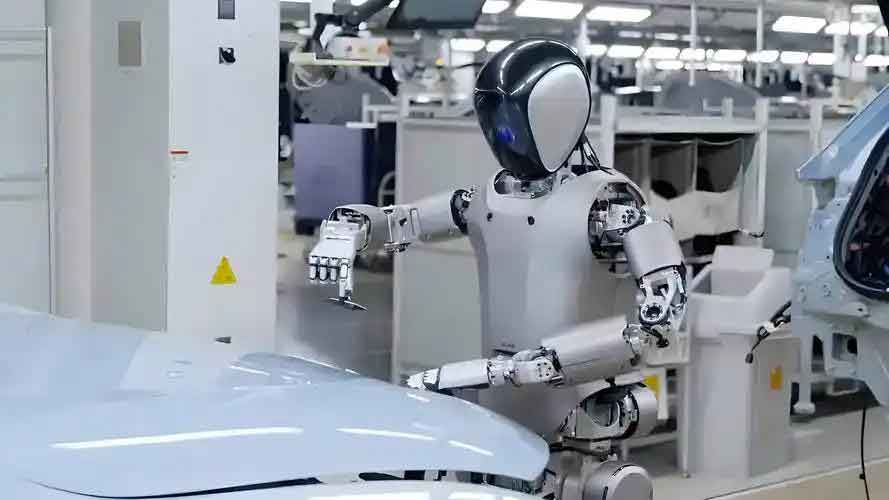
2026 is widely regarded by the industry as the first year of mass production for the humanoid robot. Yet the central question is no longer whether a humanoid robot can walk, run, or jump. The more urgent question is whether a humanoid robot can enter a real job, work reliably over time, and allow customers to calculate a clear return on investment. That shift in emphasis is transforming the humanoid robot debate from a showcase of technical agility into a test of industrial discipline, delivery capability, and real productivity.
The enthusiasm surrounding the humanoid robot sector remains strong. Financing continues to flow, orders are being announced, and supply chains are preparing for larger volumes. At the same time, the shortcomings are still visible. Core components remain constrained, real-world application scenarios are still insufficient, and the standards system has not yet been unified. These are not peripheral issues. They are the thresholds that the humanoid robot industry must cross before large-scale production can become a sustainable commercial reality. The gap between market expectations and commercialization progress has also kept the bubble debate alive, and a sharp correction in the market value of Unitree Technology has made that debate a focal point for the entire humanoid robot industry.
1. A Mass-Production Milestone Tested by Real Jobs
The humanoid robot sector has reached a stage in which headline figures alone are no longer enough. At the ninth China Robot Summit held in Hangzhou on Sept 17 and hosted by the China Electromechanical Integration Technology Application Association, the numbers presented were still striking. In the first half of the year, financing in the embodied intelligence track exceeded RMB 90 billion. Luoshi Robotics said its humanoid-style robotic arm shipments had exceeded 10,000 units. Xinghaitu said it had obtained orders on a scale of more than 1,000 units. These figures show that capital and demand are both moving toward the humanoid robot and embodied intelligence space, but they also raise a harder question: how much of this activity is converting into stable, repeatable, and measurable productivity?
Several experts at the summit argued that a moderate bubble in an early-stage industry can attract capital, talent, and technical resources. That view does not deny the risks. Rather, it recognizes that emerging industries often need a period of intense attention to accelerate the formation of supply chains, talent pools, and technical iteration. For the humanoid robot sector, the final test is whether high expectations can be digested by real output. As core components, embodied models, and edge-side computing continue to improve, the industry needs to manage expectations more rationally, combine the strengths of the scenario-oriented camp and the technology-oriented camp, use the brain to define capability, use scenarios to drive iteration, and move the humanoid robot from exhibition stands into real training and production environments.
The mass-production narrative for the humanoid robot is therefore not simply a capacity story. It is a productivity story. A humanoid robot that can perform a demonstration is not automatically a humanoid robot that can perform a job. A humanoid robot that can move is not automatically a humanoid robot that can be deployed at scale. The industry is being asked to prove that the humanoid robot can be manufactured, delivered, accepted, maintained, and sustained in real operating conditions. That is a much harder standard than the ability to attract attention, and it is the standard that will determine which humanoid robot companies survive the transition from hype to industrial reality.
2. The Technology Behind the Bubble
The humanoid robot industry is not avoiding the bubble question. Dong Kai, director of the science and technology division at the CCID Research Institute of the Ministry of Industry and Information Technology, said emerging industries need a certain degree of bubble. When social attention rises, capital, talent, knowledge, data, and computing power accelerate into the sector. Components that had previously received insufficient investment, such as tactile sensors and actuators, gain faster iteration opportunities as a result. For the humanoid robot sector, this can be a productive phase if the resources are converted into engineering progress, product maturity, and supply-chain capacity.
Song Bin, executive director and vice president of Luoshi Robotics, described the process in direct terms: when the wave comes, foam is appropriate; when the tide recedes, what remains is real. For a long-cycle industry such as embodied intelligence, the danger is not whether there is heat. The danger is whether companies can convert that heat into products and delivery capability. The humanoid robot sector must therefore be judged not only by financing announcements or order intentions, but by the ability to ship reliable products and support customers in real production environments.
Technical progress is already shifting from single-point breakthroughs to systems engineering. Song Bin said Luoshi Robotics had cumulatively shipped about 500,000 force-controlled integrated joints. The company’s experience in industrial robots, including joints, force control, precision, and real-time feedback, is being transferred to humanoid-style robotic arms. That transfer matters because the humanoid robot cannot be built on demonstration alone. It requires a supply chain capable of producing repeatable, durable, and cost-controlled subsystems. Dong Kai noted that Luoshi’s robotic arm had earlier passed an MTBF certification of 80,000 hours. Compared with flips, dances, and other intuitive demonstrations, mean time between failures is less eye-catching, but it is closer to the real requirements of a factory. A humanoid robot must not only complete a motion; it must work long-term, stably, and maintainably at a defined takt time.
Embodied models are also advancing quickly. Shen Xin, a director at Xinghaitu, said that over the past year or more, open-source embodied brain models have been released densely around the world, and models have continued to make breakthroughs in zero-shot generalization, general grasping, and long-horizon tasks. These advances are important for the humanoid robot because they point toward greater autonomy and adaptability. However, model capability does not equal industrial capability. Shen Xin argued that embodied intelligence cannot have obvious weaknesses. Five links, including motors, the complete machine, teleoperation, data, and models, must all be connected. In Xinghaitu’s judgment, a qualified industrial-grade model needs at least 1 million hours of data accumulation. That reveals a practical threshold for the humanoid robot: every decision ultimately acts on the physical world, and an error in the model may directly lead to a fall, a production line stoppage, or even a safety accident.
3. Disclosed Humanoid Robot and Embodied Intelligence Indicators
The following table summarizes key figures and status updates disclosed in the context of the humanoid robot and embodied intelligence discussion. It is intended to show the gap between visible momentum and the deeper requirements of mass production. The table does not replace due diligence; it highlights why the humanoid robot industry must move from headline metrics to deployable productivity.
| Indicator | Disclosed figure or status | Relevance to the humanoid robot sector |
|---|---|---|
| Embodied intelligence financing in the first half of the year | More than RMB 90 billion | Shows strong capital inflow into the humanoid robot and embodied intelligence ecosystem |
| Luoshi Robotics humanoid-style robotic arm shipments | More than 10,000 units | Indicates movement toward larger-volume supply of humanoid robot-related arms |
| Xinghaitu order scale | More than 1,000 units | Suggests emerging demand, while raising questions about delivery and deployment |
| Luoshi Robotics cumulative force-controlled integrated joint shipments | About 500,000 units | Demonstrates component-level accumulation relevant to humanoid robot reliability |
| Luoshi robotic arm reliability certification | MTBF certification of 80,000 hours | Highlights reliability as a core requirement for humanoid robot deployment |
| Industrial-grade embodied model data threshold cited by Xinghaitu | At least 1 million hours of data accumulation | Illustrates the data burden behind humanoid robot autonomy and generalization |
| Tesla-related team activity | Landed in Ningbo on Sept 16 and began a new mass-production audit on Sept 17 | Signals supply-chain preparation for Optimus mass production and humanoid robot scale-up |
| A-share humanoid robot sector | Active on Sept 18 | Shows market sensitivity to humanoid robot mass-production signals |
4. From “Can Demonstrate” to “Can Produce”
The distinction between demonstration and production is central to the humanoid robot debate. Zhu Shiqiang, dean of the Robotics Institute of Zhejiang University, said directly that many robots can do some work but actually do it poorly. Some can complete actions only under specific conditions and become idle after a performance. That assessment is uncomfortable, but it captures the gap that the humanoid robot industry must close. A humanoid robot that performs well in a controlled demonstration may still fail when the environment changes, when the task becomes longer, or when the cost of downtime becomes real.
Cai Zhenhui, founder and CEO of Huarui Zhipu, offered a concrete example from logistics. Some logistics customers calculated that the human efficiency ratio of current loading and unloading robots is still lower than that of workers, so cost-sensitive enterprises will not adopt them. This is a critical point for the humanoid robot sector. Even if a model runs successfully in the cloud, deployment still faces edge-side computing, power consumption, real-time control, and repeated deployment debugging. Real-machine data is scarce and expensive, and simulation data still lags behind real-machine data in training and control effects. The humanoid robot cannot be evaluated only by whether it can complete a task once. It must be evaluated by whether it can complete the task repeatedly, efficiently, safely, and at an acceptable cost.
Under the so-called bubble, mass production cannot be measured only by how many humanoid robot units come off the line in a year. It must also be measured by whether the product is manufacturable, deliverable, acceptable, and sustainable in operation. A humanoid robot that creates stable output in a real job is different from a humanoid robot that appears in a promotional video. Only when the humanoid robot can create stable output in real positions does technological progress become real productivity and industrial value after the bubble is squeezed out. This is why the humanoid robot mass-production year should be treated as a productivity qualification race rather than a pure capacity race.
The humanoid robot industry also needs to recognize that customer requirements are not abstract. Factories care about takt time, reliability, safety, maintenance, and cost. Logistics operators care about throughput, error rates, uptime, and deployment time. A humanoid robot that cannot meet these requirements will not generate repeat purchases, regardless of how impressive its demonstration may be. The mass-production story of the humanoid robot therefore depends on engineering details that are less visible than a walking demo but far more important to commercial success.
5. Brain Defines Capability, Scenarios Drive Iteration
As hardware gradually crosses the threshold of being able to move, the industrial contradiction moves upward. The question becomes whether the humanoid robot knows what it should do, whether it can continue to complete a task after the environment changes, and whether it can adjust its actions based on feedback after failure. These are questions of embodied intelligence, not merely questions of mechanical capability. The humanoid robot must be able to understand, decide, act, and improve in a physical environment.
Zhu Shiqiang summarized the current industrial routes as the scenario-oriented camp and the technology-oriented camp. The scenario-oriented camp starts from specific tasks and can form a commercial loop relatively quickly, but capabilities trained in a single environment often lack generalization. Once equipment, materials, or space change, the humanoid robot may need to be retrained, and replication costs rise. The technology-oriented camp pursues stronger autonomous decision-making, generality, and cross-scenario capability, but the development cycle is longer, investment is higher, and commercialization is relatively slower.
A single direction can hardly solve both technological evolution and commercial landing at the same time. The meeting point of the two paths is to use the brain to accumulate transferable capabilities, and then let real scenarios propose tasks, provide data, and test results. In this model, the humanoid robot is not trained only for a single demonstration. It is trained to acquire capabilities that can be transferred across tasks, while real deployment generates the data needed for further improvement. This is how the humanoid robot can move from a staged performance to a productive role.
Zhu Shiqiang introduced that the Robotics Institute of Zhejiang University, based on the Wuji Brain, has opened a robot school in an attempt to combine the two development routes. The school officially opened more than two months ago. The brain covers interaction, positioning, cognition, analysis, decision-making, behavior design, evaluation feedback, memory, knowledge, and operation. It also sets human safety, ethics and law, the safety of surrounding objects, and the safety of the robot itself as basic principles. For the humanoid robot, these principles are not optional. A humanoid robot that operates near people must be designed with safety and reliability from the beginning.
Robots entering the school must first undergo a physical examination of their hardware and software, then enter different scenarios for practical training and skill assessment. After entering a real working environment, the humanoid robot must continue to iterate based on task results and user feedback. The robot school has established a curriculum system around different tracks. Each course is an encapsulated functional module with standardized and reusable interfaces. This approach aims to turn scattered capabilities into reusable building blocks for the humanoid robot, reducing the cost and time required for deployment in new scenarios.
Zhu Shiqiang said that a guide prototype, after entering the robot school, can take up a post in about half a month. For new exhibition hall content, deployment can be completed in less than one day. In the industrial field, the robot school is training a welding robot for shipbuilding. According to Zhu Shiqiang’s vision, such a humanoid robot can be brought to the site by a person and then autonomously find weld seams and perform welding. That vision reflects the direction of the humanoid robot industry: not simply replacing human presence, but augmenting human work with reliable, adaptable, and measurable capabilities.
6. Data Loops and the Logistics Testbed
The data loop is becoming a decisive factor for the humanoid robot. At the JD Global Technology Explorer Conference, JD Logistics released five new products and technologies under its Wolf Family robot line. Song Bin revealed that Luoshi Robotics participated in JD Logistics robot projects, including an embodied dexterous arm for sorting that has been applied at scale. This kind of deployment is important because it generates real-world data that can be used to improve the humanoid robot and embodied intelligence systems.
Song Bin argued that first-person data collection, real-machine production data, and Sim2Real data need to be combined to form high-quality datasets for vertical domains. This means that when a humanoid robot executes tasks in logistics, loading and unloading, retail sorting, and other positions, it is also continuously generating environment-action-result feedback. Data feeds the model, and when the model’s generalization ability improves, it can reduce the deployment cost of the next scenario. The humanoid robot therefore becomes part of a learning loop, not a static machine.
To some extent, the principle of brain defines capability and scenarios drive iteration is becoming an industry consensus. The brain determines what the humanoid robot can understand and transfer. The scenario determines which capabilities are worth training and what cost is acceptable. This is a more mature way to think about the humanoid robot than the simple question of whether it can perform a dramatic action. The humanoid robot must be evaluated by its ability to enter a workflow, generate value, and improve over time.
In the short term, industrial and logistics positions with relatively clear processes, easily quantified value, and suitability for human-machine collaboration are more likely to run through first. These environments offer structure, repeatability, and measurable outcomes. They also impose strict requirements on reliability, safety, and cost. In the long term, the competitive barrier for humanoid robot companies will not be only body parameters or model leaderboards. It will be whether the company can continuously form a deployment-operation-feedback-retraining loop. That loop is the foundation of sustainable humanoid robot commercialization.
7. Supply-Chain Signals and Market Reaction
The humanoid robot supply chain is also sending signals that mass production preparation is moving forward. A Tesla-related team landed in Ningbo on Sept 16 and began a new round of mass-production audits for its robot business on Sept 17. The audit is expected to substantively guide the mass production of Optimus, and orders have already been placed with supply-chain companies. On Sept 18, the A-share humanoid robot sector performed actively. These developments show that the humanoid robot mass-production narrative is not only a conference theme. It is connected to real supply-chain activity and capital-market expectations.
At the same time, the market reaction should not be mistaken for proof of commercial maturity. The humanoid robot sector still needs to demonstrate that orders can be delivered, that products can be accepted, and that deployments can be sustained. Supply-chain audits and orders are necessary steps, but they are not the final measure. The final measure is whether the humanoid robot can work in a real position with acceptable reliability and cost. That is why the industry must manage expectations carefully and avoid treating every announcement as evidence that mass production has already succeeded.
The bubble debate is therefore useful if it forces the humanoid robot industry to focus on fundamentals. Capital, talent, and attention can accelerate progress, but they cannot replace engineering discipline. The humanoid robot must be manufacturable, deliverable, acceptable, and sustainable. These four requirements are simple to state and difficult to achieve. They require progress in core components, embodied models, edge computing, data collection, safety standards, and deployment methodology. They also require customers to see a clear return on investment.
8. The Productivity Qualification Race
The first year of humanoid robot mass production opens not only a capacity competition but also a productivity qualification race. Financing, orders, and shipment volumes can create visibility. They can attract talent and resources. They can support the supply chain. But whether the humanoid robot can meet customer requirements for takt time, reliability, safety, and cost, and whether it can ultimately generate repeat purchases, is the true measure of industrial value. A humanoid robot that cannot produce stable output in a real job will not sustain commercial demand.
Only when more humanoid robots continuously and stably work in real positions and form replicable commercial returns can the mass-production year move from an industry slogan to an industrial fact. The humanoid robot must move from the exhibition stand to the real training ground, from the demonstration video to the production line, and from a single task to a repeatable workflow. That transition will not be driven by hype alone. It will be driven by the ability to combine the brain’s transferable capabilities with scenario-driven iteration, and by the ability to turn deployment data into better models and lower deployment costs.
The humanoid robot industry is now at a critical juncture. The technology is advancing, the supply chain is forming, and the capital market is watching closely. But the decisive question remains practical: can the humanoid robot create real productivity? If the answer is yes, the bubble debate will fade because the value will be visible in factories, warehouses, and other real workplaces. If the answer is no, the humanoid robot sector will face a harder correction. The coming period will therefore be defined not by how many humanoid robot prototypes are unveiled, but by how many humanoid robots are accepted by customers, maintained in operation, and ordered again.
For the humanoid robot sector, the mass-production year is a test of discipline. It is a test of whether companies can convert attention into products, products into deployments, deployments into data, and data into productivity. The humanoid robot must be more than a symbol of technological ambition. It must become a reliable tool that works alongside people, improves operations, and creates measurable value. That is the real breaking point for the humanoid robot, and it is the standard by which the mass-production year will ultimately be judged.