
The rapid advancement of humanoid robots has become a symbol of a nation’s technological competitiveness. According to the strategic guidance issued by the Chinese government, the humanoid robot innovation system should be initially established by 2025, with breakthroughs in key technologies such as the “brain,” “cerebellum,” and “body.” By 2027, the innovation capability should be significantly improved, forming a safe and reliable industrial chain and supply chain that reaches the world advanced level. These policy signals strongly indicate that the cultivation of talents specialized in humanoid robot design is an urgent task for higher education institutions. However, the current course system of mechanical design fundamentals, which is a core course for robotics engineering majors, still follows the traditional structure designed for conventional machinery. It fails to meet the demands of the emerging humanoid robot industry. In this article, I present a comprehensive teaching reform and exploration of the mechanical design fundamentals course, driven by humanoid robot products. The reform covers course content restructuring, integration of theory and practice, innovation capability cultivation, and a multi-dimensional evaluation system.
Current Problems in the Mechanical Design Fundamentals Course
Based on my decades of teaching and engineering experience in robotic systems, I have identified several critical problems in the traditional mechanical design fundamentals course when it is applied to robotics engineering. These problems are not merely technical but also pedagogical, and they significantly hinder the cultivation of competent humanoid robot engineers.
Outdated Course Content and Missing Key Knowledge
The traditional mechanical design fundamentals textbook organizes content by discrete technical modules, such as planar mechanism structural analysis, planar linkages, cam mechanisms, intermittent motion mechanisms, threaded connections and screw drives, belt drives, chain drives, gear drives, worm drives, gear trains, shafts and hub connections, bearings, couplings and clutches, brake systems, and rotor balancing and speed regulation. These chapters are presented as isolated topics with weak logical connections. However, humanoid robot design is a complex system engineering task that requires top-down decomposition from overall product specifications to components. The traditional course fails to provide this integrated logic.
Moreover, key components widely used in modern humanoid robots are missing from the syllabus. For example, harmonic reducers, cycloidal pinwheel reducers, crossed roller bearings, synchronous belts, and parallel mechanisms are essential for humanoid robot joints but are not included in traditional textbooks. In practice, a humanoid robot leg joint typically uses a harmonic drive with a crossed roller bearing to achieve high torque density and compactness. The absence of these topics makes the course irrelevant to the actual needs of the humanoid robot industry.
Another severe issue is the lack of modern design tools and methods. The traditional course emphasizes analytical and graphical methods that were developed decades ago. Modern humanoid robot design relies heavily on computer-aided design, simulation, and optimization tools such as SolidWorks, ADAMS, ANSYS, MATLAB, and KISSsoft. Without introducing these tools in the course, students cannot bridge the gap between textbook knowledge and real engineering practice.
Disconnection between Theory, Experiments, and Course Design
The traditional mechanical design fundamentals course is accompanied by a set of experimental sessions, including: (1) cognition experiments of common mechanisms and standard parts, (2) drawing and analysis experiments of mechanism kinematic diagrams, (3) involute gear tooth profile generation experiments, and (4) reducer structure analysis and disassembly experiments. In these experiments, students mostly observe pre-built teaching aids or follow rigid procedures. For instance, in the cognition experiment, students watch a motor-driven mechanism display but do not participate in design. In the gear tooth profile experiment, students observe how a rack-type cutter generates an involute profile, but they rarely use any modern computational tools.
The curriculum design is traditionally to design a one-stage or two-stage parallel shaft gear reducer. This task is a simple exercise of gear and shaft calculations, far removed from the complexities of humanoid robot joint design. The complete isolation between the theoretical course, the experimental course, and the curriculum design means that students memorize formulas for examinations and then forget them. They never experience the iterative design process of a real humanoid robot product.
Insufficient Innovation Capability Cultivation
Traditional teaching of mechanical design fundamentals hardly mentions innovation. Only in the introductory chapter do we mention that Chinese ancient people invented simple spinning wheels and used rope pulleys, cams, and linkages thousands of years ago. The rest of the chapters simply describe the working principles of standard components. The curriculum design of a reducer is a fixed task with no room for creative thinking. As a result, students are not trained to solve open-ended problems, which is essential for humanoid robot design. Humanoid robots require innovative solutions for actuation, structure, and control. Without a systematic innovation pedagogy, the students cannot meet the demands of the robot industry.
Imperfect Evaluation System
The traditional evaluation system consists of a final theoretical examination (60%), regular performance including attendance and classroom participation (20%), and homework scores (20%). This system completely ignores innovation capability and practical ability. Since the final exam is memory-oriented, students simply cram formulas and standard design procedures. The homework is often copied or completed by following example problems. No attention is paid to whether a student can creatively apply mechanical design principles to a humanoid robot product. Therefore, a comprehensive multidimensional evaluation system is urgently needed.
Reforming the Theoretical Course System Based on Humanoid Robot Design
To address the above problems, I have redesigned the theoretical curriculum system for mechanical design fundamentals using a top-down humanoid robot product design approach. This approach is not merely a rearrangement of chapters; it is a fundamental rethinking of how mechanical design knowledge can be connected to the design process of a humanoid robot.
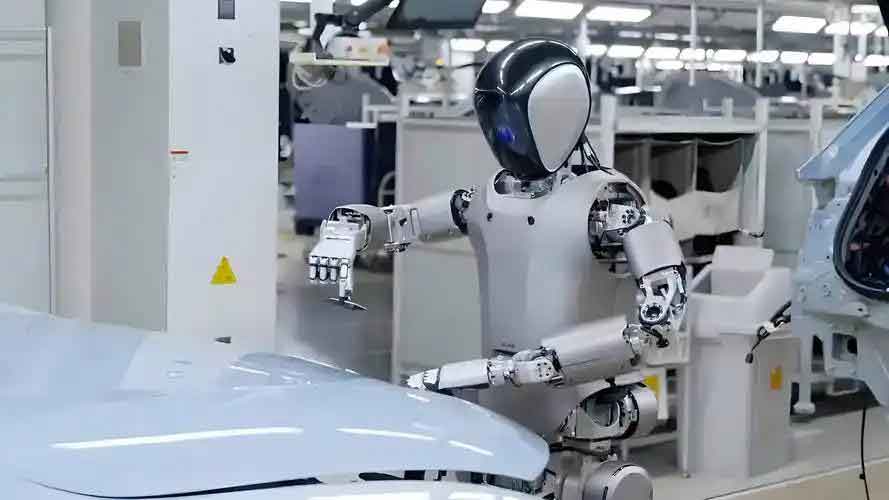
The central idea is to use the design of large and small humanoid robots as the backbone for the entire course. The course begins with system-level design tasks of a humanoid robot. Based on the application scenario, one first determines the overall configuration of the robot, including the head, arms, and legs. Then, a preliminary three-dimensional model of the robot is established. This phase gives initial dimensions, masses, and performance parameters of each joint, which are then used for whole-body dynamic simulation. From these simulations, the required torque, speed, angle range, and bandwidth of every joint are identified. After that, the detailed joint design is carried out, including the selection of motors, reducers, controllers, encoders, and the design of structural components.
Table 1 below illustrates the mapping between the large humanoid robot system design process and the course content, as well as the modern design tools used at each stage. This mapping is the backbone of the reformed curriculum.
| Design Stage | Course Content | Modern Design Tools |
|---|---|---|
| Joint preliminary design | Planar linkages, planar mechanism structure analysis | SolidWorks, ADAMS |
| Head/arm/leg configuration | Threaded mechanisms, cam mechanisms, belt drives | MATLAB, Webots |
| Whole-body dynamic simulation | Planar mechanism analysis, balancing of rotating bodies | ADAMS, ANSYS |
| Large joint detailed design | Gear drives, gear trains, shafts and hub connections, bearings, threaded connections, couplings, brakes, rotor balancing | SolidWorks, Maxwell, KISSsoft, ANSYS, Python |
| Reducer selection (harmonic, cycloid, planetary) | Gear trains, gear drives | KISSsoft, ANSYS |
For small humanoid robots, the joint design is different because the torque requirements are much lower. Typically, small humanoid robots use parallel-axis gear trains, face gears, and planetary gear trains with small brushed or brushless motors. The corresponding course content mapping is shown in Table 2.
| Small Humanoid Robot Design Stage | Course Content | Modern Design Tools |
|---|---|---|
| Joint system design | Planar mechanism analysis, cam mechanisms, linkages | SolidWorks, MATLAB |
| Gear train selection (parallel-axis, face gear, planetary) | Gear trains, gear drives, shafts, bearings | KISSsoft, ANSYS |
| Motor and encoder integration | Shaft and hub connections, couplings, threaded connections | SolidWorks, Maxwell |
| Controller and control software | Rotor balancing, mechanisms | Python, Simulink |
The reformed theoretical course not only includes traditional topics but also adds new components that are essential for humanoid robots, such as harmonic reducers, cycloidal reducers, crossed roller bearings, synchronous belts, and joint torque sensors. For example, when teaching gear trains, I introduce harmonic drive technology. The main formula of a harmonic drive is given by:
$$ i = \frac{Z_f}{Z_c – Z_f} $$
where \( Z_f \) is the number of teeth on the flexspline and \( Z_c \) is the number of teeth on the circular spline. In a standard harmonic reducer, the difference \( Z_c – Z_f \) is usually equal to twice the number of wave generator lobes. For a wave generator with two lobes, \( Z_c – Z_f = 2 \). This formula gives the reduction ratio when the circular spline is fixed, the wave generator is the input, and the flexspline is the output. The minus sign (or direction inversion) can be derived from the kinematic relationship. This direct connection to humanoid robot joints makes the transmission theory much more engaging.
Another important drive element in humanoid robots is the planetary gear train. The basic speed ratio of a planetary gear set with a fixed ring gear is:
$$ i = 1 + \frac{Z_r}{Z_s} $$
where \( Z_r \) is the number of teeth on the ring gear and \( Z_s \) is the number of teeth on the sun gear. This equation is used in many humanoid robot joint actuators to achieve a compact high-reduction gearbox.
In addition to transmissions, the course now introduces the design of structural components using topology optimization. The equivalent stress of a robot link under bending is calculated by:
$$ \sigma = \frac{M y}{I} \le [\sigma] $$
where \( M \) is the bending moment, \( y \) is the distance from the neutral axis, and \( I \) is the second moment of area. Students apply this formula in ANSYS to verify the strength of a humanoid robot thigh link.
Integration of Theory, Laboratory Sessions, Course Design, and Discipline Competitions
One of the most important innovations in my teaching reform is the through-line integration of theoretical teaching, laboratory work, course design, and extracurricular discipline competitions. In the traditional setup, these four components are separate and often contradictory. In the new scheme, all of them are centered around the development of a humanoid robot product.
Theoretical Teaching
The theoretical teaching content follows the top-down design logic of a humanoid robot. For example, when I teach the chapter on connected mechanisms, I first show a typical leg mechanism of a humanoid robot and ask students to analyze its degrees of freedom. The planar mechanism degree-of-freedom formula is:
$$ F = 3n – 2P_L – P_H $$
where \( n \) is the number of moving links, \( P_L \) is the number of lower pairs, and \( P_H \) is the number of higher pairs. Instead of just solving abstract examples, students analyze the leg mechanism of a humanoid robot model. This motivates them to understand the formula in a real engineering context.
Modern design tools are introduced alongside the theory. For example, after teaching gear calculations, I demonstrate how to use KISSsoft to design a gear pair for a humanoid robot joint. After teaching cam design, I show a MATLAB script that optimizes the cam profile of a humanoid robot finger. This tool-oriented teaching ensures that students are familiar with the software widely used in industry.
Laboratory Sessions
The laboratory sessions have been redesigned to ensure that students actively participate and use modern tools. Table 3 lists the updated laboratory sessions and their connection to humanoid robot products.
| Laboratory Session | Traditional Content | Reformed Humanoid-Robot-Oriented Content |
|---|---|---|
| Cognition of mechanisms and parts | Observe teaching aids | Disassemble a robot joint module; measure bearings, gears, and shafts |
| Kinematic diagram drawing | Manually draw a simple mechanism | Use SolidWorks to model a humanoid leg and generate its kinematic diagram |
| Involute gear profile generation | Watch a rack generate an involute profile | Use MATLAB to simulate the generation process and analyze undercutting |
| Reducer structure analysis | Disassemble a gear reducer | Disassemble a harmonic reducer from a humanoid robot joint; compare with planetary reducer |
The experiments are no longer passive observations. Students work in teams to measure, model, and simulate the relevant parts of humanoid robots. In the harmonic reducer disassembly lab, they physically inspect the flexspline, circular spline, and wave generator, and then calculate the transmission ratio using the formula above.
Course Design
The traditional curriculum design is replaced by a challenging but rewarding task: design a full humanoid robot joint module (for either a large or small robot). The joint must include a motor, a reducer, an encoder, a controller, and a housing. Students are given a set of performance requirements derived from a realistic humanoid robot specification. For example, a knee joint might need a peak torque of 120 N·m, a continuous torque of 45 N·m, and a maximum speed of 10 rad/s. The students must select a suitable motor (e.g., BLDC), choose a harmonic reducer (or planetary), design the shaft and bearing arrangement, and produce detailed drawings with dimensions. They must also validate their design using finite element analysis. This design project directly reflects the knowledge learned in the theoretical course and gives students a sense of ownership over a real humanoid robot component.
The mechanical design calculations for the joint shaft can be expressed by:
$$ d \geq \left( \frac{16 T}{\pi [\tau]} \right)^{1/3} $$
where \( T \) is the torque transmitted and \([\tau]\) is the allowable shear stress. This formula is used by students to size the output shaft of the humanoid joint.
Discipline Competitions
The reformed course encourages and assists students to participate in disciplinary competitions related to robotics. Many of these competitions involve the construction of humanoid robots or their functional modules. For example, the RAICOM (RoboCom) competition has humanoid robot challenges such as “humanoid security,” “humanoid virtual simulation,” and “humanoid selection.” In these competitions, students must apply their knowledge of mechanical design to build a robot that can walk, avoid obstacles, or manipulate objects. The course design task is often chosen to match the requirements of a competition. In this way, the competition becomes an extension of the classroom. It also strengthens teamwork, project management, and innovation capability.
Building Students’ Innovation Capability
Innovation capability is the key to successful humanoid robot development. However, it cannot be taught by simply repeating principles. My teaching reform adopts four measures to systematically cultivate innovation capability among students.
Teaching the History of Technology and Innovation Tools
In the course, I spend a significant amount of time on the history of humanoid robot development and the evolution of its joint technologies. For instance, the joint technology has evolved from the early rigid joints in the 1960s to elastic joints and then to quasi-direct-drive joints in recent years. This historical perspective helps students understand the technological trends and motivates them to propose future innovations. Additionally, I introduce the TRIZ innovation methodology, which was developed by Genrich Altshuller. TRIZ provides systematic approaches for inventive problem solving, including the “Nine Screens,” “Ideal Final Result,” “STC Operator,” “Little People,” and “Goldfish” methods. These tools allow students to break out of fixed thinking patterns.
Integrating Scientific Research into the Classroom
The mechanical design fundamentals course is taught by faculty members who are active in research on precision reducers and quasi-direct-drive robot joints. I bring my own research progress on compliant joint design into the classroom. For example, I present a quasi-direct-drive joint design with a low reduction ratio and high torque density. The motor selection is based on the joint dynamics equation:
$$ T_L = J_i \ddot{\theta}_i + b_i \dot{\theta}_i + T_g(\theta_i) + T_f(\dot{\theta}_i) $$
where \( T_L \) is the required joint torque, \( J_i \) is the inertia, \( b_i \) is the damping coefficient, \( T_g \) is the gravitational torque, and \( T_f \) is the friction torque. Students appreciate how the abstract equation is used to size a motor for a humanoid robot arm. This exposure to cutting-edge research inspires students to think creatively about how to improve existing designs.
Assigning Innovative Design Tasks
After the history and TRIZ tools are introduced, I assign two innovation design tasks. Students work in groups to solve a real design problem. The problems can be self-selected or proposed by me. For example, one task is to design a novel dexterous hand for a humanoid robot using compliant mechanisms. Another is to propose a new mechanical structure that reduces the weight of a humanoid robot leg by 20%. The only requirement is that the design must use the TRIZ methods they have learned. These tasks are not graded solely on the final model; the innovation process, including problem formulation, contradiction analysis, and solution generation, is evaluated.
Organizing Participation in Discipline Competitions
As mentioned before, competitions serve as an effective vehicle for fostering innovation. In my experience, students who participate in competitions such as the National Undergraduate Mechanical Innovation Design Competition or the China Robot Competition demonstrate significantly higher levels of creativity, problem-solving ability, and confidence. The humanoid robot oriented nature of these competitions directly reinforces the course content. I encourage every student in the class to join at least one competition during the semester. This can be a practical activity that gives them an opportunity to innovate without excessive pressure.
Establishing a Multi-Dimensional Evaluation System
The traditional evaluation system has been replaced by a multi-dimensional system that reflects the comprehensive abilities required for humanoid robot engineering. The final score for the course is now composed of five parts: theoretical examination (60%), classroom performance (10%), homework (10%), innovation capability (10%), and practical ability (10%). This weighting is expressed by the following formula:
$$ S = 0.6 E + 0.1 C + 0.1 H + 0.1 I + 0.1 P $$
where \( S \) is the total score, \( E \) is the final theoretical examination score, \( C \) is the classroom performance score, \( H \) is the homework score, \( I \) is the innovation capability score, and \( P \) is the practical ability score. Each component is assessed with clear rubrics.
Table 4 details the evaluation dimensions and their specific assessment methods.
| Evaluation Dimension | Percentage | Assessment Method |
|---|---|---|
| Theoretical examination | 60% | Closed-book exam covering fundamental concepts, formulas, and humanoid robot application problems |
| Classroom performance | 10% | Attendance, active participation in discussions, quality of questions asked |
| Homework | 10% | Problem sets, calculation reports, and short design tasks |
| Innovation capability | 10% | Two innovation design tasks evaluated by TRIZ usage, originality, and feasibility |
| Practical ability | 10% | Laboratory reports, course design quality, and competition awards |
The theoretical examination still accounts for the largest share, but the emphasis has shifted from memorization to application. Exam problems often refer to humanoid robot case studies. For example, a problem may provide the specifications of a hip joint and ask the student to choose a suitable reducer and calculate its gear ratios. Another problem may ask the student to analyze the degree of freedom of a humanoid robot arm mechanism. These questions require deep understanding rather than rote recall.
The innovation capability score is based on the two innovation tasks. For each task, students submit a short report including a problem statement, a TRIZ analysis, a proposed solution, and a reflection on the innovation process. The practical ability score is derived from the laboratory performance and the final course design project. If a student wins an award in a humanoid robot related competition, the practical ability score is set to a high grade.
Further Reflections on the Reform
In this article, I have described a comprehensive teaching reform of the mechanical design fundamentals course, centered around humanoid robot products. The reform has several notable advantages.
First, the course content now has a clear logical thread: every concept, formula, and component is tied to a specific step in the design process of a humanoid robot. This makes the learning experience more meaningful and reduces the feeling that the course is a collection of unrelated chapters.
Second, the integration of theory, experiments, course design, and competitions creates a closed learning loop. Students learn a concept in class, verify it in the laboratory, apply it in the course design, and finally demonstrate it in a competition. This loop aligns perfectly with the way professional humanoid robot engineers work.
Third, the explicit cultivation of innovation capability is critical. By teaching the history and TRIZ tools, integrating research frontiers, assigning open-ended design tasks, and encouraging competition participation, students are trained to become not just technicians but real innovators. The humanoid robot industry needs engineers who can think beyond existing solutions.
Finally, the multi-dimensional evaluation system ensures that students are rewarded for a wide range of abilities. The inclusion of innovation and practical abilities in the grading formula sends a clear signal to students that these skills are valued as much as theoretical knowledge.
Challenges and Future Work
Of course, this reform is not without challenges. The first challenge is the heavy workload for both instructors and students. A humanoid robot joint design project requires significant time in the laboratory and guidance from the instructor. To address this, I plan to develop a set of shared digital models and simulation templates that can reduce the repetitive work. Another challenge is the need for schools to invest in modern equipment, such as servo motors, harmonic reducers, and torque sensors, for the experimental sessions. Some of these components can be borrowed from research laboratories or obtained through industry cooperation.
The second challenge is the assessment of innovation capability. Grading innovation is inherently subjective. I am developing a more objective rubric based on the number of design alternatives generated, the number of TRIZ tools applied, and the novelty of the final solution. For future work, I intend to use an analytic hierarchy process to assign weights to the different innovation criteria.
Third, the laboratory sessions need to be further expanded. Currently, we have only four experiment slots due to time constraints. In the future, I hope to add virtual laboratory experiments that can be completed online. This would allow students to explore more humanoid robot designs without the constraints of physical lab time.
Fourth, the cooperation with industry should be strengthened. The humanoid robot industry is growing rapidly, and many companies are developing cutting-edge products. I plan to invite engineers from humanoid robot companies to give guest lectures and to provide real design problems for the course. This will ensure that the course content remains current and relevant.
Concluding Remarks
Humanoid robots are one of the most promising directions in the future robotics industry. The mechanical design fundamentals course, if taught in a traditional way, will not be able to support the cultivation of talents for this industry. In this article, I have proposed a teaching reform that is deeply rooted in the humanoid robot product design process. The reform includes a top-down theoretical system, integrated practical teaching, innovation-oriented pedagogy, and a multi-dimensional evaluation system. I believe this reform can serve as a model for other engineering courses in the robotics program.
The ultimate goal of our teaching is not merely to convey knowledge, but to prepare students for the exciting and challenging field of humanoid robot engineering. By aligning the course with humanoid robot products, we give students a clear picture of what they will be doing in their future careers. I am confident that this reform will significantly improve the quality of education and contribute to the development of China’s humanoid robot industry.
In summary, the humanoid robot-oriented course reform has transformed the mechanical design fundamentals course from a static collection of formulas into a dynamic, problem-driven, and innovation-centered learning experience. I hope that my exploration can provide valuable references for curriculum reform in other universities and across other disciplines. The journey of reforming engineering education is always ongoing, and humanoid robots will continue to guide us toward the future.