
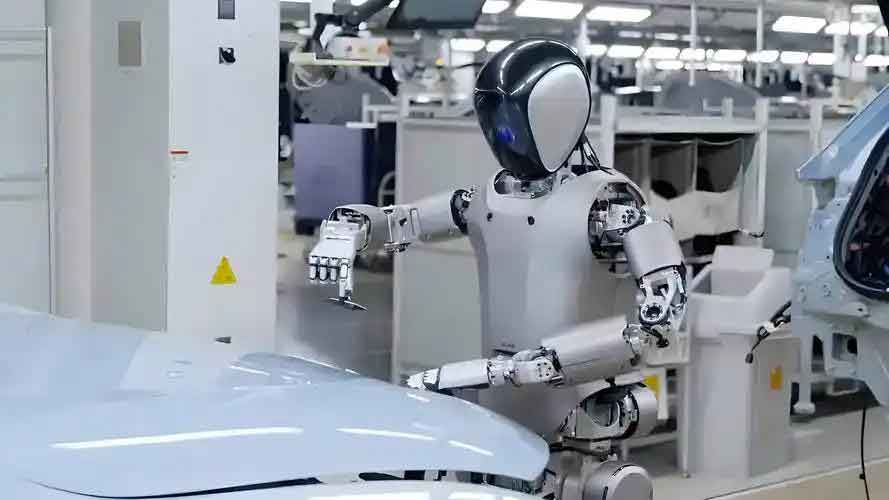
2026 is widely viewed as a critical year for humanoid robot commercialization. During the first half of the year, many A-share listed companies with businesses in humanoid robots and the humanoid robot supply chain reported impressive growth. From complete humanoid robot platforms and core hardware to system integration, the humanoid robot industry chain showed clear signals of improving profitability across multiple subsectors.
Wind data showed that 119 A-share companies belong to the humanoid robot concept sector. More than 80 percent of those companies achieved year-on-year revenue growth in the first half, while more than half achieved year-on-year growth in net profit. Since the start of 2026, humanoid robot enterprises have moved deeper into real-world application scenarios and accelerated commercialization, which in turn drove first-half earnings pre-increases across the humanoid robot supply chain.
The results suggest that the humanoid robot sector is no longer being valued only on future imagination. Revenue, profit, orders, and delivery milestones are becoming more important to the humanoid robot narrative. The humanoid robot supply chain is beginning to show the kind of operating leverage that investors have long expected from a market moving from prototypes to production.
-
Humanoid Robot Sector Reports Broad-Based Earnings Momentum
The breadth of the first-half results is one of the most important signals for the humanoid robot industry. A total of 119 A-share companies are classified in the humanoid robot concept sector. More than 80 percent of them recorded revenue growth, and more than half recorded net profit growth. That combination matters because it indicates that the humanoid robot theme is not limited to a small group of pure-play humanoid robot companies. Instead, the humanoid robot opportunity is spreading through motors, reducers, servo systems, sensors, joint modules, dexterous hands, magnetic materials, system integration, and complete-machine manufacturing.
For the humanoid robot industry, revenue growth alone is not enough. Companies must also demonstrate that humanoid robot products can be sold at scale, that customers will accept them, and that gross margins can support reinvestment. The first-half data shows progress on several of those fronts. Humanoid robot companies are moving into real application scenarios, and commercialization is accelerating. That shift is visible in both the number of companies reporting growth and the specific operating milestones disclosed by humanoid robot supply chain participants.
Indicator First-Half 2026 Humanoid Robot Sector Data A-share companies in the humanoid robot concept sector 119 Companies with year-on-year revenue growth More than 80 percent Companies with year-on-year net profit growth More than half Primary operating driver Deeper movement into real application scenarios and faster commercialization Supply chain effect First-half earnings pre-increases across the humanoid robot chain The humanoid robot concept sector’s revenue and profit breadth also suggests that the industry is moving from concept trading toward earnings delivery. For much of the humanoid robot sector’s early history, stock prices and investor attention were driven by prototypes, demonstrations, and long-term market projections. The first-half 2026 results point to a different phase, in which humanoid robot companies and their suppliers are beginning to report actual financial outcomes.
That does not mean the humanoid robot industry has reached maturity. Several humanoid robot companies still report losses or negative adjusted EBITDA. However, the direction of travel is clearer. Revenue is rising, losses are narrowing in some cases, and component suppliers are receiving orders. The humanoid robot industry is entering a stage where execution, delivery, and customer validation matter more than concept alone.
The humanoid robot supply chain is also becoming more visible to public-market investors. When more than 80 percent of a 119-company humanoid robot concept group reports revenue growth, the humanoid robot theme is no longer an isolated narrative. It is connected to real demand for components, complete machines, and integration services. That shift is important because it gives investors a wider set of companies to evaluate and a wider set of financial indicators to track.
At the same time, the humanoid robot sector remains diverse. Some companies are pure-play humanoid robot developers. Some are industrial robot manufacturers with humanoid robot adjacencies. Some are component suppliers whose robotics businesses are still a small part of total revenue. The first-half results show that all three groups can benefit from humanoid robot commercialization, but they will not benefit in the same way or at the same time.
-
Complete-Machine Humanoid Robot Leaders Show Revenue and Profit Progress
At the complete-machine level, Unitree Technology and UBTECH both reported strong first-half 2026 performance. Their results provide direct evidence that humanoid robot demand is translating into financial statements. Unitree Technology recorded first-half revenue of RMB 1.152 billion, an increase of 48.54 percent year on year. Its net profit attributable to shareholders reached RMB 274 million, compared with a loss of RMB 32.0245 million in the same period of the previous year. That swing from loss to profit is a major milestone for a complete-machine humanoid robot company.
UBTECH reported total first-half revenue of RMB 1.27 billion, a year-on-year increase of 104.2 percent. Its adjusted EBITDA was negative RMB 170 million, but that represented a reduction in loss of RMB 150 million from the same period a year earlier. UBTECH’s revenue growth was mainly driven by a 1,445.0 percent year-on-year increase in revenue from its full-size embodied intelligent humanoid robot. The growth rate shows that demand for advanced humanoid robot platforms can expand quickly when products move into commercial deployment.
Company First-Half 2026 Revenue Revenue Growth Profit or Earnings Metric Year-on-Year Change Unitree Technology RMB 1.152 billion 48.54 percent Net profit attributable to shareholders: RMB 274 million Compared with a loss of RMB 32.0245 million in the prior-year period UBTECH RMB 1.27 billion 104.2 percent Adjusted EBITDA: negative RMB 170 million Loss narrowed by RMB 150 million UBTECH full-size embodied intelligent humanoid robot Not separately disclosed in the source data 1,445.0 percent Revenue contribution Main driver of UBTECH’s revenue growth The complete-machine humanoid robot results also highlight the difference between revenue growth and profitability. UBTECH’s revenue more than doubled, and its full-size embodied intelligent humanoid robot revenue grew at an extraordinary rate, yet the company still reported negative adjusted EBITDA. This shows that humanoid robot commercialization is advancing, but scale and cost structure remain critical. Unitree Technology’s move into profit shows that a complete-machine humanoid robot company can reach profitability, but it does not mean all humanoid robot companies are at the same stage.
For the humanoid robot supply chain, the message is that complete-machine demand is becoming large enough to support component orders. When complete-machine humanoid robot companies increase production, they need more joint motors, reducers, servo motors, sensors, dexterous hands, and structural components. The complete-machine results therefore act as a leading indicator for the rest of the humanoid robot supply chain.
Unitree Technology’s profitability is particularly important because it shows that a humanoid robot company can combine revenue growth with positive net profit. UBTECH’s revenue growth is also important because it shows that demand is not static. The rapid increase in full-size embodied intelligent humanoid robot revenue indicates that customers are willing to pay for more advanced humanoid robot systems. Together, these results support the view that the humanoid robot market is moving from early interest to commercial orders.
Still, the complete-machine segment is not uniform. Unitree Technology and UBTECH have different product strategies, customer bases, and cost structures. Their first-half results show that the humanoid robot market can produce both profit and rapid revenue expansion, but they also show that profitability is not automatic. Execution in manufacturing, supply chain management, software, and customer service will determine which humanoid robot companies can sustain progress.
-
Industrial Robot Complete-Machine Makers Add Scale to the Humanoid Robot Ecosystem
Industrial robot complete-machine companies also reported generally stronger first-half performance, and their results are relevant to the humanoid robot ecosystem because the two fields share motion control, servo systems, reducers, controllers, precision manufacturing, and system integration capabilities. EFORT, Topstar, Yuejiang Technology, Estun, and Luoshi Robot are among the industrial robot complete-machine companies with exposure to the broader humanoid robot supply chain.
EFORT reported first-half revenue of RMB 656 million, up 28.93 percent year on year. Its net loss attributable to shareholders narrowed by 62.48 percent. Topstar reported revenue of RMB 1.288 billion, up 18.61 percent, and net profit attributable to shareholders of RMB 104 million, up 262.99 percent. Yuejiang Technology reported first-half revenue of RMB 316 million, up 106.6 percent. These results show that industrial robot companies are not only benefiting from automation demand but also building the manufacturing and engineering base that can support humanoid robot commercialization.
Company First-Half 2026 Revenue Revenue Growth Profit Performance EFORT RMB 656 million 28.93 percent Net loss attributable to shareholders narrowed by 62.48 percent Topstar RMB 1.288 billion 18.61 percent Net profit attributable to shareholders: RMB 104 million, up 262.99 percent Yuejiang Technology RMB 316 million 106.6 percent Not specified in the source data Estun Not specified in the source data Generally achieved growth Generally achieved growth Luoshi Robot Not specified in the source data Generally achieved growth Generally achieved growth Industrial robot makers bring several advantages to the humanoid robot industry. They already understand how to manufacture complex electromechanical systems at scale, manage supplier networks, and serve industrial customers. As humanoid robot designs move toward production, these capabilities become more valuable. The overlap between industrial robots and humanoid robots is not limited to hardware. It also includes software, safety systems, motion planning, and integration into real work environments.
At the same time, industrial robot growth does not automatically guarantee success in humanoid robots. Humanoid robot products have different form factors, use cases, and performance requirements. They must operate in unstructured environments, interact with humans, and often rely on advanced perception and artificial intelligence. The first-half results nevertheless show that the industrial robot base can provide revenue and profit while humanoid robot commercialization develops.
For the humanoid robot supply chain, industrial robot companies can serve as bridge builders. They can transfer manufacturing discipline, quality control, and automation expertise into humanoid robot production. They can also provide components and subsystems that are compatible with humanoid robot designs. As the humanoid robot market grows, industrial robot companies may become important partners for complete-machine humanoid robot developers.
The industrial robot results also show that the humanoid robot opportunity is not isolated from broader automation trends. Factories, warehouses, and logistics centers are already investing in robotics. Humanoid robots may eventually operate in some of the same environments, performing tasks that require mobility, manipulation, and human-like interaction. The capabilities developed for industrial robots can therefore support the humanoid robot transition.
-
Core Component Suppliers Become Early Humanoid Robot Earnings Beneficiaries
Core components are among the clearest beneficiaries of humanoid robot commercialization. Humanoid robots require a dense set of precision components, including joint motors, reducers, servo motors, screws, sensors, joint modules, dexterous hands, and magnetic materials. Several companies in these areas reported first-half 2026 results that reflect growing humanoid robot demand.
Langxin Electric, which focuses on robot joint motors, reported first-half revenue of RMB 667 million, up 12.11 percent year on year. Its net profit attributable to shareholders was RMB 44.51 million, up 0.39 percent. The company said that the high gross margin characteristics of the robot track are expected to optimize its overall profit structure over the medium to long term. That statement is important because it shows how humanoid robot and robotics components can improve product mix even when total revenue growth is moderate.
Leisai Intelligent focuses on two core categories: robot joint modules and dexterous hands. In the first half of 2026, the company reported revenue of RMB 1.247 billion, up 39.92 percent year on year, and net profit attributable to shareholders of RMB 194 million, up 62.79 percent. Leisai Intelligent has achieved self-research and mass production of planetary joint modules, harmonic joint modules, and multi-degree-of-freedom dexterous hands. Its products have received batch orders from mainstream domestic robot manufacturers, and the pace of commercialization continues to accelerate.
JL Mag Rare-Earth reported first-half revenue of RMB 4.649 billion, up 32.57 percent year on year, setting a record high for the same period. The company has won a project designation for an embodied robot motor rotor from a world-renowned technology company and has delivered small-batch products. The project designation and small-batch delivery are significant because they show that humanoid robot and embodied robot components are moving from samples to customer validation and early production.
Company Humanoid Robot or Robotics Focus First-Half 2026 Revenue Revenue Growth Net Profit Net Profit Growth Key Commercial Milestone Langxin Electric Robot joint motors RMB 667 million 12.11 percent RMB 44.51 million 0.39 percent Expects high gross margin robot track to improve profit structure over the medium to long term Leisai Intelligent Robot joint modules and dexterous hands RMB 1.247 billion 39.92 percent RMB 194 million 62.79 percent Self-researched and mass-produced planetary joint modules, harmonic joint modules, and multi-degree-of-freedom dexterous hands; received batch orders from mainstream domestic robot manufacturers JL Mag Rare-Earth Embodied robot motor rotor RMB 4.649 billion 32.57 percent Not specified in the source data Not specified in the source data Won a project designation from a world-renowned technology company and delivered small-batch products The component results reveal a pattern that is common in emerging hardware industries. Suppliers often see orders before complete-machine companies reach mass-market scale because every prototype, pilot line, and early production batch requires components. For the humanoid robot industry, this means component suppliers can begin to recognize revenue and profit before humanoid robots are widely sold to end users.
However, component suppliers also face execution risks. They must meet strict specifications, achieve consistent quality, scale production, and manage costs. The fact that Leisai Intelligent has received batch orders from mainstream domestic robot manufacturers and JL Mag Rare-Earth has delivered small-batch products indicates progress, but it also sets a higher bar for future delivery. The humanoid robot supply chain will need reliable component production to support mass production.
Joint modules and dexterous hands are especially important for humanoid robots because they determine movement range, precision, payload, and manipulation ability. If these components improve in performance and decline in cost, humanoid robots can become more capable and more affordable. The first-half results show that companies such as Leisai Intelligent are investing in those areas and moving toward mass production. That is a positive signal for the entire humanoid robot ecosystem.
Motor rotors and magnetic materials are also critical. Humanoid robots require efficient, compact, and powerful motors for joints and other moving parts. JL Mag Rare-Earth’s project designation for an embodied robot motor rotor from a world-renowned technology company suggests that major technology customers are preparing for humanoid robot or embodied robot production. Small-batch delivery is an early step, but it is an important one because it validates manufacturing capability and customer acceptance.
-
Humanoid Robot Orders, Mass Production, and the Coming Profit Inflection
The first-half 2026 reporting season shows that humanoid robot supply chain orders continued to grow. That order growth is important because it supports the view that the humanoid robot industry is approaching a profit inflection. The phrase “profit inflection” does not mean every humanoid robot company is already profitable. It means the direction of profitability is changing as revenue scales, product mix improves, and operating leverage begins to appear.
CICC noted that the core driving force of the global humanoid robot industry will shift from theme investment based on technological imagination to industry value realization based on mass production progress and actual scenario orders. That shift is central to understanding the first-half results. In the past, humanoid robot investment was often driven by demonstrations, prototypes, and long-term vision. In the current phase, investors and customers are looking for mass production schedules, order visibility, delivery records, and real deployment in application scenarios.
Driver of Humanoid Robot Value Earlier Phase Current Phase Reflected in First-Half 2026 Results Primary investment driver Theme investment based on technological imagination Industry value realization based on mass production progress and actual scenario orders Evidence of progress Prototypes and demonstrations Revenue growth, profit growth, loss narrowing, batch orders, project designations, and small-batch delivery Supply chain signal Early component sampling Self-research mass production, batch orders from mainstream domestic robot manufacturers, and small-batch product delivery Complete-machine signal Concept platforms Unitree Technology profitability; UBTECH revenue growth and rapid growth in full-size embodied intelligent humanoid robot revenue The humanoid robot industry is still in the early stages of commercialization. UBTECH’s adjusted EBITDA remained negative, and some industrial robot companies still reported losses. These facts show that the profit inflection is not complete. But the combination of revenue growth, net profit growth, loss reduction, and order milestones across the humanoid robot supply chain is a strong indication that the industry is moving in the right direction.
Mass production is the bridge between concept and profit. For humanoid robots, mass production requires not only assembly capacity but also a reliable supply of motors, reducers, sensors, joint modules, dexterous hands, and magnetic materials. The first-half results show that suppliers are investing in that bridge. Leisai Intelligent has moved into mass production of joint modules and dexterous hands. JL Mag Rare-Earth has delivered small batches of motor rotors. Unitree Technology has reached profitability. UBTECH has doubled revenue and seen rapid growth in full-size embodied intelligent humanoid robot revenue. Each of these milestones supports the broader humanoid robot commercialization thesis.
The next phase of the humanoid robot industry will depend on whether these early milestones can be repeated and expanded. Batch orders must become repeat orders. Small-batch delivery must become volume delivery. Project designations must become production programs. Revenue growth must become sustainable profit growth. The first-half results show that the humanoid robot supply chain has started this process, but the industry is still far from mature.
For investors, the profit inflection should be measured through a combination of indicators. Revenue growth is important, but it must be supported by gross margin and cash flow. Net profit growth is important, but it must be sustainable. Adjusted EBITDA is important, especially for companies still investing heavily in growth. Order announcements are important, but they must translate into deliveries. The humanoid robot sector will reward companies that can demonstrate progress across multiple indicators, not just one.
-
Investment Logic Shifts for the Humanoid Robot Industry
The first-half 2026 results suggest that the investment logic for the humanoid robot industry is changing. Investors are likely to pay more attention to revenue quality, order visibility, customer concentration, gross margin, cash flow, and mass production capability. The humanoid robot sector is moving from a story about future potential to a market that rewards execution.
This does not mean that long-term vision is no longer important. Humanoid robots could eventually transform manufacturing, logistics, services, healthcare, and household tasks. But the path to that future depends on companies delivering products today. The first-half data shows that the humanoid robot supply chain is beginning to deliver. More than 80 percent of the 119 A-share humanoid robot concept companies reported revenue growth. More than half reported net profit growth. Those are broad-based indicators, not isolated success stories.
Humanoid Robot Investment Signal Evidence From First-Half 2026 Interpretation Revenue breadth More than 80 percent of 119 A-share humanoid robot concept companies achieved revenue growth Demand and commercialization are spreading across the humanoid robot supply chain Profit breadth More than half of the companies achieved net profit growth Profitability is improving for a large portion of the humanoid robot ecosystem Complete-machine progress Unitree Technology reached net profit; UBTECH grew revenue by 104.2 percent Complete-machine humanoid robot companies are scaling revenue and, in some cases, profit High-growth humanoid robot product line UBTECH full-size embodied intelligent humanoid robot revenue rose 1,445.0 percent Advanced humanoid robot platforms can generate rapid revenue growth when commercial deployment begins Industrial robot adjacency EFORT, Topstar, Yuejiang Technology, Estun, and Luoshi Robot reported generally stronger performance Industrial robot capabilities support humanoid robot manufacturing and integration Core component orders Leisai Intelligent received batch orders from mainstream domestic robot manufacturers; JL Mag Rare-Earth won a project designation and delivered small batches Component suppliers are becoming early beneficiaries of humanoid robot production Strategic guidance CICC expects the global humanoid robot industry to shift from theme investment to value realization based on mass production and actual orders The humanoid robot market is entering a more fundamental, execution-driven phase The shift toward fundamentals does not remove volatility from the humanoid robot sector. Emerging industries often experience cycles of optimism and disappointment. Some companies may struggle to convert orders into profit. Others may face technical challenges, cost pressure, or customer delays. But the first-half results provide a more concrete basis for evaluating humanoid robot companies than prototypes alone. They allow investors to compare revenue growth, profit trends, order announcements, and production milestones.
For humanoid robot suppliers, the opportunity is to become indispensable. Components such as joint modules and dexterous hands are critical to humanoid robot performance. If a supplier can achieve mass production, maintain quality, and win repeat orders, it can build a durable position in the humanoid robot value chain. For complete-machine companies, the opportunity is to scale production while improving cost and reliability. For industrial robot companies, the opportunity is to leverage existing manufacturing and automation expertise into the humanoid robot market.
The humanoid robot investment logic is therefore becoming more nuanced. Pure-play humanoid robot companies may offer higher growth potential but also higher execution risk. Component suppliers may show earlier profitability because they sell to multiple robot makers. Industrial robot companies may offer a more diversified exposure, combining existing automation revenue with humanoid robot upside. Investors will need to distinguish between these profiles and assess each company’s actual humanoid robot exposure.
Another important shift is the move from concept trading to earnings delivery. In the past, a humanoid robot announcement or prototype could attract significant attention. In the current phase, the market is more likely to ask whether the product has orders, whether the orders are profitable, and whether the company can deliver at scale. The first-half results show that some humanoid robot companies and suppliers are beginning to answer those questions with financial data.
-
Humanoid Robot Commercialization Moves Into Real Application Scenarios
Since 2026 began, humanoid robot enterprises have moved deeper into real application scenarios and accelerated commercialization. That movement is visible in the first-half results. Revenue is growing, and customers are placing orders. The humanoid robot industry is beginning to move beyond laboratory demonstrations and trade-show appearances.
Real application scenarios are important because they test whether humanoid robots can create value. A humanoid robot must be reliable, safe, and productive enough to justify its cost. It must also be integrated into workflows, software systems, and human environments. The first-half results do not provide detailed deployment numbers, but they do show that humanoid robot companies and their suppliers are making commercial progress. Unitree Technology and UBTECH reported strong revenue growth. Component suppliers received batch orders and delivered small batches. These are signs that humanoid robot products are entering real use cases.
The humanoid robot supply chain is also becoming more complete. Joint motors, joint modules, harmonic and planetary reducers, dexterous hands, motor rotors, sensors, and system integration are all part of the humanoid robot ecosystem. The first-half results show activity across these categories. Langxin Electric focuses on robot joint motors. Leisai Intelligent focuses on joint modules and dexterous hands. JL Mag Rare-Earth focuses on motor rotors for embodied robots. Industrial robot companies such as EFORT, Topstar, Yuejiang Technology, Estun, and Luoshi Robot provide adjacent capabilities. Complete-machine companies such as Unitree Technology and UBTECH drive demand for the entire chain.
Humanoid Robot Value Chain Layer Companies Mentioned in First-Half 2026 Results Role in Humanoid Robot Commercialization Complete machines Unitree Technology, UBTECH Develop and sell full-size humanoid robot platforms and embodied intelligent systems Industrial robot complete machines EFORT, Topstar, Yuejiang Technology, Estun, Luoshi Robot Provide manufacturing, motion control, and integration capabilities that support humanoid robot production Joint motors Langxin Electric Supply motors used in humanoid robot joints Joint modules and dexterous hands Leisai Intelligent Supply core components for humanoid robot movement and manipulation; achieved self-research mass production and batch orders Motor rotors and magnetic materials JL Mag Rare-Earth Supply embodied robot motor rotors; won project designation and delivered small batches The humanoid robot value chain is not yet standardized. Designs are still evolving, and customers may require different specifications. That creates both opportunity and risk for suppliers. Suppliers that can adapt quickly, invest in research and development, and scale production may win share. Suppliers that cannot meet quality and cost targets may lose opportunities. The first-half results show that some suppliers are already moving ahead.
For the humanoid robot industry as a whole, real application scenarios are the ultimate test. If humanoid robots can perform useful work in factories, warehouses, laboratories, and service environments, demand will grow. If they cannot, the market will remain limited. The first-half results suggest that progress is being made, but they also show that commercialization is a multi-year process.
The movement into real application scenarios also changes the nature of competition. Humanoid robot companies must now compete on reliability, service, integration, and total cost of ownership. They must work with customers to understand workflows and adapt products to specific tasks. This is more difficult than building a demonstration robot, but it is necessary for long-term success. The first-half results show that humanoid robot companies are beginning to take on that challenge.
-
Humanoid Robot Supply Chain Risks and Execution Challenges
Although the first-half 2026 results are positive, the humanoid robot industry still faces meaningful execution challenges. The path from prototype to mass production is difficult. It requires reliable component supply, consistent manufacturing quality, effective cost control, and strong customer service. Not every company in the humanoid robot supply chain will succeed.
One challenge is profitability. UBTECH’s adjusted EBITDA remained negative, even though revenue grew rapidly. EFORT’s net loss narrowed but was still a loss. These results show that humanoid robot commercialization can increase revenue without immediately producing positive earnings. Companies must manage investment, inventory, and research and development spending carefully while they scale.
Another challenge is order conversion. Batch orders from mainstream domestic robot manufacturers and small-batch product delivery are important milestones, but they do not guarantee volume production. Companies must convert early orders into repeat orders, expand customer relationships, and increase production capacity. If demand does not scale as expected, suppliers may face underutilized capacity and financial pressure.
Humanoid Robot Execution Challenge Evidence From First-Half 2026 Results Implication Uneven profitability UBTECH adjusted EBITDA remained negative; EFORT net loss narrowed but remained a loss Humanoid robot commercialization does not guarantee immediate profit Early order stage Leisai Intelligent received batch orders; JL Mag Rare-Earth delivered small batches Orders and deliveries must scale to support sustained growth Mass production requirements Leisai Intelligent achieved self-research mass production of joint modules and dexterous hands Component quality, yield, and cost will determine humanoid robot competitiveness Customer validation JL Mag Rare-Earth won a project designation from a world-renowned technology company Customer qualification is a critical step before volume production Revenue concentration Some companies did not disclose specific humanoid robot revenue or profit figures Investors must assess actual humanoid robot exposure and revenue contribution Technology risk is another factor. Humanoid robot designs are still evolving. Different companies may pursue different actuator architectures, sensor suites, control systems, and artificial intelligence models. Suppliers that invest in one design may find that the market moves in another direction. Conversely, suppliers that remain flexible and support multiple customers may be better positioned to capture growth.
Cost is also critical. Humanoid robots must become affordable enough for widespread adoption. That requires lower component costs, more efficient manufacturing, and economies of scale. The first-half results show that some component suppliers are moving into mass production. If they can reduce costs while maintaining quality, they can help make humanoid robots more commercially viable. If costs remain high, adoption may be slower.
Finally, competition is increasing. The humanoid robot sector is attracting attention from complete-machine developers, industrial robot companies, component suppliers, and technology companies. As more players enter, pricing pressure and customer expectations will rise. Companies with strong technology, manufacturing, and customer relationships will be better able to compete. The first-half results provide early evidence of which companies are making progress, but the competitive landscape will continue to evolve.
-
Humanoid Robot Market Indicators to Watch
The first-half 2026 results provide a baseline for tracking the humanoid robot industry in future periods. Investors and industry participants should watch several indicators to determine whether the humanoid robot sector can sustain its momentum. These indicators include revenue growth, net profit growth, adjusted EBITDA, order announcements, mass production milestones, project designations, small-batch deliveries, and batch orders from mainstream domestic robot manufacturers.
Revenue growth will remain important because it shows whether humanoid robot products and components are being adopted. However, revenue growth must be evaluated alongside profitability. A company can grow revenue quickly while still losing money. The first-half results show both possibilities. Unitree Technology reached net profit, while UBTECH grew revenue rapidly but still reported negative adjusted EBITDA. Investors should therefore look at revenue and profit together.
Order announcements are another key indicator. Batch orders and project designations show that customers are committing to humanoid robot products. Small-batch delivery shows that suppliers can meet early production requirements. The next step is volume delivery. If companies can move from small batches to larger orders, the humanoid robot supply chain will become more durable.
Indicator to Watch Why It Matters for the Humanoid Robot Industry First-Half 2026 Reference Point Revenue growth Shows whether humanoid robot products and components are being sold More than 80 percent of 119 humanoid robot concept companies achieved revenue growth Net profit growth Shows whether revenue is translating into earnings More than half of the companies achieved net profit growth Adjusted EBITDA Shows operating progress for companies still investing heavily UBTECH adjusted EBITDA was negative RMB 170 million, narrowing by RMB 150 million Complete-machine profitability Shows whether humanoid robot developers can become self-sustaining Unitree Technology reported net profit of RMB 274 million High-growth humanoid robot revenue Shows demand for advanced humanoid robot platforms UBTECH full-size embodied intelligent humanoid robot revenue rose 1,445.0 percent Batch orders Shows customer commitment and supplier validation Leisai Intelligent received batch orders from mainstream domestic robot manufacturers Project designations Shows entry into customer programs before volume production JL Mag Rare-Earth won a project designation from a world-renowned technology company Mass production capability Shows whether suppliers can scale quality and output Leisai Intelligent achieved self-research mass production of joint modules and dexterous hands Mass production progress will be especially important. Humanoid robots require many precision components, and each component must meet strict specifications. If suppliers can increase production while maintaining quality, humanoid robot costs can decline and adoption can accelerate. If suppliers struggle to scale, complete-machine companies may face delays. The first-half results show that some suppliers are moving in the right direction, but mass production is a continuous challenge.
Customer diversification is another indicator. A supplier that depends on one humanoid robot customer may be vulnerable if that customer changes designs or delays production. A supplier with multiple customers may be more resilient. The first-half results mention batch orders from mainstream domestic robot manufacturers and a project designation from a world-renowned technology company. These milestones suggest that humanoid robot customers are beginning to commit, but the market is still early.
Finally, the humanoid robot industry’s ability to move into real application scenarios will determine long-term demand. Revenue growth and orders are positive, but humanoid robots must demonstrate value in actual use. If they can improve productivity, reduce costs, or perform tasks that are difficult for existing automation, demand can expand. The first-half results show that commercialization is accelerating, but they also show that the industry is still at an early stage.
-
Conclusion: Humanoid Robot Earnings Delivery Takes Center Stage
The first-half 2026 results mark an important moment for the humanoid robot industry. The humanoid robot supply chain is moving from concept trading toward earnings delivery. A total of 119 A-share humanoid robot concept companies are part of the sector, and more than 80 percent achieved revenue growth. More than half achieved net profit growth. Complete-machine humanoid robot companies such as Unitree Technology and UBTECH reported strong revenue progress, with Unitree Technology reaching net profit and UBTECH growing revenue by 104.2 percent.
Component suppliers are also making progress. Langxin Electric reported growth in robot joint motors. Leisai Intelligent achieved self-research mass production of joint modules and dexterous hands and received batch orders from mainstream domestic robot manufacturers. JL Mag Rare-Earth won a project designation for an embodied robot motor rotor from a world-renowned technology company and delivered small-batch products. Industrial robot companies such as EFORT, Topstar, Yuejiang Technology, Estun, and Luoshi Robot reported generally stronger performance, adding scale and manufacturing depth to the humanoid robot ecosystem.
The humanoid robot industry is still facing challenges. Profitability is uneven. UBTECH’s adjusted EBITDA remained negative. EFORT’s net loss narrowed but remained a loss. Mass production is difficult, and customer adoption takes time. However, the direction of change is positive. Revenue is rising, orders are growing, and the humanoid robot supply chain is beginning to demonstrate commercial traction.
CICC’s view captures the shift now underway: the global humanoid robot industry’s core driving force will move from theme investment based on technological imagination to industry value realization based on mass production progress and actual scenario orders. That is the defining theme of the first-half 2026 humanoid robot reporting season. The humanoid robot market is no longer only about future potential. It is increasingly about current execution, current orders, current revenue, and current progress toward profit.
For the humanoid robot ecosystem, the next phase will require discipline. Complete-machine companies must scale production and improve cost structures. Component suppliers must move from small batches to volume delivery. Industrial robot companies must translate existing capabilities into humanoid robot opportunities. Investors must evaluate humanoid robot exposure with greater rigor. If these efforts succeed, the humanoid robot industry can continue its transition from concept to earnings delivery. The first-half results show that the journey has begun, and the humanoid robot supply chain is beginning to prove that innovation can become business reality.