
As a researcher deeply immersed in the field of robotics, I consider humanoid robots to be a transformative advancement in technology. These robots, often referred to as anthropomorphic or human-like robots, are designed to mimic human morphology and functionality. They feature拟人 limbs, sophisticated motion and operational skills, along with advanced perception, learning, and cognitive capabilities. The development of humanoid robots is inherently multidisciplinary, integrating mechanical engineering, electrical systems, materials science, sensors, control theory, and computer science to achieve human-like features. This integration enables greater environmental adaptability, more versatile task execution, and more natural human-robot interaction. In my view, humanoid robots represent the pinnacle of robotic technology and serve as a critical indicator of a nation’s technological prowess. The journey of humanoid robots began decades ago, and today, they stand at the forefront of innovation, with potential applications spanning various sectors. This article explores the current status, key challenges, and future scenarios for humanoid robots, drawing from global developments and my own insights.
The global pursuit of humanoid robot technology started in 1969 with the first humanoid robot developed at Waseda University in Japan. Since then, countries like the United States, Japan, South Korea, Germany, Italy, France, and Russia have actively engaged in research, driven by the strategic importance of humanoid robots as a technological high ground. In my analysis, the most notable humanoid robots include Honda’s ASIMO and Boston Dynamics’ Atlas, which exemplify distinct technical approaches—electric motor驱动 versus hydraulic驱动—with implications for position control and dynamic force control. Over the years, these robots have evolved significantly, showcasing capabilities from basic walking to complex acrobatics. For instance, Atlas has demonstrated remarkable agility through maneuvers like backflips and跑酷, while ASIMO focused on precision in tasks like serving tea. More recently, Tesla’s Optimus has entered the scene, emphasizing artificial intelligence and cost-effectiveness for broad applications. The international landscape of humanoid robots can be categorized into tiers based on performance and adaptability, as summarized in the table below.
| Humanoid Robot | Country | Height (cm) | Weight (kg) | Key Features | Technical Focus |
|---|---|---|---|---|---|
| ASIMO | Japan | 130 | 48 | Electric motor驱动, precise transmission, real-time control, gait planning, balance control; capable of walking, running, jumping, and basic manipulation tasks. | Position control and交互 |
| Atlas | USA | 183 | ~150 | Hydraulic驱动, high dynamic mobility, able to perform complex acrobatics,适应 uneven terrain, and manipulation tasks. | Dynamic force control and agility |
| Optimus | USA | 173 | 56 | Electric驱动, uses advanced AI and DOJO D1 chip, visual perception, low cost, strong intelligence,多场景应用. | AI integration and affordability |
| Valkyrie | USA | 190 | 125 | Developed by NASA, 44 degrees of freedom, designed for space missions and exploration. | Space adaptability and robustness |
| Digit V2 | USA | N/A | N/A | Improved arms for carrying loads, enhanced perception with cameras and LiDAR, obstacle detection and object manipulation. | Perception and logistics |
| WALK-MAN | Italy | N/A | 102 | Designed for firefighting, equipped with 3D radar, microphones, cameras, can operate in hazardous environments. | Disaster response and manipulation |
| LOLA | Germany | 180 | 55 | 25 degrees of freedom, walking speed up to 5 km/h, obstacle avoidance via head sensors. | High-speed walking and sensing |
| REEM-C | France | 160 | 80 | 44 degrees of freedom, walking speed 2.5 km/h, capabilities in manipulation, navigation, and human-robot interaction. | Commercial service tasks |
| TALOS | France | 175 | 90 | Industrial applications,适应 uneven surfaces and stairs, can perform drilling and screw tightening. | Industrial precision and adaptability |
| DRC-HUBO | South Korea | 170 | 80 | 32 degrees of freedom, hybrid wheel-leg locomotion,适应 rough terrain and slopes. | Versatile locomotion and terrain handling |
From my perspective, the first tier, led by the United States with Boston Dynamics and Tesla, excels in both motion and intelligent operation, pushing the boundaries of what humanoid robots can achieve. The second tier includes robots from Japan, South Korea, and Europe, which may not handle extreme野外复杂 terrain but demonstrate strong hand-eye coordination and fine manipulation, often using human-made tools effectively. The third tier comprises robots designed for indoor flat surfaces, lacking adaptability to outdoor uneven ground and thus remaining distant from real-world applications. This stratification highlights the diverse approaches in humanoid robot development, each with unique strengths and limitations. As I delve deeper, it’s clear that advancements in humanoid robot technology are accelerating, driven by innovations in驱动 systems, control algorithms, and artificial intelligence.
In China, research on humanoid robots commenced in the 1990s, supported by national initiatives such as the “863”计划 and the National Natural Science Foundation. Numerous research institutions and high-tech companies have made significant strides, cultivating robust teams and technical expertise. Key achievements include the development of various humanoid robot prototypes that have reached internationally advanced levels in overall technology. For example, early efforts focused on static and dynamic walking, with robots capable of basic movements and even table tennis playing. More recent advancements have seen improvements in dynamic walking, running, jumping, and adaptation to diverse terrains like slopes and台阶. Commercial entities have also entered the fray, offering consumer and commercial humanoid robots aimed at practical applications. The progress in China reflects a growing emphasis on foundational components, new materials, control theories, recognition algorithms, and intelligent systems. With continued investment and strategic focus, humanoid robots from China are poised for real-world deployment, potentially capturing market opportunities. Below is a summary of the evolutionary phases in China’s humanoid robot development, based on my observations.
| Development Phase | Time Period | Key Achievements | Technical Specifications | Focus Areas |
|---|---|---|---|---|
| Early Exploration | 1990s-2000s | First static and dynamic walking humanoid robots; capabilities in表演 tasks like太极拳 and table tennis. | Walking speeds from 0.36 to 1.08 km/h; basic平衡 control. | Foundational locomotion and control |
| Advanced Research | 2010s-Present | Enhanced dynamic walking, running up to 6 km/h, jumping 0.5 m, adaptation to outdoor terrains; integration of perception and navigation for autonomous operation. | Improved motor skills, sensor fusion, and real-time decision-making. | High-performance motion and智能 integration |
| Commercialization | Recent Years | Entry of companies offering humanoid robots for消费 and商用 markets; emphasis on cost-effectiveness and实用化. | Focus on affordability, user-friendly interfaces, and task-specific designs. | Market adoption and application readiness |
Despite these advancements, humanoid robots face critical challenges that must be overcome to unlock their full potential. In my assessment, these challenges can be categorized into three core areas:本体能力, motion capability, and intelligent capability. Each area involves complex technical hurdles that require innovative solutions.
First, the本体能力 of a humanoid robot refers to its physical structure and驱动 systems, which form the foundation for high-speed,灵巧, and爆发运动. Key technologies include high-torque驱动, efficient传动, compact structural design, and high-energy-density batteries. Internationally, Boston Dynamics and Tesla represent two divergent approaches: hydraulic驱动 for power and electric motor驱动 for intelligence. In my view, the gap lies in high-torque驱动 technology. Hydraulic humanoid robots have made progress with oil-free designs and additive manufacturing, achieving autonomous power with improving power density. Electric-driven humanoid robots show smaller disparities in servo technology, benefiting from rapid iteration and cost advantages. The dynamics of a humanoid robot can be modeled using the Lagrangian formulation, which describes the motion of a multi-body system. For a humanoid robot with n degrees of freedom, the equations of motion are given by:
$$ \tau = M(q)\ddot{q} + C(q,\dot{q})\dot{q} + G(q) $$
where $\tau$ is the vector of joint torques, $M(q)$ is the mass matrix, $q$ is the vector of joint positions, $C(q,\dot{q})$ represents Coriolis and centrifugal terms, and $G(q)$ is the gravitational vector. This model is essential for designing驱动 systems that can deliver the necessary forces for dynamic movements. Additionally, energy efficiency is crucial, and the power requirement for a humanoid robot can be expressed as:
$$ P = \sum_{i=1}^{n} \tau_i \dot{q}_i + P_{\text{loss}} $$
where $P$ is the total power, $\tau_i$ and $\dot{q}_i$ are the torque and velocity of joint i, and $P_{\text{loss}}$ accounts for losses in传动 and electronics. Optimizing these parameters is vital for enhancing the本体能力 of humanoid robots.
Second, motion capability encompasses the ability of a humanoid robot to perform high-dynamic movements and tasks. This involves precise modeling of dynamic变构型, complex motion planning for high degrees of freedom, and平衡 control under未知扰动. The United States leads in motion control technologies, with extensive research providing a strong foundation. For instance, balance control often relies on the Zero Moment Point (ZMP) criterion, a key concept for stable bipedal locomotion. The ZMP position can be computed as:
$$ x_{\text{ZMP}} = \frac{\sum_{i} m_i (g z_i – \ddot{z}_i x_i) – \sum_{i} I_i \ddot{\theta}_{iy}}{\sum_{i} m_i (g – \ddot{z}_i)} $$
where $m_i$ is the mass of link i, $g$ is gravitational acceleration, $z_i$ and $x_i$ are coordinates, $I_i$ is the inertia, and $\ddot{\theta}_{iy}$ is angular acceleration. Maintaining the ZMP within the support polygon ensures stability during walking or running. Motion planning for humanoid robots can be formulated as an optimization problem, minimizing a cost function such as:
$$ J = \int_{0}^{T} \left( \dot{q}^T Q \dot{q} + \tau^T R \tau \right) dt $$
where $Q$ and $R$ are weighting matrices, and $T$ is the time horizon. This approach enables smooth and efficient trajectories for tasks like jumping or climbing. In China, progress in motion control is narrowing the gap with international leaders, with advancements in adaptive modeling and disturbance rejection. However, challenges remain in achieving the agility seen in robots like Atlas, especially in unstructured environments.
Third, intelligent capability refers to the perceptual, decision-making, and learning abilities of a humanoid robot. This includes environmental sensing via vision or other sensors, real-time decision-making, and integration with smart chips and algorithms. Compared to earlier robots like ASIMO, which performed basic visual tasks, modern humanoid robots demand higher levels of intelligence for complex operations. For example, the感知 of a fast-moving object, as in table tennis, requires robust prediction models. A common approach uses deep learning, where a neural network $f(x; \theta)$ is trained to minimize a loss function:
$$ L(\theta) = \frac{1}{N} \sum_{i=1}^{N} \| y_i – f(x_i; \theta) \|^2 $$
where $x_i$ are input sensor data, $y_i$ are target outputs, and $\theta$ are network parameters. This enables humanoid robots to recognize objects, plan grasps, and navigate dynamically. The concept of a “super brain” for humanoid robots, combining eye-hand-foot coordination with advanced AI, is emerging as a trend. In my opinion, this integration could lead to a robot元宇宙, where humanoid robots operate in virtual-physical spaces. The computational demand for such intelligence is high, often requiring dedicated processors like Tesla’s DOJO D1 chip. The table below summarizes key challenges and potential solutions in intelligent capability for humanoid robots.
| Intelligent Aspect | Challenges | Technological Solutions | Mathematical Formulations |
|---|---|---|---|
| Perception | Real-time sensing in dynamic environments; handling occlusions and noise. | Multi-sensor fusion (cameras, LiDAR, IMUs); deep learning for object detection and tracking. | Bayesian filtering: $p(x_t | z_{1:t}) \propto p(z_t | x_t) \int p(x_t | x_{t-1}) p(x_{t-1} | z_{1:t-1}) dx_{t-1}$ |
| Decision-Making | High-dimensional state-action spaces; uncertainty in outcomes. | Reinforcement learning; probabilistic planning; model predictive control. | Q-learning update: $Q(s,a) \leftarrow Q(s,a) + \alpha [r + \gamma \max_{a’} Q(s’,a’) – Q(s,a)]$ |
| Learning and Adaptation | Generalization across tasks; few-shot learning in real-world settings. | Meta-learning; transfer learning; sim-to-real transfer. | Meta-learning objective: $\min_{\theta} \sum_{i} \mathcal{L}_{i}(f_{\theta_i})$ where $\theta_i = g(\theta, \mathcal{D}_{i}^{\text{train}})$ |
The convergence of these technologies will define the next generation of humanoid robots, making them more autonomous and versatile.
Looking ahead, humanoid robots hold immense promise for various application scenarios. Their human-like form and adaptability make them suitable for environments designed for humans, offering solutions to societal challenges like labor shortages and hazardous work conditions. In my vision, humanoid robots will become integral to工业生产,社会服务, and救援救灾 fields. For instance, in industrial settings, humanoid robots can perform mobile tasks such as assembly, inspection, and maintenance, seamlessly integrating into factories and warehouses. The image below illustrates a potential application in quality inspection, where humanoid robots leverage their dexterity and perception to ensure product standards.
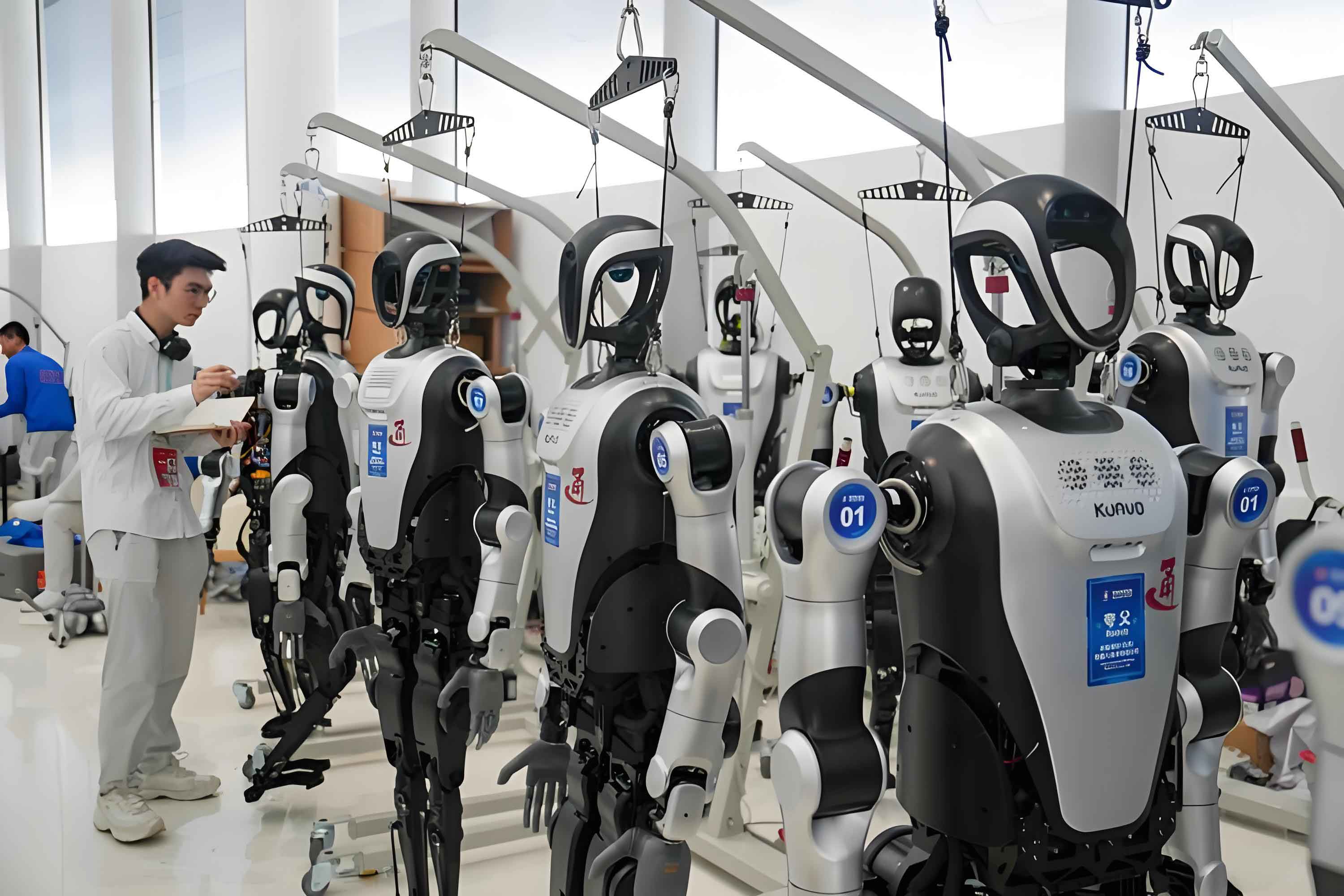
This visual underscores the practical role of humanoid robots in enhancing efficiency and safety. Beyond industry, humanoid robots can address社会服务 needs, particularly in aging societies. They may assist in办公辅助, commercial services,家务作业, and elderly care, providing companionship and support. Their亲和 interaction capabilities foster trust and acceptance among users. In救援救灾 scenarios, humanoid robots can undertake dangerous missions, such as firefighting or earthquake response, using standard equipment and operating in perilous conditions where human presence is risky. Additionally, for国家重大工程 like space exploration, humanoid robots could替代 astronauts in long-term missions, conducting repairs or experiments in extraterrestrial environments. The economic impact of widespread humanoid robot adoption could be profound, potentially reshaping labor markets and boosting productivity. However, realizing this potential requires addressing ethical, regulatory, and technical barriers, which I believe will be the focus of ongoing research and dialogue.
In conclusion, the development and proliferation of humanoid robots signify a leap forward in robotics and artificial intelligence. By emulating human appearance and behavior, these robots have already made strides in education, entertainment, and service domains. Yet, as I have outlined, significant challenges persist in本体能力, motion capability, and intelligent capability. Overcoming these hurdles demands sustained innovation,跨学科 collaboration, and thoughtful consideration of societal implications. I am optimistic that through collective efforts, humanoid robots will evolve into reliable partners, enhancing human life and driving technological progress. The future of humanoid robots is not just about machines; it’s about creating a more intelligent and人性化 world where technology serves humanity’s highest aspirations. As research continues, I anticipate breakthroughs that will bring humanoid robots closer to everyday reality, unlocking their full potential for the betterment of society.