
The landscape of global technology competition has found a new focal point: the humanoid robot. As a potential successor to the smartphone as the defining hardware platform of the coming decade, its development trajectory is being sharply defined by the strategic interplay between the United States and China. This analysis, from my perspective, examines this dynamic, focusing on the differentiated competitive paths, the structure of the global supply chain, the dual-edged impact of U.S. policies, and the strategic imperatives for fostering a resilient and leading humanoid robot industry.
The competition is characterized by a fundamental divergence in industrial logic and competitive advantage. My observation of the current ecosystem reveals a pattern where both nations are converging on certain macro trends while diverging sharply in their core approaches to technology and market application.
Convergence and Divergence: The “Three Commonalities and Two Differences”
Both the United States and China are driving the humanoid robot industry toward several key milestones simultaneously.
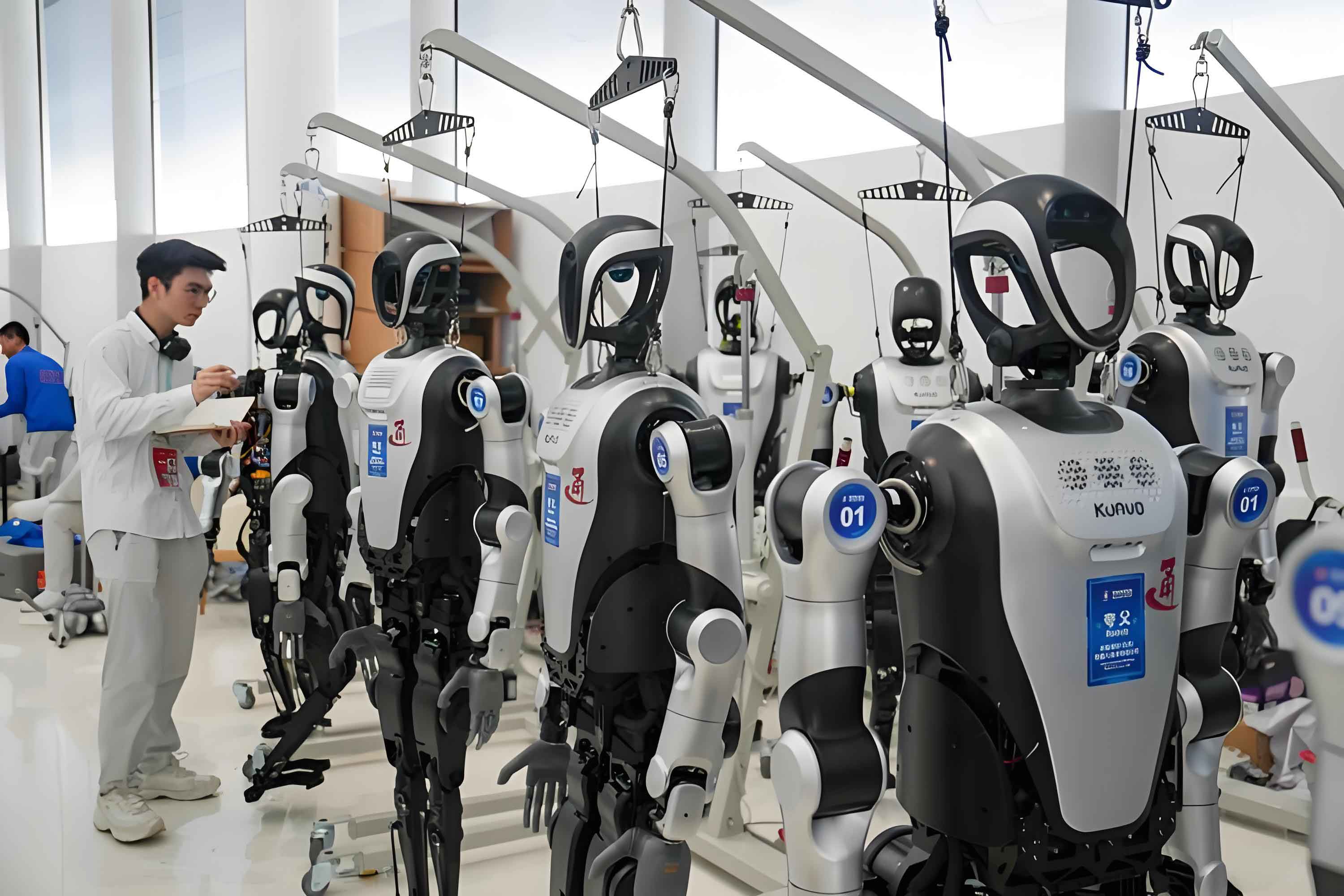
Commonality 1: The Era of Mass Production. The year 2025 marks a pivotal shift from prototype demonstrations to pre-production and scaling. Events such as high-profile public performances and the world’s first humanoid robot half-marathon signal this transition. Industry projections are optimistic: Tesla aims for an initial production of 10,000 Optimus units in 2025, scaling to a monthly rate of 10,000 by mid-2026. Companies like Figure AI project volumes in the hundreds of thousands within a few years. In China, numerous companies, following periods of technical optimization, are positioning 2025 as their true “first year of mass production.” The collective momentum suggests the humanoid robot is transitioning from a research project to a manufacturable product.
Commonality 2: The Drive Toward Embodied Intelligence via AI. Both nations recognize that the ultimate utility of a humanoid robot lies in its intelligence, not just its mechanics. Large AI models are seen as the key accelerator for training, task generation, and environmental understanding, pushing robots toward greater generality and autonomy. The formula for progress in this domain can be summarized by the enhancement of the robot’s cognitive function $C$ through model scale $M$, data $D$, and compute $C_p$:
$$C = f(M, D, C_p) = \alpha \log(M) + \beta \sqrt{D} + \gamma C_p$$
While the U.S. holds a first-mover advantage in foundational model development, significant strides are being made elsewhere in reducing the cost barrier to advanced AI, thereby empowering broader innovation in the humanoid robot software stack.
Commonality 3: Heightened Strategic Policy Support. 2025 is a critical policy window globally. In China, “embodied intelligence” has been elevated to a national priority, reflected in government work reports and multi-ministerial action plans. Numerous local governments are establishing industrial funds to spur development. The U.S. is leveraging its established technological base, channeling substantial investment—amounting to hundreds of billions of dollars—through defense and civilian agencies into AI and related fields that directly benefit advanced robotics, supported by legislative measures like tax credits for advanced manufacturing and AI R&D.
Despite these parallel pursuits, the fundamental strategies of the two nations exhibit stark contrasts.
Difference 1: Divergent Technical Pathways. The core technological philosophies have crystallized into two distinct models. The dominant Chinese approach prioritizes cost-effective electrical actuation and leverages deep, agile supply chains. The focus is on achieving functional mobility and dexterity at a fraction of the cost of earlier hydraulic systems, enabling faster commercialization. The dominant U.S. approach prioritizes establishing a high technical barrier through superior AI algorithms and system integration. This path often involves migrating advanced software (e.g., from autonomous vehicles) to robotics and maintaining leadership in the core “brain” of the system, even if some hardware is sourced globally.
| Aspect | Primary Chinese Pathway | Primary U.S. Pathway |
|---|---|---|
| Core Technical Driver | Electrically-driven actuation,供应链 integration | AI-first algorithms, advanced system integration |
| Industrial Logic | Cost-performance & rapid iteration | Technology premium & ecosystem lock-in |
| Key Commercial Scenarios | Education, customized industrial tasks (e.g., simple assembly, inspection) | High-value manufacturing (e.g., automotive logistics), specialized healthcare |
| Business Model | Hardware sales, customized solution packages | Hardware + software/service subscription |
Difference 2: Divergent Initial Application Scenarios. Market entry strategies are shaped by domestic industrial strengths and policy support. Chinese firms are finding traction in educational robotics and tailored industrial applications, such as specific assembly or quality inspection lines in electronics and automotive factories. This is driven by policy incentives and a vast domestic market for automation. U.S. firms are targeting higher-value, more complex scenarios like precise logistics in premium manufacturing and applications in healthcare, leveraging their software advantage to command a price premium, though facing different regulatory and social adoption hurdles.
Global Supply Chain Division: “Brain” vs. “Body”
The global humanoid robot value chain can be segmented into three critical modules: the Brain (intelligence core), the Body (hardware and actuators), and Integration (final system assembly). The current division of labor highlights complementary dependencies and vulnerabilities.
The “Brain”: U.S. Leadership and a Critical Chokepoint. This module, encompassing AI training chips, edge processors, core perception algorithms, and operating systems, is where the U.S. holds a commanding, though not absolute, lead. Companies like NVIDIA, Intel, and Qualcomm, alongside software giants, dominate in providing the essential silicon and foundational models for training and running advanced robotic intelligence. The performance gap here is significant, creating a potential “chokepoint” for the global advancement of sophisticated humanoid robots. The cost of developing alternatives is captured by a simplified R&D investment function:
$$I_{brain} = k \cdot (P_{target} – P_{current})^2 + C_{ecosystem}$$
where $I_{brain}$ is the required investment, $P$ represents performance metrics, $k$ is a scaling constant, and $C_{ecosystem}$ denotes the substantial cost of rebuilding a competitive software and developer ecosystem.
The “Body”: Chinese Dominance in Manufacturing and Components. The physical embodiment of the humanoid robot—its sensors, precision gearboxes (e.g., harmonic reducers), servo motors, structural components, and batteries—is an area of deep Chinese strength. The country’s mature, scalable, and cost-efficient manufacturing supply chain for consumer electronics, automotive parts, and industrial robotics translates directly to the humanoid robot domain. This capability is crucial for bringing down the Bill-of-Materials (BOM) cost, a key variable for mass adoption. The BOM cost $C_{BOM}$ for a humanoid robot can be modeled as:
$$C_{BOM} = \sum_{i=1}^{n} (p_i \cdot q_i) = C_{actuators} + C_{structure} + C_{sensors} + C_{compute}$$
China’s supply chain excels at minimizing $C_{actuators}$, $C_{structure}$, and $C_{sensors}$.
Integration: Asian, Particularly Chinese, Prominence. The final assembly and system integration of humanoid robots sees strong participation from Asian firms. Chinese integrators are especially notable, emerging from three powerful industrial bases: automotive OEMs with manufacturing prowess, internet giants with AI capabilities, and traditional industrial robot companies. This gives China a significant position in turning components into functional, deployable systems.
| Value Chain Module | Key Components | Dominant Region/Country | Characteristic |
|---|---|---|---|
| Brain (Intelligence) | AI Training Chips, Edge AI Processors, Core AI Software, OS | United States | High concentration, significant technical barrier, potential chokepoint. |
| Body (Hardware) | Sensors, Actuators (Motors, Reducers), Structural Parts, Batteries | China | Diversified, scalable, cost-competitive supply chain. |
| Integration (System) | Final Assembly, System Calibration, Application Software | Asia (with strong Chinese presence) | Growing capacity, leveraging manufacturing and vertical integration expertise. |
The Dual-Edged Sword of U.S. Tariffs and Tech Controls
American policies on tariffs and technology export controls present a complex set of pressures and, paradoxically, opportunities for the global humanoid robot industry, particularly for Chinese players.
Immediate Pressure on Supply Chains and Markets. In the short term, these policies act as a direct friction cost. Elevated tariffs increase the price of exported robots or components, potentially making them less competitive in the U.S. market. More critically, the potential expansion of “sensitive technology” controls to advanced AI software and tools could disrupt the development cycle for companies reliant on those platforms for training and simulation. This creates a clear and present danger to global collaboration and efficiency.
Long-Term Catalysis for Indigenous Innovation and Market Diversification. Historically, external pressure has often accelerated domestic substitution and innovation. This dynamic is already visible. The pressure is catalyzing focused R&D into indigenous AI chips tailored for robotic inference tasks and the development of homegrown software tools and frameworks. The innovation momentum $I_{momentum}$ can be conceptualized as a function of external pressure $P_{ext}$, internal capacity $C_{int}$, and strategic commitment $S$:
$$I_{momentum} = S \cdot (C_{int} \cdot \ln(P_{ext} + 1))$$
Furthermore, market diversification becomes a strategic imperative. It drives expansion into alternative growth regions such as Southeast Asia, the Middle East, and other “Belt and Road” partners, reducing over-reliance on any single market. The optimal market diversification index $D$ can be thought of as maximizing reach while minimizing sovereign risk $R_s$ and tariff exposure $T$:
$$D_{optimal} = \max \left( \sum_{i=1}^{n} M_i \right), \quad \text{subject to: } \sum (w_i \cdot R_{s,i}) < \lambda, \quad \sum (w_i \cdot T_i) < \tau$$
where $M_i$ is market potential, $w_i$ is the allocation weight, and $\lambda, \tau$ are risk thresholds.
| Industry Segment | Short-Term “Danger” (Pressure) | Long-Term “Opportunity” (Catalyst) |
|---|---|---|
| Hardware/Supply Chain | Increased cost for exports to U.S.; potential supply chain reconfiguration stress. | Accelerated vertical integration and domestic substitution for key components; strengthening of local supply chain resilience. |
| AI & Software (“Brain”) | Disruption if advanced AI tools are restricted; increased development complexity. | Forced innovation in domestic AI chips (e.g., for inference), software stacks, and open-source ecosystems; reduced long-term dependency. |
| Market Access | Loss of competitiveness in U.S. market due to tariff walls. | Strategic pivot to accelerate global market diversification, especially in emerging economies and friendly trade blocs (e.g., RCEP). |
Strategic Pathways: From Securing Foundations to Shaping the Future
Navigating this complex environment requires a multi-phase, strategic approach focused on foundational strength, global engagement, and future leadership.
Phase 1: Fortifying the Foundation. The immediate priority is to deepen resilience. This involves a targeted assault on remaining “chokepoint” components, such as ultra-high-performance harmonic reducers and specialized AI accelerator chips. Mechanisms like “innovation consortia” that pool resources from leading companies, academia, and research institutes are critical. Establishing strategic reserves for critical components can buffer against short-term supply shocks. The goal is to solidify control over the “Body” and make decisive inroads into the “Brain.”
Phase 2: Global Expansion and Ecosystem Cultivation. With a more secure base, the strategy must look outward. Market diversification is not just a risk mitigation tactic but a growth strategy. This involves tailoring humanoid robot solutions for the specific industrial and social needs of partner countries in Asia, the Middle East, and beyond. Concurrently, fostering a vibrant open-source software ecosystem for robotics is essential to attract global developer talent, build alternative software stacks, and avoid ecosystem lock-in. A healthy open-source ecosystem’s value $V_{os}$ grows with the number of contributors $N_c$ and projects $N_p$:
$$V_{os} \propto N_c \cdot \log(N_p) \cdot e^{-t/\tau}$$
where $t$ is time and $\tau$ is a time constant for innovation cycles.
Phase 3: Defining the Future Through Standards and New Models. The long-term ambition must be to transition from a participant to a shaper of the global humanoid robot landscape. This involves pioneering new business models, such Robotics-as-a-Service (RaaS), which reduce upfront cost barriers and create recurring revenue streams. Ultimately, leadership is exerted through standards. Proactively developing and promoting comprehensive safety, ethics, and interoperability standards for humanoid robots, and working to get them adopted internationally, is the final step in securing sustainable influence over the industry’s evolution.
| Phase | Strategic Focus | Key Actions | Desired Outcome |
|---|---|---|---|
| Short-Term (1-3 yrs) Fortify & Secure |
Supply chain resilience, core component breakthrough. | Targeted R&D on “chokepoint” tech; form industry consortia; build strategic reserves. | A fully secure and competitive hardware supply chain (“Body”), reduced critical dependencies. |
| Medium-Term (3-7 yrs) Expand & Cultivate |
Global market diversification, software ecosystem development. | Develop region-specific robot applications; invest in/open-source robot OS & AI tools; foster global developer community. | Strong market presence in multiple global regions; a thriving, independent software innovation ecosystem. |
| Long-Term (7+ yrs) Lead & Shape |
Business model innovation, international standard setting. | Pioneer RaaS and data-service models; lead in drafting safety/ethics/interoperability standards; seek ISO/IEC adoption. | Global leadership in defining the commercial and ethical framework for humanoid robot adoption. |
The journey for the humanoid robot from laboratory curiosity to ubiquitous utility is underway. The Sino-American dynamic is not a simple zero-sum contest but a complex driver of parallel, yet distinct, innovation pathways. The nation or bloc that successfully integrates a resilient supply chain for the “body,” fosters a world-class ecosystem for the “brain,” and strategically navigates the global political-economic landscape will be best positioned to define the era of humanoid robotics. The strategies enacted today will determine not only market share but also the foundational standards and ethical parameters of this transformative technology.