
As a researcher and observer in the field of advanced robotics, I have been closely monitoring the rapid evolution of intelligent systems, with a particular focus on humanoid robots. These humanoid robots represent the pinnacle of integrating artificial intelligence, sensor networks, and mechanical engineering, aiming to replicate human-like capabilities in diverse environments. In this article, I will delve into recent breakthroughs that highlight the convergence of technologies, from smart medical devices to general-purpose humanoid robot platforms, emphasizing how these innovations are reshaping industries and daily life. The journey toward creating versatile humanoid robots is fueled by advancements in AI models, sensor integration, and hardware design, all of which I will explore in detail, using formulas and tables to summarize key concepts and performance metrics.
Let me begin by discussing a smart bandage platform that exemplifies the integration of sensors and wireless connectivity, a foundational step toward more complex systems like humanoid robots. This platform combines a pH sensor, a uric acid (UA) biosensor array, and a drug carrier into a three-dimensional multiplex patch, integrated with a flexible printed circuit board (FPCB) featuring an onboard microcontroller and Bluetooth functionality. Such intelligent systems enable real-time wound biomarker detection, controlled drug delivery, and wireless communication, paving the way for smarter diagnostic tools. While not a humanoid robot itself, this technology underscores the importance of sensor fusion and AI-driven control—principles that are critical in developing humanoid robots capable of interacting with dynamic environments. The underlying equations for sensor data processing, for instance, can be modeled using signal filtering techniques, such as a Kalman filter for state estimation:
$$ \hat{x}_{k|k} = \hat{x}_{k|k-1} + K_k(z_k – H\hat{x}_{k|k-1}) $$
where $\hat{x}_{k|k}$ is the updated state estimate, $K_k$ is the Kalman gain, $z_k$ is the measurement from sensors like pH or UA biosensors, and $H$ is the observation matrix. This mathematical framework is equally applicable to humanoid robots for processing multi-modal sensory inputs, enabling tasks like environmental perception and adaptive control.
Moving to core advancements in humanoid robotics, my team and I have been involved in developing a series of humanoid robots, known as the Q-series, through a modular “big factory” approach. This initiative aims to address national needs in sectors such as aerospace and manufacturing by leveraging theoretical innovations like “environmental attraction domains” for high-precision operations and brain-inspired robotic theories. Our humanoid robot design assembly “big factory” accelerates the creation of hardware and software systems, allowing for rapid prototyping and validation across various scenarios. Below is a table summarizing the key characteristics of the Q-series humanoid robots, each tailored for specific applications:
| Humanoid Robot Model | Core Capabilities | Target Applications | Technical Highlights |
|---|---|---|---|
| Q1: High-Dynamic Humanoid Robot | Full-body pose tracking and balance control on complex terrain | Outdoor adaptive locomotion in unstructured environments | AI-empowered design for dynamic stability |
| Q2: Multi-Terrain Adaptive Humanoid Robot | Stable movement across indoor and outdoor varied landscapes | Field patrol, agricultural operations | Enhanced perception-decision-control intelligence |
| Q3: High-Burst Motion Humanoid Robot | Robust control and environmental adaptation for explosive actions | Tasks requiring rapid motion, such as rescue missions | Modular software training systems |
| Q4: Human-Like Flexible Humanoid Robot | High compliance and precision mimicking human musculoskeletal systems | Scientific research on human movement and manipulation | Incorporation of muscle nonlinearities and neural control loops |
| Q5: High-Concurrency Reasoning Humanoid Robot | Logical task inference and execution using multi-modal AI models | Smart factory logistics, household services | Integration of large-scale generative AI models |
These humanoid robots are built upon breakthroughs in high-torque density joints, AI-augmented design, robotic large models, and human-like compliant control. For example, the dynamic motion of a humanoid robot like Q1 can be described using the Lagrangian formulation of robot dynamics:
$$ \tau = M(q)\ddot{q} + C(q, \dot{q})\dot{q} + G(q) + J(q)^T F_{ext} $$
where $\tau$ is the joint torque vector, $M(q)$ is the mass-inertia matrix, $q$ represents joint angles, $C(q, \dot{q})$ accounts for Coriolis and centrifugal forces, $G(q)$ is the gravitational vector, $J(q)$ is the Jacobian matrix, and $F_{ext}$ denotes external forces. This equation underpins the balance and locomotion control in humanoid robots, enabling them to navigate slopes or resist disturbances. Our “big factory” utilizes such models to train humanoid robots via simulation, reducing real-world testing costs and accelerating deployment.
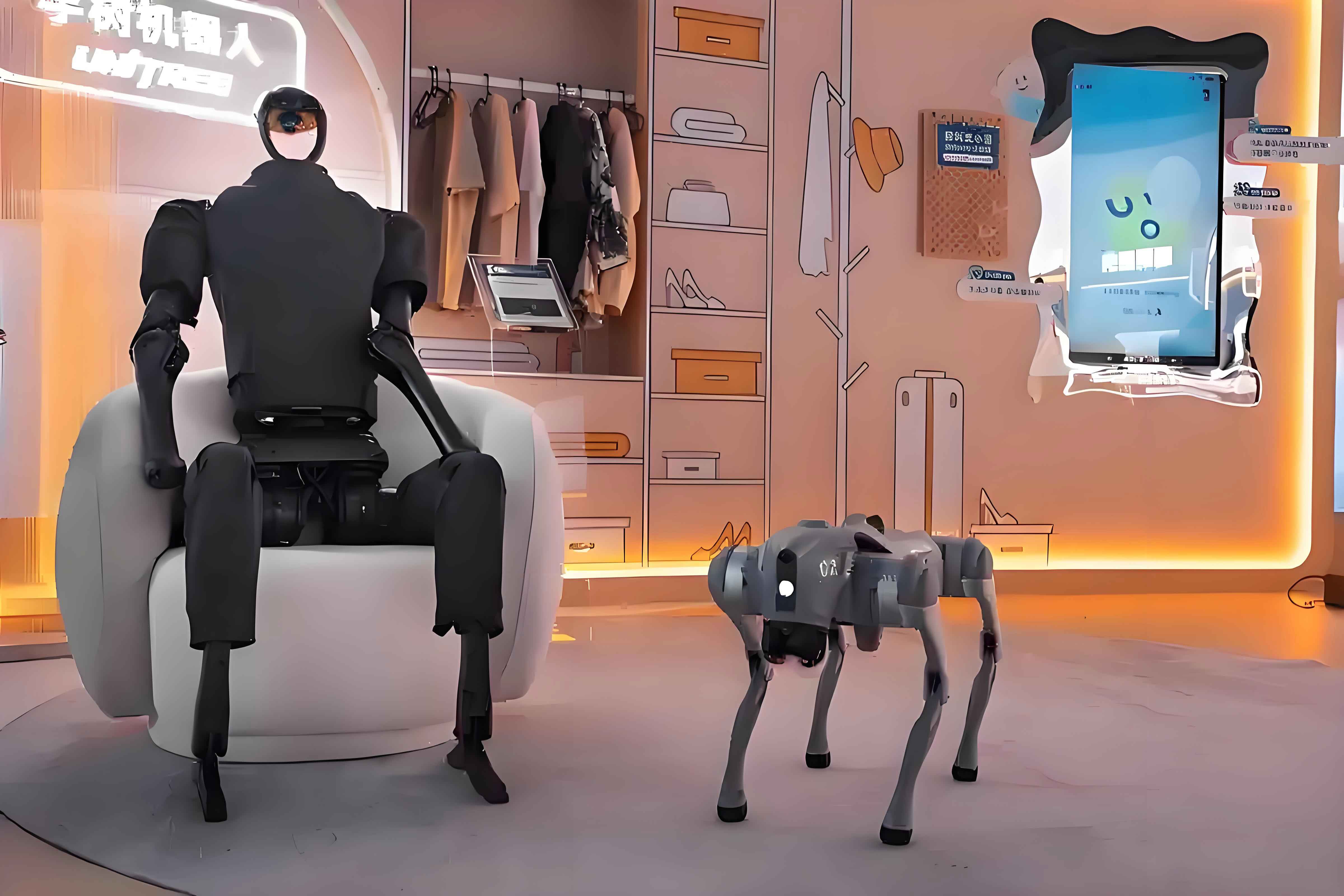
The integration of AI models is crucial for enhancing the intelligence of humanoid robots. In Q5, we embedded a multi-modal large model, similar to foundational AI systems, to enable rapid reasoning about physical tasks. This aligns with industry trends, where companies are developing general-purpose models for humanoid robots. For instance, Project GR00T, a universal foundation model for humanoid robots, represents a significant leap in embodied AI. This model allows humanoid robots to understand natural language, imitate human actions through observation, and coordinate skills flexibly. The performance of such AI models can be quantified using metrics like floating-point operations per second (FLOPS). The associated hardware, such as the Jetson Thor system-on-chip (SoC), delivers immense computational power, with specifications summarized below:
| Component | Specification | Impact on Humanoid Robots |
|---|---|---|
| GPU with Transformer Engine | Based on Blackwell architecture, 800 TFLOPS of 8-bit floating-point AI performance | Enables real-time execution of multi-modal generative AI models like GR00T |
| Integrated Safety Processor | Functional safety standards compliance | Ensures reliable operation in human-centric environments |
| High-Performance CPU Cluster | Multi-core processing for control algorithms | Supports complex decision-making and sensor fusion |
| Networking Bandwidth | 100 GB Ethernet | Facilitates high-speed data exchange for swarm robotics or cloud AI |
The AI performance of these systems can be expressed through computational throughput formulas. For example, the total operations for running a generative AI model on a humanoid robot might be estimated as:
$$ \text{Total Operations} = N_{\text{layers}} \times \sum_{i=1}^{L} (O_{\text{attention}} + O_{\text{feedforward}}) $$
where $N_{\text{layers}}$ is the number of transformer layers, $L$ is the sequence length, and $O$ terms represent operations for attention mechanisms and feedforward networks. With GR00T, humanoid robots can achieve few-shot learning, adapting to new tasks with minimal data, as shown by reinforcement learning objectives:
$$ \max_{\theta} \mathbb{E}_{\pi_\theta} \left[ \sum_{t=0}^{T} \gamma^t r(s_t, a_t) \right] $$
where $\pi_\theta$ is the policy parameterized by $\theta$, $r$ is the reward function, $s_t$ and $a_t$ are states and actions, and $\gamma$ is the discount factor. This enables humanoid robots to learn coordination skills, such as manipulating objects or dancing, by imitating human demonstrations.
Looking at broader implications, the “big factory” concept for humanoid robots exemplifies a paradigm shift toward modular and scalable design. By fusing intelligence, mechanisms, components, control, and decision-making units, we can rapidly generate diverse humanoid robot systems. This approach not only fosters standardization and industrialization but also sets the stage for self-production and evolution of humanoid robots in inaccessible environments, like space or hazardous zones. The synergy between academic research and industrial innovation is critical, as seen in the parallel development of sensor-rich platforms and AI-driven models. For instance, the smart bandage’s use of pH sensors relates to how humanoid robots might integrate similar sensors for environmental interaction, with data fusion governed by Bayesian inference:
$$ P(x|z) = \frac{P(z|x) P(x)}{P(z)} $$
where $P(x|z)$ is the posterior probability of state $x$ given measurement $z$, enhancing perception accuracy for humanoid robots.
In terms of control theory, humanoid robots like Q4 incorporate human-inspired flexibility, modeled using viscoelastic equations for muscle-like actuators:
$$ F = k \Delta x + c \dot{x} + f_{\text{nonlinear}}(x, \dot{x}) $$
where $F$ is the force output, $k$ and $c$ are stiffness and damping coefficients, and $f_{\text{nonlinear}}$ captures biological nonlinearities. This allows for delicate tasks, such as handling fragile objects or emulating human gestures. Moreover, the training pipelines for these humanoid robots involve large-scale simulations, where physics engines compute interactions using Newtonian laws:
$$ F = m a \quad \text{and} \quad \tau = I \alpha $$
with $m$ as mass, $a$ acceleration, $I$ moment of inertia, and $\alpha$ angular acceleration. Such simulations are vital for pre-training humanoid robots before real-world deployment, reducing risks and improving efficiency.
The future of humanoid robotics hinges on continued advances in AI, materials, and energy systems. As we refine models like GR00T and expand the Q-series, humanoid robots will become more autonomous and versatile. Potential applications span from healthcare, where humanoid robots assist in surgeries using sensor-based feedback, to domestic settings, where they perform chores via natural language commands. The integration of wireless technologies, as seen in the smart bandage, will enable humanoid robots to operate in networked swarms, with communication protocols optimized for low latency. A comparative analysis of humanoid robot generations can be summarized in another table:
| Generation | Key Technologies | Example Humanoid Robots | Limitations and Future Directions |
|---|---|---|---|
| First (Early 2000s) | Basic servos, pre-programmed motions | Prototypes with limited autonomy | Poor adaptability, high power consumption |
| Second (2010s) | Improved sensors, machine learning | Robots with simple task learning | Limited real-time reasoning, bulky designs |
| Third (Present) | AI foundation models, high-density actuators | Q-series, GR00T-enabled robots | Scaling to diverse environments, energy efficiency |
| Fourth (Future) | Neuromorphic computing, self-healing materials | Fully autonomous humanoid robots | Achieving human-level dexterity and cognition |
In conclusion, the evolution of humanoid robots is a testament to interdisciplinary collaboration, blending insights from fields like control theory, computer science, and biomechanics. As a participant in this journey, I am optimistic about the role of humanoid robots in addressing global challenges, from labor shortages to exploration. The mathematical frameworks and tabular summaries presented here underscore the technical depth behind these innovations. Moving forward, we must focus on standardizing interfaces, enhancing AI safety, and reducing costs to make humanoid robots accessible. The vision of a world where humanoid robots seamlessly assist humans is inching closer, driven by relentless innovation and a shared commitment to advancing intelligent systems.