
The field of robotics is witnessing a paradigm shift with the accelerated evolution of humanoid robots. As integrated systems combining advanced artificial intelligence, precision manufacturing, and novel materials, humanoid robots represent a new pinnacle in technological innovation and industrial upgrading. Defined by their anthropomorphic form and the aspiration to mimic human functionality and intelligence, these robots are posited to become disruptive products, fundamentally reshaping human production and lifestyles. Their design, centered around a bipedal “torso” with arms and a head, coupled with a cognitive “brain” and a motion-control “cerebellum,” provides a unique platform for embodied intelligence. This form factor grants them superior adaptability in human-centric environments, enabling seamless integration and the natural use of tools. Consequently, the humanoid robot has emerged as an ideal embodiment of human-centric, collaborative intelligence, driving research and development across numerous interconnected technological frontiers.
Evolution and Current Landscape
The journey of the humanoid robot from mechanical imitations to intelligent agents has unfolded in distinct phases, each marked by technological breakthroughs. The initial stage, spanning from the late 1960s to 2000, focused on basic mechanical structure and elementary locomotion, with rigid designs and pre-programmed motions. The subsequent period (2000-2015) saw increased integration of sensors, granting robots foundational environmental perception and more complex, albeit limited, autonomous capabilities. A significant leap occurred from 2015 to 2022, characterized by high-dynamic motion, as seen in robots capable of running and jumping, and the initial application of deep learning for environmental adaptation. Since 2022, we have entered an explosive growth phase fueled by large-scale AI models and high-performance computing, enabling breakthroughs in natural language interaction, complex task execution, and real-time learning, transforming the humanoid robot into a software-defined, embodied intelligent agent.
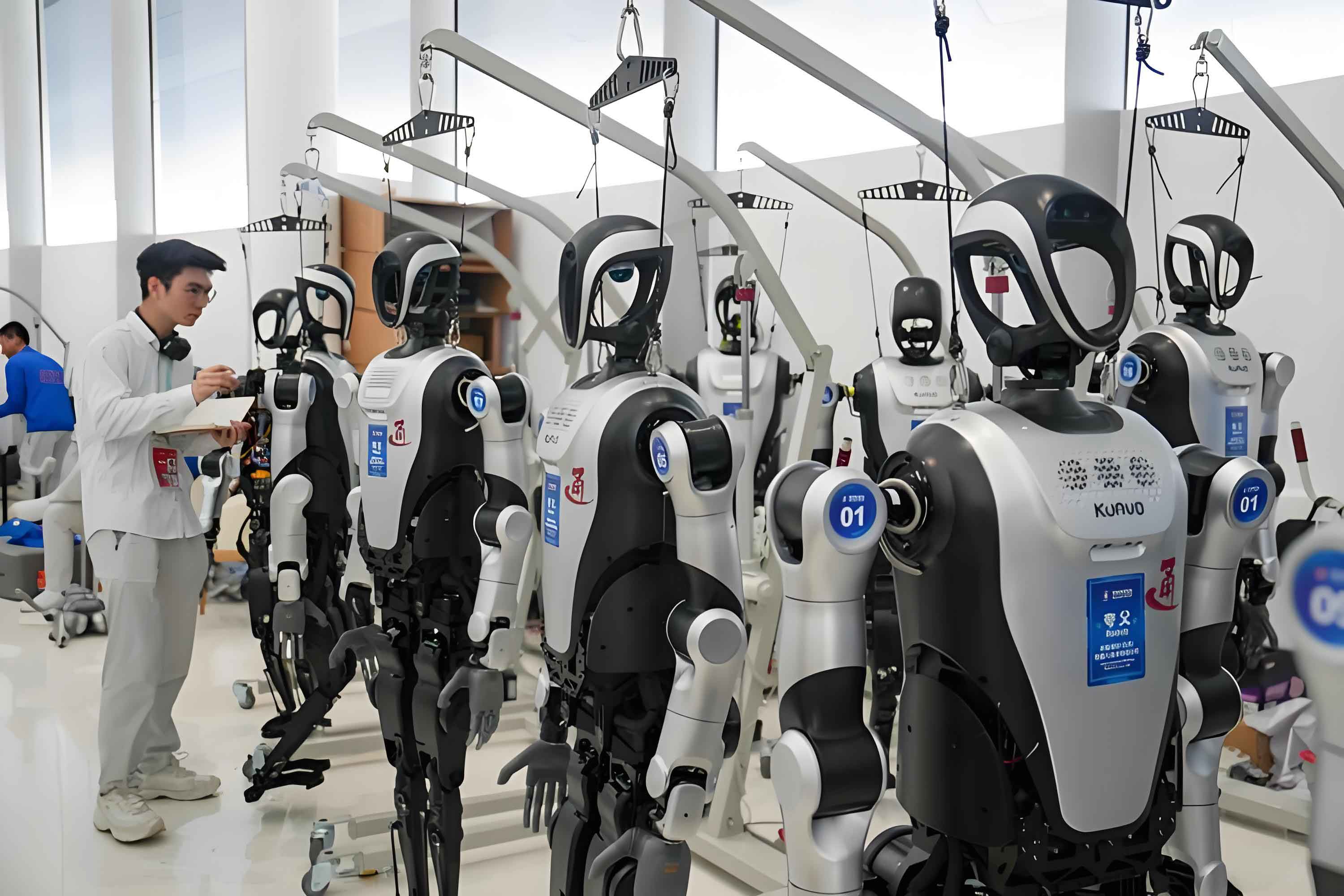
The global landscape for humanoid robot development is vibrant and competitive. Internationally, pioneers in the United States, Japan, and Europe have established strong foundations in mechanical design and actuation. The trend has shifted from hydraulic to advanced electric drive systems, emphasizing joint flexibility and high-performance actuators. Safety and AI integration are now central design tenets, with companies leveraging large models to enhance cognitive capabilities. Leading academic institutions contribute significantly to core research in control, perception, and human-robot interaction. Domestically, the development, though starting later, exhibits remarkable dynamism with a clear market-oriented focus. A “dual-track” model involving both innovative enterprises and academic research institutes fosters rapid iteration. Strong policy support and the establishment of national collaborative innovation centers are accelerating technological advancement and industrial ecosystems. While certain high-precision components and algorithms may still trail international leaders, domestic progress in stable locomotion, cost-effective hardware, and open-source frameworks is enabling a competitive “parallel run” in the global arena.
| Development Phase | Timeframe | Key Characteristics | Technological Enablers |
|---|---|---|---|
| Early Mechanical | 1969-2000 | Basic structure, pre-programmed motion | Rigid mechanics, simple control systems |
| Integrated Sensing | 2000-2015 | Environmental perception, basic autonomy | Vision/force sensors, improved control algorithms |
| High-Dynamic & Smart | 2015-2022 | Dynamic locomotion (run, jump), initial learning | Advanced actuators, deep/ reinforcement learning |
| Embodied Intelligence | 2022-Present | Natural interaction, complex task execution, learning | Large AI models, high-performance compute, soft-hardware co-design |
Core Technological Framework
The sophistication of a humanoid robot stems from the deep integration of multiple technological domains. Its functionality can be decomposed into several interdependent core stacks, which together enable perception, motion, and intelligent interaction.
Hardware Platform and Critical Components
The physical embodiment of a humanoid robot demands a careful balance of strength, lightness, and flexibility. Lightweight materials like carbon fiber composites and optimized skeletal topology are essential. The core hardware relies on high-performance components. Harmonic drives are ubiquitous as joint reducers, prized for their high ratio and precision, though challenges in fatigue life under high-frequency operation persist. Actuation is increasingly provided by frameless torque motors, which offer high power density but require sophisticated thermal management. The controller, often a heterogeneous system combining CPUs, GPUs, and FPGAs, acts as the central nervous system, requiring immense computational power (e.g., hundreds of TOPS) for real-time perception and decision-making while managing strict power budgets. Finally, dexterous end-effectors, such as multi-fingered hands with high degrees of freedom and integrated tactile sensors, are crucial for replicating human-like manipulation. The push towards flexible materials and multimodal sensing in these hands enhances safety and adaptability for delicate operations.
| Core Component | Primary Function | Key Performance Metrics | Prevailing Challenges |
|---|---|---|---|
| Harmonic Drive/Gear | Joint speed reduction, torque amplification | Transmission ratio, positioning accuracy (< ±0.05°), backlash | Fatigue life, efficiency under heavy load |
| Frameless Torque Motor | Direct joint actuation | Torque density, continuous stall torque, responsiveness | Heat dissipation, manufacturing precision for field uniformity |
| High-Performance Controller | Data processing, real-time control, AI inference | Compute (TOPS), power efficiency, real-time latency (<10 ms) | Balancing compute performance with low power consumption |
| Dexterous Hand | Fine manipulation, object interaction | Degrees of Freedom, grip force, tactile resolution | Reliable multimodal sensor fusion, stable control under uncertainty |
Perception, Understanding, and Motion
Operating in human environments requires a humanoid robot to perceive and understand its surroundings with high fidelity. This relies on a suite of traditional sensors—cameras for vision, IMUs and force sensors for proprioception—and increasingly on novel sensors like visuo-tactile skins and electronic skin for rich haptic feedback. The fundamental challenge lies in fusing these multimodal data streams (visual, tactile, auditory) in real-time to form a coherent scene understanding, a process currently hampered by algorithmic latency often above 100 ms.
Motion for a humanoid robot is inherently complex due to its bipedal, underactuated nature. Stable bipedal gait control requires solving dynamic balance problems with intermittent ground contact. Models range from simplified linear inverted pendulum models for planning to complex full-body dynamics for control. The dynamics of a humanoid robot can be represented as:
$$
M(q)\ddot{q} + C(q, \dot{q})\dot{q} + G(q) = S^T \tau + J_c^T F
$$
where \(q\) are the generalized coordinates, \(M\) is the inertia matrix, \(C\) captures Coriolis and centrifugal forces, \(G\) is gravity, \(S\) is the selection matrix for actuated joints, \(\tau\) are joint torques, \(J_c\) is the contact Jacobian, and \(F\) are contact wrenches. Control strategies have evolved from classic ZMP-based methods to modern approaches using Model Predictive Control (MPC) and Reinforcement Learning (RL) to generate stable and adaptive walking patterns over uneven terrain.
Upper-body motion focuses on dexterous manipulation. This involves the coordinated control of multi-DOF arms and complex hands. The challenge is not just in trajectory planning but in implementing compliant force control for safe and effective physical interaction with objects. The full-body control problem integrates locomotion and manipulation, requiring dynamic torque distribution and balance compensation when the arms exert forces or carry loads.
Embodied Intelligence and Large Models
The true potential of a humanoid robot is unlocked through embodied intelligence (EI)—the capacity to learn and make decisions through sensorimotor interaction with the physical world. EI contrasts with disembodied AI by grounding intelligence in physical experience. In humanoid robots, EI integrates SLAM for spatial awareness, multimodal perception for interaction, and motion planning, all closed through real-time interaction.
The recent catalyst for EI is the advent of large AI models. These can be viewed as two complementary strands: General Foundation Models and Vertical Skill Models. General models, trained on vast, diverse datasets, provide broad capabilities like language understanding and commonsense reasoning, serving as a high-level task planner and interface. Vertical models are specialized through training on domain-specific data (e.g., robotic manipulation trajectories) to excel at particular embodied skills, such as precise assembly or adaptive grasping. The integration pathway often involves using a general model to parse high-level instructions (“make coffee”) into a structured plan, which is then executed by lower-level controllers and refined by vertical models handling perception-action loops. Projects like RT-X and Open X-Embodiment are creating large-scale datasets to train such generalist robotic policies, while others focus on developing vertical models for specific dexterous skills.
Human-Robot Collaboration and System Software
The anthropomorphic form of the humanoid robot makes natural human-robot collaboration (HRC) a primary goal. This goes beyond simple co-existence to true partnership, where the robot understands human intent, predicts actions, and adjusts its behavior for safety and efficiency. This requires advances in intention recognition through gesture and gaze analysis, as well as compliant physical interaction control. Furthermore, incorporating affective computing allows the humanoid robot to respond to human emotional states, fostering deeper engagement and trust in social settings.
Underpinning all these capabilities is a robust operating system and toolchain. The OS must manage complex hardware-software coordination, support real-time processing, and enable modular development. Crucially, simulation platforms have become indispensable. High-fidelity simulators allow for safe, scalable, and rapid testing of control policies and AI models—a process known as Sim2Real. Platforms like NVIDIA Isaac Sim enable massive parallel training of reinforcement learning agents in virtual environments before deployment to physical robots, drastically reducing development time and risk. The toolchain is completed by data set creation pipelines, teleoperation interfaces, and specialized application software, forming a comprehensive ecosystem for humanoid robot development.
Application Domains and Emerging Frontiers
The versatility of the humanoid robot opens doors to transformative applications across multiple sectors, often categorized by the level of environmental structure and risk.
In Specialized Service Environments such as disaster response, military operations, or hazardous facility inspection, humanoid robots can replace humans in dangerous, unstructured settings. Their bipedal mobility allows them to traverse debris, stairs, and confined spaces where wheeled robots fail, performing tasks like reconnaissance, sampling, or valve manipulation.
The Manufacturing domain presents a significant opportunity. Humanoid robots can work flexibly on existing factory floors designed for humans, without massive retrofitting. They are envisioned for tasks like parts handling, machine tending, assembly, and quality inspection, particularly in environments with high variability or mixed-model production lines. Their ability to learn from demonstration (LfD) is key for quick task reprogramming.
Perhaps the most anticipated domain is Domestic and Social Services. Here, humanoid robots could assist with daily chores, provide companionship and care for the elderly, offer customer service in retail, or support educational activities. Their human-like form is a double-edged sword—it can foster natural interaction but also raises high expectations for safety and social intelligence. Initial deployments are likely in guided roles in controlled public spaces before advancing to fully autonomous home assistants.
Persistent Challenges and Technical Hurdles
Despite rapid progress, the path to ubiquitous, capable humanoid robots is fraught with significant challenges that span hardware, software, and system integration.
- Holistic System Co-Design: The performance of a humanoid robot is dictated by the tight coupling of hardware and software. Optimizing this synergy from the initial design stage is complex, involving trade-offs between mechanical design, actuator selection, sensor placement, compute architecture, and power distribution. Achieving optimal performance requires a systems engineering approach that is still maturing in the field.
- Robust Perception and Fusion: While sensors are plentiful, achieving human-level scene understanding in real-time remains elusive. Key issues include the seamless fusion of asynchronous multimodal data (vision, lidar, touch, force) under computational constraints, robust operation in dynamic lighting and weather conditions, and the development of cost-effective, high-durability tactile sensors.
- Generalizable Embodied Intelligence: Current AI, even with large models, often lacks the robust, causal understanding and long-horizon planning needed for open-world operation. Skills learned in simulation or for one task frequently fail to generalize to slightly different real-world scenarios. Developing AI that can learn continuously from limited physical interaction and build composable skill libraries is a fundamental research problem.
- Energy Efficiency and Endurance: The high number of actuators and compute units make the humanoid robot highly energy-intensive. State-of-the-art battery technology limits operational duration, often to just a few hours, restricting practical application. Breakthroughs are needed in energy-dense batteries, efficient actuator design, and intelligent power management that dynamically powers down unused subsystems.
- Safety, Standards, and Ethics: As humanoid robots move closer to humans, safety becomes paramount. This includes not only physical safety (collision avoidance, force limiting) but also functional safety and data security. The lack of comprehensive international standards for testing, certification, and ethical operation of humanoid robots poses a barrier to widespread adoption and societal trust.
Future Trajectories and Concluding Perspective
The trajectory of humanoid robot development is being shaped by several converging trends that promise to address current limitations and unlock new capabilities.
A primary trend is the deepening fusion of Embodied AI and General-Purpose AI. The future lies not just in large language models for task planning but in multimodal vision-language-action (VLA) models that can directly translate perceptual input and instructions into coordinated motor policies. This points towards an end-to-end learning paradigm where a single model, trained on vast amounts of robot interaction data, can handle a wide array of tasks.
This ambition is underpinned by the rise of large-scale, high-fidelity simulation platforms. As physics engines and graphics rendering become more realistic, simulators will serve as the primary crucible for training and validating AI-driven behaviors. The Sim2Real gap will narrow through techniques like domain randomization and real-world data ingestion, making virtual training a reliable proxy for physical performance and enabling rapid iteration at scale.
Concurrently, advances in specialized computing hardware (AI accelerators, neuromorphic chips) and algorithms will provide the necessary on-board processing power for complex model inference within the tight power and latency budgets of a mobile humanoid robot platform.
Finally, as the technology matures, establishing a comprehensive framework for human-robot-environment co-existence will be critical. This involves developing technical safety standards, ethical guidelines for autonomy and decision-making, and legal frameworks for liability. The goal is to foster a “human-intelligent fusion” paradigm where humanoid robots are trusted, effective partners that augment human capabilities rather than replace them.
In conclusion, the humanoid robot stands at a fascinating inflection point. It is a grand challenge that synthesizes progress from robotics, AI, materials science, and cognitive science. While substantial hurdles in hardware endurance, algorithmic robustness, and system integration remain, the pace of innovation is unprecedented. The convergence of embodied intelligence principles with powerful large-scale models and simulation tools is creating a new paradigm for machine intelligence—one that is grounded in the physical world. As these technologies mature and find their place in applications from factories to homes, the humanoid robot is poised to transition from a research marvel to a cornerstone of next-generation automation and a new form of collaborative, intelligent entity.