
The humanoid robot industry is currently at a critical juncture, transitioning from laboratory research to industrial application. With performances that are increasingly human-like, humanoid robots are appearing in a growing number of scenarios. As technological breakthroughs accelerate, mass production speeds up, and costs decline, the inflection point for the humanoid robot industry is rapidly approaching.
1. Competing for Orders and Expanding Application Scenes
Since initiating mass production in June this year, Songyan Power has already delivered over one hundred humanoid robots in June and July alone. Han Shenren, Chief Financial Officer of Songyan Power, stated that the company is rapidly and continuously enhancing its delivery capabilities. “Currently, our orders are primarily for scientific research and education, exhibition displays, and tourism guidance. In the future, we will expand into more segmented scenarios to achieve targeted breakthroughs,” Han Shenren said.
To meet the growing demand for orders, CETC Robot Co., Ltd. is constructing a pilot base for humanoid robots and an application verification production line. “We have established a robot production and assembly line at this base with an annual capacity of 100 sets. At full capacity, the annual output can exceed 200 sets, effectively ensuring the rapid delivery of current orders. If order volumes increase significantly in the future, the company will plan to build a dedicated humanoid robot production line to ensure sustained delivery capabilities,” explained Wang Hongwu, Deputy Chief Engineer of the China Electronic Technology Group Corporation Twenty-First Research Institute (CETC Robot Co., Ltd.) and Director of the Robot and Core Components R&D Center. “As humanoid robot technology continues to break through, the era of large-scale application of humanoid robots will accelerate. Our current target scenarios focus on smart logistics and intelligent manufacturing. In the future, as technology matures, our business scope will extend to special applications and other scenarios.”
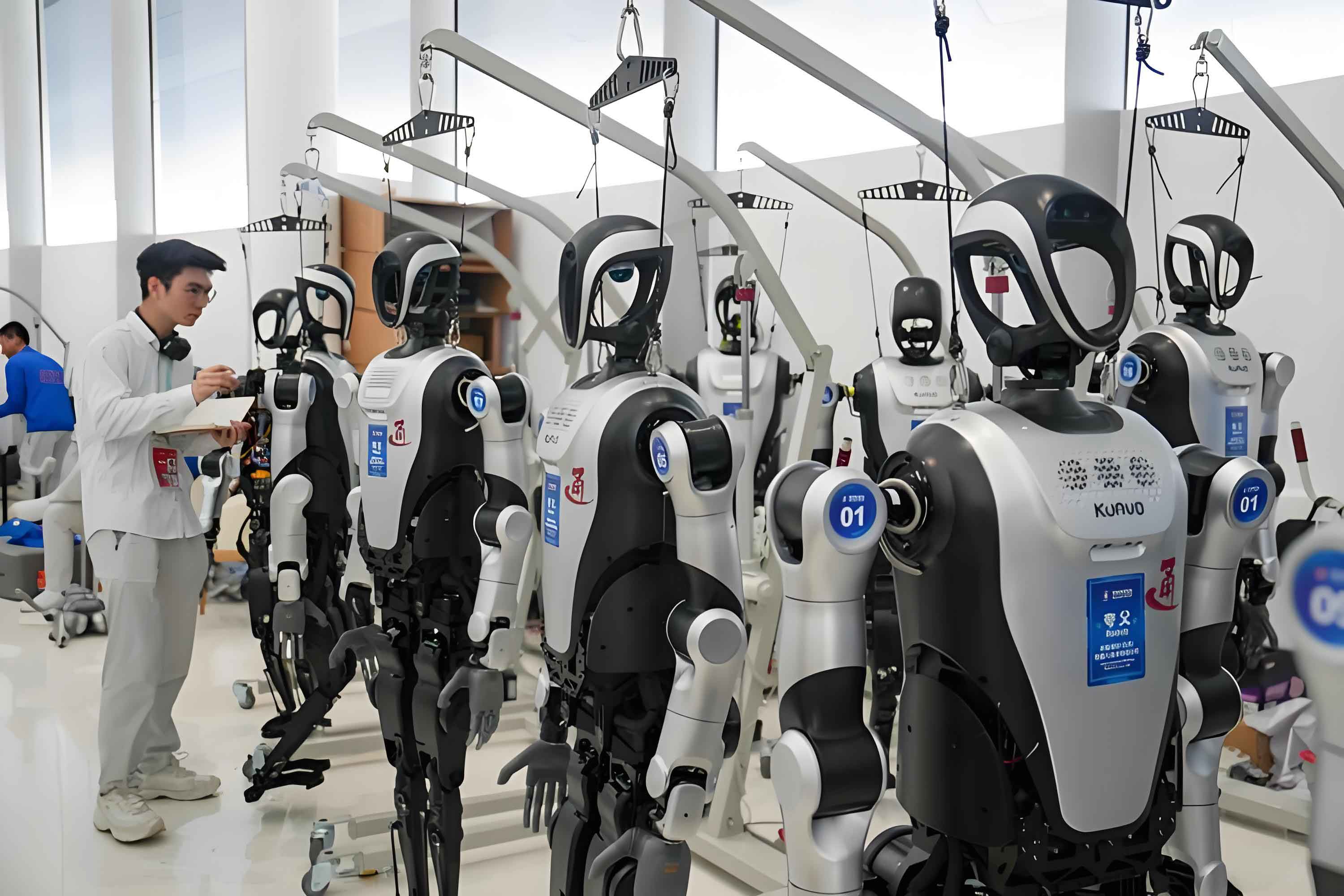
Galaxy General’s humanoid robots have already been deployed in practical applications across commercial retail, industrial manufacturing, health care, and tourism sectors. For instance, in the retail sector, the company and its partners have jointly launched a smart retail solution using humanoid robots, enabling the robots to participate in tasks such as picking and packing, helping stores reduce costs and improve efficiency. “We have established multiple R&D centers nationwide, providing a solid foundation for the large-scale deployment of humanoid robots. Our target scenarios are primarily enterprise applications, especially in commercial and industrial sectors. Retail, factory sorting, and smart logistics are all scenes highly suitable for the initial deployment of humanoid robots. As technology iterates and costs decrease, we will gradually explore consumer-facing applications, allowing robots to truly enter thousands of households,” said Zeng Hui, Government Affairs Manager at Galaxy General.
2. Dawn of Explosive Industry Growth
The market potential for humanoid robots is immense. Wang He, founder of Galaxy General, predicts that the output value of humanoid robots will increase tenfold over the next three years. In approximately six years, the industry scale is expected to exceed 100,000 units, corresponding to a market space of hundreds of billions of yuan. Over the next decade, the scale of the humanoid robot market is expected to surpass the total of all current industrial robots, even becoming a trillion-yuan market exceeding that of automobiles and mobile phones.
“The year 2025 will be a watershed for the humanoid robot industry. Only enterprises with interactive capabilities, mass production capacity, and stable operations are likely to advance to the next stage of competition,” Han Shenren asserted. He believes that embodied intelligence is an important tool for future productivity substitution and will see more practical applications in specific segmented scenarios.
Wang Hongwu views humanoid robots as potentially the next popular intelligent mobile terminal, following cars and mobile phones. In his opinion, although the full integration of humanoid robots into daily life will still take considerable time, based on current development trends, humanoid robots will gradually permeate daily life and work scenarios. With technological breakthroughs and the expansion of application scale, the humanoid robot market is expected to experience explosive growth.
Wang Miao, Executive Dean of Mitu Consulting’s Embodied Intelligence Research Institute, noted that China’s humanoid robot industry is rapidly progressing from “R&D verification – small-batch trial production” to a stage where “leading enterprises achieve small-batch production of hundreds and thousands of units in 2025; the industry ushers in the first year of mass production in 2026; and commercial元年 in 2030.” The development pace of the humanoid robot industry is faster than anticipated. Investment, customer demand, and typical scenario drivers are showing accelerating trends. The accelerated pace of supply chain localization will significantly reduce costs and ensure supply resilience.
“In the next 3 to 5 years, humanoid robots will be deployed in phases in industrial sectors (especially new energy vehicle production lines), warehouse/special inspection, health care, and commercial services. The industry is moving towards a scenario-first, scenario-driven path of data accumulation and model iteration. In the short to medium term, within specific industrial scenarios, the humanoid robot market can form hundred-billion-yuan opportunities, with trillion-yuan potential across all scenarios in the future. In the long term, the humanoid robot is the only track capable of approaching the scale of electric vehicles,” Wang Miao elaborated.
| Company/Institution | Production/Delivery Status | Target Application Scenes |
|---|---|---|
| Songyan Power | Over 100 units delivered in June and July | Scientific research education, exhibition display, tourism guidance |
| CETC Robot Co., Ltd. | Annual capacity of 100 sets, expandable to 200+ sets | Smart logistics, intelligent manufacturing, special applications |
| Galaxy General | Multiple R&D centers supporting deployment | Commercial retail, industrial manufacturing, health care, tourism |
3. Breaking Through Mass Production Capabilities and Technical Bottlenecks
Despite rapid development, the large-scale practical application of humanoid robots still has some distance to cover. The challenges involved span key technologies, data, supply chains, industrial ecosystems, and business models.
Wang Hongwu identified the main bottleneck in humanoid robot development as the incomplete breakthrough in key technologies. The humanoid robot industry urgently needs further breakthroughs in core technology areas such as mechanical structure, motion control, interactive operation, and intelligent decision-making.
Han Shenren pointed out that the humanoid robot industry needs to quickly overcome the challenges of high data costs and generalization models, enabling humanoid robots to provide functional value in more scenarios. Simultaneously, the humanoid robot industry should collectively explore incremental markets and reduce unnecessary competition.
Zeng Hui believes that the biggest problem currently facing the humanoid robot industry is the lack of sufficient general-purpose large model support, which makes it difficult for humanoid robots to operate fully autonomously in complex scenarios. The scarcity of large-scale, high-quality data suitable for robot learning restricts the generalization capability and application expansion of humanoid robots.
Wang Miao highlighted that high-quality, labeled, real-working-condition multimodal data is costly to acquire and suffers from “scenario isolation” issues, making it difficult for models to generalize across multiple working conditions. The generalization ability of humanoid robots to perform long-chain tasks across scenarios and objects remains a shortcoming, affecting the success rate of humanoid robot deployment in working scenarios. Although the localization of some components is accelerating, bottlenecks still exist in key components.
Wang Miao further noted that the commercialization path for humanoid robots is not yet entirely clear, with misalignments among demand scenarios, product function design, and business models. Concurrently, the lack of objective guidance regarding users’ understanding and psychological expectations of embodied intelligent robots also affects the commercialization speed of humanoid robots.
4. Calls for Building an Industrial Ecosystem
To better promote the development of humanoid robots, industry insiders have offered suggestions from the perspectives of industrial policy, market competition, and enterprise development.
Wang Hongwu proposed recommendations in three aspects. Firstly, strengthen fiscal and tax incentives. He suggested providing tax benefits or special subsidies to humanoid robot本体 R&D enterprises and application implementation enterprises, encouraging them to increase investment in technological攻关 and application verification, and accelerating industrial incubation and maturity. Secondly, guide良性 competition and differentiated development. At the current stage, enterprises should be prevented from falling into low-level “internal卷” and price wars, encouraging an innovative development pattern of “a hundred flowers blooming.” Policies should guide enterprises to conduct differentiated exploration in different technological paths and application directions based on their own advantages, rather than relying on capital or resource advantages for恶性 competition, to ensure the healthy and sustainable development of the industrial chain. Thirdly, accelerate the construction of a standard system. He recommended that relevant departments speed up the formulation and issuance of industry standards for humanoid robot technology, safety, performance, and interactive operation, providing clear guidance for industrial development.
Zeng Hui suggested that policies could focus more on enterprises capable of applying and deploying humanoid robots. Through support in R&D funding, demonstration scenarios, and other areas, these enterprises would have the conditions to iterate technology quickly and achieve scale. At the same time, avoid rushing headlong and excessive speculation. Promote the healthy and orderly development of the humanoid robot industry through standard leadership and application orientation.
Wang Miao advised humanoid robot enterprises to identify their positioning in the industrial chain based on their own resource endowments before entering the market. Before launching new businesses, enterprises should结合 market space, profit levels, dynamic competitive landscape, technology iteration trends, target customer profiles, etc., to find the right track for themselves, avoiding losing focus by following capital bubbles.
The collective voice from the industry underscores the importance of collaboration and strategic policy support to navigate the complexities of bringing humanoid robots from niche applications to widespread adoption. As technological hurdles are addressed and ecosystems mature, the vision of humanoid robots becoming integral to various sectors moves closer to reality, promising significant economic and societal impacts.
In summary, the humanoid robot sector is poised for transformative growth, driven by advancements in production, expanding application scenes, and concerted efforts to overcome existing barriers. The journey from technical validation to mass production is accelerating, marking a pivotal chapter in the evolution of robotics and artificial intelligence. Stakeholders across the board are urged to foster an environment conducive to innovation, standardization, and sustainable development to fully harness the potential of humanoid robots.