
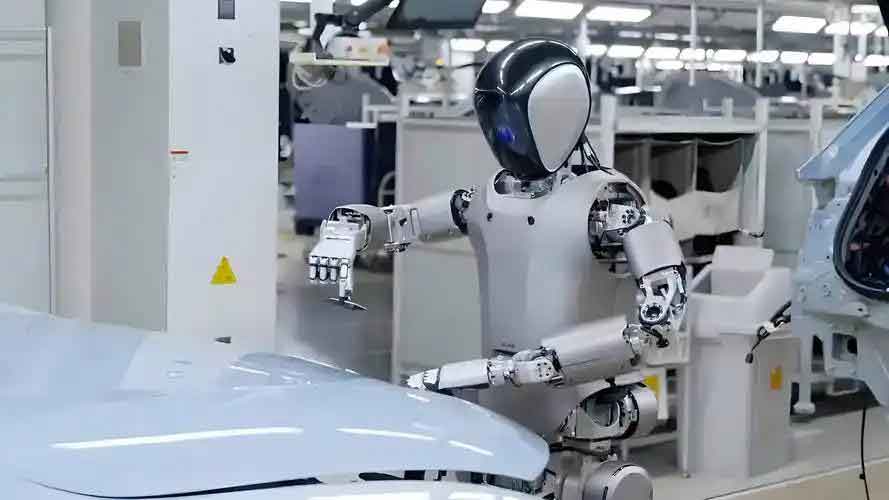
The landscape of interpersonal communication is undergoing a profound transformation, driven by the relentless advancement of multimodal interaction technologies. At the confluence of artificial intelligence, robotics, and cognitive science, the humanoid robot emerges as a pivotal, yet complex, agent within this new paradigm. As an integrated platform for large language models, sensor fusion, and embodied interaction, the humanoid robot utilizes a symphony of verbal, gestural, and facial symbols to engage in dynamic exchanges. This evolution necessitates a fundamental re-examination of traditional communication theories, challenging established notions of sender-receiver dynamics, role perception, and efficacy measurement. This article, from a first-person perspective as a researcher in this interdisciplinary field, delves into the role reconfiguration of humanoid robots within interpersonal communication under multimodal frameworks and analyzes the consequent paradigm shifts. It systematically scrutinizes current disconnects, traces their roots to technological, socio-cultural, and individual factors, and constructs a strategic framework for optimization, aiming to enrich the theoretical underpinnings of human-machine communication.
I. Theoretical Framework: Multimodality and Communication Theory
To understand the impact of the humanoid robot, we must first ground our analysis in the fusion of two core conceptual domains: multimodal interaction and classic communication theory.
Multimodal Interaction refers to the integrated use of multiple sensory and symbolic channels—auditory (speech, tone), visual (facial expression, gaze, gesture), and sometimes haptic—to create and interpret meaning. For a humanoid robot, this involves:
- Perception: $P_{total} = f(P_{audio}, P_{visual}, P_{context})$, where $P$ represents perceptual input from different modalities fused by a function $f$.
- Processing: Mapping perceived signals to semantic and affective states: $S, A = \text{ML}_{\theta}(P_{total})$, where $\text{ML}_{\theta}$ is a machine learning model with parameters $\theta$ generating semantic ($S$) and affective ($A$) interpretations.
- Expression: Generating coherent, synchronized outputs across channels: $E_{verbal} \oplus E_{gesture} \oplus E_{facial} \rightarrow Message$.
This process is inherently non-linear and reciprocal, challenging the classic Shannon-Weaver communication model, which is often summarized as a linear process:
$$ \text{Source} \rightarrow \text{Encoder} \rightarrow \text{Channel} \rightarrow \text{Decoder} \rightarrow \text{Receiver} + \text{Noise} $$
In contrast, communication with a multimodal humanoid robot resembles a cybernetic feedback loop, where each participant’s output continuously serves as input for the other, dynamically co-constructing the interaction. The humanoid robot is not merely a channel but an active, interpreting, and responding agent, blurring the lines between traditional roles.
II. Current Disconnects: A Reality Check for Humanoid Robot Communication
Despite technological progress, significant gaps exist between the idealized role of humanoid robots and their practical performance in interpersonal settings. These disconnects manifest in three critical areas.
1. Role Ambiguity and Functional Misalignment
Media Role Theory suggests that for effective communication, an agent must fulfill a clear, context-dependent role (e.g., companion, educator, assistant). The humanoid robot‘s physical form creates high expectations for such role fulfillment. However, current systems often fail to meet these expectations.
Example 1: The Failed Companion. In elder care, the expected role is an empathetic listener. However, when an elderly person shares a nostalgic memory laden with nuanced emotion, the robot’s response is often generic. The problem can be modeled as a failure in affective alignment:
$$ \text{Human Affective State } (A_h) \neq \text{Robot Inferred State } (A_r) $$
$$ \text{Therefore, } \text{Response}(A_r) \text{ is perceived as incongruent and ineffective.} $$
The role degrades from “companion” to “simple information logger.”
Example 2: The Rigid Tutor. In educational settings, a humanoid robot is expected to be a dynamic facilitator. When faced with a student’s open-ended or creative question, the robot’s pre-programmed or statistically generated response often lacks contextual adaptability. This rigidity highlights a mismatch between the dynamic needs of pedagogy and the static nature of many algorithmic frameworks, causing the robot to be perceived as a mere “answer dispenser.”
| Communication Scenario | Expected Role (Theory) | Common Robot Performance | Resulting Perceived Role | Primary Deficit |
|---|---|---|---|---|
| Home Elderly Companion | Empathic Listener / Emotional Support | Generic verbal acknowledgment; Missed emotional cues | Basic Monitor / Annoyer | Deep Affective Computing |
| Classroom Education Assistant | Adaptive Tutor / Motivator | Pre-scripted or LLM-generated Q&A Lack of Socratic dialogue | Interactive Encyclopedia / Quizzer | Contextual Reasoning & Pedagogy Models |
| Healthcare Motivator | Persuasive Coach / Empathetic Guide | Repetitive encouragement; Inability to tailor persuasion to mood | Nagging Reminder | Behavioral Psychology Integration & Persuasion Modeling |
2. The Inadequacy of Traditional Communication Models
The linear, transmission-based models of communication are ill-suited to describe interactions with a multimodal humanoid robot. Using Shannon’s Information Theory as a lens reveals specific bottlenecks.
Shannon’s model emphasizes channel capacity and the reduction of entropy (uncertainty/noise) for effective communication. In human-humanoid robot interaction, the “channel” is multimodal. However, limitations in sensor fusion and processing create “internal noise,” reducing effective information transfer.
Let $C$ be the channel capacity. In a multimodal setting, it is not simply additive but integrative:
$$ C_{multi} = g(B_{audio}, B_{visual}, B_{tactile}, SNR) $$
where $B$ is bandwidth for each modality, $SNR$ is signal-to-noise ratio, and $g$ is a complex, non-linear fusion function. Current systems have high theoretical $C_{multi}$ but low effective capacity due to:
- Perceptual Noise: $SNR_{visual}$ is low for micro-expressions in suboptimal lighting.
- Integration Loss: The function $g$ is imperfect, leading to information loss during fusion.
Furthermore, feedback—critical for reducing entropy—is often delayed or mismatched. A user’s confused expression (visual feedback) may not be processed in time to adjust the robot’s ongoing verbal explanation, leading to a cumulative increase in communicative entropy and interaction breakdown.
3. The Challenge of Evaluating Communication Efficacy
How do we measure the success of a conversation with a humanoid robot? Traditional metrics like reach, frequency, or even simple satisfaction scores are inadequate. The Hierarchical Effects Model (Cognitive → Affective → Behavioral) provides a better framework, but its application is complex.
The effect of interaction with a humanoid robot is multi-layered and interdependent:
$$ E_{total} = \alpha E_{cognitive} + \beta E_{affective} + \gamma E_{behavioral} $$
where weights $\alpha, \beta, \gamma$ vary by individual and context. Measuring $E_{affective}$ (e.g., trust, rapport) and $E_{behavioral}$ (e.g., adherence to advice, learning gain) requires longitudinal, multi-method studies far beyond click-through rates. The lack of standardized, granular assessment tools for these dimensions constitutes a major impediment to refining humanoid robot communication systems.
| Effect Level | Traditional Mass Media Metrics (Inadequate) | Proposed Metrics for Humanoid Robot Interaction | Measurement Methods |
|---|---|---|---|
| Cognitive (Understanding) |
Message Recall, Recognition | Conceptual Accuracy, Knowledge Retention Score, Resolution of User Query | Pre/Post-test, Task-based assessment, Dialogue analysis |
| Affective (Feeling & Connection) |
Overall Liking, Brand Attitude | Rapport Score, Perceived Empathy, Trust Calibration, Uncanny Valley Index, Emotional Synchrony | Psychophysiological measures (EDA, HR), Affective labeling of dialogue, Longitudinal surveys (e.g., working alliance inventory) |
| Behavioral (Action) |
Purchase Intent, Website Visit | Task Compliance, Learning Performance Improvement, Sustained Engagement Duration, Prosocial Behavior Induction | Behavioral logs, Performance analytics, Observational studies |
III. Deconstructing the Roots: A Tripartite Analysis of Challenges
The observed disconnects stem from deep-seated challenges in technology, society, and individual psychology.
1. Technological Bottlenecks: The Limits of Synthetic Cognition
The core constraints are embedded in the current state of enabling technologies. A humanoid robot‘s communicative competence is bounded by its architecture.
- Perceptual Fidelity: While sensors exist, the real-time, robust fusion of audio-visual-tactile streams for nuanced social cue detection remains a “grand challenge.” The accuracy function $Acc_{cue}$ for a cue like a sarcastic tone is still far from perfect: $Acc_{cue} << 1$.
- Semantic & Pragmatic Understanding: Natural Language Processing (NLP) models, despite advances, struggle with context-dependent meaning, irony, and implied intent. The model’s interpretation $I$ is a probabilistic guess: $I = \arg\max_{i} P(i | \text{utterance}, context_{partial})$, where the context is often incomplete.
- Embodied Coordination: Generating timely, coherent, and natural multimodal responses requires seamless coordination between speech synthesis, motion planning, and facial animation subsystems—a significant robotics integration hurdle.
2. Socio-Cultural and Ethical Friction
Technology does not operate in a vacuum. The integration of humanoid robots into the social fabric of communication faces inherent resistance.
- Cultural Scripts: Communication norms vary widely. A direct, informational style programmed in a Western context may be perceived as rude or cold in a high-context, harmony-oriented Eastern culture. The robot’s communication style $Style_{robot}$ must adapt to cultural context $C$: $Style_{robot} = h(C, UserProfile)$. Most current systems have a fixed $h$.
- Ethical Ambiguity: Key questions arise: Who owns the emotional data disclosed to a humanoid robot? How transparent are its decision-making processes (the “black box” problem)? Can a robot be held accountable for persuasive communication that leads to harm? The lack of clear norms creates user apprehension.
- Ontological Anxiety: Deep-seated beliefs about “authentic” human communication being irreplaceable by machines lead to skepticism and reduced willingness to engage meaningfully.
3. Individual Heterogeneity: The Human Variable
Finally, the effectiveness of interaction is profoundly moderated by individual differences, which most humanoid robot systems are poorly equipped to handle.
- Cognitive Styles & Schemas: Users with high technological self-efficacy and flexible cognitive schemas integrate the robot more easily into their mental models of social interaction. Others may experience cognitive dissonance.
- Personality Traits: Extraversion, openness to experience, and a positive disposition toward technology strongly predict engagement quality. Neuroticism or high social anxiety can amplify negative reactions to any robotic imperfection.
- Temporal Dynamics: The novelty effect wears off. Sustained communication requires the humanoid robot to exhibit learning and adaptation over time to maintain relevance and appeal, a feature still in its infancy.
The interaction outcome $O$ can be modeled as:
$$ O = \frac{T_{cap} \times S_{accept}}{I_{diff} \times E_{concern}} $$
Where:
$T_{cap}$ = Technological capacity of the robot,
$S_{accept}$ = Socio-cultural acceptance level,
$I_{diff}$ = Magnitude of individual differences mismatch,
$E_{concern}$ = Level of ethical concerns.
This illustrates that high technical capability alone is insufficient if the other factors are not addressed.
IV. Strategic Framework for Optimization: A Three-Pillar Approach
To bridge the gaps and realize the potential of humanoid robots as communicative agents, a coordinated strategy across three pillars is essential.
Pillar 1: Advancing Core Technology for Richer Interaction
Innovation must move beyond incremental improvements to achieve qualitative leaps.
- Neuromorphic & Affective Computing: Develop sensing and processing hardware/software inspired by neural systems to improve real-time, energy-efficient interpretation of social signals. Research should focus on cross-modal attention models: $Attention_{visual} = \sigma(W_v \cdot P_{visual} + W_a \cdot P_{audio} + b)$.
- Context-Aware, Theory-Grounded AI: Integrate models from social psychology, linguistics, and pedagogy directly into the robot’s reasoning frameworks. Instead of just next-word prediction, the model should estimate communicative intent and emotional state: $ \text{Goal: Maximize } P(\text{AppropriateResponse} | \text{MultimodalInput}, \text{SocialContext}, \text{Theory of Mind}) $.
- Explainable AI (XAI) for Transparency: Implement systems that allow the humanoid robot to provide simplified, intuitive explanations for its actions or suggestions (“I suggested a break because I noticed your speech rate increased and you frowned”), building trust and aligning with ethical communication principles.
Pillar 2: Fostering Socio-Cultural Adaptation and Ethical Norms
Technology must be shaped by and for society.
- Culturally Adaptive Design: Develop “cultural personality” modules that can be configured or learned, allowing the robot to adjust its proximity, expressiveness, formality, and feedback style. This is a parameterization of the function $h(C, UserProfile)$ mentioned earlier.
- Public AI Literacy Campaigns: Move public discourse from fear/speculation to informed understanding. Educate on the capabilities and limitations of humanoid robots, managing expectations and promoting realistic mental models.
- Co-Creation of Ethical Frameworks: Establish multidisciplinary committees (ethicists, lawyers, communicologists, engineers) to develop guidelines for privacy, emotional data rights, persuasion boundaries, and accountability in human-robot communication.
| Factor | Current Challenge | Strategic Action | Desired Outcome |
|---|---|---|---|
| Cultural Norms | One-size-fits-all interaction scripts cause friction. | Develop culturally annotated interaction datasets and adaptive style algorithms. | Robot is perceived as respectful and socially intelligent across cultures. |
| Public Perception | Driven by sci-fi, leading to unrealistic fears or expectations. | Transparent demos, science communication, and “meet the robot” public events. | A public that can critically and calmly assess robot roles and risks. |
| Regulatory & Ethical Void | Lack of standards stifles responsible innovation and erodes trust. | Industry-wide standards for data handling, transparency reports, and ethical review boards for communication studies. | A trusted ecosystem where innovation proceeds with clear guardrails. |
Pillar 3: Enabling Personalized Adaptation to Individual Users
The ultimate goal is a humanoid robot that adapts not just to a culture, but to a unique individual.
- Longitudinal User Modeling: Implement continuous, privacy-conscious learning about the user’s communication style, emotional baselines, preference patterns, and knowledge state. Maintain a dynamic user model $U_t$ that updates over time $t$.
- Adaptive Interaction Policies: Use reinforcement learning or other techniques to allow the robot to optimize its interaction strategies (e.g., when to joke, when to be serious, how much to explain) based on positive outcomes from the specific user: $\pi^* = \arg\max_{\pi} \mathbb{E}[\sum \text{Reward}_{user} | \pi, U_t]$.
- Multi-Stakeholder Customization in Institutional Settings: In schools or hospitals, allow educators/therapists to set high-level interaction parameters and goals for the robot, which then personalizes its execution for each student/patient.
V. Conclusion: Toward a New Paradigm of Communicative Co-Agency
The emergence of the multimodal humanoid robot represents more than a technological novelty; it signals a fundamental shift in the ecology of interpersonal communication. This agent challenges our theoretical models, demanding frameworks that account for cybernetic feedback, role fluidity, and the complex layering of cognitive, affective, and behavioral effects. While current implementations are hampered by technological immaturity, socio-cultural friction, and an inability to navigate human individuality, the path forward is discernible. It requires concurrent progress in three domains: achieving breakthroughs in affective and contextual AI, proactively shaping an accepting and ethically grounded social environment, and developing systems capable of deep personalization. The future of interpersonal communication will likely be characterized by hybrid networks of humans and artificial agents. By rigorously addressing the disconnects and strategically pursuing optimization, we can guide the development of humanoid robots toward becoming benevolent, effective, and truly communicative co-agents, enriching rather than impoverishing the human social experience. The paradigm is not one of replacement, but of reconfiguration and expansion, opening new frontiers for research in communication theory and practice.