
CHANGSHA, China – September 17, 2025 – The future of industrial automation took a monumental leap forward as Zhonglian Heavy Industry unveiled its revolutionary Cloud Valley Embodied Intelligence Large Model and toolchain at the concluding 2025 Internet Yuelu Summit. This announcement marks a pivotal moment in the development of humanoid robots, showcasing their transition from conceptual prototypes to practical, self-evolving machines capable of transforming manufacturing and beyond. The demonstration of multiple advanced humanoid robots highlighted the rapid acceleration of humanoid robotics innovation in Changsha, setting a new benchmark for the industry.
-
Summit Highlights and Key Announcement
The 2025 Internet Yuelu Summit served as the stage for a series of groundbreaking revelations in AI and robotics, with Zhonglian Heavy Industry emerging as a dominant force. The company’s release of the Cloud Valley Embodied Intelligence Large Model and toolchain represents a significant advancement in the field of humanoid robots, addressing long-standing barriers to their widespread adoption. This platform is designed to empower humanoid robots with enhanced cognitive and physical capabilities, enabling them to learn and adapt autonomously in complex environments. The event drew global attention to the potential of humanoid robots in reshaping industries, underscoring China’s growing influence in next-generation technology.
During the summit, experts and attendees witnessed firsthand how humanoid robots are evolving beyond simple automation tools into intelligent entities. Zhonglian Heavy Industry’s presentation emphasized the role of embodied AI in bridging the gap between digital intelligence and physical execution, a critical step for humanoid robots to achieve true autonomy. The company’s commitment to innovation was evident in the detailed exposé of their research and development journey, which has culminated in a platform that promises to democratize access to advanced robotics technology. As humanoid robots continue to gain traction, events like the Yuelu Summit highlight the collaborative efforts needed to drive this technology forward.
-
Addressing Industry Challenges with Embodied AI
The integration of AI into industrial manufacturing has long been hailed as a catalyst for efficiency, but the path to deploying humanoid robots has been fraught with obstacles. Key challenges include the difficulty in acquiring high-quality data, the high technical barriers for development, and inefficiencies in training models for real-world tasks. These issues have historically slowed the iteration and practical application of humanoid robots, limiting their use to controlled environments. Zhonglian Heavy Industry’s Cloud Valley platform directly confronts these pain points by offering a comprehensive solution that streamlines the entire development lifecycle for humanoid robots.
By leveraging advanced data processing techniques, the platform reduces the time and cost associated with training humanoid robots. It enables seamless data collection from diverse sources, including industrial operations, and integrates this with simulation-based learning to accelerate model refinement. This approach not only enhances the performance of humanoid robots but also makes the technology more accessible to smaller enterprises and research institutions. The emphasis on overcoming these hurdles underscores the transformative potential of humanoid robots in sectors like logistics, assembly, and healthcare, where adaptability and precision are paramount.
-
Inside the Cloud Valley Embodied Intelligence Large Model and Toolchain
At the core of Zhonglian Heavy Industry’s innovation is the Cloud Valley Embodied Intelligence Large Model, a sophisticated AI framework that enables humanoid robots to process and respond to multimodal data inputs. This model incorporates breakthroughs in GPU computing power scheduling, allowing for efficient resource allocation during intensive training sessions. Distributed training capabilities further enhance scalability, enabling the simultaneous development of multiple humanoid robot models without compromising speed or accuracy. The toolchain complements this by providing a suite of modules that cover data acquisition, model training, simulation evaluation, and over-the-air (OTA) deployment, creating an end-to-end ecosystem for embodied intelligence.
The data collection module facilitates the gathering of real-world information from humanoid robots in action, while the model training component uses this data to refine algorithms through iterative learning processes. Simulation evaluation allows for virtual testing of humanoid robots in various scenarios, reducing the risk of errors in physical deployments. Finally, the OTA deployment module ensures that updates and improvements can be delivered remotely, keeping humanoid robots up-to-date with the latest advancements. This integrated approach not only boosts the efficiency of developing humanoid robots but also fosters continuous improvement, as the models evolve based on new data and experiences.
-
Humanoid Robot Training and Real-World Applications
To support the development of its embodied AI platform, Zhonglian Heavy Industry has established a state-of-the-art training facility dedicated to humanoid robots. This facility features over a hundred workstations where humanoid robots engage in large-scale data collection activities, capturing real-time interactions and operational details. By combining this real data with extensive libraries of industrial video footage, the platform trains end-to-end embodied intelligence models that enhance the capabilities of humanoid robots. These models are already being piloted in practical settings, such as mechanical processing and material loading, where humanoid robots demonstrate increased precision and efficiency.
The training environment is designed to mimic real-world conditions, allowing humanoid robots to learn from a variety of scenarios and adapt to unforeseen challenges. This hands-on approach ensures that humanoid robots can perform complex tasks, such as object manipulation and environmental navigation, with minimal human intervention. As these humanoid robots continue to learn and evolve, they are poised to revolutionize industries by taking on roles that require dexterity, decision-making, and collaboration. The success of these pilot applications signals a broader shift toward the integration of humanoid robots in everyday operations, paving the way for more autonomous and intelligent systems.
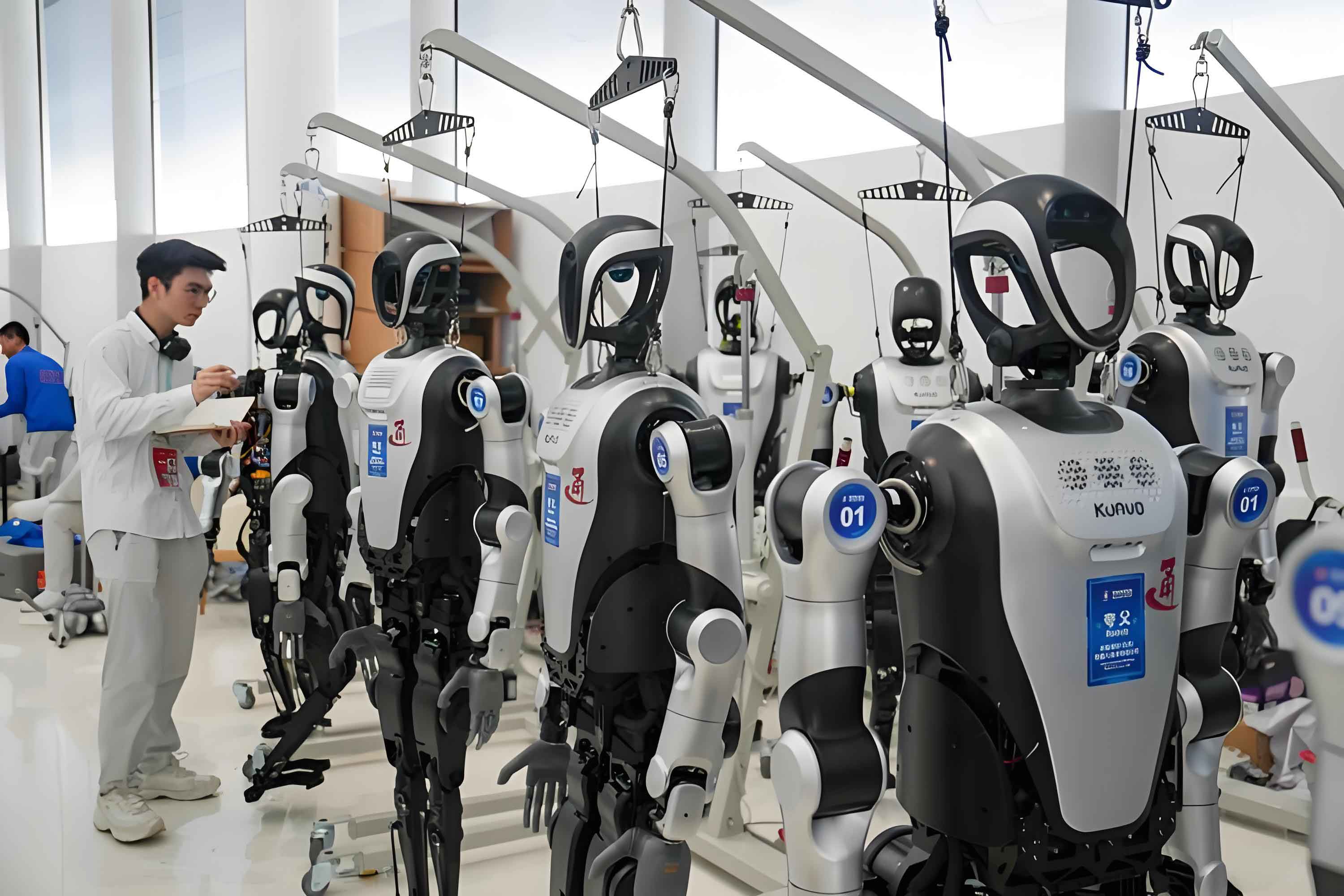
In addition to industrial uses, the training data from humanoid robots is being analyzed to identify patterns and optimize performance across different domains. This continuous feedback loop enables humanoid robots to self-correct and improve over time, embodying the concept of self-evolution that Zhonglian Heavy Industry champions. The company’s investment in this infrastructure highlights its long-term vision for humanoid robots as integral components of smart factories and beyond, where they can work alongside humans to enhance productivity and safety.
-
Live Demonstrations at the Yuelu Summit
The Internet Yuelu Summit featured an immersive robot experience center, where Zhonglian Heavy Industry showcased five distinct models of humanoid robots in action. These demonstrations were organized around five simulated scenarios: greeting and hospitality, walking performances, logistics sorting, assembly tasks, and daily life activities. Each scenario highlighted the advanced capabilities of humanoid robots, from their ability to perceive and interact with the environment to their skill in executing fine motor tasks. The bipedal humanoid robots, in particular, impressed audiences with their stable and agile movements in complex settings, while wheeled humanoid robots demonstrated efficiency in logistics and coordination.
In the logistics sorting simulation, humanoid robots responded to audience-generated orders displayed on screens, swiftly navigating to shelves to retrieve and deliver items. These humanoid robots also exhibited dual-arm coordination by attaching QR code labels and performing precise object manipulation under VR remote control. The seamless integration of perception, reasoning, and action in these humanoid robots left spectators in awe, with many noting the robots’ potential to transform sectors like e-commerce and warehousing. The demonstrations underscored how humanoid robots are not merely tools but partners in enhancing operational workflows.
Beyond functional tasks, the humanoid robots engaged in social interactions, such as waving and greeting guests, showcasing their potential in service-oriented roles. The variety of applications presented at the summit illustrated the versatility of humanoid robots, capable of adapting to both industrial and social contexts. As these humanoid robots continue to evolve, their ability to learn from each interaction will enable them to take on increasingly complex roles, making them invaluable assets in the push toward fully automated environments.
-
Independent Development of Key Components
A standout aspect of Zhonglian Heavy Industry’s humanoid robots is the entirely independent development of their core components. This includes planetary joint modules, cycloidal joint modules, linear joint modules, and critical controllers, all designed in-house to ensure compatibility, reliability, and performance. By controlling the entire supply chain for these parts, the company can optimize the design and functionality of humanoid robots, reducing dependencies on external suppliers and accelerating innovation. This self-reliance is crucial for scaling the production of humanoid robots and customizing them for specific industry needs.
The planetary joint modules, for instance, provide humanoid robots with enhanced mobility and stability, allowing them to traverse uneven surfaces and perform dynamic movements. Cycloidal and linear joint modules contribute to the precision and strength of humanoid robots’ limbs, enabling tasks that require fine motor skills and heavy lifting. The controllers act as the brains of these humanoid robots, processing sensory data and executing commands in real-time. This holistic approach to component development not only improves the performance of humanoid robots but also reduces costs, making them more accessible for widespread adoption.
Moreover, the in-house expertise in component manufacturing allows Zhonglian Heavy Industry to iterate quickly on designs, incorporating feedback from field tests and user experiences. This agility is essential for keeping pace with the rapidly evolving demands for humanoid robots in various sectors. As the company continues to refine these components, the capabilities of humanoid robots are expected to expand, opening new possibilities for their application in challenging environments like construction, disaster response, and healthcare.
-
Strategic Vision for the Future of Manufacturing
Zeng Guang, General Manager of Zhonglian Cloud Valley, articulated a forward-looking perspective on the role of humanoid robots in modern manufacturing. He emphasized that integrating humanoid robots into factories is not about merely replacing human labor but involves a fundamental rethinking of manufacturing processes and management systems. This requires a synergy between advanced工艺, automation, digitalization, and intelligence, where humanoid robots operate within frameworks that prioritize efficiency, safety, and adaptability. According to Zeng, the combination of new-generation AI and robotics technology will fundamentally reshape manufacturing, leading to the creation of “future factories” that are more responsive and sustainable.
In these future factories, humanoid robots will collaborate with human workers, handling repetitive or hazardous tasks while humans focus on strategic decision-making and creativity. This collaborative model leverages the strengths of both, with humanoid robots providing precision and endurance, and humans offering intuition and innovation. Zhonglian Heavy Industry is committed to driving this transformation by leveraging its deep understanding of industrial processes and digital management. The company’s investments in embodied AI and humanoid robots are part of a broader strategy to position itself at the forefront of the fourth industrial revolution, where smart technologies redefine productivity.
The vision extends beyond manufacturing to include sectors like agriculture, logistics, and even domestic services, where humanoid robots can address labor shortages and enhance quality of life. By fostering ecosystems that support the continuous learning and evolution of humanoid robots, Zhonglian Heavy Industry aims to create a world where these machines are seamlessly integrated into daily operations. This long-term outlook highlights the company’s dedication to innovation and its belief in the transformative power of humanoid robots to address global challenges.
-
Conclusion and Industry Impact
The unveiling of the Cloud Valley Embodied Intelligence Large Model and toolchain by Zhonglian Heavy Industry marks a watershed moment for the robotics industry, particularly in the realm of humanoid robots. This development not only addresses critical technical challenges but also sets the stage for accelerated adoption of humanoid robots across various sectors. The ability of these humanoid robots to self-evolve through continuous learning and data integration promises to unlock new levels of autonomy and efficiency, making them indispensable in the quest for smarter, more resilient systems.
As humanoid robots become more capable and affordable, their impact is expected to ripple through economies, driving productivity gains and creating new opportunities for innovation. The demonstrations at the Yuelu Summit have already inspired confidence in the potential of humanoid robots to handle complex tasks with human-like dexterity and intelligence. With ongoing advancements in AI, sensor technology, and material science, the future of humanoid robots looks brighter than ever, poised to transform not only industrial landscapes but also societal norms around automation and human-machine collaboration.
In summary, Zhonglian Heavy Industry’s breakthrough embodies the convergence of ambition and expertise, heralding a new era where humanoid robots are not just tools but partners in progress. The company’s commitment to research, development, and practical application ensures that humanoid robots will continue to evolve, adapting to the ever-changing demands of the modern world. As this technology matures, it is likely that humanoid robots will become a common sight in factories, homes, and public spaces, redefining what is possible in the age of intelligent machines.