
The 2025 World Robot Conference (WRC) in Beijing has unequivocally demonstrated a seismic shift in the robotics industry, characterized by explosive growth and a clear pivot towards practical applications. This year’s event saw participation from over 200 exhibitors, with more than 50 dedicated to humanoid robot technologies—a significant increase from previous years. The total number of exhibits reached 1,500, a substantial jump from 900 last year, while new product releases exceeded 100, doubling the figure from the 2024 conference. The venue, spanning 50,000 square meters at the Beijing Etrong International Exhibition Center, was inundated with crowds throughout the three-day event, with total registrations hitting 1.3 million visitors. These attendees ranged from industry professionals and enthusiasts to elderly individuals and young children, creating an atmosphere of palpable excitement and, at times, near-impassable congestion in popular exhibition areas.
Despite the frenetic energy, a sense of pragmatic clarity prevailed among exhibitors and industry leaders. The overarching theme that emerged was the transition of humanoid robots from mere entertainers to viable, productive members of the workforce. This sentiment was echoed by numerous companies, who are now focusing on developing humanoid robot systems capable of performing complex tasks in real-world environments, moving beyond the spectacle of demonstrations to tangible utility.
-
Performances Reach Unprecedented Levels of Sophistication
The WRC has consistently served as a platform for showcasing the cutting edge in robotic performance, and this year was no exception. Several leading humanoid robot companies took center stage, demonstrating remarkable advancements in mobility, balance, and interactive capabilities. Unitree Robotics, a standout performer, captivated audiences with its G1 humanoid robot engaged in a dynamic boxing match. The arena surrounding Unitree’s booth was packed with spectators, many layers deep, all eager to witness the G1 humanoid robots throw punches, execute kicks, taunt opponents, and even recover from falls with impressive fluidity. Compared to its appearance at the World Artificial Intelligence Conference just over a month prior, the G1 humanoid robot exhibited significantly smoother movements and enhanced balance control, managed by an advanced algorithmic “cerebellum.” Incidents of freezing or requiring manual intervention were notably reduced, highlighting rapid progress in real-time stability and motion planning for humanoid robot platforms.
Another star of the show was Acceleration Evolution, which presented a multi-robot soccer match and human-robot interaction scenarios. Observers noted that these humanoid robots displayed improved end-to-end motion control compared to earlier demonstrations where they were prone to stumbling. During a penalty shootout interactive segment, the humanoid robots delivered powerful and accurate shots, making it challenging for human participants to block them effortlessly. Zhongqing Robot’s “Iron Man”-inspired EngineAI humanoid robot showcased a repertoire of complex, nuanced dances, exhibiting a level of grace and articulation that began to approach human-like movement quality. Meanwhile, companies like Zuji Dynamics continued to emphasize the core locomotion capabilities of their bipedal humanoid robots, demonstrating remarkable resilience by withstanding forceful kicks and automatically righting themselves after falls.
Beyond humanoid robot demonstrations, other robotic forms also dazzled. The German company Festo presented its BionicBee, a 34-gram, 22-centimeter long仿生bee robot capable of autonomous swarm flight. This micro-robot pushed the boundaries of what is possible in miniaturization, integrating sophisticated flapping mechanisms, communication modules, and power systems into a tiny package. The progression from scripted video performances to live, unpredictable demonstrations in crowded, real-world settings marks a critical evolution. While events like the recent robotics marathon in Beijing tempered some over-optimistic expectations, the current generation of humanoid robots is undeniably closing the gap in dynamic motion and stability, rapidly approaching a performance threshold that makes practical deployment increasingly feasible.
-
The Shift from Entertainment to Industrial Labor
A defining characteristic of the 2025 WRC was the pronounced emphasis on demonstrating the practical, work-oriented potential of humanoid robots. While impressive performances still drew crowds, a growing number of exhibitors focused on scenarios where humanoid robots could serve as reliable laborers. Ubtech Robotics led this charge, displaying a comprehensive lineup including the Walker S2, Cruzr S2, Walker S1, and Walker C models. A notable demonstration involved eleven Walker S1 humanoid robots performing collective, randomized sorting tasks. The Walker C humanoid robot was shown conducting guided tours for visitors, while the Walker S2 showcased a hot-swappable autonomous battery replacement system, a critical feature for enabling 24/7 operation in industrial settings. Significantly, Ubtech representatives revealed that some of the exhibited humanoid robots had been temporarily recalled from active customer training sites for the event, indicating that these systems are already undergoing real-world testing and integration.
This trend was widespread. Qianxun AI’s Mozi humanoid robot (Moz1) was demonstrated at multiple booths performing delicate tasks such as removing clothes from a washing machine and folding them, as well as skillfully assembling candied hawthorn sticks. Shenzhen Yuejiang Technology’s humanoid robot displayed remarkable dexterity by simultaneously performing precision assembly—tightening a bearing with a tolerance of 0.1 millimeters with its left hand—and part sorting with its right hand, while also operating food preparation stations making popcorn, lemon tea, and claypot rice. Magic Atom’s “Xiaomai” MagicBot G humanoid robot replicated a glue-dispensing scenario common on industrial production lines.
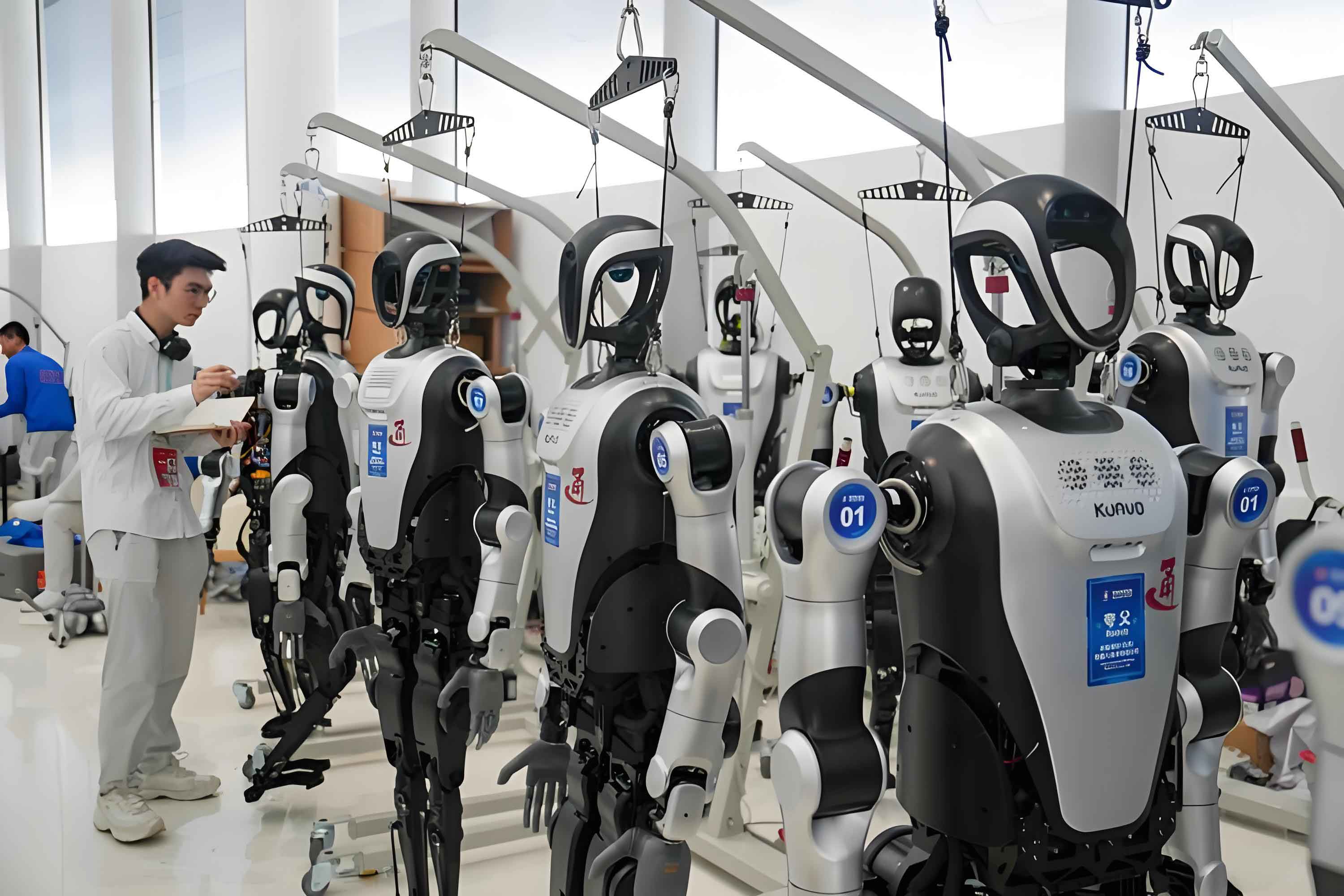
An interesting observation from the conference was the increased visibility of humanoid robot platforms utilizing wheeled bases or Automated Guided Vehicle (AGV) systems for mobility, rather than traditional bipedal legs. Many of these wheeled humanoid robot models were explicitly demonstrated performing labor-oriented tasks. A representative from a leading robotics firm explained that wheeled humanoid robot designs offer higher stability, lower technical complexity, and greater load capacity, making them suitable for applications combining manipulation with transportation. However, the same source affirmed that bipedal humanoid robot platforms remain a primary focus due to their ability to seamlessly integrate into environments designed for humans. Factories, with workstations, operational protocols, and spatial layouts tailored to human workers, represent a prime market where bipedal humanoid robot could perform a wide variety of complex, composite tasks without requiring extensive infrastructure modification.
Unitree CEO Wang Xingxing’s statements during his WRC presentation and subsequent interviews strongly corroborated this industrial focus. He articulated that while each humanoid robot company currently pursues distinct technical pathways, Unitree’s ultimate objective is to deploy humanoid robot systems in factory settings and, eventually, domestic environments for chores like serving tea, fetching water, doing laundry, or cooking. Wang acknowledged that household applications remain a longer-term goal. In the interim, he stated that having humanoid robot models perform in dances or combat serves as a vital development tool, leveraging AI to train them in executing full-body movements and showcasing their evolving physical capabilities as a stepping stone to practical work.
-
Commercialization and Service Applications Diversify
Beyond traditional manufacturing, the commercialization of humanoid robot technology is branching out into diverse service sectors. Some service robotics companies have already established profitable business models and are expanding internationally. At last year’s WRC, a pancake-making robot attracted long queues, and this year, the demand for its “crepes” remained insatiable. This exemplifies a successful, albeit niche, commercialization path.
Cloud Minds Technology, a prominent service robotics provider, exhibited its achievements in the hospitality industry at the WRC. Its displays included smart hotel solutions, intelligent laundry services, “American-style” experiential setups, and claw machine robots. The company highlighted its evolution from single-function robots to multi-functional, collaboratively operating systems. Cloud Minds representatives disclosed that their humanoid robot and other robotic solutions have been successfully deployed in several European regions, delivering measurable improvements in efficiency and service quality for hotel clients.
Another major player, Qinglang Robotics, showcased its popcorn-making robot and bartender robot at the conference. Behind the scenes of these engaging demonstrations, the company has achieved massive commercial scale, with over 100,000 service robots deployed globally, accumulating vast operational data and robust commercial capabilities. The success of these specialized service humanoid robot and robots demonstrates a viable path to market for specific, well-defined tasks, even as more general-purpose humanoid robot systems continue their development.
-
The Persistent Hurdle of Embodied Intelligence
Despite the impressive demonstrations of physical prowess and targeted applications, a significant challenge for the humanoid robot industry was evident at the WRC: a general lack of sophisticated, generalized embodied intelligence. Most exhibited humanoid robot systems were tailored for single, specific scenarios and showed limited ability to handle complex, unpredictable situations or transfer skills across different tasks. Truly versatile, composite applications for humanoid robot platforms remained largely absent from the show floor.
Wang Xingxing of Unitree provided a clear explanation for this limitation. He noted that current embodied intelligence systems can competently execute simple motor commands like running, jumping, and basic grasping, maintaining balance effectively. However, when confronted with the intricacies and variations inherent in real-world work environments, their cognitive and adaptive capabilities fall short. In his keynote address, Wang highlighted a critical issue facing the field: Vision-Language-Action models, which are central to advanced humanoid robot intelligence, do not yet exhibit a clear “Scaling Law.” This means that simply feeding these models more data does not guarantee a proportional improvement in humanoid robot performance, unlike the trends observed in large language models. This represents a fundamental bottleneck for both the “brain” and the “cerebellum” of humanoid robot systems.
Other leading exhibitors specializing in embodied intelligence echoed this sentiment. They pointed out that the humanoid robot sector generally receives less capital investment compared to pure AI software domains like large language models. Consequently, many companies are forced to adopt a strategy of specializing in narrow, single-scene applications to achieve initial commercialization and generate revenue, allowing them to fund further research incrementally. Compounding this problem is the absence of a unified ecosystem and industry-wide standardization for humanoid robot development. The lack of data interoperability and the significant “reality gap” between simulation training and actual physical performance prevent the aggregation of large, diverse datasets, thereby hindering the realization of true scaling laws for humanoid robot intelligence.
-
Demonstrations of Progress in Embodied AI
In response to these challenges, several companies at the WRC showcased their latest efforts to advance the cognitive capabilities of humanoid robot through sophisticated VLA models. Galaxy General focused on presenting its GroceryVLA, an end-to-end embodied large model designed for the retail sector. In a demonstration simulating a challenging supermarket environment with densely packed shelves, diverse SKUs, and varied product packaging, their Galbot humanoid robot exhibited superior object recognition and grasping abilities. Xinghai Tu introduced its G0 model, which it promotes as a “true end-to-end, true whole-body control” VLA system. The company supported its claims with a video demonstration showing a humanoid robot successfully interpreting natural language commands and executing a complex task from start to finish.
These presentations, while often confined to controlled demonstrations or video evidence, indicate a concentrated industry-wide push to overcome the intelligence barrier. The progress in making humanoid robot systems understand their environment, process language, and plan actions is seen as the key to unlocking their full potential as general-purpose helpers rather than single-task machines. The race is on to develop the AI “brain” that can match the rapidly advancing physical “body” of the modern humanoid robot.
-
Future Outlook and Industry Trajectory
The 2025 World Robot Conference served as a powerful snapshot of an industry in rapid transition. The sheer scale of participation and exhibition, coupled with the tangible shift in focus from spectacle to substance, signals that the era of the humanoid robot as a viable technological product is dawning. The performances are no longer just for show; they are stress tests for hardware and algorithms that must perform reliably in demanding situations. The demonstrations of factory labor and service tasks are not mere fantasies but proof-of-concepts for imminent deployments.
The journey ahead remains fraught with technical hurdles, primarily centered on achieving robust, generalizable embodied intelligence for humanoid robot platforms. The lack of a clear scaling law for VLA models, the funding disparity with other AI fields, and the nascent state of industry standards are significant obstacles that will require sustained collaboration and investment to overcome. However, the momentum is undeniable. The advancements witnessed between the 2024 and 2025 WRCs—in motor skills, balance, task specialization, and early-stage cognitive abilities—suggest an accelerating pace of innovation.
As one industry insider remarked, the difference in capability for a humanoid robot platform can be dramatic in just a few months. If the current trajectory holds, the next World Robot Conference promises to deliver even more profound demonstrations of what humanoid robot can achieve. The question is no longer if humanoid robot will become our colleagues, but how soon, and in what capacities, they will integrate into our workplaces and daily lives. The transition from actor to coworker for the humanoid robot is well underway.