
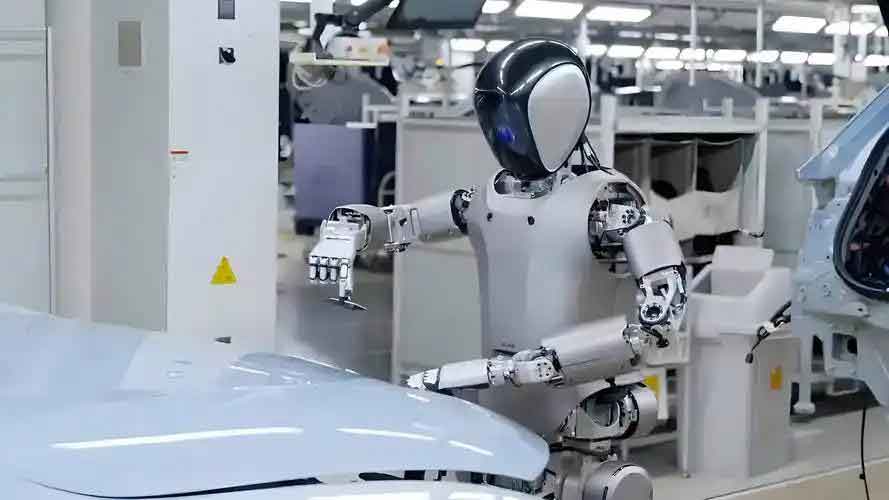
The year 2025 is witnessing accelerated integration of humanoid robots into human society through increasingly diverse applications. As this pivotal year—widely anticipated as the “inaugural year” for mass production of humanoid robots—unfolds, questions arise about how many such machines will enter commercial markets and real-world scenarios.
1. Production Forecasts and Market Projections
Leading Chinese humanoid robot manufacturer Ubtech has unveiled ambitious plans: targeting production capacity of 1,000 units in 2025, with several hundred expected for delivery. Under optimal conditions across multiple application scenarios, Ubtech projects deliveries reaching thousands of units by 2026 and scaling to tens of thousands by 2027. This announcement follows similar production forecasts from industry players like Leju Robotics and Agibot.
Complementing these corporate projections, the latest “2025 China Humanoid Robot Industry Development Blue Book” from the Gaogong Robotics Industry Institute (GGII) anticipates global humanoid robot sales reaching 12,400 units in 2025, valued at ¥6.339 billion. China is expected to account for 7,300 units. Long-term forecasts suggest explosive growth, with global sales approaching 340,000 units by 2030 (market value exceeding ¥64 billion) and surpassing 5 million units by 2035 (market value exceeding ¥400 billion).
| Year | Global Sales (units) | Global Market Value (billion yuan) | China Sales (units) |
|---|---|---|---|
| 2025 | 12,400 | 63.39 | 7,300 |
| 2030 | 340,000 | 640 | N/A |
| 2035 | 5,000,000 | 4,000 | N/A |
2. Commercialization Bottlenecks
Despite optimistic forecasts, commercialization challenges persist. Yu Lei, co-founder of Xinghai Tu, highlights limitations: “Current humanoid robots can perform only limited tasks and are incapable of handling highly complex or precision-demanding scenarios. Coupled with immature industrial chains keeping hardware costs prohibitively high, large-scale deployment in manufacturing or commercial services remains impractical.”
Critical hurdles include:
- Application Scenarios: Humanoid robots struggle with core functionality issues like remote-controlled performances and lack of true end-to-end autonomous capabilities.
- Economic Viability: High production costs undermine the value proposition compared to specialized industrial automation solutions.
- Technical Immaturity: GGII’s Blue Book identifies shortcomings in multimodal perception integration and poor generalization capabilities, limiting adaptability to novel environments.
Investment patterns reveal this tension: GGII data shows 71 financing deals in China’s humanoid robot sector during 2024, totaling approximately ¥8.45 billion—a 274% increase in deals and 226% rise in funding compared to 2023. Major tech firms like Alibaba, ByteDance, Huawei, and established robotics companies are entering this nascent field. However, recent skepticism from investors like Zhu Xiaohu of GSR Ventures about exit strategies and industry “bubbles” underscores persistent concerns about practical applications.
3. Industrial Applications: Challenges and Opportunities
Industrial adoption faces unique barriers. GGII notes humanoid robots currently lack proven competitiveness in precision and cost against traditional industrial robots, while service-sector applications remain technologically premature. A significant obstacle involves Standard Operating Procedure (SOP) access. Industrial clients must share proprietary SOPs with humanoid robot developers for task-specific programming, creating confidentiality dilemmas that hinder widespread deployment.
Song Hua, Vice President of Kepler, advocates for pragmatic specialization: “Humanoid robots don’t need universal functionality across all scenarios. Achieving conditional generalization—mastering specific workstations within controlled environments—enables viable industrial implementation.”
Notably, companies like Agibot and Ubtech have begun pilot programs in automotive assembly plants, navigating trust-building phases with B2B clients. Unlike traditional industrial robots executing fixed routines, humanoid robots’ advanced sensory and reasoning capabilities introduce data sensitivity concerns, particularly regarding end-to-end data processing in secure facilities.
4. The Humanoid Robot Marathon: A Showcase of Progress
On April 19, Beijing’s Yizhuang district will host the world’s first half-marathon exclusively for humanoid robots, symbolizing the technology’s physical capabilities. Over 20 teams from companies and research institutions—including Unitree Robotics, Songyan Dynamics, Xiaomi Robotics, and the Beijing Humanoid Robot Innovation Center (jointly funded by Ubtech)—have registered. Emerging startups like Xuanjing Technology, Magic Atom Robotics, and Lingbao will also participate, demonstrating the sector’s expanding ecosystem.
This event highlights advancements in bipedal locomotion and durability, critical foundations for broader humanoid robot deployment. The marathon serves as both a technical benchmark and a visibility platform for an industry transitioning from labs to real-world validation.
As humanoid robots enter commercial testing phases, the industry must address multifaceted challenges: cost reduction, technical reliability, scenario-specific optimization, and establishing trust frameworks for sensitive industrial applications. The journey from prototype to production remains complex, yet early adopters are laying groundwork for what many believe could become a transformative technology epoch.