
In a significant leap for the robotics industry, several leading humanoid robot companies have recently announced substantial orders and partnerships with major manufacturing firms, marking a pivotal phase of technological validation in industrial settings. These developments highlight the growing integration of humanoid robots into factory environments, where they are tasked with repetitive, labor-intensive roles such as material handling, sorting, and inspection. The surge in deployments is not only enhancing operational efficiency but also providing critical real-world data to refine and optimize humanoid robot technologies, accelerating their path to commercialization. As companies like Zhiyuan Robotics, Zhisquare, and Ubtech secure contracts worth billions of yuan, the industry is witnessing a shift from experimental prototypes to practical, scalable solutions in sectors like automotive, electronics, and logistics.
1. Major Orders and Collaborations Drive Humanoid Robot Adoption
The humanoid robot sector has experienced a flurry of activity in recent months, with multiple firms reporting large-scale orders from manufacturing giants. For instance, Zhiyuan Robotics unveiled its latest industrial-grade interactive humanoid robot, the Zhiyuan Sprite G2, and confirmed a multi-billion yuan order from Longqi Technology, alongside the initial delivery of a contract exceeding 100 million yuan with Junshun Electronics. This follows earlier collaborations, such as a project with Fuling Precision involving thousands of yuan for nearly 100 Yuanzheng A2-W humanoid robots to be deployed in Fuling’s factories. Similarly, Zhisquare partnered with Huizhi Wulian, a subsidiary of Huike Co., Ltd., to deploy over 1,000 humanoid robots across Huike’s global production bases over the next three years. These humanoid robots will handle tasks ranging from warehouse logistics and material handling to component assembly and quality testing, demonstrating the versatility of humanoid robots in diverse industrial applications.
Another notable agreement involves Ubtech and Foxconn Yunzhihui, who signed a global strategic cooperation pact to advance the development and deployment of Ubtech’s humanoid robots in Foxconn’s facilities across China and worldwide from 2025 to 2027. Ubtech has already secured nearly 500 million yuan in order contracts for its Walker S series of industrial humanoid robots through partnerships with companies like BYD, Dongfeng Liuzhou Auto, Geely Auto, and SF Express. These collaborations underscore the accelerating demand for humanoid robots in manufacturing, as firms seek to automate high-intensity tasks and improve productivity. The humanoid robot industry is rapidly moving beyond pilot programs to establish a foothold in real-world production lines, with each deployment generating valuable insights for further innovation.
2. Humanoid Robots in Action: Case Studies from Factory Floors
At the Futian Cummins Engine Factory in Beijing’s Changping District, humanoid robots like the “Embodied Tiangang 2.0” and “Tianyi 2.0” are actively participating in daily operations, performing repetitive tasks such as moving material boxes weighing between 8 and 12 kilograms. Since September, these humanoid robots, developed by the Beijing Humanoid Robot Innovation Center, have been undergoing on-site debugging for box handling in the factory’s unmanned management workshop. Equipped with wheeled bases and flexible mechanical arms, the Tianyi 2.0 humanoid robot can accurately identify box positions, lift loads, and categorize them on shelves, even handling variations in size and weight. Its lifting capability allows it to perform tasks from low to high elevations, showcasing the adaptability of humanoid robots in dynamic environments.
According to Huang Yunbao, the Smart Manufacturing Chief Engineer at Futian Cummins, the factory is in an exploratory phase transitioning from “0 to 1,” with plans to expand applications from “1 to N” in the near future. Zhao Yumeng, Product Manager at the Beijing Humanoid Robot Innovation Center, outlined a two-stage deployment strategy: initially, humanoid robots will serve as assistants to human workers, aiding in task completion; subsequently, they will integrate with the factory’s smart systems, enabling direct command transmission to the robots and making them an integral part of the production process. Beyond this site, the Embodied Tiangang 2.0 and Tianyi 2.0 humanoid robots are also being deployed in 3C manufacturing, automotive production, and power inspection scenarios in collaboration with the Electric Power Research Institute, highlighting the broad potential of humanoid robots across industries.
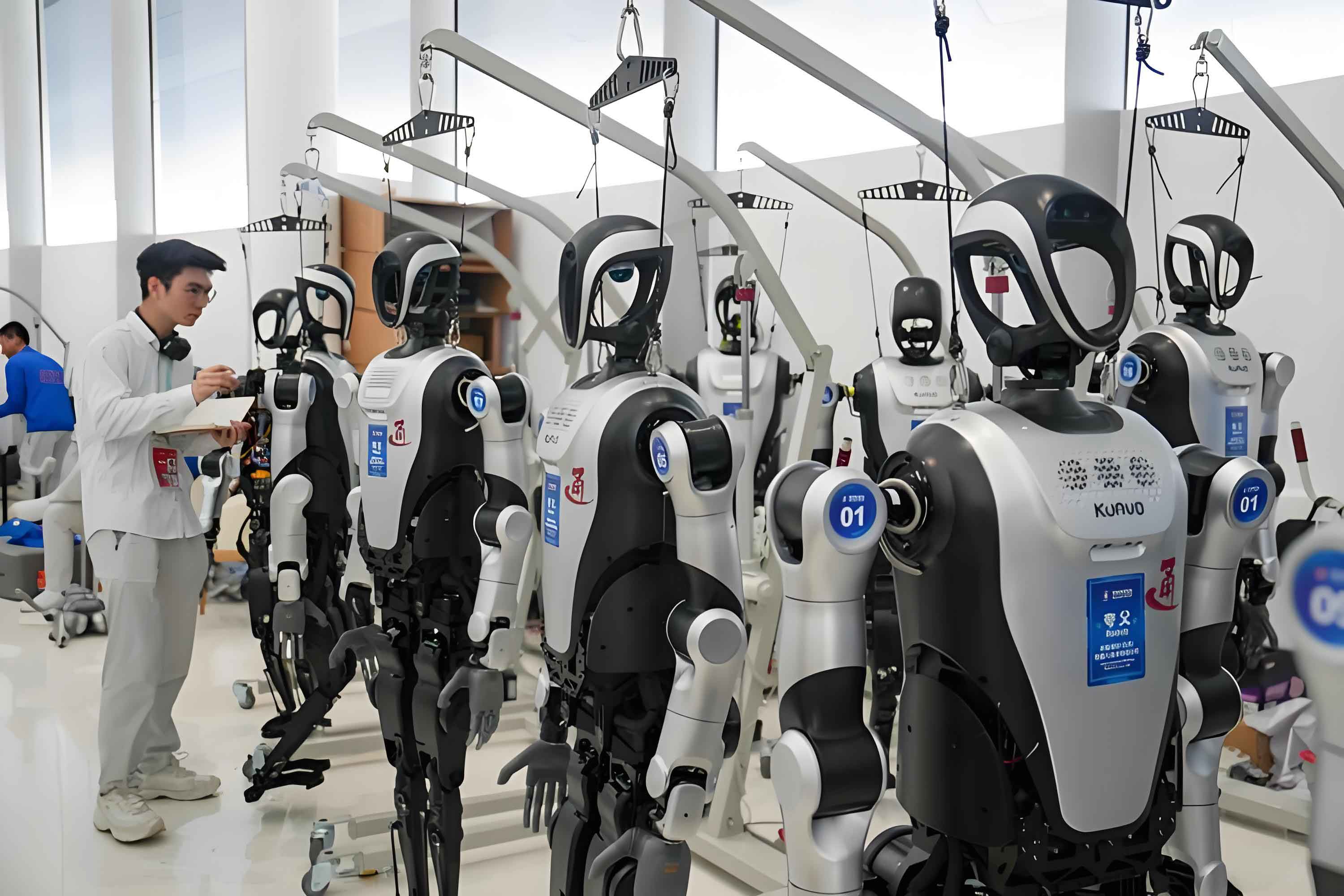
In other implementations, Zhiyuan Robotics has detailed how its Sprite G2 humanoid robots are already operational in automotive parts workshops, collaborating with workers on tasks like seatbelt lock pressing and material transport. In precision settings, these humanoid robots quickly learn delicate operations such as memory module insertion, while in logistics, they handle packages of various sizes, shapes, and materials for sorting. Similarly, Zhisquare’s Aibao series humanoid robots have been deployed at companies like Jingneng Microelectronics, Dongfeng Liuzhou Auto, and Huaxi Bio, performing functions that include quality inspection and testing. These real-world applications demonstrate the growing capability of humanoid robots to handle complex, variable tasks, though challenges remain in achieving full autonomy and reliability.
3. Industry Trends: Scaling Humanoid Robot Deployments
The recent wave of orders signals a broader trend toward the mass adoption of humanoid robots in industrial contexts. In September alone, multiple companies announced ambitious projects: Xingchen Intelligent revealed a strategic cooperation with Xian Gong Intelligent for a thousand-unit order of humanoid robots over two years, targeting large-scale, phased deployments in manufacturing, warehousing, and logistics. These humanoid robots will gradually take over tasks like material distribution, container handling, loading and unloading, and empty container retrieval. Meanwhile, Zhisquare’s partnership with Huizhi Wulian aims to cover the entire workflow from storage to assembly and testing, emphasizing the role of humanoid robots in streamlining operations and reducing human labor in hazardous or monotonous jobs.
Ubtech’s expanding portfolio with automakers and logistics firms further illustrates the scalability of humanoid robot solutions. For example, in collaborations with FAW-Volkswagen Qingdao Branch, Audi FAW, and BAIC New Energy, Ubtech’s Walker S humanoid robots are being integrated into assembly lines for tasks that require precision and endurance. The cumulative effect of these deployments is a rapid accumulation of operational data, which is crucial for iterating on humanoid robot designs. As Yao Maoqing, Partner and Senior Vice President of Embodied Business at Zhiyuan Robotics, notes, the transition from laboratory to real-world settings is essential for refining aspects like battery life, stability, and sensor configurations. This data-driven approach is key to overcoming current limitations and achieving the sustained growth of the humanoid robot market.
4. Challenges and the Path to Commercialization for Humanoid Robots
Despite the progress, the humanoid robot industry faces significant hurdles in achieving widespread commercialization. Yao Maoqing points out that humanoid robots still struggle with endurance, stability, and speed when subjected to the high-intensity demands of factory work. For outdoor applications, issues like insufficient protection against dust and water further limit their usability. Moreover, for complex, multi-step tasks, the technological maturity of humanoid robots has not yet reached the required level. As a result, Yao advocates for a focused approach: humanoid robots should initially target indoor environments with clear, simple, and fixed workflows, such as industrial sorting or exhibition guidance, where existing technology can be quickly adapted and validated.
Huang Yunbao emphasizes that improving humanoid robot performance requires close collaboration between developers and end-users to identify gaps between robot capabilities and real-world needs. Enhancements in areas like battery life, load capacity, and operational accuracy are critical for humanoid robots to meet industrial standards. He Zhongfeng, Partner of Greater China Listing Services at安永 (Ernst & Young), adds that the humanoid robot sector is at a crucial juncture for technology verification and application promotion, with long-term growth potential. However, the primary bottleneck remains the scalability and sustainability of commercialization. “While technological breakthroughs have been achieved in labs or small-scale trials, the challenge lies in applying these innovations efficiently and cost-effectively in actual scenarios to generate profits,” He notes. He suggests that humanoid robot companies should select a few application scenarios as pilots, establish replicable models and standardized implementation paths, and build ecosystems with industry leaders to optimize costs and reduce unit expenses.
5. Future Outlook: Humanoid Robots Shaping the Next Industrial Revolution
Looking ahead, the humanoid robot industry is poised for transformative growth as advancements in artificial intelligence, sensor technology, and mechanical design converge. The ongoing deployments in manufacturing are not just about replacing human labor but about creating synergistic environments where humanoid robots and workers collaborate to boost productivity. For instance, in the Futian Cummins factory, the humanoid robots are designed to assist rather than replace, reflecting a gradual integration strategy that minimizes disruption. As more data is gathered from these settings, humanoid robots are expected to evolve rapidly, with improvements in autonomy, decision-making, and adaptability to unstructured environments.
Market analysts predict that the success of humanoid robots will hinge on their ability to demonstrate clear return on investment through reduced operational costs and enhanced efficiency. Companies like Zhiyuan Robotics and Ubtech are already working on next-generation models that address current limitations, such as battery life and task complexity. The emphasis on real-world testing is accelerating this innovation cycle, as each deployment provides feedback for iterative development. In the long term, humanoid robots could expand beyond manufacturing into sectors like healthcare, retail, and domestic services, but for now, the industrial focus remains paramount. The recent billion-yuan orders and multi-year partnerships indicate strong confidence in the potential of humanoid robots to redefine modern factories, paving the way for a future where humanoid robots become commonplace in global supply chains.
In summary, the humanoid robot industry is at a tipping point, with major orders and industrial validations driving progress toward commercialization. While challenges in scalability and technology persist, the collaborative efforts between robot makers and manufacturers are fostering an ecosystem where humanoid robots can thrive. As these intelligent machines continue to learn and adapt in real-time, they are set to play an increasingly vital role in the evolution of smart manufacturing, ultimately contributing to a more automated and efficient industrial landscape.