
As I delve into the realm of robotics, I am continually fascinated by the rapid evolution of robot technology and its potential to transform various sectors. In particular, humanoid robots, which mimic human form and intelligence, have captured my attention due to their integration of advanced artificial intelligence and physical embodiment. In this article, I will share my insights on the current state, applications, and future prospects of humanoid robots in libraries, drawing from my analysis of academic literature, product developments, and real-world implementations. Throughout this discussion, I will emphasize the role of robot technology in enhancing library services, using tables and equations to summarize key points, and ensuring that the keyword ‘robot technology’ is prominently featured to underscore its importance.
My journey into this topic began with the realization that libraries, as hubs of knowledge and community engagement, are increasingly adopting robot technology to streamline operations and improve user experiences. Humanoid robots, with their human-like appearance and capabilities, represent a cutting-edge application of robot technology that can bridge the gap between traditional services and modern innovations. However, I have observed that the concept of humanoid robots is often conflated with general service robots, leading to confusion in both research and practice. To clarify, humanoid robots are characterized by their anthropomorphic design, high degrees of freedom (DOF), and ability to perform a wide range of tasks in unstructured environments. For instance, the DOF, a critical metric in robot technology, quantifies the number of independent movements a robot can execute. In humanoid robots, this is typically high, often exceeding 20 DOF, which can be expressed mathematically as:
$$ \text{DOF} = \sum_{i=1}^{n} j_i $$
where \( j_i \) represents the joints in the robot’s structure, and \( n \) is the total number of joints. This high DOF enables complex motions that are essential for tasks like walking, grasping, and interacting in human-centric spaces. As I explore the development of robot technology, I see that humanoid robots have evolved through distinct phases, from early prototypes focused on basic mobility to today’s intelligent systems powered by AI. The table below summarizes these stages, highlighting how robot technology has progressed over time.
| Development Phase | Key Characteristics | Representative Products |
|---|---|---|
| Early Exploration (1960s–2000s) | Emphasis on human-like appearance and basic locomotion | WABOT-1 |
| System Integration (2000s–2010s) | Integration of sensors and control systems for improved adaptability | ASIMO, NAO |
| High-Dynamic Motion (2010s–2022) | Enhanced mobility and emotional interaction capabilities | Pepper, Atlas |
| Intelligent Era (2022–present) | AI-driven perception, decision-making, and modular design | Optimus, H1, Figure AI |
In my assessment, the integration of robot technology in libraries started gaining traction with robots like NAO and Pepper, which I consider pioneers in this space. These robots exemplify how robot technology can be tailored for educational and service environments. For example, NAO, with its compact design and 25 DOF, allows for dynamic movements that are ideal for interactive demonstrations in libraries. Similarly, Pepper incorporates emotional recognition features, showcasing how robot technology can foster empathetic interactions. The technical specifications of these robots reveal the sophistication of modern robot technology, as outlined in the following table.
| Parameter | NAO Robot | Pepper Robot |
|---|---|---|
| Height | 58 cm | 121 cm |
| Weight | 5.5 kg | 29.1 kg |
| Degrees of Freedom | 25 | 20 |
| Battery Life | 60–90 minutes | 12 hours |
| Key Features | Open programming platform, adaptive walking | Emotion detection, tablet display |
As I reflect on the applications of robot technology in libraries, I have noted that humanoid robots are deployed in diverse roles, such as greeting visitors, providing guided tours, assisting with information queries, and supporting educational programs. For instance, in my review of global case studies, I found that libraries use these robots to engage children in storytelling sessions or to help users navigate complex catalog systems. The effectiveness of such applications often depends on the robot’s ability to process natural language, which can be modeled using probabilistic equations in robot technology. For example, the probability of a successful interaction \( P_{\text{success}} \) might be expressed as:
$$ P_{\text{success}} = \frac{\sum_{i=1}^{k} \text{correct responses}_i}{\text{total queries}} $$
where \( k \) represents the number of interaction instances. This equation highlights how robot technology relies on accurate data processing to deliver reliable services. However, in my experience, I have also encountered challenges, such as the high cost of humanoid robots and their limited functionality in certain scenarios. This has led to the rise of alternative service robots that mimic humanoid features but at a lower cost, underscoring the need for continuous innovation in robot technology.
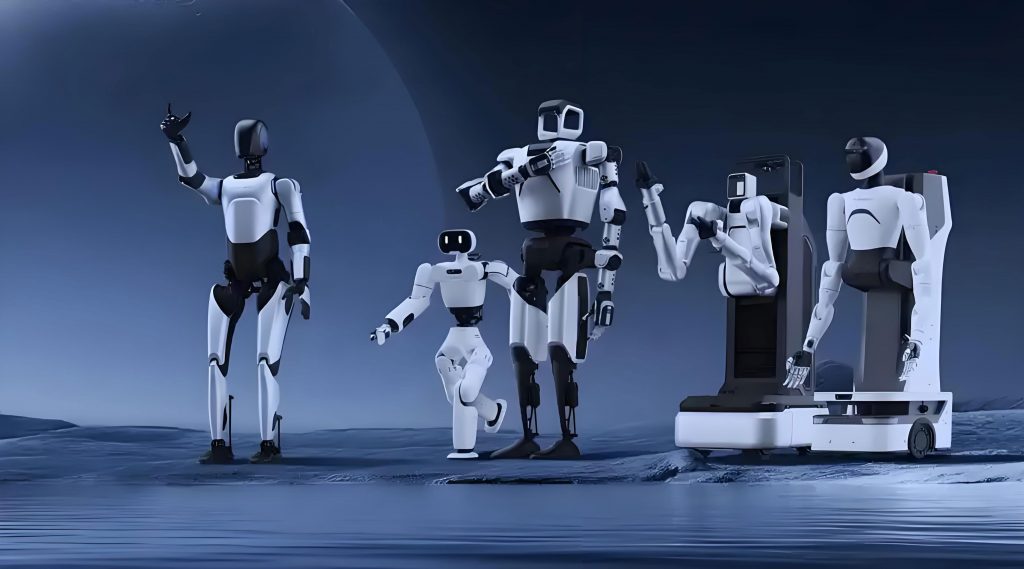
Moving to recent advancements, I am excited by the emergence of embodied intelligence in robot technology, which enables robots to perceive and act in their environments autonomously. This shift is largely driven by large-scale AI models, such as visual-language-action (VLA) models, that enhance a robot’s cognitive abilities. In my analysis, I see that these models can be categorized into end-to-end and hierarchical approaches, each with distinct advantages. For example, the end-to-end model directly maps sensory inputs to actions, which can be represented as:
$$ A = f(S) $$
where \( A \) is the action output, \( S \) is the sensory input, and \( f \) is the model function. This approach simplifies robot technology by reducing modular complexity but requires extensive training data. Conversely, hierarchical models decompose tasks into planning and execution layers, improving interpretability but potentially introducing delays. As robot technology evolves, I believe that libraries can leverage these innovations to create more adaptive and multifunctional robots, capable of handling tasks from book sorting to personalized reader assistance.
In considering the future of robot technology in libraries, I propose that stakeholders focus on scenario-driven development, standardization, and collaborative ecosystems. For instance, by identifying high-frequency tasks, libraries can prioritize robot applications that offer the greatest impact, such as automating inventory management or enhancing accessibility for diverse user groups. The potential load capacity of a robot in such tasks can be optimized using equations like:
$$ L_{\text{max}} = \min(\text{mechanical limits}, \text{environment constraints}) $$
where \( L_{\text{max}} \) is the maximum load the robot can handle. Additionally, establishing pilot projects in partnership with robot technology firms can accelerate real-world testing and refinement. As I look ahead, I am confident that humanoid robots will become integral to library ecosystems, driven by advancements in robot technology that make them more affordable and versatile. In conclusion, my exploration reaffirms that robot technology holds immense promise for transforming libraries into dynamic, intelligent spaces, and I eagerly anticipate the innovations that lie ahead.
Throughout this article, I have aimed to provide a comprehensive perspective on humanoid robots in libraries, emphasizing the transformative power of robot technology. By integrating tables, equations, and personal reflections, I hope to inspire further discussion and adoption of these technologies. As robot technology continues to advance, I encourage libraries to embrace these changes, fostering environments where humans and robots collaborate to enrich the pursuit of knowledge.